
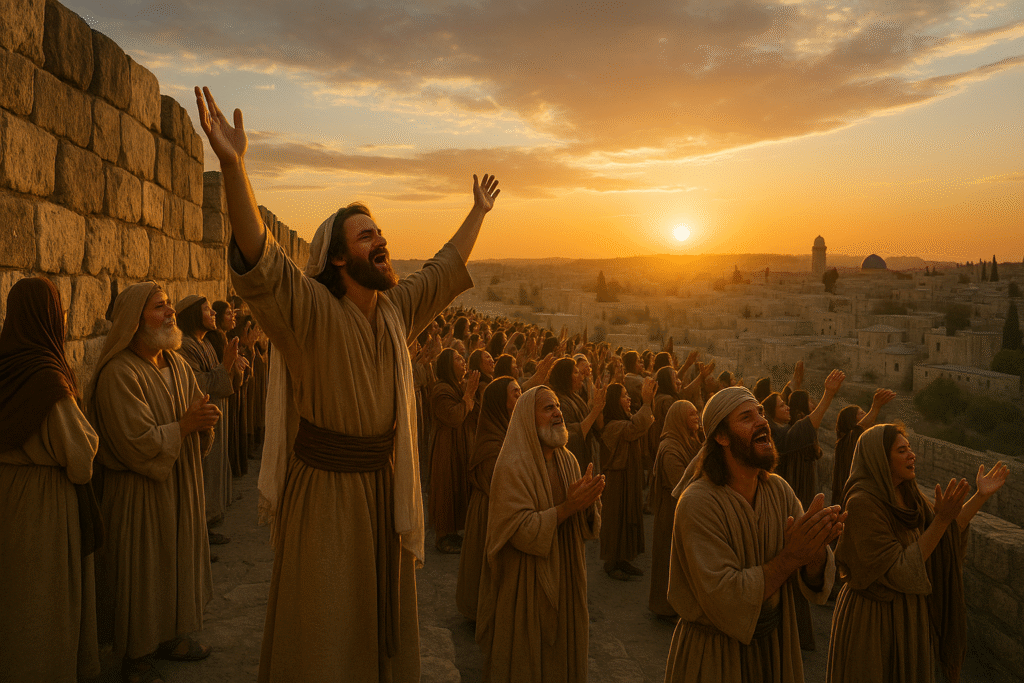
Book of Nehemiah – Set 1 (Chapters 1–6)
Theme: Rebuilding the Walls and Reviving the People
1. Summary of the Chapters
Chapters 1–2 – The Burden and the Call
The story begins in Persia, where Nehemiah serves as cupbearer to King Artaxerxes — a position of trust and influence. When he hears that Jerusalem’s walls are broken and its gates burned, his heart shatters.
He sits down, weeps, fasts, and prays. His prayer is humble yet bold:
“Lord, let Your ear be attentive to the prayer of Your servant… give Your servant success today in the presence of this man.” (Nehemiah 1:11)
Nehemiah’s heart breaks for what breaks God’s heart — and that burden becomes his calling.
When he appears before the king, his sadness cannot be hidden. The king notices and asks why. In that sacred moment, Nehemiah prays silently, then speaks courageously. The result? The king grants him permission, protection, and resources to rebuild Jerusalem’s walls.
Nehemiah travels to the city, surveys the ruins by night, and then rallies the people with faith-filled words:
“Come, let us rebuild the wall of Jerusalem, that we may no longer be a reproach.” (2:17)
Hope awakens. The people rise to build. A movement of restoration begins.
Chapters 3–4 – Rebuilding and Resisting
Chapter 3 lists the builders — priests, goldsmiths, merchants, and families — each repairing the section nearest to their home. It’s a picture of unity in diversity. Everyone has a part in God’s work.
But no sooner do they begin than opposition comes. Sanballat, Tobiah, and others mock, threaten, and plot against them.
Nehemiah’s response is both spiritual and practical:
“We prayed to our God and set a guard as protection day and night.” (4:9)
Half the people work while the other half stand guard with spears and shields. Builders carry bricks in one hand and swords in the other — an image of faith and readiness.
When fear spreads, Nehemiah reminds them:
“Do not be afraid of them. Remember the Lord, great and awesome, and fight for your brothers, your sons, your daughters, your wives, and your houses.” (4:14)
The work continues. Despite opposition, fatigue, and threat — the wall rises.
Chapters 5–6 – Integrity, Opposition, and Completion
In Chapter 5, Nehemiah faces internal crisis: the rich exploit the poor through interest and debt. He confronts the injustice directly, demanding that they release their brothers from bondage. They agree, and a spirit of generosity replaces greed.
Nehemiah also models leadership integrity — refusing to take the governor’s allowance, living humbly, and serving the people rather than ruling over them.
Then comes one last wave of opposition. Sanballat and Tobiah try to distract him with lies, manipulation, and threats. They invite him to compromise — “Come, let us meet together.” But Nehemiah answers with one of the most powerful statements in Scripture:
“I am doing a great work, and I cannot come down.” (6:3)
He refuses distraction and deception. He stays focused on God’s call.
Finally, after 52 days, the wall is finished. The enemies lose confidence, realising,
“This work was done by our God.” (6:16)
It’s a triumph of faith, perseverance, and unity — a testimony that when hearts align with Heaven, nothing can stand against God’s plan.
2. Key Themes and Lessons
| Theme | Lesson |
|---|---|
| Vision from Burden | A God-given burden is often the birthplace of calling. |
| Prayer and Action | Faith doesn’t choose between prayer and work — it marries them. |
| Opposition and Perseverance | Resistance reveals the value of the mission. Opposition is confirmation, not contradiction. |
| Leadership Integrity | God’s leaders serve with humility, courage, and unwavering focus on the mission. |
| Unity in Purpose | Every person has a part in the work — together, they build what none could alone. |
3. Encouragement
Oh, this story lights me up —
because it shows what happens when someone dares to care about what God cares about!
Nehemiah isn’t a prophet, he’s not a priest, he’s not a king —
he’s just a man whose heart broke for God’s people.
That’s all it takes!
He prays, he weeps, and Heaven listens.
God says, ‘If you’ll move, I’ll move with you.’
Then he stands before the king — trembling inside, but trusting God.
He doesn’t manipulate; he just speaks truth, and favour follows.
Come on, that’s grace in action!
When he reaches Jerusalem, he doesn’t start preaching — he starts building.
Sometimes faith looks like picking up a stone and doing your part.
And what I love most? Everyone builds near their own home. That’s revival!
When everyone takes responsibility for their corner of the wall — their family, their workplace, their community.
But then comes the resistance — mockery, fear, distraction.
That’s when you know you’re doing something eternal!
The enemy never fights what doesn’t threaten him.
Nehemiah’s answer is pure gold: ‘I’m doing a great work, and I can’t come down.’
What a mindset!
When you know who you are and what you’re called to, you stop negotiating with the enemy.
You stop coming down to defend yourself.
You just keep building, keep believing, keep declaring, ‘My God is faithful!’
And in 52 days, the wall is up.
Not because of manpower, but because of heart power.
Because faith built it.
Because obedience sustained it.
Because God finished it.
So here’s the takeaway:
You might not be rebuilding a wall, but you’re rebuilding something —
your home, your peace, your faith, your purpose.
And just like Nehemiah, you’ll face resistance. But don’t stop. Don’t come down.
You’re doing a great work.
And one day, everyone around you will have to say, ‘This was done by God.’”
4. Reflection Questions
- What “holy burden” has God placed on my heart that might be an invitation to action?
- How can I blend prayer with practical obedience the way Nehemiah did?
- Am I allowing distractions or fear to pull me away from God’s assignment?
- What section of the “wall” — my home, relationships, or community — has God asked me to rebuild?
- How can I lead with integrity and humility even when opposition comes?
Book of Nehemiah – Set 2 (Chapters 7–13)
Theme: Restoring Worship, Covenant, and Community
1. Summary of the Chapters
Chapters 7–8 – The Word Restored and Revival Ignited
The walls are finished, but Nehemiah knows that walls alone do not protect — worship does.
He appoints gatekeepers, singers, and Levites to guard not only the city but its spiritual atmosphere.
Then he gathers the people — men, women, and children — in the open square near the Water Gate for a sacred assembly.
Ezra the scribe stands on a wooden platform and opens the Book of the Law.
As he reads, the people stand, lift their hands, bow their heads, and weep.
For the first time in generations, the Word of God pierces their hearts.
But Nehemiah and Ezra say something remarkable:
“Do not mourn or weep… for the joy of the Lord is your strength.” (8:10)
The people dry their tears and begin to celebrate — not in denial of their sin, but in delight of God’s mercy.
They rediscover the Feast of Tabernacles (Sukkot), remembering how God provided in the wilderness.
This marks one of the greatest revivals in Israel’s history — a return not only to the land, but to the heart of God’s Word.
Chapters 9–10 – Confession, Covenant, and Consecration
Revival always leads to repentance.
In Chapter 9, the people gather again, this time in sackcloth and ashes. They confess their sins and the sins of their ancestors.
Ezra leads a prayer that recounts the entire story of God’s faithfulness — from Abraham to Egypt to exile — and contrasts it with Israel’s continual rebellion.
It’s a powerful reminder: God remains faithful even when His people are not.
The people respond by writing and sealing a new covenant, pledging to live differently.
They promise to keep the Sabbath, honour the Temple, and separate from idolatry and impurity.
What began as a national crisis becomes a covenant renewal — the people are not just returning to Jerusalem; they’re returning to relationship.
Chapters 11–13 – Reformation and Holiness Restored
To repopulate Jerusalem, Nehemiah casts lots so one out of every ten families will move into the city.
Leaders volunteer to live there, setting an example of commitment and sacrifice.
Then comes a grand dedication of the wall.
Two massive choirs march around Jerusalem in opposite directions, singing and rejoicing. The sound of worship echoes across the valleys.
Scripture says,
“The joy of Jerusalem was heard far away.” (12:43)
But the story doesn’t end in celebration alone. In Chapter 13, Nehemiah must confront new compromises creeping in — foreign alliances, neglect of the Sabbath, and even priests defiling the Temple.
Nehemiah acts with holy zeal. He cleanses the Temple, restores order, and re-establishes the covenant commands.
His closing prayer captures his heart perfectly:
“Remember me, O my God, for good.” (13:31)
It’s the cry of a servant who gave everything to see God’s people restored to purity, joy, and covenant love.
2. Key Themes and Lessons
| Theme | Lesson |
|---|---|
| The Power of God’s Word | True revival begins when Scripture is opened and hearts are softened. |
| Joy as Strength | The joy of the Lord sustains obedience; repentance leads to rejoicing, not despair. |
| Covenant Renewal | Restoration is not complete until hearts and habits align with God’s truth. |
| Holiness in Community | Holiness protects the atmosphere of revival — compromise slowly erodes it. |
| Faithful Leadership | God uses leaders like Nehemiah and Ezra to shepherd both the work and the worship of His people. |
3. Encouragement
Oh, this part of Nehemiah’s story is where Heaven breaks out!
The walls are up, but Nehemiah knows — a wall without the Word is just stone.
So he brings everyone together, and Ezra opens the Book.
And the moment the Word is read, something explodes inside them — conviction, awe, worship!
They’re weeping, realising how far they’d drifted… and yet, what does God say?
‘Don’t cry — rejoice! The joy of the Lord is your strength!’
That’s not God ignoring their sin — that’s God celebrating their return!
Because repentance isn’t punishment — it’s restoration.
It’s the Father running to meet His kids while they’re still covered in dust.
Then they start living it out — celebrating feasts, restoring rhythms, and recommitting their lives.
You see, revival isn’t just about emotion; it’s about transformation.
They didn’t just hear the Word — they built their lives around it again.
And when they dedicated that wall, oh my goodness — what a sound that must’ve been!
Two choirs circling the city, worship echoing in every direction.
Joy wasn’t confined to the Temple; it filled the land!
That’s what happens when hearts align with Heaven — joy gets loud.
But then compromise tries to sneak back in.
Nehemiah doesn’t ignore it — he confronts it.
Because holiness isn’t legalism; it’s protection.
He’s not angry — he’s zealous for purity, for God’s presence to stay among them.
And when it’s all said and done, he just prays, ‘Remember me, O God, for good.’
What a way to live — not for fame, not for credit — but for faithfulness.
So sister, here’s what I hear in this story:
Don’t settle for rebuilt walls when God wants a revived heart.
Let His Word break you open. Let joy become your strength.
And when compromise whispers, remember who you are.
You’re not a survivor of exile — you’re a temple of His Spirit.
Live like restoration is complete — because in Christ, it is.
4. Reflection Questions
- Do I treasure the Word of God as my foundation for revival, or treat it as an afterthought?
- How can I embrace repentance not as shame, but as joy-filled renewal?
- What areas of my life might need covenant realignment with God’s truth?
- Am I willing to guard my spiritual walls — my heart, habits, and relationships — with holiness?
- How can I lead with the same humility and faithfulness that marked Nehemiah’s life?
Book of Nehemiah – Overview Summary
Theme: Rebuilding What Was Broken — Restoring Covenant, Worship, and Identity
1. Summary of the Book
The Book of Nehemiah is a testimony of how God restores not just what is ruined, but who is ruined.
It continues the story begun in Ezra, showing how divine vision, prayer, and perseverance can transform desolation into delight.
While Ezra focused on rebuilding the Temple and renewing the people’s covenant, Nehemiah focuses on rebuilding the walls and reviving the community’s worship and holiness.
This book reveals a timeless truth: when God rebuilds, He restores both the structure and the spirit — not only the walls of a city but the hearts of His people.
Chapters 1–6 – Rebuilding the Walls
The story opens in Persia, nearly a century after the first exiles returned to Jerusalem.
Nehemiah, cupbearer to King Artaxerxes, receives devastating news: the walls of Jerusalem are still in ruins, and the people live in shame.
He weeps, fasts, and prays, confessing the nation’s sins and calling on God’s covenant mercy. His prayer is not self-pity — it’s intercession birthed from love.
God grants Nehemiah extraordinary favour. The king authorises his return and supplies timber, letters of protection, and royal authority.
Arriving in Jerusalem, Nehemiah surveys the damage by night, then rallies the people with these words:
“Come, let us rebuild the wall of Jerusalem, and we will no longer be in disgrace.” (2:17)
The people respond, “Let us rise up and build.”
Every family takes ownership of a section of the wall. Priests, merchants, and craftsmen work side by side — a picture of unity, community, and purpose.
But as with every divine assignment, opposition arises.
Enemies mock, threaten, and conspire. Yet Nehemiah leads the people to pray, post guards, and persevere.
His famous declaration rings across history:
“I am doing a great work, and I cannot come down.” (6:3)
Despite ridicule, fear, and exhaustion, the wall is completed in just 52 days — a supernatural accomplishment.
The nations around them recognise that “this work was done by God.”
This first half of Nehemiah is not just about construction; it’s about conviction — showing that obedience, unity, and prayer can rebuild what the enemy destroyed.
Chapters 7–13 – Restoring the People and Renewing Worship
Once the walls stand firm, Nehemiah knows the real work begins — the work of the heart.
He appoints gatekeepers, singers, and Levites, and assembles the people for a sacred moment: the public reading of Scripture.
As Ezra opens the Book of the Law, the people stand in reverence.
The Word pierces their hearts — they weep, repent, and worship.
But Nehemiah reminds them that this is not a day of sorrow but of strength:
“Do not grieve, for the joy of the Lord is your strength.” (8:10)
They celebrate the Feast of Tabernacles with great joy, reviving a festival that had been forgotten for generations.
Then follows a national confession of sin (chapter 9) — a heartfelt recounting of God’s faithfulness and Israel’s failures.
In response, the people make a new covenant, pledging to honour the Sabbath, support the Temple, and live holy lives.
The city is repopulated, the wall is dedicated with worship and choirs circling Jerusalem in triumph, and joy fills the land:
“The joy of Jerusalem was heard far away.” (12:43)
Yet even after revival, challenges return. In the closing chapter, Nehemiah confronts compromise — foreign marriages, neglected worship, and defilement of the Temple.
He restores holiness, re-establishes boundaries, and ends with this humble prayer:
“Remember me, O my God, for good.” (13:31)
Thus, the book ends where it began — with prayer, conviction, and God’s enduring faithfulness.
2. Key Themes and Lessons
| Theme | Lesson |
|---|---|
| God Rebuilds Through His People | Divine restoration often begins with one surrendered heart willing to act. |
| Prayer and Perseverance | Every great work of God is birthed in prayer and sustained through persistence. |
| Unity in Purpose | When each person takes responsibility for their “section of the wall,” the whole Kingdom advances. |
| The Power of God’s Word | Revival flows from hearing, understanding, and obeying the Word of God. |
| Holiness and Joy | True holiness produces joy — the joy of the Lord becomes the strength of restored people. |
3. Encouragement
Oh, this book is full of Kingdom reality!
It’s not just a story about walls — it’s a story about hearts.
It’s what happens when someone catches the Father’s heartbeat for restoration and refuses to look away.
Nehemiah wasn’t a prophet, priest, or miracle worker — he was a servant with a burden.
But that’s all God needs: one person whose love outweighs their fear.
When Nehemiah wept, God moved. And when he prayed, God provided.
The king might’ve signed the letters, but Heaven wrote the plan.
And when the opposition came — mockers, threats, exhaustion — Nehemiah didn’t fight back in the flesh.
He prayed, posted guards, and kept building.
He didn’t come down to argue with his critics because he knew who sent him.
Friend, sometimes your greatest act of faith is to keep building when everything tells you to stop.
And when the wall stood, they didn’t worship the wall — they worshipped the God who made it possible.
They opened the Word, repented, and rejoiced.
That’s revival — when conviction and joy meet in the same moment.
It’s not shame that changes you; it’s truth that restores you.
Then Nehemiah goes after compromise. Why? Because love protects what it restores.
Holiness isn’t about legalism; it’s about guarding what matters most — God’s presence in your midst.
And when Nehemiah prays, ‘Remember me, O God, for good,’ you can feel the humility.
He’s not building a legacy for man; he’s building a testimony for God.
So here’s what Nehemiah shouts to every generation:
Don’t just rebuild your life — rebuild it with God.
Let prayer lead you, let the Word shape you, let joy strengthen you, and let holiness preserve you.
Because the same God who rebuilt Jerusalem is still rebuilding hearts today.
4. Reflection Questions
- What “broken wall” in my life, home, or community is God inviting me to help rebuild?
- Do I allow prayer to be my first response, not my last resort, when challenges come?
- How can I serve faithfully where I am — like Nehemiah — without needing recognition or title?
- Does the Word of God still move my heart to reverence, repentance, and joy?
- How can I protect the “walls” of holiness in my heart so that His presence remains my focus?