
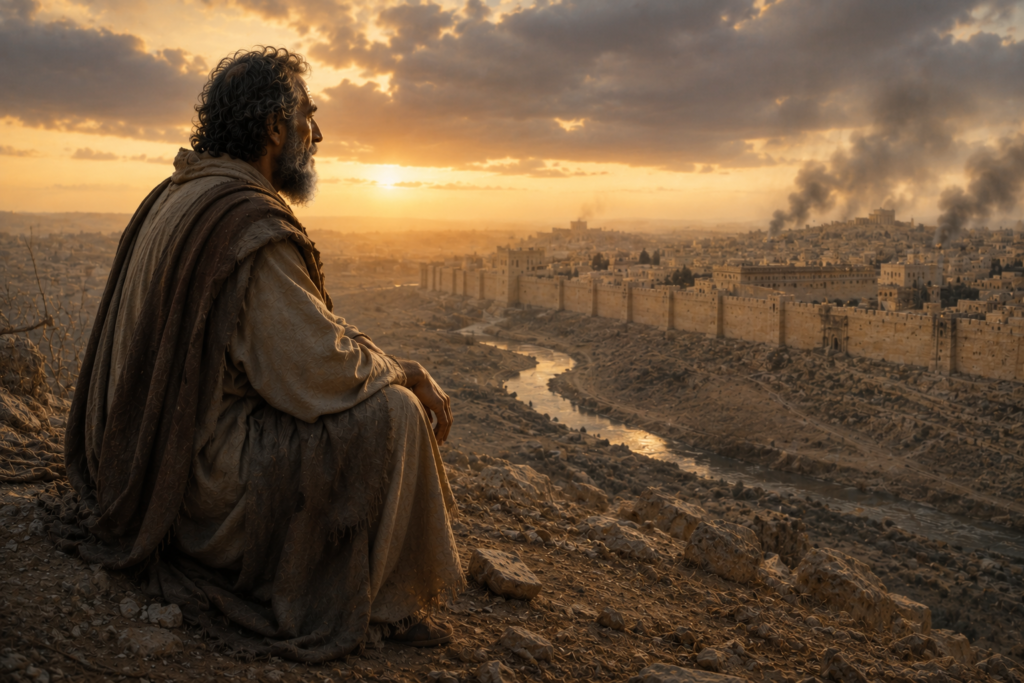
The God Who Calls His People Back to Himself
Welcome to the Jeremiah study hub — a place to encounter God not only through the warnings, grief, and collapse surrounding Judah’s final years before exile, but through the deeper invitation to surrender, repentance, restoration, and wholehearted return to the heart of God.
Here, you will find free study notes for each chapter of the Book of Jeremiah, written through the lens of becoming completely transformed — not merely observing the decline of a nation, but allowing Jeremiah’s words to reveal what happens within the human heart when people drift from intimacy with God, resist His voice, or attempt to build life apart from Him.
Jeremiah is not simply a book of judgement, destruction, and national collapse.
It is a revelation of the grief and faithfulness of God toward people He deeply loves.
The book begins with God calling Jeremiah as a young prophet during a spiritually unstable and rebellious time.
God appoints him to speak truth to a nation that outwardly continued religious practices while inwardly drifting far from genuine devotion and surrender.
Again and again, Jeremiah confronts:
- Idolatry.
- Pride.
- False security.
- Spiritual compromise.
- Self-reliance.
- And resistance to God’s voice.
The people continually trust political alliances, religious rituals, and human solutions rather than returning fully to God Himself.
Yet throughout the entire book, one reality remains unmistakably clear:
God’s warnings always flow from His desire for restoration.
Jeremiah reveals the heart of a God who continually calls His people back before destruction fully unfolds.
Again and again, God pleads: “Return to Me.”
This becomes one of the great themes of Jeremiah.
Not merely outward religion. Not empty performance. But genuine heart surrender.
The book also reveals the painful consequences of persistent rebellion and spiritual drift.
- Jerusalem eventually falls.
- The temple is destroyed.
- Exile unfolds.
- And the people experience the devastating consequences of rejecting God’s ways.
Yet even within immense grief and judgement, another reality continually shines through:
God’s covenant love remains.
- He still speaks hope.
- He still promises restoration.
- He still promises future renewal.
- He still preserves a remnant.
- And He still declares that exile and brokenness will not be the final story.
Jeremiah also reveals the emotional heart of faithful ministry and relationship with God.
Often called the “weeping prophet,” Jeremiah carries deep grief over the suffering, rebellion, and coming devastation surrounding him.
His life reveals the pain of loving people while watching them resist truth and move toward destruction.
Yet through Jeremiah’s sorrow, we also see remarkable perseverance, obedience, and intimacy with God.
One of the most breathtaking revelations within the book is God’s promise of a New Covenant.
A covenant no longer written merely on stone tablets, but upon human hearts.
God promises a future where His people will know Him personally and intimately, and where forgiveness and inner transformation become central realities.
Throughout Jeremiah, a central invitation continues emerging:
Will people humble themselves, listen to God’s voice, and return to Him before hardness of heart fully takes hold?
The book repeatedly contrasts:
- Trust versus self-reliance.
- Humility versus pride.
- Truth versus deception.
- Surrender versus rebellion.
- God’s faithfulness versus human inconsistency.
These chapters have been approached slowly and prayerfully, with the Holy Spirit as Teacher — revealing not only historical events surrounding Judah’s collapse, but the deeper invitation to remain tenderhearted, surrendered, teachable, and rooted in intimacy with God.
As you journey through Jeremiah, you will begin to see that this is not merely a book about judgement or exile.
It is a book about the relentless love of God pursuing wandering hearts.
- A story about the danger of spiritual drift.
- A story about the grief of resisting truth.
- A story about the faithfulness of God even through discipline and loss.
- And ultimately, a story about restoration, renewal, and the promise of transformed hearts.
For those who desire to journey even deeper, you will also find optional companion resources available, including printable workbooks, guided journals, and heart-transformation tools designed to help you apply and embody the truths revealed in each chapter.
May this not simply become a study of warnings, collapse, and exile —
May it become a living encounter with the God who lovingly calls His people back to Himself again and again.
May it soften your heart toward His voice, deepen your surrender, strengthen your trust, and remind you that even in seasons of discipline, grief, or refining, God’s desire remains restoration and intimate relationship with His people.
With love,
Nicola 💖
Jeremiah 1 — Called, Known, and Sent by God
Summary of the Chapter
Jeremiah 1 introduces the calling of the prophet Jeremiah during one of the most spiritually unstable and rebellious periods in Judah’s history.
The chapter begins by establishing the historical setting and Jeremiah’s background as a priest from Anathoth.
God then speaks personally and powerfully to Jeremiah, revealing that his calling began long before his birth.
“Before I formed you in the womb I knew you.”
This becomes one of the central themes of the chapter. Jeremiah’s life was not random or accidental.
God had intentionally formed, known, and appointed him for a specific purpose.
Jeremiah initially responds with fear and insecurity.
He feels too young, inexperienced, and incapable for the assignment God is giving him.
Yet God reassures him repeatedly: “Do not be afraid… for I am with you.”
God touches Jeremiah’s mouth and places His words within him, revealing that Jeremiah’s authority would come not from personal strength or confidence, but from God Himself.
The chapter also reveals the dual nature of Jeremiah’s prophetic ministry.
He is called both to uproot and tear down, and also to build and plant.
This reflects God’s heart throughout the entire book.
Before restoration can occur, false foundations, rebellion, pride, and spiritual compromise must first be confronted.
God then gives Jeremiah two visions:
The branch of an almond tree, symbolising that God is watching over His word to fulfil it.
The boiling pot tipping from the north, symbolising coming judgement upon Judah through invading nations.
Despite the opposition Jeremiah will face, God promises to strengthen and protect him like a fortified city, iron pillar, and bronze wall.
Jeremiah 1 ultimately reveals the God who personally knows, calls, equips, strengthens, and remains with those He appoints for His purposes.
Key Themes & Lessons
| Theme | Lesson for Heart Transformation |
|---|---|
| Calling | God intentionally forms and appoints lives for His purposes. |
| Identity | True identity is rooted in being known by God. |
| Fear | God’s presence strengthens hearts facing insecurity or opposition. |
| Obedience | God calls people to faithfulness even when the assignment feels difficult. |
| God’s Word | God faithfully fulfils every word and promise He speaks. |
| Transformation | God uproots unhealthy foundations in order to build what is life-giving and true. |
| Courage | Spiritual courage grows through dependence upon God rather than self-confidence. |
| Faithfulness | God strengthens and sustains those who remain faithful to Him. |
Encouragement
Sister, Jeremiah 1 carries such deep reassurance for anyone who has ever felt unqualified, insecure, overlooked, or uncertain about their purpose.
Jeremiah’s first response to God’s calling is fear. “I do not know how…” How human that feels.
So many people quietly disqualify themselves before God because they feel:
- Too weak.
- Too inexperienced.
- Too broken.
- Too fearful.
- Too ordinary.
- Or simply not enough.
Yet Jeremiah 1 reminds us that God’s calling does not begin with human qualification.
It begins with His intention. “Before I formed you… I knew you.” What an extraordinary truth.
- Your life is not accidental.
- Your existence is not random.
- God sees purpose and value within you long before you fully recognise it yourself.
One of the most comforting themes in this chapter is that God never asks Jeremiah to carry the assignment alone.
Again and again, He says: “I am with you.”
This becomes the foundation of courage throughout Scripture.
Not self-confidence. Not perfection. Not complete understanding. But God’s presence.
This chapter also reveals that transformation often requires both tearing down and rebuilding.
Sometimes God lovingly exposes unhealthy patterns, false beliefs, fear, pride, wounds, or misplaced foundations before He builds something stronger and healthier in their place.
This process can feel uncomfortable at times, yet it flows from His desire for restoration rather than destruction.
The vision of the almond branch is deeply encouraging as well. God watches over His word to fulfil it.
What He speaks, He remains faithful to complete.
Even when fulfilment feels delayed or circumstances appear uncertain, His promises remain alive.
Jeremiah’s calling also reminds us that faithfulness may sometimes involve opposition, misunderstanding, or difficult seasons.
Yet God promises strength for the journey. He does not abandon those He calls.
This chapter ultimately reveals that God delights in partnering with ordinary people who are willing to trust Him.
Let this chapter encourage your heart today:
You do not need to become fearless, perfect, or completely confident before God can work through your life.
- He already knows you fully.
- He already sees your purpose.
- And He remains with you through every step of the journey.
As you continue trusting His voice above your fears and insecurities, He will faithfully strengthen, guide, equip, and sustain you for everything He has lovingly called you into.
Reflection Questions
- Are there areas where fear or insecurity have caused me to doubt God’s ability to work through my life?
- How does knowing that God formed and knew me intentionally affect my sense of identity and purpose?
- What unhealthy foundations or patterns might God currently be uprooting within my heart?
- How can I grow in greater courage and obedience even when I feel uncertain or inadequate?
- What promises or words from God do I need to trust Him to faithfully fulfil in His timing?
Jeremiah 2 — Forsaking the Fountain of Living Water
Summary of the Chapter
Jeremiah 2 begins with God speaking tenderly about the early relationship He once shared with His people.
He remembers Israel’s devotion during their early wilderness journey — a season when they followed Him with dependence and trust.
Yet the chapter quickly shifts into grief as God confronts how far His people have drifted from Him.
One of the central themes throughout the chapter is spiritual unfaithfulness.
God asks a heartbreaking question:
“What fault did your ancestors find in Me, that they strayed so far from Me?”
Despite God’s faithfulness, provision, protection, and guidance, the people abandoned Him and pursued idols, false security, and empty substitutes.
Jeremiah describes this through one of the most powerful images in the book:
God is the fountain of living water, yet the people have forsaken Him and instead dug broken cisterns that cannot hold water.
This reveals the tragedy of human beings searching for fulfilment, security, identity, or peace in things apart from God.
The chapter also exposes Judah’s misplaced trust in political alliances, human solutions, and false gods rather than dependence upon the Lord.
Again and again, God reveals that their suffering is connected to turning away from the One who truly sustains life.
Jeremiah uses strong imagery of adultery and wandering to describe the people’s spiritual compromise and divided hearts.
Yet even within confrontation, God’s grief and longing for restoration remain visible throughout the chapter.
Jeremiah 2 ultimately reveals the deep sorrow of God over wandering hearts and the emptiness of seeking life apart from the One who alone satisfies the soul.
Key Themes & Lessons
| Theme | Lesson for Heart Transformation |
|---|---|
| Spiritual Drift | Hearts slowly wander when intimacy with God is neglected. |
| God’s Faithfulness | God remains faithful even when people turn away from Him. |
| Idolatry | False sources of security and fulfilment ultimately leave the soul empty. |
| Dependence | God alone is the true source of life, peace, and satisfaction. |
| Relationship | God desires faithful and wholehearted intimacy with His people. |
| Self-Reliance | Human solutions cannot replace dependence upon God. |
| Repentance | God lovingly calls wandering hearts back to Himself. |
| Living Water | True spiritual life flows only from relationship with God. |
Encouragement
Sister, Jeremiah 2 carries both deep grief and deep invitation.
At the heart of this chapter is a God grieving the loss of intimacy with His people.
Not because He is controlling or needy, but because He knows that hearts separated from Him eventually become thirsty, restless, and wounded.
One of the most powerful images in this chapter is the contrast between the fountain of living water and broken cisterns.
Human beings naturally search for life in many places:
- Approval.
- Success.
- Relationships.
- Control.
- Comfort.
- Distraction.
- Achievement.
- Possessions.
- Or self-reliance.
Yet Jeremiah reveals that anything apart from God eventually becomes a broken cistern — unable to truly satisfy the soul.
This chapter also reminds us how slowly spiritual drift often happens.
People rarely wake up one morning fully disconnected from God.
Instead, hearts gradually become distracted, self-sufficient, wounded, fearful, or consumed by other things.
Intimacy fades slowly when dependence upon Him weakens.
Yet one of the most beautiful truths in this chapter is that God notices the distance because He deeply values relationship.
His confrontation flows from love.
Again and again throughout Jeremiah, God calls His people back because His desire remains restoration, not abandonment.
This chapter also speaks deeply into the exhaustion of self-reliance.
The people continually searched for security through political alliances and worldly solutions, yet none of these things brought lasting peace.
Human beings still do the same today.
Yet true peace flows from returning to the source of living water Himself.
One of the most comforting realities in this chapter is that even wandering hearts are still being called back.
God does not stop pursuing His people when they drift.
He continues inviting them toward restoration.
This chapter gently asks every heart: Where am I searching for life apart from God?
Because only He truly satisfies the deepest thirst of the soul.
Let this chapter encourage your heart today:
If you feel weary, spiritually dry, restless, or distant, God is not rejecting you.
He is calling you back to Himself.
- Back to intimacy.
- Back to dependence.
- Back to living water.
And as you continue turning your heart toward Him rather than toward empty substitutes, you will increasingly discover the peace, fullness, and restoration your soul was always created to receive from Him alone.
Reflection Questions
- Are there areas where my heart may have slowly drifted from deeper intimacy with God?
- What “broken cisterns” or false sources of fulfilment might I be relying upon?
- How does viewing God as the fountain of living water affect the way I approach Him?
- Are there areas where self-reliance or worldly solutions may be replacing deeper dependence upon God?
- What practical steps can I take to cultivate greater intimacy and closeness with God in this season?
Jeremiah 3 — Returning to the God Who Still Calls You Home
Summary of the Chapter
Jeremiah 3 continues God’s heartbreaking yet compassionate confrontation of Judah and Israel’s spiritual unfaithfulness.
The chapter uses the imagery of adultery and broken covenant relationship to describe how deeply the people have wandered from God through idolatry, rebellion, and divided devotion.
Israel, the northern kingdom, had already experienced judgement and exile because of persistent unfaithfulness.
Yet remarkably, Judah did not learn from Israel’s downfall and continued drifting in the same direction while often maintaining outward religious appearance.
One of the central themes throughout the chapter is God’s continual invitation to return.
Despite repeated rebellion, God still calls His people back with tenderness: “Return, faithless people.”
This reveals the extraordinary mercy and persistence of God’s love.
The chapter also exposes the difference between outward religion and genuine heart surrender.
The people often appeared religious externally, yet inwardly their hearts remained distant and resistant.
Jeremiah reveals that God desires truth, humility, repentance, and restored intimacy rather than superficial spiritual performance.
Another major theme throughout the chapter is God’s longing to heal backsliding and spiritual drift.
God does not merely expose wandering in order to condemn people.
He exposes it because He desires restoration.
The chapter also looks forward prophetically to future restoration when God’s people will again dwell securely with Him and nations will gather to the Lord in worship.
Jeremiah 3 ultimately reveals the grief of spiritual unfaithfulness alongside the relentless mercy of God who continually calls wandering hearts back into relationship with Himself.
Key Themes & Lessons
| Theme | Lesson for Heart Transformation |
|---|---|
| Repentance | God continually invites wandering hearts to return to Him. |
| Mercy | God’s compassion remains greater than human failure and rebellion. |
| Spiritual Drift | Outward religion cannot replace genuine intimacy with God. |
| Restoration | God desires to heal and restore spiritually wounded hearts. |
| Relationship | God longs for faithful, wholehearted relationship with His people. |
| Humility | Honest acknowledgement of sin opens the way for healing and renewal. |
| Covenant Love | God remains faithful even when people wander from Him. |
| Hope | Restoration remains possible through surrender and return to God. |
Encouragement
Sister, Jeremiah 3 reveals one of the most beautiful and healing truths about God’s heart:
Even wandering hearts are still invited home.
Again and again throughout this chapter, God says: “Return to Me.” What extraordinary mercy.
So many people quietly believe that after enough failure, compromise, drifting, fear, or inconsistency, God eventually becomes distant or unwilling to receive them fully.
Yet Jeremiah 3 reveals the exact opposite.
God continues pursuing His people even after repeated wandering.
This chapter also speaks deeply into the reality of spiritual drift.
Often hearts do not intentionally set out to move away from God.
- Life becomes busy.
- Pain enters.
- Disappointment grows.
- Fear rises.
- Self-reliance increases.
- And intimacy slowly weakens over time.
Yet even when outward spirituality continues, inward closeness with God can quietly fade.
Jeremiah lovingly exposes this because genuine relationship matters deeply to God.
One of the most comforting truths in this chapter is that repentance is not about shame-driven punishment.
It is about returning home.
God’s invitation to return flows from His desire to restore intimacy, healing, and wholeness.
This chapter also reveals the tenderness of God toward broken and inconsistent people.
Human beings often struggle to extend mercy repeatedly after betrayal or failure.
Yet God’s covenant love remains astonishingly faithful.
This does not minimise the seriousness of rebellion or compromise.
Rather, it magnifies the depth of His mercy.
The promise that God desires to “heal backsliding” is especially beautiful.
Spiritual drift, fear, compromise, and woundedness do not need to become permanent conditions.
Healing and restoration remain possible.
This chapter also gently reminds us that outward religious appearance cannot substitute for genuine surrender.
God desires truthful hearts that remain soft, humble, and open before Him.
Let this chapter encourage your heart today:
No matter how distant, weary, inconsistent, or spiritually dry you may sometimes feel, God is still calling you closer.
- His mercy has not run out.
- His invitation has not been withdrawn.
- And His desire remains restoration rather than rejection.
As you continue turning your heart honestly toward Him, He will faithfully meet you with healing, compassion, renewal, and deeper intimacy than you may currently realise possible.
Reflection Questions
- Are there areas where spiritual drift or distance may have slowly developed within my heart?
- How does knowing that God continually invites people to return affect the way I approach Him?
- Are there outward spiritual habits that may need deeper inward surrender and authenticity?
- What areas of my life currently need God’s healing and restoration?
- What practical steps can I take to cultivate deeper intimacy and wholehearted relationship with God in this season?
Jeremiah 4 — Returning Before Destruction Fully Unfolds
Summary of the Chapter
Jeremiah 4 continues God’s urgent call for His people to return to Him wholeheartedly before the coming devastation overtakes them.
The chapter begins with a tender invitation to repentance.
God calls His people not merely to perform outward religious actions, but to remove the deeper hardness, compromise, and rebellion within their hearts.
“Break up your unploughed ground.” This becomes one of the central themes of the chapter.
God desires inward transformation, not superficial spirituality.
Jeremiah warns that judgement is approaching from the north — referring to the coming Babylonian invasion that would eventually devastate Judah and Jerusalem.
The imagery throughout the chapter becomes increasingly intense and emotional as destruction draws near.
Trumpets sound warnings. Cities tremble. Fear spreads throughout the land.
Yet even within these warnings, God’s desire remains repentance and restoration rather than destruction.
One of the most powerful aspects of the chapter is Jeremiah’s deep emotional grief.
He does not speak coldly or mechanically about coming judgement.
Instead, he feels profound anguish over the suffering and devastation approaching his people.
This reveals both the emotional cost of rebellion and the compassion within Jeremiah’s prophetic ministry.
The chapter also contains vivid imagery of chaos and desolation resembling the earth before creation itself.
Sin and rebellion lead toward disorder, devastation, and loss when humanity continually resists God’s ways.
Yet even here, God declares that total destruction will not be the final outcome. A remnant will remain.
Jeremiah 4 ultimately reveals God’s urgent call to wholehearted repentance before hardness of heart leads toward deeper destruction and loss.
Key Themes & Lessons
| Theme | Lesson for Heart Transformation |
|---|---|
| Repentance | God desires deep inward transformation rather than outward religion alone. |
| Spiritual Softness | Hardened hearts must be surrendered for true growth and renewal. |
| Warning | God lovingly warns His people before consequences fully unfold. |
| Grief | Sin and rebellion bring real pain, loss, and devastation. |
| Compassion | Jeremiah reflects God’s sorrow over wandering and broken people. |
| Humility | Honest surrender opens the heart toward restoration. |
| Consequences | Persistent resistance to God eventually produces destruction and instability. |
| Hope | Even in judgement, God preserves hope and future restoration. |
Encouragement
Sister, Jeremiah 4 carries both urgency and deep compassion.
At first glance, the chapter can feel heavy because it honestly confronts the destructive reality of spiritual drift, rebellion, and hardened hearts.
Yet underneath every warning is another reality:
God is still calling His people back before destruction fully unfolds.
One of the most powerful invitations in this chapter is: “Break up your unploughed ground.”
This imagery is deeply beautiful.
Ground that remains hard cannot easily receive seed, growth, or fruitfulness.
In the same way, human hearts can slowly become hardened through fear, disappointment, pain, pride, compromise, distraction, or self-reliance.
Yet God’s invitation is not condemnation. It is preparation for restoration.
He desires hearts that remain soft, teachable, surrendered, and open to Him.
This chapter also reveals that consequences are real. God’s warnings are not empty threats.
Persistent rebellion and resistance eventually bring pain and devastation because separation from God’s wisdom always leads toward brokenness.
Yet even within this, God’s heart remains compassionate.
Jeremiah himself feels deep grief over the suffering approaching his people.
This reveals something important: God does not delight in destruction.
He longs for repentance because He desires life, peace, and restoration for His people.
One of the most comforting truths within this chapter is that even when judgement becomes necessary, God still preserves hope.
The devastation would not be the end of the story.
- A remnant would remain.
- Restoration would still come.
- God’s covenant purposes would continue.
This chapter also speaks deeply into the importance of responding tenderly when God convicts or exposes unhealthy areas within the heart.
Conviction is not rejection. It is invitation.
God lovingly reveals what needs healing before deeper destruction takes root.
Let this chapter encourage your heart today:
God’s desire is not to shame or condemn you, but to soften, heal, and restore your heart.
He lovingly calls you away from anything that leads toward emptiness, hardness, or destruction.
And as you continue surrendering every hardened or fearful place to Him, He will faithfully cultivate greater softness, wisdom, healing, and fruitfulness within your life.
Reflection Questions
- Are there areas where my heart may have become hardened through fear, pain, disappointment, or compromise?
- What does “breaking up unploughed ground” practically look like in my spiritual life right now?
- How do I usually respond when God lovingly convicts or exposes unhealthy areas within my heart?
- Are there patterns, attitudes, or compromises that God may be inviting me to surrender more fully?
- How can I cultivate greater softness, humility, and openness toward God in this season?
Jeremiah 5 — Searching for Truth in a Spiritually Corrupt Nation
Summary of the Chapter
Jeremiah 5 continues exposing the deep spiritual corruption and rebellion within Judah and Jerusalem.
The chapter begins with God challenging Jeremiah to search throughout Jerusalem for even one person who acts justly, seeks truth, and lives faithfully.
The implication is devastating:
Truth, integrity, humility, and genuine righteousness had become exceedingly rare within the nation.
One of the central themes throughout the chapter is the danger of persistent spiritual hardness.
Despite repeated warnings, correction, and opportunities to return to God, the people continually resist Him.
Both the poor and the leaders alike have rejected God’s ways.
The chapter reveals how widespread deception, injustice, dishonesty, and spiritual compromise had become.
Jeremiah also confronts the people’s false sense of security.
Although they continue outward religious practices, their hearts remain rebellious and self-serving.
They assume they are safe from consequences while continually rejecting God’s authority and truth.
Another major theme throughout the chapter is spiritual blindness.
The people see outwardly, yet they do not truly perceive. They hear, yet they refuse to listen.
God compares them to foolish people without understanding who fail to recognise His power, provision, and faithfulness.
The chapter also exposes how greed, exploitation, corruption, and abuse of power had deeply infected society.
Even spiritual leaders spoke falsely while the people accepted deception because it suited their desires.
Yet even amidst judgement, God still declares that He will not completely destroy His people.
A remnant will remain.
Jeremiah 5 ultimately reveals the devastating effects of rejecting truth while also revealing God’s continued mercy and desire for repentance and restoration.
Key Themes & Lessons
| Theme | Lesson for Heart Transformation |
|---|---|
| Truth | Genuine spiritual life requires honesty, integrity, and truthfulness. |
| Spiritual Blindness | Hearts can become hardened when truth is continually resisted. |
| Deception | False security and self-deception distance people from God. |
| Justice | God deeply cares about righteousness and how people treat one another. |
| Repentance | God continually calls people back before destruction fully unfolds. |
| Leadership | Spiritual leaders carry responsibility to speak truth faithfully. |
| Mercy | Even within judgement, God preserves hope and restoration. |
| Humility | Soft and teachable hearts remain open to God’s correction and wisdom. |
Encouragement
Sister, Jeremiah 5 is a deeply sobering chapter because it honestly reveals what happens when truth is repeatedly ignored and hearts become hardened over time.
Yet even within the heaviness, there is still invitation and hope.
One of the most important truths within this chapter is that God values truth deeply.
Not merely outward appearance. Not religious performance. Not pretending. Truth within the heart.
Human beings can become very skilled at maintaining outward appearances while inwardly remaining fearful, prideful, compromised, wounded, or resistant to God’s voice.
Yet God lovingly searches deeper than appearances.
This chapter also reveals how dangerous spiritual numbness can become.
When people continually ignore conviction, resist truth, or justify compromise, the heart slowly loses sensitivity.
What once felt wrong begins feeling normal. What once stirred conviction becomes easier to ignore.
This happens gradually.
Yet Jeremiah’s warnings flow from love because God desires to awaken hearts before deeper destruction unfolds.
The chapter also speaks powerfully into the importance of discernment.
The people accepted false messages because those messages were easier and more comfortable than truth.
Human hearts still naturally gravitate toward voices that affirm comfort, control, or self-will rather than genuine surrender.
Yet true freedom only grows where truth is embraced honestly.
One of the most comforting realities in this chapter is that even while confronting corruption and rebellion, God still preserves mercy.
He does not utterly destroy His people. A remnant remains.
This reveals that His desire is always restoration rather than hopeless destruction.
This chapter also reminds us how deeply God cares about justice, integrity, and the treatment of others.
Spiritual maturity is never separated from how people live, speak, love, and act toward others.
Let this chapter encourage your heart today: God’s correction is not rejection.
It is mercy inviting hearts back into truth, freedom, and intimacy with Him.
And as you continue remaining soft, honest, humble, and teachable before Him, your heart will become increasingly protected from deception, spiritual numbness, and false security.
God delights in hearts that genuinely seek truth and remain surrendered to His voice.
Reflection Questions
- Are there areas where I may be resisting truth or avoiding honest surrender before God?
- How can I guard my heart against spiritual numbness or gradual compromise?
- Are there voices or influences I rely upon that may prioritise comfort over truth?
- In what ways can I grow in greater integrity, honesty, and righteousness in daily life?
- What practical steps can I take to remain spiritually soft, teachable, and responsive to God’s voice?
Jeremiah 6 — The Tragedy of Ignoring God’s Warnings
Summary of the Chapter
Jeremiah 6 continues warning Judah and Jerusalem about the coming devastation that will arrive through invading armies from the north.
The chapter carries deep urgency as God repeatedly calls His people to recognise the danger approaching and turn back to Him before destruction fully unfolds.
Jerusalem, once intended to reflect God’s presence and righteousness, has become filled with violence, corruption, oppression, deceit, and spiritual rebellion.
One of the central themes throughout the chapter is the danger of continually rejecting correction and truth.
Again and again, God speaks warnings through Jeremiah, yet the people refuse to listen.
Their hearts have become resistant, stubborn, and spiritually dull.
The chapter also exposes the failure of leaders and prophets who speak false reassurance rather than confronting the deeper spiritual sickness within the nation.
One of the most famous statements in Jeremiah appears here:
“They dress the wound of My people as though it were not serious. ‘Peace, peace,’ they say, when there is no peace.”
Rather than leading people toward genuine repentance and healing, false leaders offer superficial comfort while ignoring the deeper problem.
Another major theme throughout the chapter is the loss of sensitivity toward sin and compromise.
The people no longer blush or feel conviction over wrongdoing.
Spiritual numbness has become normalised.
Yet despite the strong warnings, God still lovingly calls His people toward restoration.
He urges them to stand at the crossroads, look for the ancient paths, and walk in the good way that leads toward rest and peace.
However, the people refuse. The chapter closes with imagery of refining metal.
God has tested and refined His people, yet they continually resist purification and remain hardened.
Jeremiah 6 ultimately reveals the tragedy of resisting truth and correction while also revealing God’s persistent desire to lead His people back into peace, healing, and restoration.
Key Themes & Lessons
| Theme | Lesson for Heart Transformation |
|---|---|
| Warning | God lovingly warns His people before destruction unfolds. |
| Truth | Genuine healing requires honest recognition of the heart’s condition. |
| Spiritual Numbness | Repeated compromise slowly hardens sensitivity to conviction. |
| Leadership | False reassurance cannot replace genuine repentance and truth. |
| Repentance | God continually calls people back toward life, peace, and restoration. |
| Discernment | Spiritual wisdom requires listening carefully to God’s voice. |
| Refinement | God allows refining to expose and purify what is unhealthy. |
| Rest | God’s ways lead toward true peace and rest for the soul. |
Encouragement
Sister, Jeremiah 6 carries both deep grief and deep invitation.
This chapter honestly reveals the danger of continually resisting truth, ignoring conviction, or settling for superficial peace instead of genuine transformation.
Yet underneath every warning is the loving heart of God still calling His people back before greater devastation unfolds.
One of the most important truths within this chapter is that false peace cannot heal wounded hearts.
The leaders repeatedly said: “Peace, peace,” when there was no true peace.
Human beings still often seek quick comfort without addressing deeper heart issues.
People may try to cover pain, fear, compromise, wounds, exhaustion, or spiritual drift with distraction, busyness, outward spirituality, or temporary reassurance.
Yet genuine healing requires truth and surrender.
This chapter also speaks deeply into the danger of spiritual numbness.
When compromise continues unchecked, hearts slowly lose sensitivity.
- Conviction weakens.
- Truth feels uncomfortable.
- And unhealthy patterns begin feeling normal.
Yet God’s correction flows from mercy, not rejection. He warns because He desires restoration.
One of the most beautiful invitations in the chapter is:
“Stand at the crossroads and ask for the ancient paths… and you will find rest for your souls.”
What a powerful image.
God’s ways are not restrictive burdens designed to steal life.
They are pathways toward peace, stability, wisdom, and rest.
This chapter also reminds us how important discernment becomes in spiritually confusing times.
Not every reassuring voice speaks truth.
Sometimes the most loving voices are the ones willing to speak honestly while still offering hope and restoration.
The imagery of refinement is also deeply important.
Refining can feel uncomfortable because it exposes hidden impurities within the heart.
Yet God refines because He desires purity, healing, and freedom rather than destruction.
This chapter ultimately reveals that God’s desire is not outward compliance alone.
He desires soft, responsive hearts that remain open to His voice.
Let this chapter encourage your heart today: God’s correction is never meant to push you away from Him.
It is invitation into deeper healing, wisdom, truth, and peace.
And as you continue responding tenderly to His voice rather than resisting it, He will faithfully lead your heart into greater freedom, clarity, stability, and rest for your soul.
Reflection Questions
- Are there areas where I may be ignoring conviction or settling for superficial peace instead of genuine healing?
- How can I guard my heart against spiritual numbness or gradual compromise?
- What does it practically look like for me to walk in the “ancient paths” that lead toward peace and rest?
- Are there areas where God may currently be refining or exposing unhealthy patterns within my life?
- How can I remain spiritually soft, discerning, and responsive to God’s voice in this season?
Jeremiah 7 — Trusting God Rather Than Empty Religion
Summary of the Chapter
Jeremiah 7 contains one of the most confronting and important messages in the entire book of Jeremiah, often called “The Temple Sermon.”
God sends Jeremiah to stand at the gate of the temple and speak directly to the people as they come to worship.
The people believed that because the temple of the Lord stood in Jerusalem, they were automatically secure and protected regardless of how they lived.
One of the central themes throughout the chapter is the danger of false spiritual security.
The people continued religious rituals and temple worship outwardly while inwardly living with injustice, idolatry, dishonesty, oppression, and rebellion against God.
They assumed outward religion would protect them while their hearts remained far from genuine surrender and obedience.
Again and again, God confronts this deception.
He makes it clear that He desires transformed lives, justice, compassion, righteousness, and wholehearted relationship rather than empty religious performance.
The chapter also highlights how the people oppressed the vulnerable, shed innocent blood, and pursued false gods while still entering the temple believing they remained spiritually safe.
God warns that the temple itself will not protect them if they continually reject His ways.
Jeremiah points back to Shiloh — a former place of worship that was destroyed because of Israel’s persistent rebellion — as a warning that outward religious structures do not guarantee God’s favour apart from genuine relationship and obedience.
Another major theme throughout the chapter is God’s grief over His people’s refusal to listen.
Again and again, He sent prophets and warnings, yet the people hardened their hearts and refused correction.
The chapter also reveals the heartbreaking reality of idolatry and generational spiritual compromise spreading throughout families and society.
Yet even within strong confrontation, God’s desire remains repentance and restoration.
Jeremiah 7 ultimately reveals that genuine relationship with God cannot be replaced by outward religion, spiritual appearance, or false security.
Key Themes & Lessons
| Theme | Lesson for Heart Transformation |
|---|---|
| Genuine Relationship | God desires transformed hearts rather than empty religious performance. |
| False Security | Outward spirituality cannot replace true surrender and obedience. |
| Repentance | God continually calls His people back before destruction unfolds. |
| Justice | God deeply cares about how people treat the vulnerable and oppressed. |
| Obedience | Genuine faith affects daily living, not merely religious activity. |
| Spiritual Deception | Hearts can become deceived while maintaining outward spiritual appearance. |
| Idolatry | Divided devotion weakens intimacy and alignment with God. |
| Mercy | God repeatedly warns and calls people back because He desires restoration. |
Encouragement
Sister, Jeremiah 7 carries such an important invitation toward authentic relationship with God.
One of the deepest warnings in this chapter is that outward spirituality can sometimes hide inward distance from God.
The people attended the temple. They participated in worship. They maintained religious routines.
Yet inwardly, many hearts remained hardened, self-reliant, compromised, and resistant to true surrender.
This chapter gently asks an important question for every believer:
Is my relationship with God flowing from genuine intimacy and transformation, or merely outward habit and appearance?
God is not looking for performance alone.
He desires hearts that are soft, honest, surrendered, and deeply connected to Him.
One of the most beautiful truths hidden within this confronting chapter is that God continually warns because He loves.
His correction is mercy.
Again and again, He sent prophets and invitations to return before destruction fully unfolded.
This reveals His extraordinary patience and compassion.
The chapter also reminds us that genuine spirituality affects every area of life.
How people treat others matters deeply to God.
- Justice.
- Compassion.
- Integrity.
- Humility.
- And honesty are all expressions of a heart aligned with Him.
This chapter also speaks deeply into the danger of false security.
Human beings naturally search for reassurance through systems, routines, appearances, or external identity markers.
Yet true peace only comes through genuine relationship and surrendered trust in God Himself.
One of the saddest realities within the chapter is the repeated refusal to listen.
Hearts slowly become hardened when conviction is continually ignored.
Yet even here, God’s desire remains restoration.
This chapter ultimately invites every heart back into authenticity.
Not empty religion. Not performance. Not image management. But real intimacy with God.
Let this chapter encourage your heart today: God does not desire superficial spirituality from you.
He desires your heart.
Your honesty. Your surrender. Your trust. And your relationship with Him.
And as you continue walking openly and sincerely with Him, He will faithfully lead you into deeper transformation, wisdom, integrity, and genuine peace that flows from truly knowing Him.
Reflection Questions
- Are there areas where outward spiritual habits may be stronger than genuine inward surrender?
- How can I cultivate deeper authenticity and intimacy in my relationship with God?
- Are there areas where I may be relying upon false spiritual security rather than genuine dependence upon God?
- How does my relationship with God practically affect the way I treat others each day?
- What steps can I take to remain spiritually soft, responsive, and honest before God in this season?
Jeremiah 8 — The Sorrow of Hearts That Refuse to Return
Summary of the Chapter
Jeremiah 8 continues describing the devastating consequences of Judah’s persistent rebellion and refusal to listen to God’s warnings.
The chapter begins with disturbing imagery showing the disgrace and shame that will come upon the people after judgement unfolds.
Those who once pursued false gods and idols will discover that these things cannot save or sustain them.
One of the central themes throughout the chapter is the tragedy of stubborn resistance to truth.
Again and again, God calls His people to return, yet they continually refuse correction and persist in spiritual deception.
Jeremiah describes them as people who cling to deceit and refuse to repent even when confronted with the consequences of their choices.
The chapter also exposes the failure of spiritual leaders.
The priests, prophets, and wise men claim wisdom and peace while rejecting the truth of God’s word.
Once again, Jeremiah repeats the heartbreaking statement: “Peace, peace,” when there is no peace.
False reassurance continues while the deeper spiritual sickness remains untreated.
Another major theme throughout the chapter is spiritual blindness and loss of discernment.
Jeremiah contrasts the people with birds that instinctively recognise the changing seasons, while God’s people fail to recognise the spiritual reality unfolding around them.
Despite repeated warnings, they continue walking toward destruction.
The chapter then shifts into deep grief and lament.
Jeremiah personally feels overwhelming sorrow for the suffering and brokenness surrounding him.
He mourns over the spiritual condition of the people and the devastation approaching the nation.
The chapter closes with one of the most famous questions in Jeremiah:
“Is there no balm in Gilead? Is there no physician there?”
This reflects the aching longing for healing and restoration that the people desperately need yet continue resisting.
Jeremiah 8 ultimately reveals the sorrow and devastation that unfold when hearts continually reject truth, while also revealing God’s deep longing to bring healing and restoration.
Key Themes & Lessons
| Theme | Lesson for Heart Transformation |
|---|---|
| Repentance | Refusing correction hardens the heart and deepens spiritual brokenness. |
| Truth | Genuine healing requires honest acknowledgement of reality. |
| Spiritual Blindness | Hearts lose discernment when truth is continually resisted. |
| False Peace | Superficial reassurance cannot replace true repentance and healing. |
| Grief | Sin and rebellion bring deep sorrow and devastation. |
| Compassion | Jeremiah reflects God’s sorrow over wandering and wounded people. |
| Healing | God desires restoration even when people resist Him. |
| Wisdom | Spiritual wisdom requires humility and responsiveness to God’s voice. |
Encouragement
Sister, Jeremiah 8 carries such deep sorrow because it reveals what happens when people continually resist truth and ignore the invitations of God toward healing and restoration.
Yet even within the grief, the heart of God still shines through.
One of the most important truths in this chapter is that God’s desire has always been healing.
The final cry: “Is there no balm in Gilead?” reveals the longing for restoration beneath the warnings.
God is not exposing brokenness in order to shame people. He reveals sickness because He desires healing.
This chapter also speaks deeply into the danger of self-deception.
Human beings naturally resist uncomfortable truth at times.
- People often prefer reassurance over repentance.
- Comfort over correction.
- Or distraction over honest surrender.
Yet superficial peace can never truly heal wounded hearts.
Real healing begins where truth is welcomed honestly before God.
The comparison with birds recognising seasons is especially powerful.
Creation itself responds naturally to God’s design, yet human beings often ignore spiritual warning signs, conviction, or wisdom because pride, fear, distraction, or stubbornness cloud discernment.
This chapter gently invites hearts to remain spiritually awake and responsive.
One of the most moving aspects of Jeremiah 8 is Jeremiah’s grief itself.
He does not deliver warnings coldly or harshly.
He mourns deeply over the suffering and destruction surrounding him.
This reflects the compassion of God.
God is not emotionally distant from human pain, rebellion, or brokenness.
He grieves over the devastation sin causes within lives, families, and nations.
This chapter also reminds us that wisdom is not merely intellectual knowledge.
True wisdom begins with humility and openness toward God’s voice.
Without surrendered hearts, even knowledgeable people can become spiritually blind.
Yet even here, hope remains.
The question about healing itself reveals that restoration is still available.
God still desires to heal wounded hearts.
Let this chapter encourage your heart today:
No matter how wounded, weary, confused, or spiritually dry life may sometimes feel, God’s desire remains healing and restoration.
He is not pushing you away through conviction.
He is lovingly calling you toward truth, freedom, and wholeness.
And as you continue responding tenderly to His voice, He will faithfully bring greater healing, discernment, wisdom, and peace into every surrendered place within your life.
Reflection Questions
- Are there areas where I may be resisting truth, correction, or deeper surrender before God?
- How can I guard my heart against spiritual numbness or self-deception?
- Are there places where I have accepted superficial peace instead of genuine healing and transformation?
- What does remaining spiritually awake and discerning practically look like in my current season?
- How can I become more open to God’s healing work within wounded or weary areas of my heart?
Jeremiah 9 — The Grief of a Broken and Deceptive Heart
Summary of the Chapter
Jeremiah 9 continues expressing deep sorrow over Judah’s spiritual condition and the devastation that rebellion has brought upon the nation.
The chapter opens with Jeremiah’s heartbreaking lament as he longs to weep continually over the destruction and suffering of his people.
His grief reflects both the emotional weight of prophetic ministry and the sorrow of God Himself over hearts that continually resist truth.
One of the central themes throughout the chapter is the destructive power of deceit and unfaithfulness.
The people have become deeply dishonest with one another, using words deceptively while inwardly remaining disconnected from truth and integrity.
Trust within relationships and society has deteriorated because hearts have drifted far from God.
The chapter also reveals how spiritual compromise affects every area of life.
Greed, betrayal, manipulation, and falsehood spread throughout the nation as people abandon the knowledge of God.
Another major theme throughout the chapter is misplaced confidence.
The people trusted in wisdom, strength, wealth, and outward status rather than in relationship with God.
Yet Jeremiah reveals that none of these things can provide lasting security or true life.
One of the most powerful declarations in the chapter says:
“Let not the wise boast of their wisdom or the strong boast of their strength or the rich boast of their riches, but let the one who boasts boast about this: that they have understanding to know Me.”
This becomes the heart of the chapter.
True life, wisdom, and security are found in genuinely knowing God.
The chapter also reveals God’s grief over the coming devastation while still pointing toward His desire for hearts that understand His character — His love, justice, righteousness, and faithfulness.
Jeremiah 9 ultimately reveals the emptiness of human pride and self-reliance while calling people back into genuine relationship with the God who desires truth, humility, and intimacy.
Key Themes & Lessons
| Theme | Lesson for Heart Transformation |
|---|---|
| Relationship with God | True life and wisdom are found in genuinely knowing God. |
| Deception | Dishonesty and spiritual compromise damage both hearts and relationships. |
| Humility | Human wisdom, strength, and wealth cannot replace dependence upon God. |
| Grief | Sin and rebellion bring sorrow, division, and devastation. |
| Integrity | God values truthfulness and sincerity within the heart. |
| Self-Reliance | Human pride and misplaced confidence lead hearts away from God. |
| God’s Character | God delights in love, justice, righteousness, and faithfulness. |
| Restoration | God continually calls people back into intimacy and truth. |
Encouragement
Sister, Jeremiah 9 carries such deep emotion because it reveals both the grief of spiritual brokenness and the beauty of truly knowing God.
One of the most powerful truths within this chapter is that outward success, intelligence, strength, or achievement were never designed to become the foundation of identity or security.
Human beings naturally tend to build confidence upon:
Knowledge. Ability. Wealth. Performance. Influence. Or control.
Yet Jeremiah reminds us that none of these things can fully satisfy or sustain the soul.
True life is found in knowing God.
Not merely knowing about Him intellectually. But walking with Him relationally.
This chapter also speaks deeply into the importance of integrity.
The people had become deceptive with one another because hearts disconnected from God eventually struggle to remain truthful, trustworthy, and sincere.
When intimacy with God weakens, relationships often become affected as well.
Yet God desires hearts marked by honesty, humility, and love.
One of the most beautiful declarations in the chapter is that God delights in:
- Lovingkindness.
- Justice.
- And righteousness.
This reveals His heart so clearly.
God is not primarily impressed by human status, outward success, or achievement.
He values hearts that reflect His character.
The grief throughout the chapter also reminds us that God is not emotionally distant from human pain or rebellion.
Jeremiah’s tears reflect the sorrow of watching people move toward destruction while refusing the very relationship that could heal them.
Yet even here, God’s invitation remains open.
This chapter also gently challenges every heart to ask: What am I truly building my life upon?
Because anything apart from God ultimately proves unstable.
Only relationship with Him remains eternal and life-giving.
Let this chapter encourage your heart today:
You do not need to prove your worth through achievement, strength, performance, or outward success.
Your greatest treasure is knowing God and being known by Him.
And as you continue walking closely with Him in humility, honesty, and surrender, your heart will increasingly become anchored in the peace, wisdom, and security that only genuine relationship with Him can provide.
Reflection Questions
- What areas of my life am I most tempted to place confidence in apart from God?
- How does genuinely “knowing God” differ from merely knowing about Him?
- Are there areas where greater honesty, integrity, or humility are needed within my heart or relationships?
- How can I cultivate deeper intimacy and daily relationship with God in this season?
- What does it practically look like for my life to reflect God’s love, justice, righteousness, and faithfulness?
Jeremiah 10 — The Living God Compared to Lifeless Idols
Summary of the Chapter
Jeremiah 10 contrasts the emptiness of idols with the greatness, power, and living reality of the one true God.
The chapter begins with a warning not to imitate the practices and fears of surrounding nations who worship idols and place trust in man-made objects.
Jeremiah describes how idols are carefully crafted by human hands from wood and decorated with silver and gold, yet they remain powerless, lifeless, and unable to speak, move, guide, or save.
One of the central themes throughout the chapter is the foolishness of placing trust in created things rather than in the Creator Himself.
Idols may appear impressive outwardly, yet they possess no life, wisdom, or power.
In contrast, God is revealed as the eternal King, Creator of the heavens and earth, and sovereign ruler over all nations.
Jeremiah powerfully declares: “There is none like You, Lord.”
The chapter repeatedly emphasises God’s greatness, wisdom, authority, and living presence compared to the emptiness of false worship and human-made security.
Another major theme throughout the chapter is human limitation and dependence upon God.
Jeremiah acknowledges that people cannot fully direct their own steps apart from God’s wisdom and guidance.
The chapter also contains deep sorrow as Jeremiah grieves over the coming judgement and devastation that Judah will experience because of rebellion and spiritual compromise.
Yet even within this grief, Jeremiah prays for God’s correction to come with mercy rather than overwhelming wrath.
Jeremiah 10 ultimately reveals the absolute contrast between the living God and every false substitute humanity trusts in apart from Him.
Key Themes & Lessons
| Theme | Lesson for Heart Transformation |
|---|---|
| God’s Greatness | God alone is sovereign, living, eternal, and worthy of trust. |
| Idolatry | False sources of security and worship are powerless and empty. |
| Dependence | Human beings need God’s wisdom and guidance for life. |
| Worship | True worship belongs to the living Creator rather than created things. |
| Humility | Human strength and self-direction are limited apart from God. |
| Wisdom | God alone possesses perfect wisdom, power, and understanding. |
| Mercy | Even correction from God flows through His compassion and desire for restoration. |
| Reverence | God’s majesty calls for awe, surrender, and wholehearted trust. |
Encouragement
Sister, Jeremiah 10 carries such a powerful reminder that only God can truly hold the weight of your trust, hope, identity, and security.
Human beings naturally create “idols” in many forms.
Not only physical objects, but also:
Control. Success. Approval. Money. Relationships. Achievement. Comfort. Or self-reliance.
People often place emotional security and identity into things that were never designed to carry the weight of the human soul.
Yet Jeremiah 10 lovingly exposes how powerless these substitutes ultimately become.
One of the most beautiful truths within this chapter is the repeated contrast between lifeless idols and the living God.
God is not distant, empty, or powerless.
He is alive. Present. Wise. Sovereign. And actively involved in the lives of His people.
“There is none like You, Lord.” What a beautiful declaration.
This chapter also speaks deeply into human limitation.
Jeremiah honestly acknowledges that people cannot successfully direct their own lives apart from God’s wisdom.
This is not meant to produce fear or shame. It is invitation into dependence.
Human beings were never designed to carry life independently from God.
One of the most comforting aspects of this chapter is Jeremiah’s prayer for mercy even within correction.
God’s discipline is never cruel or vindictive.
It flows from His desire to restore wandering hearts rather than destroy them.
This chapter also gently asks every heart: What am I truly trusting in?
Because whatever people trust most will eventually shape the direction of their lives.
Only God remains fully trustworthy, unshaken, eternal, and life-giving.
The chapter ultimately invites hearts back into reverence and awe.
Not fear driven by terror, but deep trust rooted in recognising who God truly is.
The Creator. The eternal King. The One unlike any other.
Let this chapter encourage your heart today:
You do not need to build your life upon unstable or temporary things.
God alone is steady, faithful, wise, and fully able to sustain you.
And as you continue placing your trust more deeply in Him rather than in outward security or self-reliance, your heart will increasingly experience the peace, stability, wisdom, and freedom that only the living God can provide.
Reflection Questions
- Are there things other than God that I may be relying upon for security, identity, or peace?
- How does seeing God as the living and sovereign Creator affect the way I approach Him?
- In what areas do I need greater dependence upon God’s wisdom rather than self-reliance?
- What practical steps can help me deepen reverence, trust, and intimacy with God in daily life?
- How can I continue building my life upon what is eternal rather than temporary or unstable?
Jeremiah 11 — The Covenant God Desired His People to Keep
Summary of the Chapter
Jeremiah 11 centres around God’s covenant relationship with His people and the tragedy of their continual refusal to remain faithful to Him.
God instructs Jeremiah to proclaim the words of the covenant made with Israel when He brought them out of Egypt.
This covenant was built upon relationship, obedience, trust, and wholehearted devotion to God.
One of the central themes throughout the chapter is covenant faithfulness.
God had faithfully led, protected, provided for, and sustained His people throughout generations.
Yet despite His faithfulness, the people continually broke covenant through idolatry, rebellion, and spiritual compromise.
Again and again, they refused to listen to God’s voice or walk in His ways.
The chapter also reveals the seriousness of persistent disobedience.
The people had repeatedly ignored warnings, rejected correction, and turned toward false gods and idols.
As a result, the consequences of covenant unfaithfulness were now unfolding.
Another major theme throughout the chapter is the pain of betrayal within relationship.
God compares His people to an olive tree once flourishing and beautiful, now facing destruction because of their rebellion.
This imagery reveals both God’s love for His people and the grief caused by their unfaithfulness.
The chapter also becomes deeply personal for Jeremiah.
The people from his own hometown, including those close to him, secretly plot against him because of the message he carries.
Jeremiah experiences rejection, betrayal, and opposition even from those he trusted.
Yet God reveals the schemes against him and promises justice and protection.
Jeremiah 11 ultimately reveals the grief of broken covenant relationship alongside the faithfulness of God who continually calls His people back to obedience, trust, and intimacy with Him.
Key Themes & Lessons
| Theme | Lesson for Heart Transformation |
|---|---|
| Covenant Relationship | God desires faithful, wholehearted relationship with His people. |
| Obedience | Genuine love for God is reflected through listening and surrender. |
| Faithfulness | God remains faithful even when people wander or rebel. |
| Spiritual Compromise | Persistent disobedience gradually damages intimacy with God. |
| Betrayal | Following God faithfully may sometimes lead to misunderstanding or opposition. |
| Discernment | God reveals hidden dangers and protects surrendered hearts. |
| Consequences | Choices carry spiritual consequences that affect both individuals and communities. |
| Perseverance | God strengthens those who remain faithful despite opposition. |
Encouragement
Sister, Jeremiah 11 reveals both the beauty and the seriousness of relationship with God.
At the heart of this chapter is covenant.
Not cold religion. Not outward performance. But relational faithfulness.
God deeply desired intimacy, trust, and wholehearted devotion from His people.
One of the most beautiful truths within this chapter is that God’s faithfulness never weakened even while His people continually wandered.
Again and again, He warned them. Called them back. Protected them. And pursued restoration.
This reveals the extraordinary patience and persistence of His love.
Yet the chapter also honestly reveals that spiritual compromise has consequences.
Human beings often slowly drift through repeated small compromises, ignored convictions, divided loyalties, or hardened patterns.
Over time, intimacy weakens when hearts continually resist God’s voice.
This chapter gently reminds us that obedience is not about legalism or control.
It is about protecting relationship and alignment with the God who truly gives life.
Jeremiah’s personal experience of betrayal also speaks deeply into the pain that can sometimes accompany faithfulness.
Those closest to him turned against him because of the truth he carried.
This reminds us that walking faithfully with God may occasionally involve misunderstanding, rejection, or opposition from others.
Yet even here, Jeremiah is not abandoned.
- God sees hidden attacks fully.
- He reveals what Jeremiah could not see.
- And He promises protection and justice.
One of the most comforting aspects of this chapter is that God continues pursuing relationship even after repeated failure.
His heart remains restorative. This chapter also invites every heart to ask:
Am I remaining tender and responsive to God’s voice, or slowly becoming resistant through compromise or distraction?
Because intimacy with God grows through continual surrender and trust.
Let this chapter encourage your heart today:
God’s desire is not distant obligation, but close covenant relationship with you.
- He longs for your trust.
- Your openness.
- Your faithfulness.
- And your surrendered heart.
And as you continue listening to His voice and walking closely with Him even through difficult or misunderstood seasons, He will faithfully strengthen, protect, guide, and sustain you with His steadfast love.
Reflection Questions
- Are there areas where compromise or distraction may be weakening my intimacy with God?
- What does faithful covenant relationship with God practically look like in my daily life?
- How do I usually respond when God convicts or calls me toward deeper surrender?
- Have there been seasons where faithfulness to God felt lonely, misunderstood, or difficult?
- How can I cultivate greater trust, obedience, and responsiveness toward God’s voice in this season?
Jeremiah 12 — Trusting God When Life Feels Unfair
Summary of the Chapter
Jeremiah 12 begins with Jeremiah honestly wrestling with one of the deepest questions many faithful people eventually face:
Why do the wicked seem to prosper while those seeking to walk faithfully with God experience suffering, opposition, or difficulty?
Jeremiah openly brings his confusion and grief before God, expressing frustration over the apparent success of people who speak about God outwardly while remaining far from Him inwardly.
One of the central themes throughout the chapter is learning to trust God’s wisdom and justice even when circumstances feel confusing or unfair.
Rather than rejecting Jeremiah’s honesty, God responds by challenging and strengthening him for the difficult journey ahead.
God essentially tells Jeremiah that greater challenges still lie ahead and that he will need deeper endurance, perseverance, and dependence upon Him.
The chapter also reveals God’s grief over the spiritual devastation of His people and land.
Because of rebellion and unfaithfulness, destruction spreads throughout the nation.
The land mourns, peace disappears, and the effects of sin impact both people and creation itself.
Another major theme throughout the chapter is God’s heartbreak over betrayal.
God describes His beloved inheritance becoming hostile toward Him.
This reveals again the relational nature of covenant between God and His people.
Yet remarkably, the chapter does not end only with judgement.
God also speaks of future restoration.
Even nations who once opposed His people will have opportunity for restoration if they learn God’s ways and turn toward Him.
Jeremiah 12 ultimately reveals the tension of trusting God through confusing seasons while reminding us that God’s justice, wisdom, and redemptive purposes extend far beyond what human understanding can immediately see.
Key Themes & Lessons
| Theme | Lesson for Heart Transformation |
|---|---|
| Trust | God remains trustworthy even when life feels unfair or confusing. |
| Honesty with God | God welcomes sincere questions and struggles brought honestly before Him. |
| Endurance | Spiritual maturity requires perseverance through difficult seasons. |
| Justice | God sees human corruption fully and will ultimately bring justice. |
| Dependence | Human understanding is limited compared to God’s eternal perspective. |
| Grief | Sin and rebellion bring devastation to both people and creation. |
| Restoration | God’s redemptive purposes remain even after judgement and loss. |
| Faithfulness | God strengthens those who continue walking with Him through hardship. |
Encouragement
Sister, Jeremiah 12 speaks so deeply into seasons where life feels confusing, painful, or unfair.
One of the most comforting truths in this chapter is that Jeremiah brings his honest questions directly to God.
He does not pretend to understand everything. He does not hide his frustration or grief.
And remarkably, God allows the conversation.
This reveals something deeply beautiful about relationship with Him:
God is not threatened by honest questions from sincere hearts.
Many faithful people eventually wrestle with difficult questions.
- Why do some people prosper while causing harm?
- Why do faithful people sometimes suffer deeply?
- Why does injustice seem to continue for so long?
Jeremiah 12 reminds us that these struggles are not signs of weak faith.
They are part of wrestling honestly with life in a broken world.
One of the most important lessons in this chapter is that God often strengthens people for endurance rather than immediately removing every difficulty.
His response to Jeremiah calls him into deeper perseverance and maturity.
This can feel challenging, yet it reveals that God sees a larger picture beyond present circumstances.
The chapter also reminds us that God sees injustice fully. Nothing escapes His awareness.
Even when human justice appears delayed, God remains righteous, wise, and fully aware of every hidden reality.
This chapter also speaks deeply into emotional exhaustion.
Jeremiah carried grief over the condition of the people and the destruction surrounding him.
Faithful hearts often feel deeply affected by brokenness, suffering, betrayal, or injustice around them.
Yet God continues strengthening those who remain close to Him.
One of the most hopeful aspects of the chapter is that restoration still remains part of God’s heart even after judgement.
His purposes are ultimately redemptive.
This chapter gently reminds us that human understanding is limited.
There are seasons where complete answers may not immediately come.
Yet God remains trustworthy even when understanding feels incomplete.
Let this chapter encourage your heart today:
If you are carrying unanswered questions, grief, disappointment, or confusion, God welcomes your honest heart.
You do not need to pretend before Him.
And as you continue walking with Him through uncertain seasons, He will faithfully strengthen your endurance, deepen your trust, and remind you that His wisdom, justice, and purposes remain far greater than what you can currently see.
Reflection Questions
- Are there situations in my life where I am struggling to understand God’s timing, justice, or ways?
- How does knowing God welcomes honest questions affect the way I approach Him?
- What does deeper endurance and perseverance with God look like in my current season?
- Are there areas where I need to trust God’s larger perspective beyond my limited understanding?
- How can I continue remaining close to God even when life feels confusing, painful, or unfair?
Jeremiah 13 — Pride, Resistance, and the Ruined Belt
Summary of the Chapter
Jeremiah 13 begins with God instructing Jeremiah to perform a symbolic act involving a linen belt.
Jeremiah is told to buy the belt, wear it close to himself, and later hide it near the Euphrates River.
After some time, God instructs Jeremiah to retrieve it, and the belt is found ruined and useless.
This becomes a powerful picture of Judah’s spiritual condition.
One of the central themes throughout the chapter is pride and the destructive effects of resisting God.
Just as the belt was originally meant to remain close to Jeremiah, God had intended His people to remain close to Him in covenant relationship.
They were meant to reflect His glory, honour, and beauty.
Yet through pride, idolatry, stubbornness, and rebellion, they became spiritually ruined and unfruitful.
The chapter repeatedly exposes the pride of the nation.
The people refuse to listen to God’s warnings, assuming they can continue living independently from Him without consequence.
Jeremiah also uses the imagery of wineskins filled with drunkenness to describe how confusion, judgement, and collapse will overtake the people because of their rebellion.
Another major theme throughout the chapter is spiritual blindness and stubbornness.
The people continue refusing correction even as destruction approaches.
God pleads with them to humble themselves before darkness overtakes them completely.
The chapter also reveals Jeremiah’s deep grief.
He weeps over the pride and coming captivity of the people because they refuse to listen to God’s voice.
The chapter closes with powerful imagery showing the shame, exposure, and helplessness that pride and rebellion ultimately bring.
Jeremiah 13 ultimately reveals the danger of prideful independence from God and the tragic consequences of refusing humility, surrender, and repentance.
Key Themes & Lessons
| Theme | Lesson for Heart Transformation |
|---|---|
| Pride | Pride separates hearts from intimacy, humility, and dependence upon God. |
| Relationship | God created His people to remain close to Him in covenant relationship. |
| Humility | Soft and humble hearts remain teachable and responsive to God’s voice. |
| Spiritual Blindness | Persistent resistance gradually dulls spiritual sensitivity and discernment. |
| Consequences | Rebellion and self-reliance eventually produce spiritual ruin and instability. |
| Grief | God and Jeremiah both grieve over the destruction caused by pride and rebellion. |
| Repentance | God continually calls His people to humble themselves before greater devastation unfolds. |
| Identity | Human lives flourish when closely connected to God’s presence and purposes. |
Encouragement
Sister, Jeremiah 13 carries such an important invitation toward humility and closeness with God.
The imagery of the linen belt is deeply personal and beautiful.
The belt was designed to stay close to Jeremiah, reflecting honour and beauty.
In the same way, human hearts were created for closeness with God.
Not distant religion. Not independent self-sufficiency. But intimate relationship.
One of the most important truths within this chapter is that pride slowly damages intimacy with God.
Pride does not always appear loud or obvious. Sometimes it quietly shows itself through:
- Self-reliance.
- Resistance to correction.
- Emotional independence.
- Control.
- Or refusal to remain soft and teachable before God.
Over time, pride hardens the heart and weakens sensitivity to His voice.
This chapter also reminds us that spiritual ruin rarely happens suddenly.
The belt became ruined gradually while hidden away from its intended place of closeness.
In the same way, hearts disconnected from intimacy with God slowly lose spiritual vitality, peace, and clarity over time.
Yet even within the warnings, God’s heart remains deeply compassionate.
Again and again, He calls His people to humble themselves before deeper darkness unfolds.
His correction flows from love because He knows the destruction pride eventually produces.
Jeremiah’s tears throughout the chapter are especially powerful.
He does not speak harshly or coldly. He grieves. This reflects the heart of God Himself.
God does not delight in exposing weakness or confronting pride.
He longs for restoration and closeness with His people.
One of the most beautiful invitations in this chapter is the call back into humility.
Humility is not weakness or shame.
- It is openness.
- Teachability.
- Dependence.
- And willingness to remain close to God.
This chapter also gently reminds us that our greatest beauty and strength come from remaining connected to Him.
Human hearts flourish most fully when living near His presence.
Let this chapter encourage your heart today: God’s desire is not distance from you, but closeness.
He created you for intimacy, trust, and dependence upon Him.
And as you continue choosing humility over pride and surrender over self-reliance, your heart will increasingly reflect the beauty, peace, wisdom, and life that flow from remaining near to the God who lovingly formed you for Himself.
Reflection Questions
- Are there areas where pride or self-reliance may be weakening my closeness with God?
- What does genuine humility and teachability practically look like in my current season?
- Are there areas where I have become resistant to God’s correction or conviction?
- How can I cultivate deeper intimacy and dependence upon God in daily life?
- What parts of my life flourish most when I remain closely connected to God’s presence?
Jeremiah 14 — Seeking God in Seasons of Drought and Desperation
Summary of the Chapter
Jeremiah 14 takes place during a severe drought that affects the land, animals, cities, and people of Judah.
The drought becomes both a physical crisis and a spiritual picture of the deeper condition of the nation.
- The land mourns.
- The ground cracks from lack of rain.
- Animals wander desperately searching for water.
- And the people become overwhelmed by fear, weakness, and suffering.
One of the central themes throughout the chapter is the connection between spiritual rebellion and deep inner dryness.
The outward drought reflects the inward spiritual condition of a people who have continually turned away from God while still expecting protection and blessing.
The chapter also reveals the difference between superficial spirituality and genuine repentance.
The people cry out to God during the crisis, yet their hearts remain resistant and inconsistent.
God exposes how false prophets continue giving deceptive reassurance, promising peace and safety when judgement is actually approaching.
Another major theme throughout the chapter is Jeremiah’s intercession.
Jeremiah pleads with God on behalf of the people, appealing to God’s mercy, covenant love, and reputation among the nations.
His prayers reveal deep compassion and grief over the suffering surrounding him.
The chapter also honestly confronts the seriousness of persistent rebellion and the consequences that eventually unfold when people continually resist God’s warnings.
Yet even within judgement, the longing for restoration remains visible throughout the chapter.
Jeremiah 14 ultimately reveals the emptiness of superficial repentance, the sorrow of spiritual drought, and the desperate need for genuine return to the God who alone gives living water and restoration.
Key Themes & Lessons
| Theme | Lesson for Heart Transformation |
|---|---|
| Spiritual Drought | Separation from God eventually produces dryness, instability, and emptiness. |
| Dependence | God alone is the true source of life, provision, and restoration. |
| Genuine Repentance | True repentance involves surrendered hearts, not merely crisis-driven desperation. |
| Intercession | Jeremiah models compassionate prayer for broken and wandering people. |
| Discernment | False reassurance can keep hearts from genuine transformation. |
| Consequences | Persistent rebellion eventually produces suffering and instability. |
| Mercy | Even in judgement, God’s compassion and covenant love remain visible. |
| Hope | God remains the only true source of healing and restoration. |
Encouragement
Sister, Jeremiah 14 speaks deeply into seasons of dryness, exhaustion, disappointment, and spiritual desperation.
The imagery throughout the chapter is incredibly powerful.
The land cracks. Water disappears. Creation itself feels weary and depleted.
Yet beneath the physical drought lies a deeper spiritual reality:
Human hearts disconnected from God eventually become spiritually thirsty and dry.
One of the most important truths within this chapter is that God alone is the true source of living water.
Human beings often try to satisfy inner thirst through control, comfort, distractions, achievement, relationships, or temporary solutions.
Yet without genuine intimacy with God, the soul eventually feels depleted.
This chapter also speaks honestly about the difference between superficial repentance and true surrender.
Sometimes people only seek God during crisis while still resisting deeper transformation internally.
Yet God desires more than temporary desperation. He desires restored relationship.
Jeremiah’s prayers throughout the chapter are deeply beautiful as well.
He carries compassion for the people even while recognising their rebellion.
This reflects the heart of intercession — standing before God with humility, grief, and longing for restoration.
The chapter also reminds us how dangerous false reassurance can become.
The false prophets promised peace while ignoring the deeper spiritual sickness within the nation.
Human beings still naturally seek comforting messages that avoid difficult truth.
Yet genuine healing only begins where honesty and surrender meet God’s mercy.
One of the most comforting realities in this chapter is that even during drought, people still cry out to God.
And even within judgement, His covenant love remains visible.
This chapter ultimately invites hearts to stop searching for life in temporary places and return fully to the One who truly restores the soul.
Let this chapter encourage your heart today:
If you feel weary, spiritually dry, emotionally depleted, or deeply thirsty within your soul, God remains your source of living water.
He is not inviting you into shallow religion or temporary comfort.
He is inviting you back into deeper intimacy, surrender, and dependence upon Him.
And as you continue drawing near to Him honestly and wholeheartedly, He will faithfully begin restoring the dry and weary places within your heart with His presence, peace, wisdom, and life.
Reflection Questions
- Are there areas of my life where I feel spiritually, emotionally, or mentally dry and depleted?
- What “sources” have I been relying upon that cannot truly satisfy the deeper thirst of my soul?
- How does genuine repentance differ from only seeking God during difficult circumstances?
- What can I learn from Jeremiah’s compassion and intercession for others?
- How can I cultivate deeper dependence and intimacy with God in this current season?
Jeremiah 15 — Strengthened by God in Seasons of Rejection and Weariness
Summary of the Chapter
Jeremiah 15 continues revealing the seriousness of Judah’s rebellion and the unavoidable consequences that are now unfolding because of persistent resistance to God.
The chapter begins with God declaring that even if Moses or Samuel stood before Him interceding for the people, judgement would still proceed because of the depth of the nation’s rebellion and hardness of heart.
One of the central themes throughout the chapter is the emotional cost of faithfully walking with God during difficult and resistant seasons.
Jeremiah experiences profound grief, loneliness, rejection, and discouragement as he carries God’s message to people who continually refuse to listen.
The chapter also reveals the pain of watching destruction unfold while feeling isolated and misunderstood.
Jeremiah laments his suffering and questions why his pain feels continual and unresolved.
This becomes one of the most deeply personal and emotionally raw moments in the book.
Yet in the middle of Jeremiah’s discouragement, God responds with both correction and reassurance.
God calls Jeremiah back into trust and steadfastness, reminding him not to allow despair or fear to pull him away from faithfulness.
God promises to strengthen and sustain him like a fortified wall against opposition.
Another major theme throughout the chapter is the refining nature of suffering and faithful endurance.
Jeremiah’s life reveals that following God faithfully does not always lead toward ease, approval, or comfort.
Sometimes it involves misunderstanding, loneliness, opposition, and emotional exhaustion.
Yet God remains present within the struggle.
The chapter also contains one of the most beautiful expressions of intimacy with God:
“When Your words came, I ate them; they were my joy and my heart’s delight.”
This reveals the sustaining power of God’s word within difficult seasons.
Jeremiah 15 ultimately reveals both the pain and the strength involved in faithfully walking with God during seasons of rejection, sorrow, and spiritual resistance.
Key Themes & Lessons
| Theme | Lesson for Heart Transformation |
|---|---|
| Endurance | Faithfulness to God sometimes requires perseverance through difficult seasons. |
| Rejection | Following God faithfully may lead to misunderstanding or loneliness. |
| God’s Word | God’s truth becomes strength, nourishment, and delight for the soul. |
| Honesty | God welcomes honest expressions of grief, discouragement, and struggle. |
| Strength | God strengthens and sustains surrendered hearts through opposition. |
| Refinement | Difficult seasons often deepen spiritual maturity and dependence upon God. |
| Intimacy | Deep relationship with God sustains hearts during hardship. |
| Faithfulness | God remains present and faithful even when life feels painful or unfair. |
Encouragement
Sister, Jeremiah 15 speaks so deeply into seasons where faithfulness feels exhausting, lonely, or emotionally heavy.
One of the most comforting truths within this chapter is that Jeremiah speaks honestly with God about his pain.
He does not hide his discouragement. His weariness. Or his confusion.
And remarkably, God continues engaging with him relationally.
This reveals something deeply important: God welcomes honest hearts.
Many people quietly believe they must always appear spiritually strong, composed, or unwavering before God.
Yet Jeremiah reveals that genuine relationship includes bringing sorrow, disappointment, exhaustion, and questions honestly into God’s presence.
This chapter also reminds us that faithful obedience does not always produce immediate comfort or outward success.
Jeremiah remained faithful while facing rejection, isolation, misunderstanding, and emotional strain.
Sometimes walking closely with God means standing differently from the surrounding culture or enduring seasons where others may not understand the path you are walking.
Yet God does not abandon Jeremiah in the struggle.
One of the most beautiful promises in this chapter is God’s assurance that He will strengthen and sustain him.
Jeremiah’s strength was never meant to come from human approval or personal resilience alone.
It flowed from God’s presence.
The statement about eating God’s words is especially powerful. “When Your words came, I ate them.”
God’s truth became nourishment for Jeremiah’s weary soul.
This chapter gently reminds us that intimacy with God becomes especially vital during painful or discouraging seasons.
His presence sustains what external circumstances cannot.
The chapter also reveals that suffering can deepen spiritual refinement and dependence.
Painful seasons often expose where deeper trust, surrender, or endurance are still being formed within the heart.
Yet refinement is never abandonment. God remains deeply present within the process.
Let this chapter encourage your heart today:
If you feel weary, misunderstood, emotionally exhausted, or discouraged, God sees your heart fully.
He is not distant from your struggles.
And as you continue bringing your honest heart into His presence and feeding upon His truth, He will faithfully strengthen, sustain, refine, and carry you through every difficult season with His unfailing love and wisdom.
Reflection Questions
- Are there areas where I currently feel weary, discouraged, misunderstood, or emotionally exhausted?
- How does knowing God welcomes honest prayer affect the way I approach Him?
- In what ways has God’s word become strength or nourishment for me during difficult seasons?
- What might God be refining or strengthening within my character through current challenges?
- How can I remain close to God and rooted in His presence during emotionally difficult or lonely seasons?
Jeremiah 16 — Living as a Prophetic Sign in a Time of Judgement
Summary of the Chapter
Jeremiah 16 reveals how Jeremiah’s own life becomes a living prophetic message to the people of Judah.
God instructs Jeremiah not to marry, have children, participate in mourning rituals, or join celebrations within the land.
These unusual instructions symbolise the severe judgement and devastation that are approaching because of the nation’s persistent rebellion and refusal to return to God.
One of the central themes throughout the chapter is the seriousness of spiritual rebellion and the far-reaching consequences that follow when people continually reject God’s ways.
The coming destruction will affect every area of life — families, relationships, celebrations, daily routines, and the stability of society itself.
The chapter also reveals that the people had become so spiritually blind and hardened that they no longer understood why judgement was coming.
When they ask Jeremiah what wrong they have committed, God exposes the long-standing pattern of idolatry, stubbornness, and refusal to listen that had characterised both them and previous generations.
Another major theme throughout the chapter is exile and displacement.
Because the people continually pursued false gods and abandoned covenant relationship with the Lord, they would now experience removal from the land and loss of security.
Yet even within strong warnings, God’s redemptive heart remains visible.
The chapter shifts toward future hope and restoration.
God promises that one day He will gather His people back again from the nations where they were scattered.
The future restoration would become so significant that it would surpass even the memory of the Exodus from Egypt.
The chapter closes with a powerful declaration that the nations themselves will eventually recognise the emptiness of idols and come to know the Lord as the true and living God.
Jeremiah 16 ultimately reveals both the devastating consequences of persistent rebellion and the enduring faithfulness of God who still promises future restoration and redemption.
Key Themes & Lessons
| Theme | Lesson for Heart Transformation |
|---|---|
| Consequences | Persistent rebellion eventually affects every area of life. |
| Spiritual Blindness | Hearts can become hardened and unaware of their distance from God. |
| Idolatry | False gods and misplaced trust ultimately lead toward emptiness and loss. |
| Obedience | Jeremiah models costly faithfulness even when God’s instructions are difficult. |
| Exile | Separation from God’s ways leads toward instability and displacement. |
| Restoration | God’s mercy and covenant purposes continue beyond judgement. |
| Hope | God’s restoration is greater than present devastation or loss. |
| Revelation | God ultimately reveals Himself as the only true and living God. |
Encouragement
Sister, Jeremiah 16 reminds us that obedience to God is not always easy or fully understood in the moment.
Jeremiah’s life itself became part of the message God was communicating to the people.
This meant carrying unusual restrictions, loneliness, and sacrifice during a deeply difficult season.
One of the most important truths within this chapter is that faithful obedience may sometimes involve surrendering personal comfort, expectations, or understanding.
Yet even when God’s ways feel difficult to fully comprehend, His purposes remain wise and loving.
This chapter also reveals how easily human hearts can become spiritually desensitised.
The people had drifted so far from God that they no longer recognised the seriousness of their spiritual condition.
This becomes a gentle warning for every believer to remain soft, teachable, and responsive before God rather than slowly normalising compromise or distance.
The repeated exposure of idolatry also speaks deeply into the human tendency to place trust in things apart from God.
Human beings still naturally look toward control, security, comfort, approval, success, or worldly systems to provide what only God truly can.
Yet Jeremiah reminds us that every false source eventually proves empty.
One of the most beautiful aspects of this chapter is that even while judgement is unfolding, God still speaks restoration.
Exile would not become the final story.
- Scattering would eventually lead toward gathering.
- Loss would eventually lead toward restoration.
- And the nations themselves would one day recognise the greatness of God.
This reveals something deeply comforting about His character:
God’s redemptive purposes continue even through painful seasons.
This chapter also reminds us that God often sees far beyond what human beings can currently understand.
Seasons that appear devastating are not necessarily the end of His story.
Let this chapter encourage your heart today:
Even in seasons that feel confusing, costly, uncertain, or deeply stretching, God remains faithful to His purposes and promises.
- He is still leading.
- Still refining.
- Still restoring.
- And still drawing hearts back toward Himself.
And as you continue walking with Him in surrender and trust, He will faithfully guide you through every difficult season with wisdom, purpose, and the hope of restoration that only He can bring.
Reflection Questions
- Are there areas where obedience to God currently feels difficult, costly, or unclear?
- How can I guard my heart against slowly becoming spiritually hardened or desensitised?
- Are there false sources of security or identity that God may be inviting me to release?
- How does God’s promise of restoration strengthen my hope during difficult seasons?
- What would deeper trust and surrender to God practically look like in my current season?
Jeremiah 17 — Rooted in God Rather Than Trusting Human Strength
Summary of the Chapter
Jeremiah 17 continues exposing the spiritual condition of Judah while contrasting two very different ways of living — trusting in human strength or trusting fully in God.
The chapter begins by describing how deeply sin and rebellion had become engraved upon the hearts of the people.
Their idolatry and spiritual compromise were no longer occasional struggles but deeply rooted patterns shaping their lives and decisions.
One of the central themes throughout the chapter is the contrast between misplaced trust and wholehearted dependence upon God.
Jeremiah declares: “Cursed is the one who trusts in man… but blessed is the one who trusts in the Lord.”
Those who place their security, identity, and hope in human strength, worldly systems, or self-reliance are compared to dry shrubs struggling in barren places.
In contrast, those who trust in God are compared to flourishing trees planted beside water — stable, fruitful, and sustained even during drought.
Another major theme throughout the chapter is the condition of the human heart.
Jeremiah reveals that the heart is deeply deceptive and difficult for human beings to fully understand on their own.
Yet God sees and searches every hidden motive, thought, and desire fully.
The chapter also reveals Jeremiah’s personal prayer life and dependence upon God amid opposition and suffering.
He honestly brings his fears, frustrations, and need for protection before the Lord.
Toward the end of the chapter, God calls the people to honour the Sabbath properly.
This reflects a deeper invitation to trust God’s provision, authority, and rhythms rather than living independently and striving constantly through self-effort.
Jeremiah 17 ultimately reveals that true stability, fruitfulness, peace, and life are found only through wholehearted trust and rootedness in God.
Key Themes & Lessons
| Theme | Lesson for Heart Transformation |
|---|---|
| Trust | True security and stability are found through dependence upon God. |
| The Heart | Human hearts require God’s truth and guidance because they are easily deceived. |
| Rootedness | Lives rooted in God remain spiritually nourished even during difficult seasons. |
| Self-Reliance | Trusting human strength apart from God ultimately leads toward dryness and instability. |
| Discernment | God sees beneath outward appearances into the true condition of the heart. |
| Prayer | Honest dependence upon God strengthens hearts during opposition and uncertainty. |
| Rest | Honouring God’s rhythms reflects trust in His provision and leadership. |
| Fruitfulness | Spiritual flourishing grows through continual connection to God. |
Encouragement
Sister, Jeremiah 17 contains one of the most beautiful pictures of spiritual life found anywhere in Scripture:
A tree planted beside water. Stable. Rooted. Nourished. And fruitful even during drought.
What a powerful image.
This chapter reminds us that the deepest stability in life does not come from circumstances being easy or predictable.
It comes from where the heart is rooted.
Human beings naturally place trust in many things:
People. Finances. Control. Plans. Achievement. Emotional security. Or personal strength.
Yet Jeremiah gently reveals that anything apart from God eventually proves unstable when life becomes difficult.
One of the most comforting truths within this chapter is that people who trust God can remain sustained even during drought seasons.
This does not mean difficulty disappears. The heat still comes. The drought still exists.
Yet the roots remain connected to a deeper source. This speaks so powerfully into difficult seasons of life.
When hearts remain rooted in intimacy with God, His presence continues nourishing the soul even when outward circumstances feel exhausting, uncertain, or painful.
The chapter’s honesty about the human heart is also deeply important.
Human beings often do not fully understand their own motives, fears, wounds, or patterns.
Yet God sees fully — not to shame or condemn, but to heal, guide, and transform.
This chapter also reminds us that spiritual life requires continual dependence rather than self-reliance.
Jeremiah himself continually turns toward God in prayer amid fear, opposition, and weariness.
The invitation regarding Sabbath is deeply beautiful as well.
At its core, Sabbath reflects trust.
- Trust that God remains provider.
- Trust that striving is not the source of life.
- Trust that rest and dependence are part of His design for human flourishing.
This chapter ultimately asks every heart: Where are my roots truly planted?
Because whatever nourishes the roots will shape the fruit of life.
Let this chapter encourage your heart today:
Even if you are walking through difficult, dry, uncertain, or stretching seasons, you can remain deeply sustained when your heart stays rooted in God.
He is your living water. Your stability. Your wisdom. And your source of life.
And as you continue trusting Him above human strength or outward circumstances, He will faithfully nourish your heart with peace, resilience, wisdom, and fruitfulness through every season ahead.
Reflection Questions
- Where am I most tempted to place trust apart from God?
- What does it practically look like for my life to remain rooted in God during difficult seasons?
- Are there areas where self-reliance may be replacing deeper dependence upon God?
- How can I cultivate greater spiritual nourishment and intimacy with God in daily life?
- What rhythms of rest, trust, or surrender might God be inviting me into during this season?
Jeremiah 18 — The Potter and the Clay
Summary of the Chapter
Jeremiah 18 contains one of the most beautiful and deeply personal pictures of God’s relationship with His people in all of Scripture.
God instructs Jeremiah to go to the potter’s house where he watches a potter shaping clay upon a wheel.
As the potter works, the vessel becomes marred in his hands.
Rather than discarding the clay, the potter reshapes it into another vessel according to his wisdom and intention.
One of the central themes throughout the chapter is God’s authority and ability to shape, refine, and remake lives.
God explains that just as the potter has authority over the clay, He also has authority over nations and people.
He can uproot, rebuild, restore, or reshape according to how people respond to Him.
The chapter also reveals the importance of responsiveness and humility.
If a nation turns from evil, God may withhold judgement.
If a people turn away from righteousness, consequences may follow.
This reveals the relational nature of God’s dealings with humanity rather than mechanical inevitability.
Another major theme throughout the chapter is stubbornness and resistance.
Despite God’s invitations to repent and return, the people refuse to change course.
They cling to their own plans, desires, and hardened ways rather than surrendering to God’s shaping work.
The chapter also exposes the tragedy of forgetting God.
The people pursue worthless substitutes while abandoning the God who had faithfully led and sustained them.
Toward the end of the chapter, Jeremiah experiences hostility and opposition from people plotting against him because of the message he carries.
Yet Jeremiah continues bringing his pain and frustration honestly before God.
Jeremiah 18 ultimately reveals the God who lovingly shapes and reshapes lives while inviting hearts to remain soft, surrendered, and responsive in His hands.
Key Themes & Lessons
| Theme | Lesson for Heart Transformation |
|---|---|
| The Potter and the Clay | God lovingly shapes lives according to His wisdom and purposes. |
| Surrender | Soft and yielded hearts remain open to God’s transforming work. |
| Responsiveness | Human choices and responses matter deeply within relationship with God. |
| Restoration | God can reshape what appears marred, broken, or damaged. |
| Humility | Pride and stubbornness resist God’s refining and shaping process. |
| Dependence | Human flourishing comes through remaining in the Potter’s hands. |
| Refinement | God patiently works through imperfect and unfinished lives. |
| Faithfulness | God continues pursuing restoration even when people resist Him. |
Encouragement
Sister, Jeremiah 18 carries such extraordinary hope because it reveals that God is not finished with imperfect, wounded, or unfinished lives.
The image of the potter is deeply tender.
When the clay became marred, the potter did not throw it away in frustration. He reshaped it.
What a beautiful picture of God’s heart.
Human beings often fear failure, weakness, mistakes, or broken seasons because they assume these things permanently disqualify them.
Yet Jeremiah 18 reveals that God specialises in restoration and reshaping.
He is not intimidated by unfinished places within your life.
One of the most important truths within this chapter is that softness matters.
Clay that remains soft can still be shaped.
In the same way, hearts that remain humble, teachable, surrendered, and responsive to God can continue being transformed even after failure, pain, or wandering.
This chapter also reminds us that God’s shaping process is deeply relational.
He responds to human surrender, humility, and repentance.
His goal is not harsh control, but restoration and formation.
Sometimes the shaping process feels uncomfortable.
Pressure on the clay is necessary for the vessel to be formed properly.
In the same way, difficult seasons may sometimes expose unhealthy patterns, fears, pride, wounds, or areas requiring deeper surrender.
Yet refinement is not rejection. The Potter’s hands remain loving and intentional throughout the process.
The tragedy in this chapter is not imperfection. It is stubbornness.
The people refuse to return, soften, or allow God to redirect their lives.
This becomes a gentle invitation for every believer: Remain soft in God’s hands.
One of the most comforting aspects of this chapter is that God still works with marred clay.
This means no season is beyond redemption.
No wound. No failure. No disappointment. No brokenness.
God still shapes beauty from surrendered lives.
Let this chapter encourage your heart today: You do not need to fear unfinished places within yourself.
The Potter is patient, wise, loving, and fully committed to the work He is doing within your life.
And as you continue remaining surrendered in His hands, He will faithfully shape, refine, restore, and form your life into something beautiful for His purposes and glory.
Reflection Questions
- Are there areas of my life where God may currently be reshaping or refining me?
- How do I usually respond when God exposes areas needing change or deeper surrender?
- Are there places where pride, fear, or stubbornness may be resisting God’s shaping work?
- What does remaining soft and surrendered in the Potter’s hands practically look like for me?
- How does knowing God can reshape marred and imperfect lives strengthen my hope today?
Jeremiah 19 — The Shattered Jar and the Consequences of Hardened Hearts
Summary of the Chapter
Jeremiah 19 continues God’s warnings to Judah through another powerful prophetic sign.
God instructs Jeremiah to purchase a clay jar from a potter and take some of the elders and priests to the Valley of Ben Hinnom — a place associated with idolatry, child sacrifice, and spiritual corruption.
There, Jeremiah proclaims God’s coming judgement upon Jerusalem because the people had persistently rejected Him, filled the land with innocent blood, and pursued false gods.
One of the central themes throughout the chapter is the seriousness of hardened rebellion and the devastating consequences of continually resisting God’s voice.
The people had not merely drifted occasionally.
They had repeatedly chosen idolatry, violence, spiritual compromise, and stubbornness despite countless warnings and opportunities to return.
The Valley of Ben Hinnom had become a symbol of how far the nation had moved from God’s ways.
Another major theme throughout the chapter is irreversible brokenness caused by persistent hardness of heart.
After proclaiming God’s message, Jeremiah shatters the clay jar before the people.
This symbolic act reveals that the coming destruction upon Jerusalem would be severe and devastating because the people refused correction.
The chapter also exposes the horror of idolatry and the way spiritual rebellion eventually destroys both individuals and communities.
Yet even within the severity of the message, the deeper heart of God remains visible.
The warnings themselves reveal His desire to awaken the people before destruction fully unfolds.
Jeremiah 19 ultimately reveals the tragic consequences of persistent rebellion while warning against allowing hearts to become hardened beyond responsiveness to God’s voice.
Key Themes & Lessons
| Theme | Lesson for Heart Transformation |
|---|---|
| Hardened Hearts | Persistent resistance to God eventually produces deep brokenness. |
| Consequences | Choices and spiritual compromise carry real consequences. |
| Idolatry | False worship and divided devotion lead toward destruction. |
| Warning | God lovingly warns His people before devastation unfolds. |
| Responsiveness | Soft and repentant hearts remain open to restoration. |
| Spiritual Corruption | Sin affects individuals, families, communities, and nations. |
| Obedience | Jeremiah faithfully delivers difficult truth despite opposition. |
| Mercy | God’s warnings themselves reveal His desire for repentance and restoration. |
Encouragement
Sister, Jeremiah 19 is a deeply sobering chapter because it reveals what happens when people continually harden their hearts against God’s voice over long periods of time.
The shattered jar becomes a powerful picture of the damage persistent rebellion eventually creates.
Yet even within the heaviness of this chapter, there is still invitation for every responsive heart.
One of the most important truths within this chapter is that God’s warnings flow from love, not cruelty.
God did not remain silent while destruction approached.
Again and again, He spoke. Warned. Called. And invited the people to return.
This reveals His extraordinary patience and mercy.
The tragedy was not that God stopped speaking.
The tragedy was that the people stopped listening.
This chapter also reminds us how dangerous spiritual numbness can become when conviction is continually ignored.
Human hearts slowly harden through repeated compromise, pride, self-reliance, bitterness, or resistance.
Over time, sensitivity weakens unless hearts remain soft and surrendered before God.
Yet one of the most beautiful realities hidden within this chapter is that soft hearts can still respond.
Jeremiah’s message becomes both warning and invitation.
Every warning throughout Scripture carries an opportunity for repentance before destruction fully unfolds.
This chapter also speaks deeply into the seriousness of idolatry.
Human beings were never designed to worship or build identity around anything apart from God.
False worship eventually damages both the individual heart and the surrounding community.
Jeremiah’s faithful obedience is also deeply significant.
He delivered difficult truth even when it was unpopular and emotionally costly.
This reminds us that genuine love sometimes requires honesty rather than superficial reassurance.
One of the most hopeful lessons in this chapter is that God desires responsiveness now rather than regret later.
Softness before Him protects the heart from deeper brokenness.
Let this chapter encourage your heart today: God’s desire is never destruction for your life.
His desire is restoration, healing, wisdom, and intimacy with Him.
And as you continue remaining soft, teachable, humble, and responsive to His voice, He will faithfully guide your life away from deeper brokenness and into greater peace, wisdom, freedom, and spiritual wholeness.
Reflection Questions
- Are there areas where my heart may be becoming resistant, numb, or hardened toward God’s voice?
- How do I usually respond when God lovingly convicts or corrects me?
- Are there patterns, attitudes, or compromises that God may be inviting me to surrender more fully?
- What practical steps can help me remain spiritually soft and responsive before God?
- How can I cultivate greater humility, surrender, and teachability in my relationship with God?
Jeremiah 20 — Honest Struggle and Unshaken Calling
Summary of the Chapter
Jeremiah 20 reveals one of the most emotionally raw and personal moments in Jeremiah’s life and ministry.
After faithfully delivering God’s warnings, Jeremiah is beaten and placed in stocks by Pashhur, a priest and temple official who opposes his message.
Jeremiah experiences public humiliation, rejection, and suffering because of his obedience to God.
One of the central themes throughout the chapter is the emotional cost of faithfully carrying God’s truth in resistant environments.
Jeremiah feels overwhelmed by mockery, isolation, and continual opposition.
People ridicule him daily because of the difficult messages he proclaims.
The chapter also reveals Jeremiah’s intense internal struggle.
At one point, he considers remaining silent and no longer speaking God’s word because the pain feels too heavy.
Yet he discovers that God’s word burns within him like fire shut up in his bones.
He cannot suppress it because the calling of God remains alive within him.
Another major theme throughout the chapter is the tension between discouragement and trust.
Jeremiah moves emotionally between despair and renewed confidence in God’s faithfulness.
Despite his suffering, he declares that God remains with him like a mighty warrior who will ultimately uphold justice.
The chapter also honestly exposes Jeremiah’s deep anguish and emotional exhaustion.
He laments the day of his birth and expresses profound sorrow over the hardship surrounding his life.
This reveals the humanity of even deeply faithful servants of God.
Jeremiah 20 ultimately reveals the reality that faithful obedience may involve suffering, rejection, and emotional struggle, while also revealing the sustaining power of God’s presence and calling.
Key Themes & Lessons
| Theme | Lesson for Heart Transformation |
|---|---|
| Faithfulness | Obedience to God may sometimes lead through painful or misunderstood seasons. |
| Honest Emotion | God welcomes honest expressions of grief, discouragement, and struggle. |
| Calling | God’s purpose within a life remains powerful even during hardship. |
| Perseverance | Spiritual endurance grows through continued dependence upon God. |
| Opposition | Following truth faithfully may bring resistance from others. |
| God’s Presence | God strengthens and sustains His people amid suffering. |
| Emotional Struggle | Faithful believers can experience deep emotional pain while still trusting God. |
| Hope | God’s purposes and justice remain greater than present suffering. |
Encouragement
Sister, Jeremiah 20 is such an important chapter because it reminds us that faithful people are still human.
Jeremiah was not emotionally untouched by hardship.
He felt rejection. Humiliation. Loneliness. Exhaustion. And deep discouragement.
Yet remarkably, God did not reject Jeremiah for his emotional honesty.
This chapter gives permission for sincere believers to acknowledge pain honestly before God rather than pretending to be emotionally unaffected.
One of the most powerful truths within this chapter is the image of God’s word burning like fire within Jeremiah’s bones.
Even when he wanted to withdraw in discouragement, God’s calling and truth remained alive within him.
This reveals something deeply beautiful:
God’s work within a surrendered life is often deeper than temporary emotions or difficult circumstances.
There are seasons where people may feel weary, misunderstood, or emotionally stretched while still carrying genuine love for God and faithfulness to His purposes.
This chapter also reminds us that opposition does not necessarily mean failure.
Jeremiah experienced resistance precisely because he remained faithful to truth.
Sometimes walking closely with God means standing differently from surrounding voices or enduring misunderstanding from others.
Yet God remained with Jeremiah in the middle of the struggle.
The emotional swings throughout the chapter are also deeply human.
Jeremiah moves between trust and despair, hope and grief.
This reflects the reality that spiritual maturity does not eliminate all emotional struggle.
Faith often grows while people continue bringing their honest emotions into God’s presence rather than withdrawing from Him completely.
One of the most comforting aspects of this chapter is that God never abandons Jeremiah during his darkest moments.
His presence remains steady even when Jeremiah’s emotions feel unstable.
This chapter also gently reminds us that discouragement is not the same as defeat.
God can sustain weary hearts. Let this chapter encourage your heart today:
If you feel emotionally exhausted, misunderstood, discouraged, or weary from difficult seasons, you are not failing because you feel deeply.
God sees your heart fully.
And as you continue bringing your honest struggles into His presence, He will faithfully strengthen, sustain, comfort, and carry you through every painful season with His enduring love and faithfulness.
Reflection Questions
- Are there areas where I currently feel emotionally weary, misunderstood, or discouraged?
- How does Jeremiah’s honesty affect the way I view emotional struggle within faith?
- What “fire” or calling from God continues stirring within my heart even during difficult seasons?
- How can I remain close to God rather than withdrawing from Him during discouragement or pain?
- What practical steps help strengthen my endurance, trust, and emotional health during challenging seasons?
Jeremiah 21 — The Consequences of Rejecting God’s Leadership
Summary of the Chapter
Jeremiah 21 takes place during the final stages of Jerusalem’s crisis as King Zedekiah seeks guidance from Jeremiah while Babylon’s army surrounds the city.
The king hopes God may intervene miraculously as He had done in previous generations.
However, Jeremiah delivers a sobering message:
Because the people have continually rejected God, resisted His warnings, and refused repentance, judgement will now unfold rather than be removed.
One of the central themes throughout the chapter is the danger of turning to God only when consequences become unavoidable while resisting Him throughout everyday life.
The people wanted rescue without genuine surrender or repentance.
Yet God reveals that persistent rebellion has led the nation toward unavoidable destruction.
The chapter also highlights God’s sovereignty over nations and events.
Even Babylon’s invasion is described as part of God’s judgement against Judah’s long-standing rebellion, injustice, idolatry, and refusal to listen.
Another major theme throughout the chapter is the choice between life and death.
God sets before the people two paths:
One leading toward destruction through continued resistance.
The other involving surrender and preservation of life.
This reveals that even during judgement, God still provides opportunity for mercy and survival.
The chapter also confronts the leadership of Jerusalem directly.
The kings and rulers had failed to uphold justice, righteousness, and obedience to God.
As a result, both leaders and people now face the consequences of spiritual corruption and self-reliance.
Jeremiah 21 ultimately reveals the seriousness of continually rejecting God’s leadership while also showing that even in difficult consequences, God still extends opportunities for mercy and life.
Key Themes & Lessons
| Theme | Lesson for Heart Transformation |
|---|---|
| Surrender | Genuine surrender to God matters more than crisis-driven desperation. |
| Consequences | Persistent rebellion eventually leads toward painful consequences. |
| Leadership | God values justice, righteousness, and integrity within leadership. |
| Choice | Human beings continually choose between life-giving surrender or destructive resistance. |
| Mercy | Even during judgement, God still provides opportunities for preservation and mercy. |
| Sovereignty | God remains sovereign over nations, events, and human history. |
| Obedience | God desires daily faithfulness, not temporary dependence during emergencies only. |
| Wisdom | Ignoring God’s voice over time eventually produces instability and loss. |
Encouragement
Sister, Jeremiah 21 reminds us that relationship with God was never meant to become something people seek only during crisis while living independently from Him the rest of the time.
One of the deepest invitations within this chapter is toward daily surrender and ongoing intimacy with God rather than occasional desperation when life becomes difficult.
Human beings naturally tend to turn toward God more urgently during painful seasons, uncertainty, fear, or crisis.
Yet God desires something deeper than temporary emergency dependence. He desires relationship.
This chapter also honestly reveals that choices carry consequences.
God’s warnings throughout Jeremiah were never random threats.
They were loving invitations designed to protect people from destruction.
Persistent resistance eventually leads toward instability because separation from God’s wisdom always affects life deeply.
Yet even within this difficult chapter, mercy still appears.
God still offers a pathway toward life and preservation.
This reveals something deeply important about His heart:
Even in judgement, He looks for opportunities to extend mercy.
The chapter also speaks powerfully about leadership and influence.
The leaders of Judah failed to guide people toward righteousness, humility, and dependence upon God.
This reminds us how important integrity, wisdom, and spiritual responsibility are within every area of influence.
One of the most comforting truths in this chapter is that God remains sovereign even when circumstances appear chaotic or frightening.
Nations rise and fall. Human systems shift. Crisis unfolds. Yet God remains fully aware and fully in control.
This chapter also gently asks every heart:
Am I only seeking God when life feels difficult, or am I cultivating continual surrender and intimacy with Him daily?
Because lasting peace grows from ongoing relationship rather than temporary crisis-driven spirituality.
Let this chapter encourage your heart today:
God’s desire is not merely that you turn to Him in emergencies.
He desires daily closeness, trust, surrender, and dependence.
And as you continue walking closely with Him through both peaceful seasons and difficult ones, He will faithfully guide your life with wisdom, stability, mercy, and peace that remain anchored in His unchanging presence.
Reflection Questions
- Are there areas where I tend to seek God mostly during crisis rather than through daily relationship?
- What consequences have I seen arise when people continually resist wisdom or correction?
- How can I cultivate deeper daily surrender and dependence upon God?
- Are there areas of leadership or influence where God may be calling me toward greater integrity or responsibility?
- How does knowing God remains sovereign strengthen my peace during uncertain or difficult seasons?
Jeremiah 22 — The Fall of Proud and Unfaithful Leadership
Summary of the Chapter
Jeremiah 22 contains a direct message from God to the kings and leaders of Judah.
God calls the royal house to practise justice, righteousness, compassion, and humility rather than oppression, greed, violence, and self-serving leadership.
The chapter reveals that leadership carries deep spiritual responsibility because the choices of leaders affect entire nations and communities.
One of the central themes throughout the chapter is the contrast between righteous leadership and prideful self-reliance.
God reminds the kings that true authority and stability come through obedience, justice, and dependence upon Him rather than through wealth, power, luxury, or political strength.
The chapter specifically contrasts the godly actions of King Josiah with later kings who pursued selfish gain and oppression.
Josiah defended the poor and needy and walked in greater alignment with God’s heart, while later rulers exploited people and ignored justice.
Another major theme throughout the chapter is the emptiness of outward success without genuine righteousness.
The kings built impressive palaces and pursued personal comfort while neglecting truth, compassion, and obedience to God.
Yet none of these outward achievements could protect them from eventual downfall.
The chapter also contains prophecies concerning several kings of Judah, including Shallum (Jehoahaz), Jehoiakim, and Jehoiachin (Coniah), revealing the coming consequences of their rebellion and pride.
Jeremiah mourns the coming collapse of Jerusalem and its leadership because they refused correction and trusted in false security.
The chapter repeatedly exposes the danger of pride and self-exaltation.
Despite warnings, the leaders believed their position, power, or status would preserve them.
Yet God reveals that human greatness apart from Him is fragile and temporary.
Jeremiah 22 ultimately reveals that true leadership and lasting security flow from humility, justice, compassion, and surrendered relationship with God.
Key Themes & Lessons
| Theme | Lesson for Heart Transformation |
|---|---|
| Leadership | God values leadership marked by justice, compassion, and humility. |
| Pride | Self-exaltation and reliance upon status or power lead toward downfall. |
| Justice | God deeply cares about the treatment of the vulnerable and oppressed. |
| Integrity | Outward success cannot replace inward righteousness and obedience. |
| Responsibility | Influence carries spiritual responsibility before God. |
| Humility | True greatness grows through dependence upon God rather than self-glory. |
| Consequences | Corrupt leadership eventually produces instability and destruction. |
| Faithfulness | God honours hearts that genuinely reflect His character and ways. |
Encouragement
Sister, Jeremiah 22 reminds us that God looks far deeper than outward appearance, success, influence, or achievement.
Human beings naturally admire visible strength, status, wealth, or accomplishment.
Yet God continually measures differently. He looks at the heart.
One of the most important truths within this chapter is that genuine greatness is revealed through humility, justice, compassion, and integrity.
Josiah is remembered not primarily for power or wealth, but because he cared for the vulnerable and sought to walk rightly before God.
This reveals something deeply beautiful about God’s heart: He values how people love, lead, and treat others.
This chapter also speaks deeply into the danger of building identity around outward success while neglecting inward surrender.
The kings built impressive palaces and pursued personal comfort, yet their hearts drifted far from God’s ways.
Human beings still face the same temptation today.
People may build impressive external lives while inwardly becoming disconnected from intimacy, humility, or dependence upon God.
Yet outward success alone can never sustain the soul.
One of the most comforting aspects of this chapter is that God’s standards are deeply relational and accessible.
You do not need worldly status or recognition to reflect His heart.
Everyday acts of humility, integrity, compassion, justice, and faithfulness matter deeply to Him.
This chapter also reminds us that influence carries responsibility.
Whether within family, friendships, ministry, leadership, work, or community, people shape others through the way they live.
God desires influence that reflects His character rather than self-centred ambition.
The repeated warnings about pride are especially important.
Pride quietly convinces people they are secure through their own strength, wisdom, or success.
Yet Jeremiah reminds us that true security only comes through surrendered dependence upon God.
Let this chapter encourage your heart today:
God is far more interested in the condition of your heart than outward appearance or achievement.
- He delights in humility.
- Compassion.
- Integrity.
- And surrendered faithfulness.
And as you continue walking closely with Him, allowing His character to shape the way you live and influence others, your life will increasingly reflect the beauty, wisdom, and strength that come from genuinely knowing and trusting Him.
Reflection Questions
- Are there areas where I may be valuing outward success more than inward spiritual health and integrity?
- How can I reflect God’s justice, compassion, and humility more fully in daily life?
- Are there areas of influence or leadership where God may be shaping my character more deeply?
- How can I guard my heart against pride, self-reliance, or seeking identity through achievement?
- What does true greatness in God’s kingdom look like for me personally in this season?
Jeremiah 23 — The Shepherd God and the Promise of a Righteous King
Summary of the Chapter
Jeremiah 23 contains both strong warnings against corrupt spiritual leaders and one of the most hope-filled promises of restoration and future redemption in the book of Jeremiah.
The chapter begins with God confronting the shepherds — the kings, prophets, and leaders — who had failed to care for His people faithfully.
Instead of protecting, guiding, and nourishing the people, these leaders scattered, harmed, misled, and neglected them through selfishness, deception, and spiritual corruption.
One of the central themes throughout the chapter is God’s deep concern for leadership and spiritual guidance.
Leadership was always meant to reflect God’s heart through truth, justice, compassion, and faithfulness.
Yet the false shepherds led the people further into deception and destruction.
Despite this failure, God promises that He Himself will gather and restore His scattered people.
He will raise up faithful shepherds who genuinely care for them.
Another major theme throughout the chapter is the promise of the coming Messiah.
God declares that a “righteous Branch” from David’s line will arise — a wise and righteous King who will reign with justice, wisdom, and salvation.
This prophecy ultimately points toward Jesus Christ.
One of the most beautiful names in the chapter is given here: “The Lord Our Righteousness.”
This reveals that true righteousness and restoration would ultimately come through God Himself rather than through flawed human leadership or self-effort.
The chapter also strongly confronts false prophets who speak visions from their own imagination rather than from God’s heart.
They offer false peace, superficial reassurance, and deceptive promises while ignoring the people’s deeper spiritual condition.
God contrasts their empty words with the true power of His own word, describing it as:
“A fire… and a hammer that breaks rock in pieces.”
Jeremiah 23 ultimately reveals the failure of corrupt human leadership while pointing toward the faithful Shepherd and righteous King who alone can truly guide, heal, restore, and save His people.
Key Themes & Lessons
| Theme | Lesson for Heart Transformation |
|---|---|
| Leadership | God values leaders who reflect His heart with truth, humility, and compassion. |
| The Shepherd | God lovingly cares for, gathers, and protects His people. |
| The Messiah | Jesus is the righteous King who brings true salvation and restoration. |
| Righteousness | True righteousness comes from God rather than human striving alone. |
| Discernment | False voices can mislead hearts away from truth and genuine transformation. |
| God’s Word | God’s truth carries power to refine, awaken, and transform hearts. |
| Restoration | God remains committed to gathering and restoring His people. |
| Faithfulness | God Himself remains the faithful Shepherd even when human leaders fail. |
Encouragement
Sister, Jeremiah 23 carries such extraordinary comfort because it reveals that even when human leadership fails, God remains the faithful Shepherd of His people.
One of the deepest wounds many people experience comes through broken trust, poor leadership, spiritual disappointment, manipulation, neglect, or betrayal from those who were meant to guide, protect, or care for them.
God sees this fully.
This chapter makes it unmistakably clear that He takes leadership seriously because people matter deeply to Him.
Yet one of the most beautiful truths within the chapter is that God Himself steps in where human shepherds fail.
He gathers. He restores. He protects. And He lovingly leads His people Himself.
The promise of the “righteous Branch” is especially breathtaking.
Jeremiah points forward to Jesus — the King unlike every flawed earthly leader.
- A Shepherd who does not exploit.
- A King who rules with justice and compassion.
- A Saviour who carries righteousness for His people.
“The Lord Our Righteousness.” What a beautiful name.
Human beings often live striving to become worthy, accepted, secure, or “good enough.”
Yet Jeremiah reminds us that true righteousness ultimately comes from God Himself.
This chapter also speaks deeply into discernment.
The false prophets continually spoke comforting messages disconnected from truth.
Human beings still naturally gravitate toward voices that avoid conviction or promise peace without transformation.
Yet God’s word, though sometimes confronting, always leads toward genuine healing, freedom, and restoration.
One of the most powerful images in this chapter is God’s word as fire and a hammer.
His truth breaks through deception, hardness, fear, and false foundations in order to awaken hearts to life.
This chapter also reminds us that God never abandons His people even when leadership around them becomes unhealthy or disappointing.
He remains the faithful Shepherd. Let this chapter encourage your heart today:
You are not ultimately dependent upon flawed human leadership for your spiritual security.
God Himself lovingly watches over your life.
Jesus remains your faithful Shepherd, righteous King, and safe foundation.
And as you continue staying close to His voice and allowing His truth to shape your heart, He will faithfully guide, protect, restore, and lead you with wisdom, compassion, and unwavering faithfulness through every season ahead.
Reflection Questions
- Have there been experiences of disappointment, hurt, or distrust connected to leadership or spiritual guidance in my life?
- How does seeing Jesus as the righteous Shepherd and King affect my sense of security and trust?
- Are there voices or influences I need greater discernment about in this season?
- What areas of my life need the refining and transforming work of God’s truth?
- How can I continue growing in deeper trust, intimacy, and dependence upon God as my faithful Shepherd?
Jeremiah 24 — The Two Baskets of Figs
Summary of the Chapter
Jeremiah 24 contains a prophetic vision given to Jeremiah after the first group of exiles had been taken from Jerusalem to Babylon.
In the vision, Jeremiah sees two baskets of figs placed before the temple of the Lord.
One basket contains very good figs — ripe and desirable.
The other contains very bad figs — spoiled and inedible.
One of the central themes throughout the chapter is God’s surprising perspective on discipline, exile, and restoration.
The people remaining comfortably in Jerusalem assumed they were spiritually safer and more blessed than those already taken into exile.
Yet God reveals the opposite.
The exiles represented by the good figs would ultimately experience God’s refining, restoration, and future renewal because their hearts would become softened and responsive through the difficult season ahead.
In contrast, those represented by the bad figs — including rebellious leaders and people who resisted God’s warnings — would continue hardening their hearts and eventually face greater destruction.
Another major theme throughout the chapter is God’s redemptive purpose within painful seasons.
The exile was not merely punishment.
For the faithful remnant, it would become a place of refinement, humbling, and renewed relationship with God.
God promises: “I will give them a heart to know Me.”
This becomes one of the most beautiful promises in the chapter.
God’s ultimate desire is not external behaviour modification alone, but transformed hearts that genuinely know Him.
The chapter also reveals that outward comfort, stability, or appearance do not necessarily reflect spiritual health.
Sometimes painful seasons become the very environments where deeper intimacy, surrender, and transformation develop.
Jeremiah 24 ultimately reveals that God can use even difficult and painful seasons redemptively to soften hearts, deepen relationship, and prepare people for future restoration.
Key Themes & Lessons
| Theme | Lesson for Heart Transformation |
|---|---|
| Refinement | God can use difficult seasons to soften and transform hearts. |
| Restoration | God’s ultimate desire is renewed relationship and restored hearts. |
| Perspective | God’s view of circumstances often differs from human assumptions. |
| Surrender | Humble and responsive hearts remain open to God’s shaping work. |
| Discipline | God’s correction flows from His desire for restoration rather than destruction. |
| Heart Transformation | God desires people who genuinely know Him relationally. |
| Hope | Painful seasons are not necessarily the end of God’s purposes. |
| Faithfulness | God watches over His people even during exile, loss, or uncertainty. |
Encouragement
Sister, Jeremiah 24 carries such profound hope for anyone walking through difficult, refining, or unexpected seasons.
One of the most important truths within this chapter is that God often sees circumstances very differently than human beings do.
The people remaining in Jerusalem likely assumed they were the fortunate ones while the exiles were abandoned or cursed.
Yet God revealed that the painful season of exile would actually become a place of transformation and restoration for many hearts.
This speaks so deeply into difficult seasons of life.
Human beings naturally interpret comfort, ease, or outward success as signs of blessing while viewing hardship, loss, waiting, or disruption as signs of abandonment.
Yet Jeremiah 24 reminds us that God often does some of His deepest work within painful or stretching seasons.
One of the most beautiful promises in this chapter is: “I will give them a heart to know Me.”
What tenderness. God’s greatest desire is not merely outward obedience.
- He desires intimacy.
- Relationship.
- Softness.
- And transformed hearts.
Sometimes difficult seasons strip away false securities, distractions, pride, or self-reliance in ways that create deeper openness toward God.
This does not mean pain itself is good.
But it does mean God is able to work redemptively within painful experiences.
The contrast between the good and bad figs also reminds us that the condition of the heart matters deeply.
Two people may walk through similar circumstances while responding very differently internally.
Soft and surrendered hearts remain open to refinement and restoration.
Hardened hearts resist and become increasingly closed.
This chapter also offers tremendous comfort for anyone who feels displaced, uncertain, or far from what once felt stable or familiar.
God had not abandoned the exiles. He was still watching over them. Still shaping them. Still planning restoration.
Let this chapter encourage your heart today:
If you are walking through a season that feels uncomfortable, refining, uncertain, or deeply stretching, God has not forgotten you.
He is still present within the process.
And as you continue remaining soft, surrendered, and open before Him, He will faithfully use even difficult seasons to deepen your intimacy with Him, strengthen your character, heal your heart, and prepare you for future restoration and fruitfulness.
Reflection Questions
- Are there difficult or refining seasons in my life that God may be using for deeper transformation?
- How does knowing God can work redemptively within painful seasons affect my perspective?
- What does it practically mean to have “a heart to know God” more deeply?
- Are there areas where my heart is remaining soft and surrendered — or becoming resistant and hardened?
- How can I continue trusting God’s purposes even when circumstances feel uncertain or uncomfortable?
Jeremiah 25 — God’s Sovereignty Over Nations and Seasons
Summary of the Chapter
Jeremiah 25 marks a major turning point in the book as Jeremiah summarises many years of prophetic warnings given to Judah and the surrounding nations.
For twenty-three years, Jeremiah had faithfully spoken God’s messages, calling the people to repentance, humility, and surrender.
Yet the people continually refused to listen.
One of the central themes throughout the chapter is the seriousness of persistently rejecting God’s voice.
Because Judah continually resisted correction, pursued idolatry, and ignored repeated warnings, Babylon would now rise as the instrument of judgement against them.
The people would experience exile and captivity for seventy years.
This prophecy reveals both the consequences of rebellion and the sovereignty of God over history and nations.
Another major theme throughout the chapter is God’s authority over all nations, not only Judah.
Jeremiah receives a symbolic cup filled with the wine of God’s judgement and is instructed to make the surrounding nations drink from it.
This reveals that no nation or people stand outside God’s authority, justice, or accountability.
Kings, empires, and nations may appear powerful, yet all remain subject to God’s sovereignty.
The chapter also exposes human pride and false security.
The nations believed themselves strong, stable, and untouchable, yet judgement would eventually reach them as well.
Another important theme is the patience of God.
For decades, He repeatedly warned His people before judgement unfolded.
This reveals His extraordinary mercy and desire for repentance rather than destruction.
Yet the chapter also makes clear that continually ignored truth eventually leads toward unavoidable consequences.
Jeremiah 25 ultimately reveals God’s sovereignty over individuals, nations, history, and seasons while reminding us that His justice, patience, and purposes remain perfectly wise and trustworthy.
Key Themes & Lessons
| Theme | Lesson for Heart Transformation |
|---|---|
| God’s Sovereignty | God rules over nations, history, leaders, and human events. |
| Patience | God repeatedly warns and calls people to repentance before judgement unfolds. |
| Consequences | Persistent rebellion eventually produces unavoidable consequences. |
| Humility | Human power and pride are temporary and unstable apart from God. |
| Accountability | All people and nations remain accountable before God. |
| Discernment | Ignoring truth over long periods hardens hearts spiritually. |
| Justice | God’s justice is righteous, wise, and ultimately unavoidable. |
| Hope | Even difficult seasons remain under God’s authority and redemptive purposes. |
Encouragement
Sister, Jeremiah 25 reminds us that God remains sovereign even when the world feels unstable, uncertain, or overwhelming.
Empires rise. Nations shift. Leaders change. Crisis unfolds.
Yet throughout all of history, God remains seated firmly upon the throne.
One of the most comforting truths within this chapter is that nothing unfolding around God’s people was outside His awareness or authority.
Even difficult seasons remained under His sovereign oversight.
This does not mean painful events themselves are good.
But it does mean chaos never removes God’s control.
The chapter also reveals God’s extraordinary patience.
For twenty-three years Jeremiah faithfully warned the people before judgement unfolded.
Again and again, God gave opportunities for repentance and return.
This reveals His heart so clearly:
God is patient. Merciful. And deeply unwilling that people move toward destruction.
Yet this chapter also honestly reminds us that continually ignoring truth eventually carries consequences.
Human beings cannot continually resist wisdom, truth, humility, and surrender without eventually experiencing the effects of those choices.
This is not cruelty. It is the reality of life separated from God’s ways.
One of the most important lessons within this chapter is humility.
Nations and leaders believed themselves secure and powerful, yet Jeremiah reveals how temporary human strength truly is.
Only God remains eternal, unshaken, and fully trustworthy.
This chapter also speaks deeply into personal trust during uncertain seasons.
Human beings often feel anxious when circumstances feel unstable or when the future appears unclear.
Yet Jeremiah 25 reminds us that God’s sovereignty extends far beyond what human eyes can currently see.
He remains wise over every season.
Even exile had limits. Even judgement had timing. Even difficult seasons remained under His authority.
This chapter ultimately invites hearts into deeper humility, trust, and surrender before the God who rules wisely over all things.
Let this chapter encourage your heart today:
No matter how uncertain, chaotic, or unstable life may sometimes appear, God remains sovereign.
- He has not lost control.
- He has not abandoned His people.
- And His purposes continue unfolding even when human understanding feels limited.
As you continue placing your trust in Him rather than in temporary earthly security, He will faithfully steady your heart with His wisdom, peace, guidance, and unshakable presence through every season ahead.
Reflection Questions
- Are there areas where fear or uncertainty are causing me to struggle trusting God’s sovereignty?
- How does knowing God rules over nations, history, and seasons affect my sense of peace?
- Are there places where God may have been patiently calling me toward deeper surrender or obedience?
- How can I cultivate greater humility rather than relying upon temporary forms of security?
- What does trusting God during uncertain or unstable seasons practically look like for me right now?
Jeremiah 26 — Courageously Speaking Truth Despite Opposition
Summary of the Chapter
Jeremiah 26 records one of the most dangerous moments in Jeremiah’s ministry.
God instructs Jeremiah to stand in the courtyard of the temple and proclaim His message openly to all the people coming to worship.
Jeremiah faithfully warns that if the nation refuses to repent and listen to God’s words, Jerusalem and the temple itself will face destruction similar to what happened at Shiloh.
One of the central themes throughout the chapter is the courage required to speak truth faithfully in environments resistant to repentance and change.
Jeremiah is commanded not to hold back a single word even though the message would provoke strong opposition.
The chapter also reveals God’s deep desire for repentance and restoration.
Before judgement unfolds, God still offers opportunity for the people to turn from their evil ways so that disaster might be averted.
This reveals once again that God’s warnings flow from mercy and compassion rather than cruelty.
Another major theme throughout the chapter is the hostility people often show toward confronting truth.
The priests, prophets, and many of the people react with anger and demand Jeremiah’s death because his message threatens their false security and challenges the spiritual corruption within the nation.
Yet some leaders and elders recognise that Jeremiah is genuinely speaking from God rather than acting rebelliously.
The chapter also highlights the importance of discernment and courage within leadership.
Certain officials defend Jeremiah by remembering the prophet Micah, who had spoken similar warnings generations earlier and was not executed.
This historical perspective helps protect Jeremiah’s life.
Another prophet named Uriah, however, is later killed for speaking similar truths, revealing the real danger Jeremiah faced.
Jeremiah 26 ultimately reveals the cost of faithful obedience, the resistance truth often encounters, and the courage required to continue speaking God’s word with humility and faithfulness.
Key Themes & Lessons
| Theme | Lesson for Heart Transformation |
|---|---|
| Courage | Faithfulness to God sometimes requires courage in difficult environments. |
| Truth | God’s truth must not be softened to maintain comfort or approval. |
| Repentance | God continually offers opportunity for people to return before destruction unfolds. |
| Opposition | Truth often confronts false security and may provoke resistance. |
| Obedience | Jeremiah models faithful obedience despite personal risk. |
| Discernment | Spiritual discernment is essential when evaluating messages and voices. |
| Mercy | God’s warnings reveal His desire for restoration rather than destruction. |
| Perseverance | God strengthens those who remain faithful during opposition. |
Encouragement
Sister, Jeremiah 26 reminds us that faithfulness to God sometimes requires great courage.
Jeremiah stood publicly in one of the most dangerous places possible and spoke the truth God gave him even though rejection, humiliation, or death were real possibilities.
Yet remarkably, God did not ask Jeremiah to control the outcome.
He simply asked him to remain faithful.
This chapter speaks deeply into the fear many people experience around rejection, disapproval, confrontation, or standing differently from surrounding voices.
Human beings naturally long for acceptance and safety.
Yet there are moments where obedience to God requires choosing truth over comfort or approval.
One of the most beautiful truths within this chapter is that God’s difficult warnings always carried an invitation toward mercy.
Again and again, God offered the people opportunity to repent and return.
This reveals His heart so clearly: God desires restoration, not destruction.
The resistance Jeremiah faced also reminds us that truth often unsettles people when it exposes false foundations or misplaced security.
Not everyone welcomes correction immediately.
Yet Jeremiah remained faithful without becoming harsh, arrogant, or self-righteous.
This chapter also highlights the importance of discernment.
Some leaders recognised the difference between rebellious accusation and genuine prophetic warning.
This reminds us that spiritual maturity requires wisdom, humility, and willingness to listen carefully to God’s voice rather than reacting emotionally or defensively.
One of the most comforting aspects of this chapter is that Jeremiah was not alone.
God continued protecting and sustaining him even amid intense opposition.
This does not mean the path was easy. But God remained faithful to him within the difficulty.
This chapter ultimately reminds us that obedience is measured by faithfulness, not popularity or immediate results.
Let this chapter encourage your heart today:
You do not need to fear standing faithfully with God even in difficult or uncomfortable situations.
- He sees your heart fully.
- He remains with you.
- And He will faithfully strengthen, guide, and sustain you as you continue choosing truth, humility, courage, and obedience over fear or compromise.
Reflection Questions
- Are there areas where fear of rejection or disapproval may be affecting my obedience to God?
- What does courageous faithfulness practically look like in my current season?
- How can I grow in speaking truth with both humility and love?
- Are there places where God may be calling me to trust Him more deeply despite uncertainty or opposition?
- How can I cultivate greater discernment and responsiveness toward God’s voice and truth?