
When Legacy Continues … and Alignment Determines the Outcome
Welcome to the 2 Kings study hub — a place to encounter God not only as faithful across generations, but as the One who remains constant while everything around Him shifts.
Here, you will find free study notes for each chapter of the Book of 2 Kings, written through the lens of becoming completely transformed — not merely observing the rise and fall of kings, but allowing the patterns of alignment, compromise, and response to shape your own walk with God.
2 Kings begins where the previous journey continues.
Leadership transitions. Prophetic voices remain. Nations rise and fall.
The story carries forward from the days of Elijah and into the ministry of Elisha.
The power of God is still present. The voice of God is still speaking.
But something deeper is revealed: What people choose determines what unfolds.
This book is not simply a record of events. It is a pattern.
Kings rise. Kings lead. Kings make decisions. And those decisions shape entire nations.
Some walk in alignment. Others turn aside.
And the outcome is clear: Alignment leads to life, stability, and direction. Misalignment leads to decline, confusion, and loss.
As the chapters unfold, we will see:
- Miracles that reveal God’s power.
- Moments of provision in unlikely places.
- Warnings given… and responses that vary.
We will also see something sobering: God remains faithful — but people do not always remain aligned.
And the consequence of that unfolds over time.
2 Kings is not only about leadership. It is about influence.
About how choices — both personal and collective — shape what follows.
It shows us that: God does not change. But response matters.
These chapters have been approached slowly and prayerfully, with the Holy Spirit as Teacher — revealing not only the historical movement of kings and prophets, but the deeper spiritual reality of what it means to remain aligned, to respond to God’s voice, and to recognise the long-term impact of decisions.
For those who desire to journey even deeper, you will also find optional companion resources available, including printable workbooks, guided journals, and heart-transformation tools designed to help you apply and live out the truths revealed in each chapter.
May this not simply be a study of kings and history — May it become a personal invitation to remain aligned.
To recognise the weight of your choices. To respond to God’s voice. To walk with consistency and clarity.
And to live in a way that reflects a heart fully turned toward Him.
With love,
Nicola 💖
2 Kings 1 — When You Choose Where You Seek Your Answers
Summary of the Chapter
2 Kings 1 opens with a moment of crisis. After a fall, Ahaziah is injured. The situation is serious. Uncertain.
And in that moment, he makes a decision.
Instead of seeking God, he sends messengers to inquire of another source. To ask if he will recover.
This reveals something important: Where he turns in a moment of need.
God responds through Elijah. The message is direct: “Is it because there is no God…?”
This is not just about the action — it is about the heart behind it.
The king is confronted with truth: His outcome is now set.
Not because of the injury alone — but because of where he chose to turn.
The king does not receive the message quietly. He sends men to bring Elijah to him.
The first group comes with authority. A command.
But Elijah responds with the power of God. Fire falls. They are consumed.
A second group comes. The same approach. The same outcome.
Then a third group comes. But this time, something changes. The captain approaches with humility.
He acknowledges the situation. He asks for mercy. And the response is different.
God instructs Elijah to go with him. Elijah speaks again to the king. The message remains unchanged.
And the outcome follows. Ahaziah dies, just as spoken.
2 Kings 1 is an invitation into alignment — to recognise that where you turn in moments of need reveals the posture of your heart, and that humility opens the way for a different response.
Key Themes & Lessons
| Theme | Lesson for Heart Transformation |
|---|---|
| Where You Seek Answers | What you turn to reveals what you trust. |
| God’s Authority | God’s voice remains above all other sources. |
| Responding to Truth | How you respond determines what follows. |
| Pride vs Humility | Posture changes outcome and response. |
| Consistency of God’s Word | What God speaks remains unchanged. |
| The Power of Alignment | Staying aligned brings clarity and direction. |
Encouragement
Sister, 2 Kings 1 speaks into a moment we all face: When something happens… when there is uncertainty… when you need an answer.
Ahaziah turned elsewhere. Not because God was unavailable — but because his heart was not aligned.
This is your invitation: To consider where you turn first. Where do you seek answers? Where do you look for direction? Because that place reveals trust.
And notice this: The message from God was clear. Consistent. Unchanging.
This is your encouragement: God’s voice does not shift based on circumstances. It remains steady.
And then — the difference in response. The first approached with authority. The second the same.
But the third came with humility. This changed everything.
Let this chapter remind you: You are not only invited to seek God — you are invited to approach Him rightly.
With openness. With humility. With a willingness to hear.
And as you do — you will find that direction becomes clear, and your path becomes aligned with truth.
Reflection Questions
- When I face uncertainty, where do I turn first for answers or direction?
- What does my response to difficult situations reveal about what I trust?
- How do I approach God — with assumption, or with humility and openness?
- Am I willing to receive truth even when it challenges my current direction?
- What would it look like for me to intentionally seek God first in this season?
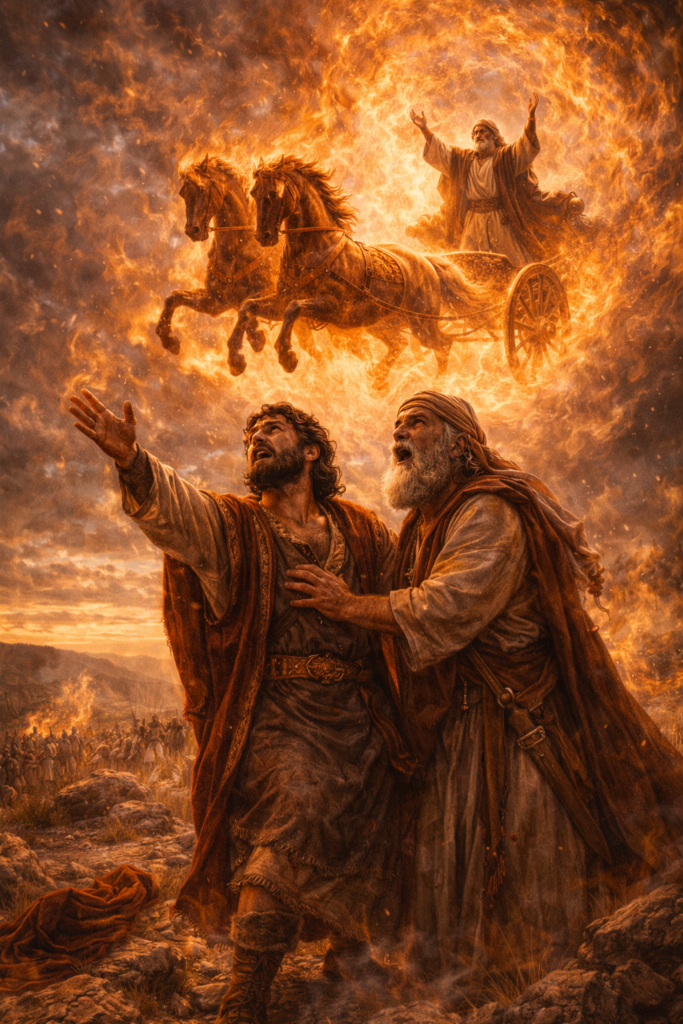
2 Kings 2 — When Transition Carries Forward What God Has Established
Summary of the Chapter
2 Kings 2 is a chapter of transition. A moment where one season ends and another begins.
Elijah is about to be taken. And Elisha walks closely with him.
From place to place, Elijah tells Elisha to stay behind. But Elisha refuses. “I will not leave you…”
This reveals something important: Commitment. Positioning. A desire to remain present until the end.
They arrive at the Jordan. Elijah strikes the water. It parts. They cross.
A familiar pattern — God making a way. Then Elijah asks: “What do you want?”
Elisha responds: “A double portion…”
Not of power alone — but of what God has established through Elijah.
The condition is clear: “If you see me…” This is about attentiveness. Awareness. Being present in the moment.
Then it happens. Elijah is taken. Not gradually — but suddenly. A transition that is undeniable.
Elisha sees. And the mantle falls. He picks it up. He returns to the Jordan. He strikes the water. And it parts again.
This is the confirmation: What was carried before is now carried forward.
The chapter continues with moments that reveal authority and responsibility.
Water is made pure. Order is restored. And also — a moment where dishonour is addressed.
2 Kings 2 is an invitation into transition and continuation — to recognise that what God establishes does not end with one season, but is carried forward through those who remain aligned and attentive.
Key Themes & Lessons
| Theme | Lesson for Heart Transformation |
|---|---|
| Staying Close | Positioning yourself matters in times of transition. |
| Commitment to the Journey | Not stepping away before the moment is complete. |
| Receiving What God Gives | Desire aligned with purpose opens the way. |
| Transition Between Seasons | What ends makes way for what continues. |
| Carrying Forward What Is Established | God’s work continues through aligned hearts. |
| Authority with Responsibility | What is received must be stewarded rightly. |
Encouragement
Sister, 2 Kings 2 speaks into a moment that can feel uncertain: Transition.
When something is ending… when something is shifting… when what was familiar is changing…
Elisha stayed. He did not step back. He did not disengage. He remained present.
This is your invitation: To stay close in moments of transition.
To not withdraw when things are changing. Because positioning matters.
And notice this: Elisha asked. He expressed desire.
This is your encouragement: You are invited to ask God for what aligns with His purpose in your life.
And then — the moment came. What was carried before did not disappear. It was passed on.
This reminds you: God’s work does not end with a season. It continues.
And you can be part of that continuation.
Let this chapter remind you: You are not left behind in transition. You are invited forward.
To remain present. To stay aligned. To receive what God is giving.
And as you do — you will step into what is next with clarity, with purpose, and with the ability to carry forward what God has already begun.
Reflection Questions
- How do I respond in seasons of transition — do I stay present or withdraw?
- What does it look like for me to remain close to God during times of change?
- Is there something I sense God is inviting me to ask for or step into?
- How can I carry forward what God has already been doing in my life?
- What responsibility comes with what I have been given, and how can I steward it well?
2 Kings 3 — When God Makes a Way Beyond What You Expect
Summary of the Chapter
2 Kings 3 brings together kings, conflict, and dependence on God.
Jehoram forms an alliance with Jehoshaphat and the king of Edom.
They set out to confront Moab. The plan is formed. The direction is chosen.
But soon, a problem arises: There is no water. What began with strategy now faces limitation.
The situation becomes urgent. Concern grows. At this point, Jehoshaphat asks: “Is there not a prophet…?”
This shifts the focus. From human planning to seeking God. They are led to Elisha.
At first, Elisha addresses the reality: Not all hearts present are aligned.
Yet because of Jehoshaphat, he chooses to respond.
Then comes the instruction: “Make this valley full of ditches…” This is unexpected.
There is no sign of rain. No visible source. And yet — they are told to prepare.
The promise follows: Water will come. Not seen in the usual way — but it will come.
They obey. And in the morning, the valley is filled. Provision arrives.
Not through visible cause — but through God’s intervention.
The situation shifts again. What appears as water to Israel appears as blood to their enemies.
Confusion spreads. The battle turns. Victory begins.
The chapter closes with a complex outcome. Victory is gained — but not without tension.
2 Kings 3 is an invitation into trust and preparation — to recognise that God’s provision may not look as expected, and that obedience prepares the way for what He will do.
Key Themes & Lessons
| Theme | Lesson for Heart Transformation |
|---|---|
| Turning to God | When human plans fall short, seek God. |
| Preparation Before Provision | Obedience prepares space for what God will bring. |
| God’s Unexpected Ways | Provision does not always come in familiar forms. |
| Influence of Alignment | One aligned heart can impact the whole situation. |
| Seeing Differently | What you perceive shapes how you respond. |
| Trust Beyond Evidence | Acting before seeing requires faith. |
Encouragement
Sister, 2 Kings 3 speaks into moments where plans do not unfold as expected.
Where what seemed clear suddenly feels uncertain.
There was a plan. There was movement. And then — there was lack. No water.
This is your invitation: To recognise that even when things feel dry… even when something is missing… God has not stepped away.
And notice this: The turning point came when they sought God.
This is your encouragement: You are never without direction when you turn to Him.
And then — the instruction. Dig ditches. Prepare. Even without visible evidence.
This reminds you: Obedience often comes before provision. You make space before you see the outcome.
Let this chapter remind you: God is not limited to expected ways. He provides. He leads. He makes a way.
And as you trust Him and respond to His instruction — you will find that what once seemed impossible begins to unfold in ways you could not have planned.
Reflection Questions
- How do I respond when my plans do not unfold as expected?
- Am I willing to seek God when I face uncertainty or lack?
- What does “preparing the ground” look like for me in this season?
- Can I trust God’s provision even when I cannot see how it will come?
- Where might God be inviting me to act in faith before I see the outcome?
2 Kings 4 — When God Multiplies What You Place in His Hands
Summary of the Chapter
2 Kings 4 is a collection of moments that reveal God’s provision, care, and power working through Elisha.
Each situation is different — but each reveals the same truth: God meets people where they are.
The chapter begins with a widow in need. She is in debt. At risk of losing everything.
Elisha asks: “What do you have?” Not what you lack — what you have.
She responds: “Nothing… except a small jar of oil.”
He instructs her to gather empty jars. To pour. She obeys. And the oil flows.
Not limited to the jar she started with — but multiplied according to the space she prepared.
The moment the jars run out — the oil stops. Provision meets preparation.
Next, a woman shows kindness to Elisha. She creates space for him.
Out of that place of honour, a promise is spoken: She will have a son. And it comes to pass.
But later, the child becomes ill and dies. She does not settle in despair. She seeks Elisha.
She brings the situation back to the place of promise. Elisha comes. He prays. And life is restored.
Then, a group of prophets face lack. Food is scarce. A meal is prepared — but it is harmful.
Elisha intervenes. What was dangerous becomes safe. Provision is restored.
Finally, a man brings a small amount of food. Not enough for many.
But Elisha instructs: “Give it to the people…” And it multiplies. There is more than enough.
2 Kings 4 is an invitation into trust and surrender — to recognise that what you place in God’s hands is not limited by its size, and that His provision meets your willingness to respond.
Key Themes & Lessons
| Theme | Lesson for Heart Transformation |
|---|---|
| Starting with What You Have | God works with what you bring, not what you lack. |
| Preparation for Provision | Making space allows God’s provision to flow. |
| Faith in Crisis | Turning to God in difficulty brings breakthrough. |
| Honour and Relationship | What you value opens the way for what follows. |
| Restoration | What feels lost is not beyond God’s reach. |
| Multiplication | What is given to God is not limited by natural measure. |
Encouragement
Sister, 2 Kings 4 speaks into everyday moments: Need. Loss. Lack. Expectation.
And in each one, God meets the person where they are.
The widow thought she had nothing. And yet — what she had became more than enough.
This is your invitation: To not dismiss what is in your hands. Because God can work with it.
And notice this: The oil flowed as long as there was space.
This is your encouragement: Make room. In your heart. In your life. In your expectation.
Because provision often meets preparation.
And then — the moment of loss. The promise seemed gone. But it was not final.
This reminds you: What feels lost can be restored.
Let this chapter remind you: You are not limited by what you see. God multiplies. God restores. God provides.
And as you bring what you have and trust Him with it — you will find that what seems small becomes more than enough in His hands.
Reflection Questions
- What do I currently have that I may be overlooking as insignificant?
- Am I making space in my life for what God wants to do?
- How do I respond when I face loss or disappointment — do I turn toward God or away?
- Where might God be inviting me to trust Him with what I have?
- How can I shift my perspective from lack to expectation of God’s provision?
2 Kings 5 — When Humility Opens the Way for Healing
Summary of the Chapter
2 Kings 5 centres on the journey of Naaman. He is powerful. Respected. Successful.
But he carries a hidden issue: Leprosy. A condition that no position or achievement can remove.
A young servant girl speaks. She points to Elisha. A simple direction. Naaman listens.
He goes. But when he arrives, something unexpected happens. Elisha does not meet him personally.
Instead, he sends a message: Wash in the Jordan River seven times. Be restored.
Naaman reacts. The instruction feels too simple. Too ordinary. He expected something greater.
More dramatic. More fitting for his status. He turns away.
But his servants speak to him: “If it had been something difficult…” This shifts his perspective.
Naaman humbles himself. He follows the instruction. He goes to the Jordan. He washes.
And on the seventh time — he is restored. Completely.
His response changes. He recognises God. He returns with gratitude.
But the chapter does not end there. Gehazi chooses a different path.
He pursues personal gain. He takes what was not given.
What was offered freely he attempts to turn into advantage.
The result is immediate. What Naaman was healed from now comes upon him.
2 Kings 5 is an invitation into humility and integrity — to recognise that God’s work is not shaped by status or expectation, and that how you respond determines what unfolds.
Key Themes & Lessons
| Theme | Lesson for Heart Transformation |
|---|---|
| Hidden Need | Outward success does not remove inner need. |
| Simple Obedience | God’s instruction may be simple, but it requires trust. |
| Humility | Letting go of expectation opens the way for change. |
| Listening to Guidance | Wisdom can come from unexpected voices. |
| Gratitude and Recognition | Experiencing God leads to a changed response. |
| Integrity | What is handled wrongly affects the outcome. |
Encouragement
Sister, 2 Kings 5 speaks into something very real: Expectation.
Naaman expected something specific. A certain experience. A certain process.
And when it did not match — he almost walked away.
This is your invitation: To not limit God to what you expect.
Because sometimes, the way forward is simpler than you imagine.
And notice this: It was humility that changed everything.
When Naaman let go of his expectation… when he chose to follow… he experienced restoration.
This is your encouragement: You do not need to strive to receive what God is offering.
You are invited to respond. Simply. Willingly. Openly.
And then — the contrast. Gehazi saw opportunity where there should have been honour.
This reminds you: How you handle what God does matters.
Let this chapter remind you: You are not defined by your position or your expectation.
You are invited into alignment. To respond with humility. To walk with integrity.
And as you do — you will find that what God brings is not only received… but sustained in your life.
Reflection Questions
- Are there areas in my life where I have expectations that may be limiting how I receive from God?
- How do I respond when God’s instruction feels too simple or unexpected?
- What does humility look like for me in this current season?
- Am I listening to guidance, even when it comes from unexpected sources?
- How can I walk in greater integrity with what has been entrusted to me?
2 Kings 6 — When God Opens Your Eyes to What Is Already There
Summary of the Chapter
2 Kings 6 unfolds through several moments, each revealing God’s awareness, provision, and protection.
It begins simply. A group of prophets are building. As they work, an axe head falls into the water.
A small moment. A practical problem. But it matters.
They turn to Elisha. He responds. The iron floats. What was lost is restored.
Even the smallest need is not overlooked.
The focus then shifts. The king of Aram plans attacks. Strategic. Intentional.
But each time, the plans fail. Because God reveals them to Elisha. And Elisha speaks them to king of Israel.
The enemy becomes frustrated. They seek Elisha. To capture him.
They surround the city. A large army. Horses. Chariots.
Elisha’s servant sees it and is afraid. But Elisha responds: “Those who are with us are more…”
He prays. The servant’s eyes are opened. He sees what was already there: A greater army. Surrounding them.
God’s presence. God’s protection. The situation has not changed — but the perspective has.
Then Elisha prays again. The enemy is struck with blindness. They are led away.
And instead of destruction, they are shown mercy. Fed. Released. Conflict is diffused.
The chapter closes with a different scene. A siege. Scarcity. Desperation.
The situation becomes extreme. And the weight of it falls on the king.
2 Kings 6 is an invitation into awareness and trust — to recognise that God is present in both the small and the overwhelming, and that what you see is not the full reality.
Key Themes & Lessons
| Theme | Lesson for Heart Transformation |
|---|---|
| God Cares About Details | No situation is too small for God’s involvement. |
| God’s Awareness | Nothing is hidden from Him. |
| Seeing Beyond the Natural | Perspective changes when you see what God is doing. |
| God’s Protection | You are not alone, even when it feels overwhelming. |
| Responding with Mercy | Strength does not always respond with force. |
| Trust in Difficult Moments | God remains present even in times of pressure. |
Encouragement
Sister, 2 Kings 6 speaks into both ends of life: The small moments… and the overwhelming ones.
An axe head lost. An army surrounding. Both are met with God’s presence.
This is your invitation: To not separate what feels important from what feels insignificant.
Because God is present in both.
And notice this: The servant was afraid because of what he could see.
But when his eyes were opened — everything changed.
This is your encouragement: There is more happening than what you see.
God’s presence is not absent just because it is not visible.
And then — the response to the enemy. Mercy instead of destruction.
This reminds you: Strength does not always act in the way you expect.
Let this chapter remind you:
You are not surrounded by what opposes you. You are surrounded by what supports you.
You are not alone. You are not without help.
And as you ask God to open your eyes — you will begin to see that His presence has been there all along.
Reflection Questions
- Are there areas in my life where I feel overwhelmed by what I can see?
- How can I begin to trust that there is more happening than what is visible?
- Do I bring both small and large concerns to God, or only the major ones?
- What would it look like for me to respond with wisdom and mercy in difficult situations?
- How can I ask God to help me see my circumstances from His perspective?
2 Kings 7 — When God Changes Everything in a Moment
Summary of the Chapter
2 Kings 7 continues from a place of extreme lack.
The city is under siege. Resources are gone. Hope feels distant.
Into this situation, Elisha speaks: “Tomorrow…” Provision is coming. Abundance will replace scarcity.
The word is clear. But not everyone believes.
An officer of the king questions it: “Even if… could this happen?” Doubt rises.
Yet the word remains unchanged.
Outside the city, four lepers sit at the edge.
They face a decision: Stay — and die. Go forward — and possibly live. They move. Step by step.
As they approach the enemy camp, something unexpected has already happened.
God has caused the enemy to hear a great army. They flee. The camp is empty. Provision is left behind.
The lepers enter. They find food. Resources. Everything needed.
At first, they keep it to themselves. Then they realise: “This is not right…” They return to the city. They share the news.
At first, the king questions it. Is it a trap? But the situation is confirmed. The people go out. They take what has been left.
The word spoken by Elisha comes to pass exactly. Abundance replaces lack.
But one detail remains: The officer who doubted sees it — but does not experience it.
2 Kings 7 is an invitation into faith and response — to recognise that God can change circumstances suddenly, and that how you respond to His word shapes your experience.
Key Themes & Lessons
| Theme | Lesson for Heart Transformation |
|---|---|
| God’s Word Stands | What God speaks is not limited by circumstances. |
| Faith vs Doubt | Response to truth shapes experience. |
| Taking Action | Movement often positions you for breakthrough. |
| Unexpected Provision | God’s ways go beyond natural expectation. |
| Sharing What You Receive | What is found is meant to be shared. |
| Seeing vs Experiencing | Belief determines participation. |
Encouragement
Sister, 2 Kings 7 speaks into moments that feel impossible.
Where lack feels overwhelming. Where change seems unlikely.
And into that space, God speaks: “Tomorrow…”
This is your invitation: To not measure what is possible by what you see.
Because God is not limited to your current situation.
And notice this: The lepers moved. They did not have certainty — but they took a step.
This is your encouragement: You do not need full clarity to move forward.
Sometimes, movement itself positions you for what God has already done.
And then — the sudden shift. What was empty became abundant.
This reminds you: God can change everything in a moment.
Let this chapter remind you: You are not confined to your current circumstance.
You are invited to trust. To respond. To move forward.
And as you do — you will find that what once seemed impossible can become reality through God’s provision and timing.
Reflection Questions
- Are there areas in my life where I feel stuck in lack or limitation?
- How do I respond when God’s promise feels beyond what I can imagine?
- What step can I take, even without full certainty, to move forward?
- Have I experienced God’s provision in unexpected ways before?
- How can I share what I have received with others rather than keeping it to myself?
2 Kings 8 — When God Works Across Time, Position, and Response
Summary of the Chapter
2 Kings 8 reveals how God’s work unfolds beyond a single moment — across time, people, and situations.
It begins with a woman we have seen before — the Shunammite woman connected to Elisha.
Elisha instructs her to leave her land because of a coming famine. She responds. She leaves. Years pass.
When she returns, her land has been taken. She goes to the king to appeal.
At that exact moment, the king is hearing her story from Gehazi. The timing aligns.
Her situation is restored. Everything is returned. What seemed lost over time is brought back.
The chapter then shifts to a different moment. Elisha goes to Damascus.
There, he encounters Hazael, who is serving the current king.
Hazael asks about the future. Elisha reveals what will come.
But also sees something deeper — what Hazael will do. What he will become.
Hazael does not fully recognise it in that moment. Yet the outcome unfolds.
He takes the throne. What was spoken comes to pass.
The chapter then returns to the kings of Judah and Israel. Reigns begin. Leadership shifts.
And a pattern becomes clear: Some walk in alignment. Others do not.
The influence of those around them shapes their direction.
2 Kings 8 is an invitation into awareness — to recognise that God’s work unfolds over time, that positioning and response matter, and that what is spoken will come to pass.
Key Themes & Lessons
| Theme | Lesson for Heart Transformation |
|---|---|
| Obedience Over Time | Responding to God leads to long-term preservation. |
| Divine Timing | God aligns moments in ways you cannot control. |
| Restoration | What is lost can be returned in full. |
| Influence and Direction | Who you align with shapes your path. |
| God’s Knowledge of the Future | God sees beyond what is visible. |
| Response Matters | What you do with what is revealed determines outcome. |
Encouragement
Sister, 2 Kings 8 speaks into something that unfolds quietly: Time. Not everything happens immediately.
Some things unfold over years. The woman left. She returned. And what was hers was restored.
This is your invitation: To trust God even when time passes. Even when things feel uncertain.
Because what He has spoken is not lost in time.
And notice this: The moment of restoration aligned perfectly.
This is your encouragement: God’s timing is precise. What seems delayed is not forgotten.
And then — the contrast. Hazael heard something but did not fully understand.
This reminds you: Awareness matters. Response matters.
Let this chapter remind you: You are part of a journey that unfolds over time.
God is working beyond what you can see in the moment.
And as you remain aligned and responsive — you will find that what is meant to unfold will do so in the right time and in the right way.
Reflection Questions
- How do I respond when things take longer than I expect?
- Have I seen God restore something in my life over time?
- Do I trust God’s timing, even when I do not understand it?
- Who or what is influencing my direction in this season?
- How can I remain responsive to what God is revealing to me?
2 Kings 9 — When God Brings About What He Has Spoken
Summary of the Chapter
2 Kings 9 is a chapter of swift fulfilment. What had been spoken earlier now begins to unfold in action.
Elisha sends a messenger to anoint Jehu.
The instruction is clear: He is to become king. And he is to bring an end to the house of Ahab.
The anointing is done privately. But the response is immediate. Jehu does not delay.
He acts. He rises. He moves forward.
Those around him recognise what has happened and support him. Momentum builds quickly.
Jehu travels to Jezreel. There, the current king, Joram, goes out to meet him. He asks: “Is it peace?”
Jehu’s answer reveals the truth: There cannot be peace while misalignment remains.
The encounter ends decisively. The word spoken is being fulfilled.
Then, Ahaziah is also caught in the unfolding events. He too falls within the same moment.
The shift of leadership is complete.
The chapter then turns to Jezebel. She prepares herself. She stands at the window.
But the outcome has already been spoken. Jehu arrives. The command is given.
And what was declared long before now comes to pass. Nothing remains unfulfilled.
2 Kings 9 is an invitation into recognition — to see that what God has spoken will come to pass, and that there are moments when fulfilment unfolds quickly and decisively.
Key Themes & Lessons
| Theme | Lesson for Heart Transformation |
|---|---|
| Fulfilment of God’s Word | What God speaks is brought to completion. |
| Responding Without Delay | Alignment leads to decisive action. |
| The End of Misalignment | What is not aligned cannot remain indefinitely. |
| Momentum in Obedience | Action creates movement and clarity. |
| God’s Timing | What has been spoken unfolds at the appointed time. |
| Recognising the Moment | Awareness of timing shapes response. |
Encouragement
Sister, 2 Kings 9 speaks into a powerful truth: There are moments when everything shifts.
What had been spoken over time… what had been building… what had been waiting… suddenly unfolds.
This is your invitation: To recognise that God’s word is not passive. It is active.
And when the time comes — it moves forward. And notice this: Jehu did not hesitate. He responded.
This is your encouragement: When clarity comes, there are moments to act.
To step forward. To move with what has been revealed.
And also — to understand this: What is not aligned cannot remain forever.
This is not about fear — it is about truth.
Let this chapter remind you: You are part of a journey where God’s word is unfolding.
Some moments are gradual. Others are decisive.
And as you stay aligned — you will recognise the moment and respond with clarity, with confidence, and with purpose.
Reflection Questions
- Are there areas in my life where I sense God is bringing something to completion?
- How do I respond when I recognise a moment that requires action?
- Am I willing to move forward without delay when God makes something clear?
- Are there areas of misalignment that I need to address before moving forward?
- How can I stay aware of God’s timing and what He is doing in this season?
2 Kings 10 — When Zeal Needs to Be Matched with Full Alignment
Summary of the Chapter
2 Kings 10 continues the actions of Jehu. He carries forward what was set in motion.
The house of Ahab is brought to an end. What had been spoken is being completed.
Jehu moves decisively. Letters are sent. Leaders respond. The outcome unfolds quickly.
Resistance does not stand.
The chapter then shows Jehu continuing his mission. He encounters Jehonadab.
Jehu invites him to see his zeal. Together, they move forward. Jehu gathers those devoted to Baal.
He calls for a great assembly. It appears as worship — but it is a strategy.
Once all are gathered, the place is cleared of those aligned with God.
Then the temple of Baal is destroyed. Idolatry is removed.
What had drawn the people away is brought to an end.
But then, a shift becomes visible. Despite all that Jehu has done, he does not fully turn.
He removes one form of misalignment — but allows another to remain.
The golden calves are not removed. Partial alignment. The result is clear:
God acknowledges what Jehu has done. But also reveals what remains incomplete.
The chapter closes with a gradual decline in the nation. Not immediate — but unfolding over time.
2 Kings 10 is an invitation into complete alignment — to recognise that zeal and action are not enough on their own, and that full alignment requires consistency in every area.
Key Themes & Lessons
| Theme | Lesson for Heart Transformation |
|---|---|
| Completing What Was Spoken | God’s word is fulfilled through action. |
| Zeal for What Is Right | Passion can drive powerful change. |
| Removing Misalignment | What draws you away must be addressed. |
| Partial Obedience | Incomplete alignment affects long-term outcome. |
| Consistency Matters | Alignment must remain across all areas. |
| Long-Term Impact | What is left unaddressed unfolds over time. |
Encouragement
Sister, 2 Kings 10 speaks into something important:
The difference between starting strong and remaining aligned.
Jehu acted. He moved with clarity. He removed what needed to go.
This is your invitation: To not hold back when something needs to be addressed.
To act. To respond. To step forward.
But notice this: It was not fully complete. Some things were removed — others were left.
This is your encouragement: Alignment is not selective.
It is not about choosing some areas and leaving others.
Because what remains still shapes the outcome. And over time, it becomes visible.
Let this chapter remind you: You are not only called to act with zeal. You are invited to walk in full alignment.
To remain consistent. To address what needs to be addressed. To continue beyond the initial action.
And as you do — you will find that what is established is not only strong at the beginning… but sustained over time with clarity, with integrity, and with purpose.
Reflection Questions
- Are there areas in my life where I have acted strongly, but not fully followed through?
- Do I tend to address some areas of misalignment while leaving others untouched?
- What does full consistency look like for me in this season?
- How can I move beyond initial zeal into sustained alignment?
- Is there something I need to address now to prevent future impact?
2 Kings 11 — When What God Has Established Is Preserved
Summary of the Chapter
2 Kings 11 unfolds during a moment of crisis and hidden preservation.
After the death of the king, Athaliah rises to power. She acts decisively.
She attempts to remove the royal line. To secure her position.
To ensure no one remains who could take the throne.
From the outside, it appears complete. The line seems ended. But something happens quietly.
A child — Joash — is hidden. Protected. Kept safe in secret. For years, he remains unseen.
While Athaliah reigns publicly, God’s purpose is preserved privately.
Then, at the right time, action begins. Jehoiada gathers leaders. He reveals what has been hidden.
He establishes a plan. Positioning. Timing. Protection.
Everything is set in place. The child is brought forward. He is crowned. The rightful line is restored.
Athaliah hears the noise. She comes out. She sees what has happened. “Treason…”
But the moment has already shifted. What she thought was secure is no longer.
She is removed. And order is restored.
The chapter closes with covenant. The people return to alignment.
Idolatry is removed. The temple is restored. The city becomes settled again.
2 Kings 11 is an invitation into trust — to recognise that what God has established can be preserved even when it is not visible, and that His purposes are not undone by what appears to happen externally.
Key Themes & Lessons
| Theme | Lesson for Heart Transformation |
|---|---|
| Hidden Preservation | What God establishes can be protected, even in secret. |
| God’s Timing | What is hidden is revealed at the right moment. |
| Restoration of Order | Alignment brings stability and clarity. |
| The Limits of Control | Human effort cannot override God’s purpose. |
| Faithfulness in the Background | Quiet obedience plays a vital role. |
| Renewal of Covenant | Returning to alignment restores direction. |
Encouragement
Sister, 2 Kings 11 speaks into something that can feel uncertain: When it looks like something has been lost.
When what was meant to continue seems to have disappeared.
From the outside, everything looked complete. The line appeared gone.
And yet — God had preserved what mattered.
This is your invitation: To trust what you cannot see. Because God is able to protect what He has established.
Even in hidden places.
And notice this: The timing mattered. What was hidden was revealed at the right moment.
This is your encouragement: You do not need to force what God is doing.
He brings it forward in the right time.
Let this chapter remind you: You are not defined by what appears on the surface.
God’s purpose is not fragile. It is secure.
And as you remain aligned — you will find that what has been preserved will be revealed, restored, and established with clarity and strength.
Reflection Questions
- Are there areas in my life where I feel something has been lost or undone?
- How can I trust God’s ability to preserve what He has established, even when I cannot see it?
- Am I willing to wait for God’s timing rather than trying to force outcomes?
- What does faithfulness look like in the quieter, unseen areas of my life?
- How can I remain aligned and ready for when God brings something forward?
2 Kings 12 — When What Is Established Needs Ongoing Stewardship
Summary of the Chapter
2 Kings 12 focuses on the reign of Joash. He begins well.
Under the guidance of Jehoiada, he walks in alignment. Direction is clear. Leadership is steady.
And there is a focus on restoration.
The temple — a place of worship and significance — has fallen into disrepair. Joash sets out to restore it.
Resources are gathered. Contributions are given. The intention is strong.
But over time, something becomes evident: The process is not effective. The work is delayed.
What was intended is not being carried out as expected.
Joash recognises this. He brings correction. He restructures the process. Accountability is established.
And the work begins to move forward again. The temple is repaired. Order is restored. The purpose is fulfilled.
Yet, alongside this, another reality remains: Not everything is fully aligned. Certain practices continue.
And as time progresses, external pressure arises.
Joash responds by giving from the temple to protect the kingdom.
The chapter closes with a sobering moment: Joash’s reign ends not in strength — but through internal conflict.
2 Kings 12 is an invitation into stewardship and consistency — to recognise that beginning well is important, but maintaining alignment and accountability over time is essential.
Key Themes & Lessons
| Theme | Lesson for Heart Transformation |
|---|---|
| Starting Well | Alignment at the beginning sets direction. |
| The Need for Stewardship | What is established must be maintained. |
| Recognising What Is Not Working | Awareness allows for correction. |
| Accountability | Structure supports progress. |
| Partial Alignment | What is left unaddressed affects the outcome. |
| Finishing Well | Consistency matters throughout the journey. |
Encouragement
Sister, 2 Kings 12 speaks into something practical: Sustaining what has begun.
Joash started well. There was direction. There was purpose. And yet — over time, something slowed.
This is your invitation: To not only begin with intention — but to continue with awareness.
Because what is established requires stewardship.
And notice this: When something was not working, it was addressed.
This is your encouragement: You are allowed to adjust. To recognise what needs change.
To bring structure where needed. Because progress is not just about effort — it is about alignment.
And also — to remain aware of what continues beneath the surface.
Let this chapter remind you: You are not only called to start well. You are invited to remain aligned.
To steward. To maintain. To stay consistent.
And as you do — you will find that what is built remains strong, endures over time, and reflects a life lived with intention and care.
Reflection Questions
- Am I giving attention to maintaining what I have started, or only focusing on the beginning?
- Are there areas in my life where something is not working and needs adjustment?
- How can I bring greater accountability or structure into what I am doing?
- Are there areas of partial alignment that I need to address?
- What would it look like for me to remain consistent and finish this season well?
2 Kings 13 — When God’s Mercy Remains, Even in Ongoing Weakness
Summary of the Chapter
2 Kings 13 unfolds during a time of continued decline. The king of Israel, Jehoahaz, does not walk in alignment.
The pattern continues. As a result, pressure increases. Opposition rises. Strength diminishes.
The nation becomes weakened.
Yet in the middle of this, something significant happens: Jehoahaz seeks the Lord.
Not perfectly. Not consistently. But in that moment, he turns. And God responds. Relief is given.
Not because everything is aligned — but because God is merciful.
This reveals something important: God’s response is not limited to perfect circumstances.
The chapter then moves to the reign of Jehoash. The pattern continues.
Partial alignment. Ongoing compromise. And yet — God continues to act.
Then comes a final moment with Elisha. He is nearing the end of his life.
The king comes to him. There is emotion. There is recognition.
Elisha gives him an instruction: Take a bow and arrows. Strike the ground.
The king strikes three times. Then stops.
Elisha responds: This was not about the action alone — but the depth of response.
What could have been complete victory becomes partial.
Even after Elisha’s death, one final moment occurs: A man is brought to his tomb.
When the body touches Elisha’s bones, life returns.
This reveals something profound: What God has done does not end with a moment. It continues.
2 Kings 13 is an invitation into awareness and response — to recognise that God’s mercy remains available, but that the depth of your response shapes the outcome of what unfolds.
Key Themes & Lessons
| Theme | Lesson for Heart Transformation |
|---|---|
| God’s Mercy | God responds even in imperfect situations. |
| Turning to God | Seeking Him opens the way for change. |
| Partial Alignment | Incomplete response affects long-term outcome. |
| Depth of Response | How fully you engage shapes what follows. |
| Ongoing Influence | What God establishes continues beyond a moment. |
| Opportunity and Outcome | What is available may not always be fully received. |
Encouragement
Sister, 2 Kings 13 speaks into something both honest and hopeful:
You do not need to be perfect to turn to God.
Jehoahaz sought God in the middle of misalignment. And God responded.
This is your invitation: To not hold back because things are not perfect. To turn. To seek. To respond.
Because God’s mercy is still available.
And notice this: The king was given an opportunity. But his response was limited.
This is your encouragement: You are invited to respond fully. Not halfway. Not partially. But with intention.
Because what you receive is often connected to how you respond.
And then —even after Elisha’s life ended… God’s work continued.
This reminds you: What God establishes is not limited to a moment.
Let this chapter remind you: You are not without opportunity. You are not without mercy.
And as you choose to respond with depth, with intention, and with alignment — you will find that what unfolds is greater, fuller, and more complete than what partial response allows.
Reflection Questions
- Do I hesitate to turn to God when things are not fully aligned in my life?
- How can I respond more fully to what God is asking of me?
- Are there areas where I have responded partially rather than completely?
- What opportunities might God be placing before me that require deeper engagement?
- How can I trust that God’s work continues beyond what I can see in the moment?
2 Kings 14 — When Success Tests the Heart as Much as Struggle
Summary of the Chapter
2 Kings 14 follows the reigns of two kings and reveals how success and strength can shape — and test — the heart.
The chapter begins with Amaziah. He begins with a level of alignment. He does what is right — but not fully.
There is a pattern of partial obedience. He establishes justice. He strengthens his position.
And he experiences victory. But after success, something shifts. Confidence increases.
He challenges Jehoash. Not from necessity — but from pride. Jehoash responds with a warning.
A simple illustration: Do not overstep. But Amaziah does not listen. He moves forward.
The outcome is clear: He is defeated. What was built begins to weaken.
Jerusalem is breached. Treasures are taken. The strength that had been gained is diminished.
The chapter then shifts to Israel. Jehoash dies, and Jeroboam II reigns.
He experiences expansion. Restoration of boundaries. Strength in the nation.
Yet the pattern remains: Success does not equal alignment. The deeper condition of the heart is still present.
2 Kings 14 is an invitation into awareness — to recognise that success can test the heart just as much as difficulty, and that maintaining alignment requires humility, not just strength.
Key Themes & Lessons
| Theme | Lesson for Heart Transformation |
|---|---|
| Partial Alignment | Doing some things right does not equal full alignment. |
| The Test of Success | Victory can reveal pride if not held with humility. |
| Listening to Wisdom | Ignoring warning leads to unnecessary consequence. |
| Overstepping Boundaries | Confidence without discernment leads to loss. |
| Strength vs Alignment | External success does not replace internal alignment. |
| The Condition of the Heart | What is within shapes long-term outcome. |
Encouragement
Sister, 2 Kings 14 speaks into a subtle but important reality: Success can be just as testing as struggle.
Amaziah began well. There was direction. There was strength. But after victory — his perspective shifted.
This is your invitation: To remain grounded even when things are going well.
To not allow success to lead you away from alignment.
And notice this: A warning was given. Clear. Simple. But it was not received.
This is your encouragement: You are invited to listen. To remain open. To stay teachable.
Because wisdom protects you from unnecessary loss.
And then — the broader picture. Success came to Israel as well. But alignment was still lacking.
This reminds you: What is visible is not always the full story.
Let this chapter remind you: You are not only called to grow. You are called to remain aligned as you grow.
To stay humble. To listen. To not overstep.
And as you do — you will find that what is built remains strong, stable, and rooted in truth over time.
Reflection Questions
- How do I respond when things are going well — do I remain grounded or become overconfident?
- Am I open to receiving guidance and correction, even when I feel strong?
- Are there areas where I may be stepping beyond what God has asked of me?
- What does humility look like for me in seasons of success?
- How can I ensure that my heart remains aligned, not just my outward actions?
2 Kings 15 — When Patterns Continue and Stability Depends on Alignment
Summary of the Chapter
2 Kings 15 moves through a succession of kings — revealing patterns that repeat over time.
The chapter begins with Azariah (Uzziah). He does what is right in many ways.
There is strength. There is stability. But not everything is fully aligned. Certain practices remain.
And over time, there is consequence. He becomes isolated. His rule continues — but not without limitation.
The chapter then shifts to Israel. Several kings rise in quick succession:
Zechariah, Shallum, Menahem, Pekahiah, and Pekah.
The pattern becomes clear: Leadership changes rapidly. Instability increases. Violence becomes common.
Each reign reflects a similar issue: Lack of alignment.
The result is not immediate collapse — but ongoing instability.
There are moments of strength. Moments of expansion. But beneath it, the same pattern remains.
External strength without internal alignment. The chapter closes with rising external pressure.
The Assyrians begin to take territory. What was once secure begins to shift.
2 Kings 15 is an invitation into awareness — to recognise that patterns left unchanged will continue, and that true stability comes from consistent alignment, not temporary strength.
Key Themes & Lessons
| Theme | Lesson for Heart Transformation |
|---|---|
| Repeating Patterns | What is not addressed continues over time. |
| Partial Alignment | Doing some things right does not remove deeper issues. |
| Instability Without Alignment | Lack of alignment leads to inconsistency. |
| External Strength vs Internal Reality | Outward success can mask inward weakness. |
| The Impact of Leadership | Direction shapes the environment over time. |
| Gradual Decline | Misalignment often unfolds slowly, not suddenly. |
Encouragement
Sister, 2 Kings 15 speaks into something that can be easy to overlook: Patterns.
Not just moments — but what continues over time. Some of the kings did well in part.
There was strength. There was progress. But the deeper alignment was not complete.
This is your invitation: To not only look at individual moments — but at what is consistent.
What repeats. What continues. Because patterns shape direction.
And notice this: Instability did not happen all at once. It unfolded. Gradually.
This is your encouragement: You have the opportunity to recognise patterns early.
To address what needs attention before it grows.
And also to remember: True stability does not come from temporary strength. It comes from consistent alignment.
Let this chapter remind you: You are not called to manage patterns. You are invited to transform them.
To bring awareness. To make changes. To walk in consistency.
And as you do — you will find that what once felt unstable becomes steady, grounded, and aligned over time.
Reflection Questions
- Are there patterns in my life that I have not fully addressed?
- How can I move beyond partial alignment into consistency?
- What areas of my life appear strong externally but may need deeper alignment?
- How do my daily choices shape long-term direction?
- What step can I take today to begin transforming a pattern rather than repeating it?
2 Kings 16 — When Compromise Reshapes What Was Meant to Be Set Apart
Summary of the Chapter
2 Kings 16 centres on the reign of Ahaz. From the beginning, a clear shift is visible. He does not walk in alignment.
Instead, he follows the patterns around him. What had been set apart begins to be reshaped.
Pressure arises. Opposition comes against Judah. And in response, Ahaz makes a decision.
Instead of turning to God, he seeks help from Assyria. He sends tribute. He forms an alliance.
Relief comes — but at a cost. Dependence shifts.
Then, something deeper happens. Ahaz sees an altar in Damascus. He is drawn to it.
He sends instructions to replicate it. The altar in the temple is altered. Replaced in position.
What was central is moved aside. What was never intended takes prominence.
This is not just adjustment — it is replacement.
The chapter continues with further changes. The structure of the temple is modified.
Elements are removed. Others are added. All shaped by external influence.
What was established by God is no longer being preserved.
2 Kings 16 is an invitation into awareness — to recognise how compromise and external influence can reshape what was meant to remain set apart, and that alignment requires guarding what God has established.
Key Themes & Lessons
| Theme | Lesson for Heart Transformation |
|---|---|
| Influence from Outside | What you allow to shape you determines your direction. |
| Compromise | Small shifts can lead to larger changes. |
| Misplaced Dependence | Turning elsewhere changes foundation. |
| Replacing What Is Central | What should remain primary can be moved aside. |
| The Cost of Alignment | Remaining true may feel harder, but protects what matters. |
| Guarding What Is Given | What is established must be protected intentionally. |
Encouragement
Sister, 2 Kings 16 speaks into something subtle but powerful: Influence.
Ahaz did not begin with complete rejection. He shifted. Gradually. Step by step.
This is your invitation: To be aware of what is shaping you.
Because what you allow in begins to influence what you build.
And notice this: The altar was not removed completely. It was moved. Replaced in priority.
This is your encouragement: Alignment is not only about what is present. It is about what is central.
What holds first place. And when that shifts — everything else follows.
Let this chapter remind you: You are not called to adapt to every influence around you. You are invited to remain set apart.
To protect what God has established. To keep what matters in its rightful place.
And as you do — you will find that your life remains anchored, clear, and aligned with what is true.
Reflection Questions
- What influences in my life may be shaping my thinking or decisions?
- Are there areas where I have allowed compromise to enter gradually?
- What is currently at the centre of my life — and has that shifted?
- How do I respond under pressure — do I turn to God or look elsewhere?
- What can I do to intentionally guard and protect what God has established in my life?
2 Kings 17 — When Persistent Misalignment Leads to Separation
Summary of the Chapter
2 Kings 17 marks a major turning point. The northern kingdom of Israel comes to an end.
Under Hoshea, there is continued misalignment. He does some things differently — but not fully.
The deeper pattern remains. External pressure increases. Assyria rises.
At first, Israel submits. But then Hoshea seeks help elsewhere. He turns to Egypt. Trust shifts again.
The response is swift. Assyria comes against them. The land is taken. The people are exiled. The kingdom is removed.
The chapter then pauses. It explains why. This is not random. It is the result of repeated patterns.
The people had turned away. They followed other ways. They ignored what had been spoken.
Time and time again, they were warned. But they did not respond.
What had been gradual now becomes final.
Then, a new group of people is brought into the land. They do not know God.
They continue in mixed practices. Some acknowledgement. Some compromise. But not full alignment.
The result is confusion. Not fully one way. Not fully another.
2 Kings 17 is an invitation into awareness and responsibility — to recognise that persistent misalignment has consequence, and that what is repeated over time shapes the outcome.
Key Themes & Lessons
| Theme | Lesson for Heart Transformation |
|---|---|
| Persistent Patterns | What continues unchecked shapes the future. |
| The Consequence of Misalignment | Repeated turning away leads to separation. |
| Ignoring Warning | Truth not received cannot bring change. |
| Mixed Alignment | Partial commitment leads to confusion. |
| Responsibility Over Time | Choices accumulate and influence direction. |
| The Importance of Response | Hearing truth must lead to action. |
Encouragement
Sister, 2 Kings 17 speaks into something serious — but also deeply clarifying: Patterns matter.
Not just individual moments… but what continues. Israel did not fall in one moment.
It unfolded over time. Small decisions. Repeated choices. Until the direction was clear.
This is your invitation: To not ignore patterns. To not dismiss what is repeated.
Because what continues shapes where you go.
And notice this: There were warnings. Opportunities to respond. But they were not acted on.
This is your encouragement: You are not without opportunity. You can respond. You can adjust.
You can change direction. And also — to recognise this: Partial alignment does not bring clarity.
It creates confusion. Let this chapter remind you:
You are not called to live in mixture. You are invited into alignment. Clear. Intentional. Consistent.
And as you choose that — you will find that your path is not shaped by drift… but by direction, by clarity, and by a heart that responds to truth.
Reflection Questions
- Are there patterns in my life that I have been ignoring or not fully addressing?
- How do I respond when I recognise something needs to change — do I act or delay?
- Am I living in full alignment, or is there a mixture in certain areas?
- What warnings or nudges have I sensed that I may not have responded to yet?
- What step can I take today to bring greater clarity and alignment into my life?
2 Kings 18 — When Wholehearted Trust Sets a New Direction
Summary of the Chapter
2 Kings 18 introduces a new king in Judah: Hezekiah. From the beginning, something shifts.
He does not follow the patterns before him. He removes what had been left in place.
High places are taken down. Idols are removed. Even long-standing objects of misplaced focus are broken.
This is not partial alignment — it is decisive. The result is clear: God is with him. What he does prospers.
Yet, the chapter does not remain in ease. Pressure comes.
The Assyrian king, Sennacherib, rises against Judah. Cities are taken. Threat increases.
At first, Hezekiah responds with compromise. He sends tribute.
Attempts to ease the situation. But the pressure does not stop.
Then comes a direct confrontation. Assyrian officials stand at the wall.
They speak loudly. To the people. They question: “Do not trust…”
They challenge confidence in God. They attempt to create fear. To shift perspective. To cause doubt.
The message is not only strategic — it is psychological.
Hezekiah instructs the people: Do not respond. Remain silent. This is not avoidance — it is control.
Refusing to be shaped by the voice of opposition.
The chapter closes with tension. The situation remains unresolved.
But a new direction has been set: Trust. Not in strength. Not in strategy alone. But in God.
2 Kings 18 is an invitation into wholehearted alignment — to recognise that removing what does not belong is only the beginning, and that trust must remain firm when pressure arises.
Key Themes & Lessons
| Theme | Lesson for Heart Transformation |
|---|---|
| Wholehearted Alignment | True change requires removing what no longer belongs. |
| Breaking Old Patterns | What has been accepted for a long time can still be changed. |
| God’s Presence | Alignment brings strength and direction. |
| Facing Pressure | External challenges test internal trust. |
| The Voice of Opposition | What you listen to shapes what you believe. |
| Choosing Trust | Confidence in God must remain, even when challenged. |
Encouragement
Sister, 2 Kings 18 speaks into something powerful: You can choose differently.
Hezekiah did not continue the pattern. He changed it.
This is your invitation: To not feel bound by what has been before.
To recognise that you can shift direction. Fully. Decisively.
And notice this: The change brought strength. But it also brought challenge.
This is your encouragement: Alignment does not remove pressure — it prepares you to stand within it.
And then — the voice of opposition. Loud. Persistent. Challenging what is true.
This reminds you: Not every voice deserves your response. You can choose what you listen to.
Let this chapter remind you: You are not only called to begin well. You are called to remain steady.
To hold your trust. To not allow external voices to reshape what you know is true.
And as you do — you will stand with clarity, with strength, and with a confidence that is not shaken by what surrounds you.
Reflection Questions
- Are there areas in my life where I need to make a clear, decisive change?
- How do I respond when pressure or opposition arises after I step into alignment?
- What voices am I allowing to influence my thinking and decisions?
- What does it look like for me to remain silent rather than reacting to every challenge?
- How can I strengthen my trust in God in this current season?
2 Kings 19 — When You Bring the Pressure to God
Summary of the Chapter
2 Kings 19 continues the tension from the previous chapter. The threat from Sennacherib remains.
The message has been spoken. Fear has been stirred. Now the question is: How will the king respond?
Hezekiah does something different. He does not react outwardly first. He turns inward.
He goes to the temple. He seeks God. He sends word to Isaiah.
This is a shift: From pressure to seeking direction. God responds through Isaiah: Do not be afraid.
What has been spoken against you will not stand. The outcome is declared before the situation changes.
Yet the pressure continues. Another message comes. More words. More challenge.
This time, it is written. Direct. Personal. Hezekiah receives it.
And instead of holding it internally — he brings it to God. He spreads it before Him. He prays. Not casually. But with clarity. He acknowledges who God is. He brings the situation honestly. He places it fully before Him.
God responds again. The message is clear: The threat will not succeed. The city will be protected.
Not because of their strength — but because of who God is.
Then the outcome unfolds. In one moment, everything changes. The Assyrian army is struck. The threat is removed.
What seemed overwhelming is gone. And Sennacherib returns home. His end follows shortly after.
2 Kings 19 is an invitation into trust and surrender — to recognise that when pressure comes, the most powerful response is to bring it fully before God.
Key Themes & Lessons
| Theme | Lesson for Heart Transformation |
|---|---|
| Turning to God First | True response begins with seeking God. |
| Bringing Everything to God | Nothing needs to be carried alone. |
| God’s Word Over Circumstance | What God speaks defines the outcome. |
| Responding to Pressure | Pressure reveals where you turn. |
| Trust in God’s Power | God is able to act beyond what you can do. |
| Surrender | Releasing control opens the way for God to move. |
Encouragement
Sister, 2 Kings 19 speaks into moments when pressure feels overwhelming.
When the situation is loud… when the voices are strong… when the outcome feels uncertain…
Hezekiah did not try to carry it alone. He brought it to God.
This is your invitation: To not hold everything inside. To not try to manage it alone. But to bring it fully before Him.
And notice this: He did not hide the situation. He laid it out. Openly. Honestly.
This is your encouragement: You can come to God as you are. With what you are facing. With what feels real. And place it before Him.
And then — God responded. Not gradually. But decisively.
This reminds you: God is not limited by what you see.
Let this chapter remind you: You are not alone in pressure. You are not without help.
And as you bring what you are facing fully before God — you will find that He is able to respond in ways that bring clarity, peace, and resolution beyond what you could create on your own.
Reflection Questions
- When I face pressure, do I try to handle it alone or bring it to God?
- What would it look like for me to openly place my concerns before God?
- Do I trust God’s word more than the circumstances I see around me?
- Are there situations I need to surrender rather than control?
- How can I develop a habit of turning to God first in every situation?
2 Kings 20 — When Response Shapes What Follows
Summary of the Chapter
2 Kings 20 centres on a deeply personal moment in the life of Hezekiah. He becomes ill. The situation is serious.
Through Isaiah, a message comes: Set your house in order. The outcome appears final.
Hezekiah responds immediately. He turns to God. He prays. Not with formality — but with honesty.
He brings his heart openly. He asks. Before Isaiah has even left, God speaks again.
The outcome shifts. Time is extended. Healing is given.
The message changes: You will recover. Years are added. This reveals something powerful: Response matters.
A sign is given. The shadow moves backwards. Something visible confirms what has been spoken.
But the chapter does not end here. Visitors come from Babylon. They hear of what has happened.
They come to see. And Hezekiah responds differently.
He shows them everything. Treasures. Resources. All that he has. Nothing is held back.
Isaiah returns. He asks: “What have they seen?” The answer is clear: Everything.
Then comes another word: What has been shown will one day be taken.
The consequence is not immediate. But it is set in motion.
Hezekiah responds with acceptance. But there is a subtle shift: The focus becomes his own time. His own season.
2 Kings 20 is an invitation into awareness and humility — to recognise that how you respond in moments of breakthrough matters just as much as how you respond in moments of need.
Key Themes & Lessons
| Theme | Lesson for Heart Transformation |
|---|---|
| Turning to God in Need | Honest prayer opens the way for change. |
| The Power of Response | What you do in a moment shapes the outcome. |
| God’s Mercy | God responds with compassion and grace. |
| Stewarding Breakthrough | What follows healing or success matters deeply. |
| Guarding What Is Given | Not everything needs to be displayed or shared. |
| Long-Term Impact | Present actions can affect future outcomes. |
Encouragement
Sister, 2 Kings 20 speaks into two moments that often come one after the other: Need… and breakthrough.
Hezekiah faced something final. And he turned to God. This is your invitation: To not hold back in prayer.
To come openly. Honestly. Fully. Because God hears. And notice this: The situation changed.
This is your encouragement: God is able to respond in ways that shift what seems fixed.
But then — the next moment. After the breakthrough. After the healing. There is another response.
This reminds you: What you do after matters just as much as what you do during.
Let this chapter remind you: You are not only called to seek God in need.
You are invited to walk with awareness in seasons of blessing.
To remain humble. To steward what has been given. To guard what matters.
And as you do — you will find that what God begins is not only received… but sustained with wisdom, with clarity, and with purpose.
Reflection Questions
- How do I respond when I face difficult or uncertain situations?
- Am I open and honest with God in my prayer, or do I hold things back?
- How do I respond after experiencing breakthrough or blessing?
- Are there things in my life that I need to steward more carefully?
- What choices am I making now that could influence the future?
2 Kings 21 — When Deep Misalignment Shapes the Direction of a Life
Summary of the Chapter
2 Kings 21 presents one of the clearest contrasts in leadership. It begins with Manasseh. His reign is long. But the direction is deeply misaligned.
He does not simply drift — he actively rebuilds what had been removed.
Altars are restored. Practices return. Influence shifts. What had once been cleared is re-established.
But it goes further. He brings these practices into the temple itself.
What was meant to be set apart is reshaped. The centre is altered. The boundaries are removed.
The impact spreads. The people follow. Direction changes. What began as a decision becomes a pattern.
And over time, that pattern shapes the whole nation. God speaks. A warning is given. Clear. Direct.
The outcome is declared: What has been set in motion will have consequence. Not immediate — but certain.
The chapter then moves to Amon. He follows the same pattern. Without change. Without correction.
His reign is short. And it ends suddenly.
2 Kings 21 is an invitation into awareness and responsibility — to recognise that deep misalignment affects more than a moment, and that what is allowed to take root shapes the direction of a life.
Key Themes & Lessons
| Theme | Lesson for Heart Transformation |
|---|---|
| Re-establishing Old Patterns | What was removed can return if not guarded. |
| Deep Misalignment | Persistent choices shape long-term direction. |
| Influence on Others | Personal decisions impact those around you. |
| The Importance of Boundaries | What is allowed in determines what remains. |
| Ignoring Warning | Not responding to truth leads to consequence. |
| Generational Impact | Patterns can extend beyond one moment or season. |
Encouragement
Sister, 2 Kings 21 speaks into something that requires honesty: What is being allowed.
Manasseh did not simply ignore alignment — he reversed it. He rebuilt what had been removed.
This is your invitation: To be aware of what is re-entering your life.
Not just what you are doing — but what you are allowing.
Because what is allowed becomes established. And notice this: The impact was not isolated. It spread.
This is your encouragement: Your choices matter. Not only for you — but for what flows from your life.
And also — to recognise this: Warnings were given. Opportunities to respond.
This reminds you: You are not without awareness. You can choose differently.
Let this chapter remind you: You are not called to manage misalignment. You are invited to remove it.
To guard what is set apart. To protect what has been established. To remain aware of what is taking root.
And as you do — you will shape a direction that is not defined by drift… but by clarity, by intention, and by a heart that remains aligned.
Reflection Questions
- Are there patterns or influences in my life that I have allowed to return?
- What boundaries might I need to re-establish to protect what God has done?
- How do my choices impact those around me?
- Am I responding to what I sense God is showing me, or ignoring it?
- What step can I take today to remove something that does not belong?
2 Kings 22 — When Rediscovering Truth Brings Realignment
Summary of the Chapter
2 Kings 22 introduces a new king: Josiah. He begins differently.
There is a desire for alignment. A willingness to do what is right.
Early in his reign, he turns his attention to the temple. It has fallen into disrepair. He initiates restoration.
Resources are gathered. Work begins. The intention is clear: To restore what has been neglected.
In the process, something unexpected happens. The Book of the Law is found.
What had been lost is rediscovered. It is read aloud. And everything shifts.
When Josiah hears it, his response is immediate. He tears his clothes.
Not as ritual — but as recognition. What has been missing is now clear.
There is an awareness of how far things have moved.
He does not ignore it. He seeks understanding. He sends for insight.
And a message comes: What has been set in motion will have consequence.
But because of his response — because of his humility — there will be mercy in his time.
2 Kings 22 is an invitation into awareness and response — to recognise that truth may be rediscovered after being neglected, and that how you respond to it determines what follows.
Key Themes & Lessons
| Theme | Lesson for Heart Transformation |
|---|---|
| Rediscovering Truth | What has been lost can be found again. |
| Awareness Leads to Change | Seeing clearly creates the opportunity to respond. |
| Humility | A soft heart allows for realignment. |
| Responding to Conviction | Recognition must lead to action. |
| Restoration Begins with Truth | External repair follows internal alignment. |
| God’s Mercy | Humble response opens the way for grace. |
Encouragement
Sister, 2 Kings 22 speaks into a powerful moment: Rediscovery.
Something that was always there… but had been lost sight of. And when it was found — everything changed.
This is your invitation: To remain open to what God may bring back into view. Truth. Direction. Clarity.
Even if it has been distant. Even if it has been forgotten.
And notice this: Josiah did not dismiss what he heard. He responded. Fully. Immediately.
This is your encouragement: You are not called to ignore conviction. You are invited to respond to it.
With humility. With openness. Because that response creates the pathway forward.
Let this chapter remind you: It is never too late to realign. To return. To respond.
And as you do — you will find that what was once unclear becomes defined, and what was once distant becomes central again in your life.
Reflection Questions
- Are there truths I once knew but may have drifted from or neglected?
- How do I respond when something becomes clear that requires change?
- What does humility look like for me in this current season?
- Is there an area where I need to realign based on what I now understand?
- How can I remain open to God revealing truth to me, even when it challenges me?
2 Kings 23 — When Realignment Leads to Decisive Change
Summary of the Chapter
2 Kings 23 shows what happens when truth is not only heard — but acted upon.
After rediscovering the law, Josiah gathers the people. The words are read aloud. Publicly. Clearly.
This is not private awareness — it becomes shared understanding.
Then comes a defining moment: A covenant is made. A decision to return. To align. To follow.
But this is not just words. Josiah moves into action. He removes what does not belong.
Altars are destroyed. Practices are ended. Objects of misalignment are taken away. Not partially — but thoroughly.
What had been built over time is dismantled.
The focus is not only on removal. It is also on restoration. The Passover is re-established.
What had been neglected is brought back.
Alignment is not just about stopping something — it is about restoring what matters.
The chapter describes Josiah clearly: There was no king like him in his response. Wholehearted. Complete.
Yet, even with this level of realignment, there is a sobering reality:
What had been set in motion over time does not disappear immediately.
The direction has shifted — but the broader consequence remains.
2 Kings 23 is an invitation into decisive action — to recognise that realignment requires more than awareness, and that true change is expressed through what is removed and what is restored.
Key Themes & Lessons
| Theme | Lesson for Heart Transformation |
|---|---|
| Acting on Truth | Awareness must lead to action. |
| Removing Misalignment | What does not belong must be addressed fully. |
| Restoring What Matters | Alignment includes rebuilding what was lost. |
| Wholehearted Response | Full commitment leads to deeper transformation. |
| Public and Personal Alignment | What is internal becomes expressed outwardly. |
| Long-Term Impact | Past patterns may still influence the future. |
Encouragement
Sister, 2 Kings 23 speaks into a powerful truth: Realignment is active.
Josiah did not stop at recognising truth. He responded. Fully.
This is your invitation: To move beyond awareness into action.
To not simply know what needs to change — but to step into it.
And notice this: He removed what did not belong.
This is your encouragement: You are allowed to let go of what is not aligned. Completely. Without hesitation.
And then — he restored what mattered. This reminds you: Realignment is not only about removal.
It is about returning to what is true.
Let this chapter remind you: You are not called to partial change. You are invited into wholehearted alignment.
To act. To restore. To walk fully in what God has shown you.
And as you do — you will find that your life reflects clarity, purpose, and a direction that is anchored in truth.
Reflection Questions
- Is there something I know I need to act on, but have not yet taken steps to address?
- What do I need to remove from my life to create space for alignment?
- What practices or priorities do I need to restore that may have been neglected?
- What does a wholehearted response look like for me right now?
- How can I ensure that what I am doing internally is reflected in how I live outwardly?
2 Kings 24 — When Consequences Unfold Over Time
Summary of the Chapter
2 Kings 24 reveals the continuation of what has been building. After the reign of Josiah, leadership shifts.
The direction changes. Kings rise — but the pattern of misalignment returns.
Under Jehoiakim, pressure increases. External powers begin to assert control. Babylon rises.
At first, there is submission. Then resistance. The result is instability.
Raiding groups come. The land is unsettled.
The chapter makes something clear: This is not random.
It is the result of what has been set in motion over time.
Patterns that were not fully removed now unfold in consequence.
The leadership continues to change. Jehoiachin reigns briefly. The situation intensifies.
Babylon comes directly. The city is taken. Resources are removed. People are taken into exile.
The strength of the nation is diminished. Another king is established: Zedekiah.
But the direction does not change. The pattern continues.
2 Kings 24 is an invitation into understanding — to recognise that what unfolds in a moment is often the result of what has been building over time, and that choices carry long-term impact.
Key Themes & Lessons
| Theme | Lesson for Heart Transformation |
|---|---|
| Long-Term Consequences | What is set in motion unfolds over time. |
| Returning to Old Patterns | Without sustained alignment, previous patterns return. |
| External Pressure | Misalignment leaves you vulnerable to outside influence. |
| Leadership and Direction | Who leads affects the outcome. |
| Gradual Decline | Change often happens step by step, not all at once. |
| Responsibility | Choices accumulate and shape the future. |
Encouragement
Sister, 2 Kings 24 speaks into something that can feel difficult to face: Consequence.
Not as punishment — but as outcome. What had been building now begins to unfold.
This is your invitation: To recognise that your choices matter over time.
Not just in the moment — but in what they lead to.
And notice this: The change was gradual. It did not happen all at once.
This is your encouragement: You have the opportunity to recognise direction early.
To respond. To adjust. Because what unfolds later is often shaped now.
And also — to remember this: Even in decline, God’s awareness remains. Nothing is outside His sight.
Let this chapter remind you: You are not powerless in your direction. You are invited to choose.
To remain aligned. To stay consistent. To recognise what is being shaped over time.
And as you do — you will find that your life is not defined by drift… but by intentional, aligned, and purposeful direction.
Reflection Questions
- Are there patterns in my life that could lead to long-term consequences if not addressed?
- How do my current choices shape my future direction?
- Am I responding to early signs of misalignment, or waiting until things become more difficult?
- What areas of my life need consistent attention to remain aligned?
- What step can I take today to shift the direction toward greater clarity and stability?
2 Kings 25 — When What Falls Apart Still Holds a Future
Summary of the Chapter
2 Kings 25 brings the book to its final and sobering moment.
Under Zedekiah, the pressure that has been building reaches its peak.
Babylon returns. The siege begins. It is long. Restrictive. Draining.
Resources run out. Strength fades. The city weakens.
Eventually, the wall is breached. The enemy enters. Zedekiah attempts to flee. But he is captured.
The outcome is final. His reign ends in loss.
Jerusalem is then dismantled. The temple is burned. The palace is destroyed. The walls are broken down.
What had stood as the centre is now in ruins. The people are taken. Exile is complete. Only a remnant remains.
Leadership shifts again. Gedaliah is appointed. There is a brief moment of stability. A possibility of rebuilding.
But it does not hold. Conflict arises. Fear returns. The remaining people flee.
The chapter could end here — with loss. But it does not.
The final moment shifts to Babylon. Jehoiachin, who had been taken earlier, is brought out of prison.
He is lifted up. Given a place at the king’s table. Provided for. Not restored fully — but not forgotten.
2 Kings 25 is an invitation into perspective — to recognise that even in moments of loss, God’s story is not finished, and that what appears to be an ending can still carry forward into something more.
Key Themes & Lessons
| Theme | Lesson for Heart Transformation |
|---|---|
| The Outcome of Patterns | What has been building reaches completion. |
| Loss and Consequence | Actions over time shape final outcomes. |
| The Breaking of What Was Established | Even strong foundations can fall when not sustained. |
| Remnant and Continuation | What remains still carries purpose. |
| Unexpected Mercy | Even in exile, there is provision. |
| Hope Beyond the Ending | The story does not end in loss alone. |
Encouragement
Sister, 2 Kings 25 speaks into one of the hardest realities: Loss.
What once stood strong… what once felt secure… what once carried significance… falls.
This is your invitation: To not look away from difficult moments.
To recognise that sometimes, what has been building reaches a point of collapse.
But notice this: The story does not end there. Even in exile… even in limitation… there is still movement.
Jehoiachin is lifted. Provided for. Remembered.
This is your encouragement: God’s story does not end where things fall apart.
Even when something ends… there is still continuation. There is still purpose. There is still future.
Let this chapter remind you: You are not defined by what has been lost. You are not confined to what has ended.
You are part of something that continues.
And even when the picture changes… even when things do not look as they once did… God is still present.
Still working. Still unfolding something beyond what you can see in the moment.
Reflection Questions
- How do I respond when things in my life do not turn out as expected?
- Are there areas where I need to accept what has ended in order to move forward?
- Can I recognise moments of provision or grace, even in difficult seasons?
- What does it look like for me to trust that my story is not finished?
- How can I remain open to what God may still be doing, even after loss or change?
Completion Note — The Book of 2 Kings
You have now walked through the full journey of 2 Kings.
From continuation… to contrast… to consequence… to quiet hope.
And as we step back and take it in as a whole — we begin to see something deeper:
This is not just the story of kings rising and falling.
It is the story of alignment… and what unfolds when it is sustained… or lost.
It begins with transition. The ministry of Elijah gives way to Elisha.
God’s power continues. His voice remains. Miracles flow. Provision appears. Direction is given.
This reminds us: God does not change. His presence remains active, available, and consistent.
But as the chapters unfold, another pattern becomes clear. Leadership matters.
Kings make decisions. And those decisions shape nations.
Some remove what does not belong. Others rebuild it.
Some respond with humility. Others with pride.
And over time, the outcome is seen: Alignment brings stability, clarity, and direction.
Misalignment brings confusion, pressure, and decline.
We also see something sobering: Misalignment is not always immediate. It unfolds.
Quietly at first… then progressively… until what was once small becomes established.
Warnings are given. Opportunities to respond appear.
But when they are ignored, the direction becomes fixed.
Yet, throughout it all, one truth remains: God is merciful.
Even in misalignment, He responds. Even in weakness, He makes a way.
Even in decline, He provides moments of restoration, opportunity, and grace.
And then we reach the end. The city falls. The temple is destroyed. The people are taken.
It appears complete. Final. And yet — it is not the end.
Because in the final moment, there is still movement.
Jehoiachin is lifted. Provided for. Remembered.
A quiet reminder: God’s story continues even when circumstances say otherwise.
So what does 2 Kings reveal? That God remains faithful even when people do not.
That what is chosen consistently shapes what unfolds over time.
That alignment is not a moment — it is a way of living.
And that even in consequence, there is still hope.
And this is your invitation. To not only observe the pattern — but to recognise it.
In your own life. In your own choices. In the direction you are walking.
You are not called to drift. You are invited to align. To respond. To remain aware. To choose consistently.
Because what you choose today does not remain isolated. It shapes what comes next.
And even if there are moments where things feel uncertain… where direction feels unclear… where something seems lost…
This book reminds you: God is still present. Still speaking. Still working.
And your story is not finished. You are part of something that continues.
Not defined by failure. Not limited by the past.
But shaped by your willingness to align, to respond, and to walk forward with clarity and intention.
And as you do — you will find that what unfolds is not random… but formed through a life that remains anchored in Him.
Overall Summary of 2 Kings
1. Big-Picture Summary
The Book of 2 Kings is a journey through leadership, alignment, and consequence.
It continues the unfolding story of God’s people — not by introducing something new, but by revealing what happens over time through consistent choices.
From the ministry of Elijah transitioning to Elisha, to the rise and fall of kings, the central thread remains:
God is constant — but response varies.
Throughout the book, we see:
- Moments of power and provision.
- Moments of humility and turning.
- Moments of pride, compromise, and drift.
And over time, these responses shape direction.
Some kings walk in alignment — bringing clarity, restoration, and strength.
Others turn away — reintroducing what had been removed, and allowing misalignment to grow.
The result is not immediate collapse — but gradual decline.
Until eventually, what has been building reaches completion.
The kingdom falls. The people are taken. The temple is destroyed.
Yet even at the end — there is still movement.
A reminder that God’s story continues beyond what appears final.
2. Chapter-by-Chapter Summary
| Chapter | Summary |
|---|---|
| 1 | Ahaziah seeks answers from the wrong source, revealing misplaced trust. |
| 2 | Elijah is taken, and Elisha carries forward what God has established. |
| 3 | God provides in unexpected ways when His direction is sought. |
| 4 | God multiplies, restores, and provides in both small and significant moments. |
| 5 | Naaman’s healing reveals the power of humility and simple obedience. |
| 6 | God opens eyes to unseen reality and protects beyond what is visible. |
| 7 | Sudden provision replaces lack, showing God’s power to change circumstances. |
| 8 | God works across time, restoring and revealing what will unfold. |
| 9 | Jehu rises, and what has been spoken begins to unfold quickly. |
| 10 | Zeal without full alignment reveals the limits of partial obedience. |
| 11 | God preserves His purpose even when it is hidden. |
| 12 | What begins well must be stewarded to remain aligned. |
| 13 | God’s mercy remains, but response determines the extent of outcome. |
| 14 | Success tests the heart and reveals the need for humility. |
| 15 | Patterns repeat, leading to instability when not addressed. |
| 16 | Compromise reshapes what was meant to remain set apart. |
| 17 | Persistent misalignment leads to the fall of Israel. |
| 18 | Hezekiah brings reform and calls the people back to trust in God. |
| 19 | Turning to God in pressure brings decisive deliverance. |
| 20 | Response in both need and blessing shapes what follows. |
| 21 | Deep misalignment spreads and shapes the direction of a nation. |
| 22 | Rediscovered truth leads to awareness and the opportunity for change. |
| 23 | Josiah acts decisively, restoring alignment and removing what does not belong. |
| 24 | Consequences unfold as patterns continue across leadership. |
| 25 | Jerusalem falls, yet hope remains as God’s story continues. |
3. Major Movements in 2 Kings
| Movement | Chapters | Focus | Transformation Thread |
|---|---|---|---|
| 1. Continuation of God’s Power | 1–8 | Prophetic ministry, miracles, and provision | God remains active, present, and powerful |
| 2. Rising Leadership & Partial Alignment | 9–16 | Kings act, but alignment is inconsistent | Zeal without full alignment leads to instability |
| 3. Decline and Consequence | 17–21 | Persistent misalignment leads to collapse | Patterns left unchanged reach completion |
| 4. Reform, Fall, and Remaining Hope | 22–25 | Return to truth, followed by final consequence | Even in loss, God’s story continues |
4. Key Themes and Lessons
| Theme | Transformation Lesson |
|---|---|
| God’s Faithfulness | God remains constant, regardless of human response. |
| The Power of Choice | Consistent decisions shape long-term outcomes. |
| Alignment vs Misalignment | Direction is determined by what is followed over time. |
| The Influence of Leadership | Leadership affects not only individuals, but entire environments. |
| The Reality of Consequence | What is repeated becomes established and eventually unfolds. |
| God’s Mercy | Even in misalignment, there are moments of grace and opportunity. |
| The Importance of Response | Hearing truth must lead to action for change to occur. |
| Stewardship | What begins well must be maintained intentionally. |
| Guarding What Is Central | What is prioritised shapes everything else. |
| Hope Beyond the Ending | Even in loss, God’s purpose continues. |
5. Encouragement
Sister, the Book of 2 Kings speaks with both clarity and compassion.
It shows you what happens when alignment is sustained — and when it is not.
But it also reminds you: God does not change.
Through every chapter — through every rise and fall — He remains.
And this is your invitation: To not simply observe the pattern — but to recognise it in your own life.
To become aware of what is shaping your direction. To respond to what God is showing you.
To remain aligned — not occasionally, but consistently.
Because this is what 2 Kings reveals: Your life is not shaped by a single moment.
It is shaped by what you choose again and again.
And even if there have been moments of drift… even if there have been seasons of misalignment…
This book also reminds you: There is always an invitation to return. To realign. To respond. To choose again.
And as you do — you will find that your story is not defined by what has been… but shaped by what you choose from this moment forward.
Reflection Questions
- What patterns can I recognise in my life that are shaping my long-term direction?
- Am I consistently choosing alignment with God, or only responding in certain moments?
- Where might I need to return and realign in this season?
- How do my daily decisions reflect what I truly prioritise and value?
- What would it look like for me to intentionally choose a direction that leads to life, clarity, and purpose moving forward?