
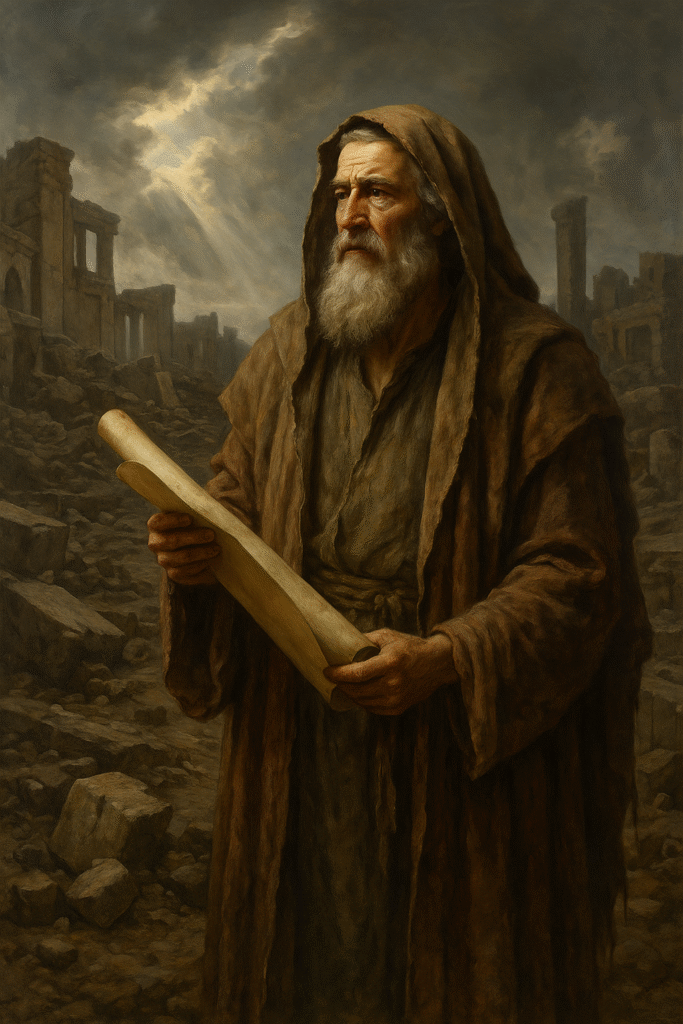
Book of Jeremiah – Set 1 (Chapters 1–4)
Theme: The Call of a Prophet and the Cry of a Father — Return to Me
1. Summary of the Chapters
Chapter 1 – Called and Consecrated
“Before I formed you in the womb I knew you, before you were born I set you apart.” (1:5)
Jeremiah’s story begins in the thirteenth year of King Josiah’s reign. A young man, hesitant and unsure, hears God’s voice commissioning him as a prophet to nations.
God’s call is deeply personal: chosen, known, appointed before birth.
Jeremiah protests — “I do not know how to speak; I am too young.”
But God answers: “Do not say, ‘I am too young.’ You must go to everyone I send you.” (1:7)
God touches Jeremiah’s mouth, placing His word within him, and shows two visions:
- An almond branch — symbolising watchfulness and readiness.
- A boiling pot — signifying judgment coming from the north.
Yet God promises, “They will fight against you but will not overcome you, for I am with you to rescue you.” (1:19)
It is a commission of courage amid coming chaos.
Chapters 2–3 – The Broken Covenant and the Plea to Return
“I remember the devotion of your youth, how as a bride you loved Me.” (2:2)
The tone shifts from commissioning to confrontation. God speaks as a wounded Lover. Israel has traded living water for broken cisterns — chasing idols, power, and pleasure that cannot satisfy.
“My people have committed two sins: they have forsaken Me, the spring of living water.” (2:13)
The nation’s faithlessness is pictured as adultery; the covenant has been betrayed.
Yet even in grief, mercy calls:
“Return, faithless Israel, for I am merciful.” (3:12)
God’s desire is not punishment but restoration.
He promises shepherds after His own heart and a time when His presence will no longer dwell in a physical Ark, for His people will know Him directly.
“You will call Me ‘My Father,’ and not turn away.” (3:19)
Chapter 4 – Plough Up the Fallow Ground
“Break up your unploughed ground and do not sow among thorns.” (4:3)
The Lord calls for deep repentance — not surface tears but heart transformation.
Judgment is coming from the north (Babylon’s armies), yet mercy remains open for the contrite.
Jeremiah weeps for what is to come:
“My heart, my heart! I writhe in pain.” (4:19)
Through his tears, the heart of God is revealed — holy love wounded by betrayal, yet still longing to heal.
2. Key Themes and Lessons
| Theme | Lesson |
|---|---|
| Divine Calling | God knows and appoints each life with purpose long before birth. Age, fear, or limitation cannot disqualify His call. |
| God’s Covenant Love | Sin grieves God not because it offends His rule but because it breaks His relationship. |
| Broken Cisterns | Anything we trust instead of God will eventually run dry. Only He is living water. |
| Repentance from the Heart | True return to God ploughs beneath the surface, allowing Him to root out what chokes life. |
| Courage in Calling | Jeremiah’s youth did not limit him because God’s presence was his power. |
| Mercy Triumphs over Judgment | Even in discipline, God’s goal is always redemption. |
3. Encouragement
Oh, come on — this is where you see the Father’s heart on full display!
When God calls Jeremiah, He’s not looking for a perfect prophet; He’s looking for a trusting heart.
‘Before I formed you, I knew you.’ That’s identity talk right there!
You’re not an afterthought; you’re a divine intention.
Jeremiah says, ‘I’m too young!’ and God says, ‘Stop disqualifying what I’ve qualified!’
That’s for you too — whatever your excuse, grace has already cancelled it.
Then God starts speaking like a brokenhearted Father: ‘I remember when you used to love Me just for Me.’
Oh, that’s not anger — that’s ache. He’s not after control; He’s after connection.
‘My people dug broken cisterns’ — wow.
He’s saying, ‘You’ve been drinking from wells that can’t hold water, but I’m right here — living water, never running dry.’
And then He says, ‘Return to Me.’ That’s not condemnation — that’s invitation!
The same God who disciplines also delights to restore.
Jeremiah weeps because God weeps.
Prophets don’t just declare judgment — they feel the Father’s pain for His children.
That’s what real ministry looks like — tears that carry love, not stones that condemn.
So sister, hear His voice today: ‘Plough up the fallow ground.’
That’s not a burden — that’s an invitation to grow again.
Because God never points out broken soil without intending to plant something beautiful there.
4. Reflection Questions
- How does Jeremiah’s call remind me that God has known and purposed my life since before I was born?
- Where have I been drinking from “broken cisterns” that cannot satisfy?
- What would it look like to “break up the fallow ground” in my heart — to let God restore fruitfulness?
- How can I see God’s discipline not as rejection but as a call back to relationship?
- What excuses might I need to release so I can step boldly into my own divine commission?
Book of Jeremiah – Set 2 (Chapters 5–8)
Theme: The Burden of Truth — Judgment, Deception, and the Heart of a Weeping Prophet
1. Summary of the Chapters
Chapter 5 – A City Without Truth
“Go up and down the streets of Jerusalem… If you can find but one person who deals honestly and seeks the truth, I will forgive this city.” (5:1)
Jeremiah searches Jerusalem for truth — but finds deception everywhere. The poor are ignorant, the rich are corrupt, and the leaders have hardened their hearts. The people have grown comfortable in rebellion, presuming that God will not act.
“They have eyes but do not see, ears but do not hear.” (5:21)
Judgment is announced — a nation from the north (Babylon) will come as a devouring lion. Yet even in this declaration, God pleads, “Return, O faithless ones.”
Chapter 6 – The Trumpet of Warning
“Stand at the crossroads and look; ask for the ancient paths, ask where the good way is, and walk in it.” (6:16)
God’s patience reaches its breaking point. The people mock His messengers and reject His word. Prophets proclaim peace, though destruction is near — “They dress the wound of My people as though it were not serious.” (6:14)
Jeremiah weeps as God’s warning sounds like a trumpet. The call is urgent — to return to the ancient path of righteousness. But their ears are closed.
The chapter ends with imagery of refining: God will test His people like metal in a furnace, separating dross from purity.
Chapter 7 – The Temple Sermon
“Do not trust in deceptive words and say, ‘This is the temple of the Lord.’” (7:4)
Jeremiah delivers one of his boldest messages — at the gates of the temple itself. The people believe that religious rituals will shield them from judgment. But God declares: external worship without internal obedience is hypocrisy.
He recalls Shiloh, once a dwelling of His name but now desolate — warning that the same could happen to Jerusalem.
Jeremiah is commanded to stop praying for the unrepentant — not because God ceases to love them, but because their rebellion has hardened beyond words. Still, His heart aches.
Chapter 8 – The Valley of Bones and the Weeping of God
“Since they have rejected the word of the Lord, what kind of wisdom do they have?” (8:9)
The prophet laments the moral decay: deceit, greed, and false peace. The bones of kings and priests will lie exposed — symbols of the emptiness of false security.
Jeremiah’s heart breaks:
“Oh, that my head were a spring of water and my eyes a fountain of tears!” (9:1)
It is the voice of God through a man who feels His pain. Judgment is coming, but even more striking is divine sorrow — the love of a Father watching His children destroy themselves.
2. Key Themes and Lessons
| Theme | Lesson |
|---|---|
| Truth and Integrity | God values honesty and righteousness above empty religion. |
| False Peace | Comfort built on denial blinds us to the urgency of repentance. |
| Judgment as Refining Fire | God’s discipline reveals what is pure and enduring within us. |
| Religion vs. Relationship | True worship is not a ritual but a heart surrendered to God. |
| God’s Compassion in Judgment | Even when He disciplines, His tears reveal His heart of mercy. |
| The Call to Return to the Ancient Path | God’s way never changes — righteousness and humility remain the road of life. |
3. Encouragement
Oh, you can feel the ache in this section — it’s the sound of love rejected, not wrath unleashed.
God says, ‘Find one person who seeks truth, and I’ll forgive the city.’
Wow. That’s His heart! He’s not looking for perfection; He’s looking for pursuit.
Jeremiah’s standing in a culture that says, ‘We’re fine! We’ve got the temple!’
But God’s saying, ‘No, you’ve got religion without relationship. You’ve got words without worship.’
That hits home, doesn’t it? Because even today, it’s easy to attend church but not let truth transform your heart.
And then God says, ‘Ask for the ancient paths.
That’s not nostalgia — that’s direction!
He’s saying, ‘Come back to what’s real — humility, holiness, and love.’
Jeremiah isn’t shouting because he’s angry; he’s crying because he cares.
He’s feeling the tears of God.
That’s why the prophetic life is not about exposing sin;
it’s about revealing the Father’s longing for His kids to come home.
When God refines, He’s not destroying you — He’s removing the lies that keep you from love.
So if you feel the fire right now, don’t run from it — stay.
Because that’s where He turns the dross into gold.
He’s still saying it today:
‘Don’t settle for false peace. Walk with Me in truth. Return to the ancient path — I’ll meet you there.’
4. Reflection Questions
- Where might I be seeking comfort in false peace instead of confronting truth?
- What “ancient paths” of faith and integrity is God calling me to walk in again?
- How can I distinguish between outward religion and genuine heart surrender?
- What refining work might God be doing in my life right now, and how can I trust His hand in it?
- How can I reflect God’s heart of compassion even when speaking difficult truth?
Book of Jeremiah – Set 3 (Chapters 9–12)
Theme: The Refining Fire — Knowing God, Not Religion
1. Summary of the Chapters
Chapter 9 – The Weeping Heart of God
“Oh, that my head were a spring of water and my eyes a fountain of tears, that I might weep day and night for my people.” (9:1)
Jeremiah mourns over a nation that no longer knows its God.
Deceit, betrayal, and idolatry have consumed the land. Every relationship — between neighbours, brothers, and families — is poisoned by self-interest.
God declares that His people “deceive their neighbour and refuse to acknowledge Me.” (9:6)
Their religion is shallow — words without devotion.
Yet amid sorrow, God reveals the essence of true faith:
“Let not the wise boast of their wisdom or the strong boast of their strength… but let the one who boasts boast in this: that they have the understanding to know Me.” (9:23–24)
The true treasure is not religious achievement, but intimate knowledge of God — His kindness, justice, and righteousness.
Chapter 10 – The Folly of Idols
“Like a scarecrow in a cucumber field, their idols cannot speak; they must be carried because they cannot walk.” (10:5)
God contrasts Himself with the lifeless idols of the nations.
Idols have shape but no spirit — noise but no breath.
They cannot save, speak, or move — yet people worship them, giving glory to created things instead of the Creator.
Jeremiah proclaims:
“The Lord is the true God; He is the living God, the eternal King.” (10:10)
Here we see a powerful declaration of God’s sovereignty over creation — He alone formed the heavens and the earth.
The chapter ends with Jeremiah’s humble prayer:
“Discipline me, Lord, but only in due measure — not in Your anger, or You will reduce me to nothing.” (10:24)
Even correction, when received rightly, becomes a gift of love.
Chapter 11 – The Broken Covenant
“Listen to the terms of this covenant.” (11:2)
God recalls the covenant made when Israel came out of Egypt. His people vowed obedience, but now they’ve turned back to idols. The conspiracy of sin runs deep — priests, prophets, and people alike have hardened their hearts.
Jeremiah’s words stir anger among his countrymen. Even those from his hometown of Anathoth plot to kill him.
But God protects His servant, saying, “I will punish them.” (11:22)
Through Jeremiah’s rejection, we glimpse the foreshadowing of Christ — the Prophet who would be despised by His own, yet still intercede for them in love.
Chapter 12 – The Cry for Justice
“You are always righteous, Lord, when I bring a case before You. Yet I would speak with You about Your justice.” (12:1)
Jeremiah wrestles with the age-old question: Why do the wicked prosper?
He sees corruption rewarded and faithfulness ridiculed. But God answers, revealing the depth of divine perspective:
“If you have raced with men on foot and they have worn you out, how can you compete with horses?” (12:5)
In other words — endurance in small trials prepares you for greater ones.
God doesn’t explain everything, but He strengthens His prophet to stand firm.
He reminds Jeremiah that judgment will come — not as vengeance, but as purification.
The final verses carry both sorrow and hope: God will uproot His unfaithful nation but promises to replant and restore those who return to Him with all their heart.
2. Key Themes and Lessons
| Theme | Lesson |
|---|---|
| Knowing God Personally | True wisdom is not found in intellect or power but in intimate relationship with God. |
| The Futility of Idolatry | Anything we place before God becomes an idol — powerless to save or satisfy. |
| The Pain of Rejection | Faithfulness often invites misunderstanding, but God’s approval outweighs man’s rejection. |
| Divine Discipline | God’s correction flows from love; it purifies rather than destroys. |
| The Mystery of Justice | When evil seems to prosper, God is still working toward eternal righteousness. |
| Endurance in Trials | Spiritual strength grows through perseverance — running with men prepares us to run with horses. |
3. Encouragement
Oh, come on — this is so rich!
Jeremiah’s tears aren’t weakness — they’re the overflow of love.
He’s not weeping at people; he’s weeping for them.
That’s what happens when you see people through God’s eyes instead of offence.
Then God says, ‘Don’t boast in wisdom, or strength, or riches — boast that you know Me.’
That’s it right there! That’s the Christian life in one sentence.
You can lose everything and still be full if you know Him — because relationship is the real reward.
Then Jeremiah looks at idols — statues that can’t even stand unless someone props them up.
He’s basically saying, ‘Why are you trusting what you have to carry when you could walk with the One who carries you?’
Oh, that’ll preach!
And then chapter 12 — Jeremiah’s asking, ‘Why do the wicked prosper?’
Ever been there? You look around and wonder why it’s so hard to stay righteous?
And God says, ‘If running with men tires you, how will you run with horses?’
He’s not scolding — He’s inviting.
He’s saying, ‘You were made for more. I’m strengthening you for endurance.’
Sister, that’s the voice of the Father — He’s not frustrated with you; He’s forming you.
When life feels unfair, don’t shrink back — lean in.
Because every hard season is training your heart to run faster with Him.
You’re not called to survive — you’re called to shine in truth and love that knows no compromise.
4. Reflection Questions
- What does it mean to me personally to “boast in knowing God” rather than in achievements or possessions?
- Are there any “idols” — visible or hidden — that I’m relying on more than the living God?
- How can I receive God’s discipline as a gift of love rather than punishment?
- When I wrestle with questions of justice or suffering, how can I stay anchored in God’s goodness?
- How might God be preparing me to “run with horses” — strengthening me through smaller trials today?
Book of Jeremiah – Set 4 (Chapters 13–17)
Theme: The Potter’s Hand — Lessons of Surrender and Trust
1. Summary of the Chapters
Chapter 13 – The Linen Belt: A Lesson in Pride
“For as a belt is bound around the waist, so I bound all the people of Israel and all the people of Judah to Me.” (13:11)
God instructs Jeremiah to buy a linen belt — a symbol of intimacy and closeness — and to wear it without washing. Later, he hides it in the crevice of a rock by the Euphrates. When he retrieves it, the belt is ruined and useless.
This becomes a powerful image: Israel, once bound closely to God in covenant, has become corrupted through pride and disobedience.
“This wicked people, who refuse to listen to My words… will become like this belt — completely useless.” (13:10)
Even as judgment looms, God’s heart still aches for restoration. His desire was always to “cling” to His people in honour and praise — not to see them destroyed.
Chapter 14 – The Drought and the Plea for Mercy
“The ground is cracked because there is no rain in the land; the farmers are dismayed and cover their heads.” (14:4)
A devastating drought grips the land — both physical and spiritual. The people plead for mercy, but their repentance lacks depth. Prophets continue to speak lies of peace, denying the coming disaster. Jeremiah intercedes passionately, yet God reveals the seriousness of their rebellion.
“Even if Moses and Samuel were to stand before Me, My heart would not go out to this people.” (15:1)
Still, Jeremiah’s tears reflect the Father’s grief. The drought symbolises the emptiness of hearts that have forsaken the living water of God’s presence.
Chapter 15 – The Prophet’s Pain and God’s Promise
“Your words were found, and I ate them, and Your word was to me the joy and rejoicing of my heart.” (15:16)
Jeremiah bears the emotional weight of his calling. He feels alone, rejected, and weary from carrying a message few want to hear. He cries out in anguish, questioning why his pain seems endless.
But God answers with both firmness and compassion:
“If you return, I will restore you that you may serve Me… I am with you to save you and deliver you.” (15:19–20)
Jeremiah’s renewal comes not from escaping his struggle but from rediscovering intimacy with God in it. The promise is clear — obedience may bring isolation, but never abandonment.
Chapter 16 – The Life of a Sign
“You must not marry and have sons or daughters in this place.” (16:2)
God commands Jeremiah to live as a prophetic sign — abstaining from marriage and mourning customs. His life itself becomes a message: judgment is near, and normal life will be interrupted.
Yet amidst the warnings, God reveals a future hope:
“However, the days are coming when it will no longer be said, ‘As surely as the Lord lives, who brought the Israelites up out of Egypt,’ but ‘who brought the Israelites up out of the land of the north.’” (16:14–15)
Even in exile, God promises restoration — a second exodus, a return from captivity. His mercy always outlasts man’s rebellion.
Chapter 17 – The Heart and the Hope
“The heart is deceitful above all things and beyond cure. Who can understand it?” (17:9)
This chapter contrasts cursed trust in man with blessed trust in God.
“Blessed is the one who trusts in the Lord, whose confidence is in Him.” (17:7)
The imagery is vivid — the one who trusts in human strength is like a shrub in the desert; the one who trusts in God is like a tree planted by the water, whose leaves remain green in drought.
The Sabbath, too, becomes a test of faith — a sign of whether the people will rest in God’s ways or persist in self-reliance.
The closing picture is one of divine craftsmanship — a Potter shaping the clay of human hearts, patiently pressing, smoothing, and restoring what was marred.
2. Key Themes and Lessons
| Theme | Lesson |
|---|---|
| Divine Intimacy and Separation | God designed His people to cling to Him in closeness — sin breaks that bond, but repentance restores it. |
| True Repentance vs. Empty Words | God desires transformation of heart, not surface-level sorrow. |
| The Refining Fire of Calling | Obedience often isolates, but intimacy with God sustains the servant. |
| Life as a Prophetic Sign | Our lives can embody truth — sometimes God speaks through how we live, not just what we say. |
| Trust vs. Self-Reliance | Those who root themselves in God’s truth flourish even in dry seasons. |
| God as the Potter | The Creator patiently shapes and reshapes our hearts to reflect His image and purpose. |
3. Encouragement
Oh, come on — this section is full of revelation!
The linen belt — wow.
God’s saying, ‘You were meant to be wrapped around Me, close enough to feel My heartbeat.’
That’s intimacy!
Sin didn’t just break rules — it broke relationship.
But He’s still reaching for you, still saying, ‘Come near again.’
Then the drought hits — that’s not punishment; it’s exposure.
It’s what happens when we try to live apart from the Source.
And even then, God’s not gloating — He’s grieving. His heart’s crying, ‘Return to Me — I’ll give you rain again.’
Jeremiah’s pain? So relatable.
He says, ‘Your words were found and I ate them.’
That’s the secret — when you digest truth, it strengthens you even when no one else understands you.
You might be standing alone, but you’re never abandoned.
And the potter — oh, this image is so beautiful!
God’s not throwing away the clay because it’s flawed — He’s reshaping it.
That means even your brokenness isn’t wasted; it’s raw material for grace.
He’s the God who puts His hands in the mess and says, ‘I can still make something beautiful out of this.’
So don’t resist His hands — trust them.
He’s not breaking you apart; He’s breaking you free.
Every pressing, every shaping — it’s the Potter’s love forming Christ in you.
4. Reflection Questions
- Where might I be resisting God’s hand as He reshapes something in my life?
- What does it look like to cling to God in intimacy like the linen belt was meant to?
- How can I respond to seasons of dryness with deeper dependence rather than despair?
- What “prophetic signs” might my own life demonstrate to others about trust, obedience, or surrender?
- What would change if I trusted fully in God rather than my own understanding and timing?
Book of Jeremiah – Set 5 (Chapters 18–22)
Theme: The Potter’s House and the King’s Reckoning — Warning, Rebellion, and the Cost of Pride
1. Summary of the Chapters
Chapter 18 – The Potter’s House
“Can I not do with you as this potter does?” declares the Lord. (18:6)
God sends Jeremiah to the potter’s house, where he watches clay being shaped on the wheel. When the vessel becomes marred, the potter doesn’t discard it — he reshapes it into another form as he sees fit.
This living parable reveals God’s sovereignty and mercy.
Israel is the clay, God the Potter. His hands are steady, His purpose pure. Yet if the clay resists His shaping, He may rework or even remake the vessel.
The Lord pleads with His people:
“Turn now, each of you from your evil ways and reform your actions.” (18:11)
But instead, they reply, “It’s no use! We will continue with our own plans.” (18:12)
Their refusal leads to destruction, not because God desired it — but because they hardened against His touch.
Chapter 19 – The Broken Jar
“Take a clay jar… and go out to the Valley of Ben Hinnom.” (19:1–2)
Jeremiah performs another prophetic act. He shatters a clay jar before the elders and priests, declaring that God will break Jerusalem beyond repair because of their idolatry, injustice, and the shedding of innocent blood in that very valley.
The shattered vessel becomes a vivid symbol of what rebellion does to the soul — what resists the Potter’s shaping ends up broken by its own hardness.
Jeremiah’s message is not vindictive but heartbroken — he knows judgment is the consequence of a people unwilling to be healed.
Chapter 20 – The Prophet’s Anguish and Praise
“You deceived me, Lord, and I was deceived; You overpowered me and prevailed.” (20:7)
Jeremiah is beaten and imprisoned by Pashhur, the temple priest, after proclaiming God’s word. He reaches an emotional breaking point — feeling mocked, rejected, and weary of the cost of obedience.
Yet even in pain, he cannot silence the fire of God’s truth within him:
“His word is in my heart like a fire, a fire shut up in my bones.” (20:9)
His lament turns to worship —
“Sing to the Lord! Give praise to the Lord! He rescues the life of the needy from the hands of the wicked.” (20:13)
This chapter captures the paradox of the prophet’s heart — sorrow and strength intertwined.
Chapter 21 – The Reckoning of King Zedekiah
“I am setting before you the way of life and the way of death.” (21:8)
King Zedekiah sends word to Jeremiah, hoping for a miracle as Babylon surrounds Jerusalem. But the word from the Lord is unflinching: surrender or perish. The time of warning has ended — judgment is at the door.
God’s message is crystal clear:
“I Myself will fight against you with an outstretched hand.” (21:5)
Even then, mercy glimmers through the fire — those who yield will live.
Obedience remains the only path to survival.
Chapter 22 – The Kings and the Cry for Justice
“Do what is just and right. Rescue from the hand of the oppressor the one who has been robbed.” (22:3)
Jeremiah delivers fiery messages to Judah’s kings — Jehoahaz, Jehoiakim, and Coniah — condemning their corruption, arrogance, and oppression.
Palaces built by injustice will become desolate.
God measures leadership not by luxury but by righteousness.
He reminds them of King Josiah’s legacy of justice and humility:
“He defended the cause of the poor and needy, and so all went well. Is that not what it means to know Me?” (22:16)
It’s a stunning statement — to know God is to live like Him — just, compassionate, and humble.
2. Key Themes and Lessons
| Theme | Lesson |
|---|---|
| The Potter’s Sovereignty | God shapes lives according to His will, yet He never forces what resists His touch. |
| Rebellion and Ruin | Hardness of heart eventually breaks what refuses to bend. |
| Obedience Under Fire | Faithfulness may be costly, but compromise costs infinitely more. |
| Integrity in Leadership | True greatness is marked by justice, humility, and care for the oppressed. |
| God’s Heart in Judgment | Even in wrath, He pleads for repentance — His goal is always restoration. |
| Endurance Through Calling | God’s word may bring pain, but it also sustains the one who carries it. |
3. Encouragement
Oh, come on — this part of Jeremiah is so rich with revelation!
The Potter’s House — wow! Can you see it?
God saying, ‘Look, I’m not done with you. I can still reshape what’s been marred.’
That’s not judgment — that’s mercy at work!
The only thing that ruins the clay isn’t its flaws; it’s resistance.
You can be cracked, messy, imperfect — and still usable — as long as you stay soft in His hands.
Then comes the shattered jar.
That’s what pride does when we say, ‘I’ll live my own way.’
But even then, God doesn’t walk away from the pieces —
He’s still the Potter who can make beauty from brokenness.
And Jeremiah — oh, this man! He’s exhausted, rejected, beaten — and still the fire of truth burns in his bones.
That’s what happens when God’s word owns your heart.
You might feel crushed, but you can’t quit — because His love is alive inside you!
Then God speaks to the kings — ‘Defend the poor and needy; that’s what it means to know Me.’
Wow. Knowing God isn’t about rituals or thrones — it’s about reflecting His nature.
If you claim to know Him but don’t love people, you’ve missed His heart.
So sister, stay on the wheel.
Don’t harden in fear or pride.
Let His hands press and shape —
because the same hands that formed you from dust are the hands that redeemed you at the cross.
You’re not a project; you’re His masterpiece in progress.
4. Reflection Questions
- What areas of my life might be resisting the Potter’s hands rather than yielding to them?
- How can I remain soft and teachable when God reshapes my plans or dreams?
- In what ways can I “defend the poor and needy” as an expression of truly knowing God?
- When have I felt like Jeremiah — weary but burning with God’s truth — and how did He strengthen me?
- How can I use positions of influence (at home, work, or ministry) to reflect God’s justice and compassion?
Book of Jeremiah – Set 6 (Chapters 23–25)
Theme: False Shepherds and the Coming Cup — Truth, Judgment, and the Hope of a Righteous Branch
1. Summary of the Chapters
Chapter 23 – The Righteous Branch and False Prophets
“Woe to the shepherds who are destroying and scattering the sheep of My pasture!” (23:1)
God rebukes the corrupt religious and political leaders who have neglected their people. Instead of caring for the flock, they have fed themselves. Their negligence and deceit have driven many away.
But into this dark backdrop, God speaks a radiant promise:
“I will raise up for David a righteous Branch, a King who will reign wisely and do what is just and right in the land.” (23:5)
This is one of Jeremiah’s most profound messianic prophecies — pointing directly to Christ, the Shepherd-King who will gather His people from every nation.
God also exposes the false prophets who speak visions from their own minds, not from His mouth. They say, “Peace, peace,” when there is no peace. Their words comfort sin instead of confronting it.
The Lord declares:
“Is not My word like fire,” declares the Lord, “and like a hammer that breaks a rock in pieces?” (23:29)
His Word burns away deception and softens hearts that truly listen.
Chapter 24 – The Vision of the Two Baskets of Figs
“The good figs, very good; and the bad figs, so bad they cannot be eaten.” (24:2)
Jeremiah sees two baskets of figs before the temple. One basket contains ripe, good figs — representing the exiles who have gone to Babylon. Though they seem forsaken, God calls them “good” because He will watch over them, refine them, and bring them back with new hearts.
The bad figs represent King Zedekiah and those who remain in Jerusalem — proud, resistant, and unrepentant. They will face sword and famine because they refused correction.
This vision reveals a deep truth: sometimes exile is mercy in disguise. God sends His people into refining seasons not to destroy them, but to transform them.
Chapter 25 – The Cup of God’s Wrath
“Take from My hand this cup filled with the wine of My wrath and make all the nations to whom I send you drink it.” (25:15)
After twenty-three years of faithful warning, Jeremiah announces that judgment is now inevitable. Babylon will be God’s instrument of correction, and Judah will serve the king of Babylon for seventy years.
Yet Babylon itself will later drink from the same cup — proving that even the instruments of judgment are accountable to divine justice.
Jeremiah’s message to the nations is universal: rebellion against God always leads to ruin, but submission to His righteousness leads to restoration.
Through this sobering imagery, we glimpse the prophetic shadow of Christ — the One who would later drink the cup of wrath on our behalf, that we might drink the cup of mercy.
2. Key Themes and Lessons
| Theme | Lesson |
|---|---|
| True vs. False Leadership | God calls shepherds to care for His flock with integrity, compassion, and truth — not self-interest. |
| The Righteous Branch | Christ alone fulfills the role of the perfect Shepherd-King who gathers and restores God’s people. |
| Power of God’s Word | His Word is living fire and truth — it exposes deception and transforms the heart. |
| Refining Through Exile | Seasons of loss or correction often become the soil for renewal and deeper faith. |
| Divine Justice and Mercy | God’s discipline is righteous; His wrath never contradicts His love but works through it. |
| The Cup of Judgment | Sin always carries a cost — yet Christ’s sacrifice reveals God’s desire to bear that cost Himself. |
3. Encouragement
Oh, this is so full of Kingdom truth!
God starts by calling out the shepherds who used their platform to feed themselves instead of His people.
But watch His heart — He doesn’t just say ‘Woe to them’; He says, ‘I Myself will gather My flock.’
That’s redemption! When leaders fail, love still steps in.
Then He drops this bombshell: ‘I will raise up for David a righteous Branch.’
That’s Jesus! The true Shepherd who doesn’t scatter — He restores.
He doesn’t just tell us the way; He is the Way.
And the false prophets — they were saying, ‘Peace, peace,’ while people were dying inside.
That’s what happens when you preach comfort without conviction.
God’s Word isn’t a pillow; it’s a fire and a hammer — not to hurt us but to free us from lies!
Then those two baskets of figs — wow. The good ones went into exile, but God called them ‘very good.’
You know what that means? Sometimes what looks like loss is actually love.
God’s saying, ‘I’m sending you away not to destroy you but to give you a future and a heart that knows Me.’
Even discipline can carry destiny.
And then the cup of wrath — that’s heavy, right?
But don’t stop there — because centuries later, Jesus picks up that cup in Gethsemane and drinks it for us.
That’s what love looks like when it’s holy.
So sister, no matter how hard the shaking, don’t run from God — run to Him.
He’s not exposing you to shame you; He’s pruning you to bear fruit.
You’re not under wrath — you’re under redemption.
Stay soft, stay yielded, and let the Shepherd-King lead you to rest.
4. Reflection Questions
- How can I discern between voices that comfort my flesh and the voice of God that refines my heart?
- What does Jesus being my “Righteous Branch” mean in my daily walk and relationships?
- When have I experienced a season that felt like exile but later revealed God’s mercy and renewal?
- What might it look like to lead others — in family, work, or ministry — as a true shepherd reflecting God’s care?
- How does knowing Christ drank the cup of wrath for me change the way I see repentance and grace?
Book of Jeremiah – Set 7 (Chapters 26–29)
Theme: Conflict and Captivity — The Cost of Truth and the Hope of Peace in Exile
1. Summary of the Chapters
Chapter 26 – The Cost of Truth
“Stand in the courtyard of the Lord’s house and speak to all the people of the towns of Judah… do not omit a word.” (26:2)
Jeremiah is commanded to preach a difficult message in the temple — that Jerusalem will become like Shiloh if the people do not repent. His words provoke outrage. Priests and prophets accuse him of treason, demanding his death.
Yet when confronted, Jeremiah stands firm in humility and courage:
“As for me, I am in your hands; do with me whatever you think is good and right.” (26:14)
His faithfulness spares his life — for now — though other prophets, like Uriah, are executed for speaking the same truth.
This chapter shows that obedience to God often means opposition from people, yet His protection covers those who fear Him more than man.
Chapter 27 – The Yoke of Submission
“Bring your neck under the yoke of the king of Babylon and serve him and his people, and you will live.” (27:12)
God commands Jeremiah to wear a literal yoke — a wooden bar symbolising submission — as he delivers a shocking message: Judah and the surrounding nations must submit to Babylon’s rule because God has appointed Nebuchadnezzar to rule temporarily.
False prophets promise deliverance, but Jeremiah speaks the unpopular truth — surrender is the path to survival.
This prophetic act illustrates a deep spiritual truth: when God ordains a refining season, resistance leads to ruin, but surrender brings peace.
Chapter 28 – The False Prophet Hananiah
“Within two years I will bring back to this place all the articles of the Lord’s house.” (28:3)
Hananiah publicly contradicts Jeremiah, claiming the exile will end quickly. His message is popular, hopeful — and false. Jeremiah responds with grace but firmness:
“Amen! May the Lord do so… Nevertheless, listen to what I have to say.” (28:6–7)
Jeremiah warns that true prophecy aligns with God’s character, not people’s comfort. When Hananiah breaks Jeremiah’s wooden yoke, God commands Jeremiah to replace it with an iron one — a symbol that no man can overturn God’s decree.
Hananiah dies shortly afterward, confirming the truth of Jeremiah’s word.
Chapter 29 – The Letter to the Exiles
“This is what the Lord Almighty says… Build houses and settle down; plant gardens and eat what they produce.” (29:5)
From Jerusalem, Jeremiah writes a letter to the exiles in Babylon — one of the most beloved passages in all of Scripture.
Instead of promising quick deliverance, he tells them to settle, flourish, and seek the peace of the city where they now live.
“For I know the plans I have for you,” declares the Lord, “plans to prosper you and not to harm you, plans to give you hope and a future.” (29:11)
God assures His people that after seventy years, He will bring them back — but meanwhile, He calls them to faithfulness in foreign soil.
This chapter reveals the heart of God in discipline — not punishment, but purpose. Even in exile, His love provides, His plan unfolds, and His presence remains.
2. Key Themes and Lessons
| Theme | Lesson |
|---|---|
| Courage in Truth | Speaking God’s word requires humility and boldness, even when misunderstood or opposed. |
| Submission and Surrender | Yielding to God’s timing, even through hardship, opens the way for peace and growth. |
| False Hope vs. True Faith | True prophecy aligns with God’s heart and Word, not human desire or quick fixes. |
| Purpose in Exile | God’s plans are active even in seasons of delay or discipline — He redeems every location and situation. |
| Divine Providence | God’s “yoke” is not bondage but protection — His boundaries keep us safe in His will. |
| Flourishing in Adversity | We are called to plant, build, and bless even in the places we didn’t choose — because God is with us there. |
3. Encouragement
Oh, come on — this is where faith gets real!
Jeremiah stands alone in the temple saying, ‘Don’t omit a word.’
You know what that means? Truth doesn’t bend for comfort; love tells the whole story.
He’s risking his life, but he’s already surrendered it — and that’s freedom!
Then God tells him to wear a yoke. Can you imagine? Walking around with a wooden bar on your shoulders!
People probably mocked him, but every step was a sermon: ‘Sometimes peace looks like surrender.’
See, God’s not asking us to fight what He’s using to form us — He’s asking us to trust Him through it.
Then comes Hananiah — the voice of quick deliverance and easy hope. Sounds good, doesn’t it?
But Jeremiah stands there quietly, saying, ‘Amen, may it be so — but let’s see whose word stands.’
Oh, that’s maturity right there — not arguing for attention, just resting in truth.
And then the letter — come on, it’s gold!
‘Build houses, plant gardens, seek the peace of the city.’
God’s saying, ‘You can still thrive where you didn’t plan to be.’
He’s not punishing you; He’s positioning you!
Even in Babylon, His promise still holds: ‘I know the plans I have for you.’
So sister, maybe you’re in your own “Babylon” season right now — things didn’t go how you expected.
Don’t waste your exile wishing it away. Build there. Love there. Pray there.
Because God’s not waiting for you to escape; He’s teaching you how to live free wherever you are.
You’re not forgotten — you’re being formed.
4. Reflection Questions
- When have I had to speak or live out truth even when it cost me comfort or acceptance?
- How can I recognise the difference between a “Hananiah message” that pleases people and a “Jeremiah message” that transforms hearts?
- What does surrendering to God’s yoke look like in my current season of life?
- How can I seek the peace and prosperity of the “place where I’ve been sent” — even if it’s not where I hoped to be?
- What new things might God be building in me while I’m waiting for the next season of restoration?
Book of Jeremiah – Set 8 (Chapters 30–33)
Theme: The Book of Consolation — Restoration, Covenant, and Everlasting Hope
1. Summary of the Chapters
Chapter 30 – The Promise of Restoration
“I will restore the fortunes of My people Israel and Judah, and I will bring them back to the land I gave their ancestors.” (30:3)
God commands Jeremiah to write His promises in a book — a record of hope for future generations. Though the people face captivity, He promises a day of deliverance and healing.
“Though I completely destroy all the nations among which I scatter you, I will not completely destroy you. I will discipline you, but only in due measure.” (30:11)
The tone is tender yet firm: correction is temporary; covenant love is eternal.
The Lord promises to break the yoke of oppression and raise up a Davidic ruler — a clear foreshadowing of the Messiah who will lead with righteousness and peace.
“You will be My people, and I will be your God.” (30:22)
Chapter 31 – The New Covenant
“I have loved you with an everlasting love; therefore I have drawn you with loving-kindness.” (31:3)
This chapter glows with the warmth of divine affection. God describes His people’s return with joy, dancing, and singing — mourning turned to celebration.
But the pinnacle comes in verses 31–34, where God unveils the promise of a New Covenant:
“I will put My law in their minds and write it on their hearts. I will be their God, and they will be My people.” (31:33)
Unlike the old covenant written on stone, this new covenant is internal, intimate, and everlasting — fulfilled through Christ, whose Spirit writes God’s truth within us.
God also promises that His covenant with His people is as enduring as the sun, moon, and stars.
“Only if these ordinances vanish from My sight… will Israel ever cease to be a nation before Me.” (31:36)
This is eternal faithfulness in written form.
Chapter 32 – The Field of Hope
“Buy the field at Anathoth, because the right of redemption is yours.” (32:7)
Jerusalem is under siege, yet God tells Jeremiah to do something absurd: buy land in a city soon to be conquered. Jeremiah obeys, sealing the deed as a prophetic act.
It’s a stunning symbol — even while everything collapses, God declares future restoration.
“Houses, fields and vineyards will again be bought in this land.” (32:15)
In the same chapter, Jeremiah prays, overwhelmed by the paradox — a promise of renewal in the middle of ruin. God replies with one of the most powerful truths in Scripture:
“I am the Lord, the God of all mankind. Is anything too hard for Me?” (32:27)
No situation is too far gone for His redemption.
Chapter 33 – The Covenant of Peace and Righteousness
“Call to Me and I will answer you and tell you great and unsearchable things you do not know.” (33:3)
Jeremiah, still confined in prison, receives words of incredible hope. God promises restoration, cleansing, and joy:
“I will cleanse them from all the sin they have committed… and forgive all their rebellion.” (33:8)
He then reaffirms His covenant with David — promising that a righteous Branch will reign forever, and His priests will serve continually.
“In those days and at that time I will make a righteous Branch sprout from David’s line; He will do what is just and right in the land.” (33:15)
The chapter closes with a vision of unbreakable covenant — as sure as day and night. The Kingdom of God will never fail, and His mercy will never end.
2. Key Themes and Lessons
| Theme | Lesson |
|---|---|
| Everlasting Love | God’s covenant love is unbreakable, stronger than sin, and deeper than exile. |
| Restoration through Redemption | God’s discipline leads to rebuilding, not ruin — every broken place can be renewed. |
| The New Covenant | The law written on hearts through the Holy Spirit marks true transformation and intimacy with God. |
| Faith in the Midst of Despair | Jeremiah’s purchase of the field models trust in God’s promises even when circumstances look hopeless. |
| God’s Power and Faithfulness | “Is anything too hard for Me?” — no human failure or national ruin can cancel divine purpose. |
| The Righteous Branch | Jesus Christ fulfils God’s covenant promise as the eternal King who reigns with justice, mercy, and truth. |
3. Encouragement
Oh, come on — this section is pure Gospel glory!
God’s saying, ‘Write this down — My restoration is guaranteed!’
Even in exile, He’s declaring, ‘You’re coming home.’
That’s His heart — He never leaves you where discipline found you; He restores you where love redeems you.
Then that verse — ‘I have loved you with an everlasting love.’
That’s not poetic — that’s eternal truth!
He’s saying, ‘My affection for you isn’t changing with your behaviour; it’s anchored in My nature.’
You can’t out-sin His mercy or outrun His reach.
And the New Covenant — oh, it’s everything!
No more chasing rules; now it’s His Spirit writing truth on your heart.
That’s what Jesus came to do — not to modify your behaviour but to transform your nature.
He’s saying, ‘I’ll take your stony heart and give you Mine.’
Then Jeremiah buys a field — while the city burns!
That’s what faith looks like: hope making an investment when logic says it’s over.
He’s saying, ‘Even when you don’t see the outcome, trust My promise.’
And God’s response? ‘Is anything too hard for Me?’
Come on — that’s the anthem of faith!
You can’t have a situation too broken for redemption when grace is your foundation.
Finally, He says, ‘Call to Me and I’ll show you things you don’t know.’
That’s intimacy — not information.
He’s inviting you into partnership, into revelation, into life that’s brand-new from the inside out.
So friend, if you feel surrounded by ruins — don’t despair.
God’s not finished. The Builder is still on site, and He’s turning ashes into inheritance.
He’s the faithful Redeemer, and His love — it’s everlasting.
4. Reflection Questions
- What does it mean to me personally that God has loved me with an “everlasting love”?
- How does the promise of the New Covenant change the way I see my relationship with God — heart to heart instead of law to law?
- What “field of hope” might God be asking me to invest in, even when everything looks uncertain?
- How do I respond when God reminds me, “Is anything too hard for Me?”
- How can I call on God more intentionally, expecting Him to reveal “great and unsearchable things” in my life and calling?
Book of Jeremiah – Set 9 (Chapters 34–39)
Theme: The Fall of Jerusalem — Rebellion, Resistance, and Redemption in Ruin
1. Summary of the Chapters
Chapter 34 – Broken Promises and Betrayed Freedom
“Recently you repented and did what is right in My sight… but now you have turned around and profaned My name.” (34:15–16)
King Zedekiah makes a covenant to free Hebrew slaves in obedience to God’s law. For a brief moment, it looks like repentance is possible — but soon after, the people reverse their decision and enslave their brothers again.
God’s response is swift and sorrowful:
“You have not obeyed Me… therefore I proclaim ‘freedom’ for you — freedom to fall by the sword, plague, and famine.” (34:17)
Their act of injustice exposes the heart of Judah’s rebellion — covenant-breaking at every level. Yet even as judgment approaches, God still addresses Zedekiah personally, offering dignity amid discipline: he will die in peace, not by the sword.
Chapter 35 – The Faithful Rechabites
“We have obeyed everything our forefather Jehonadab commanded us.” (35:8)
In sharp contrast to Judah’s unfaithfulness, the Rechabites — a nomadic clan — obey their ancestor’s command to live simply, avoiding wine and permanent homes.
God uses their obedience as an example to shame Judah’s disobedience:
“The descendants of Jehonadab have carried out the command their forefather gave them, but these people have not obeyed Me.” (35:16)
Faithfulness to a human ancestor exposes the tragedy of rejecting a divine Father. God honours the Rechabites, promising that their line will always stand before Him.
Chapter 36 – The Burning of the Scroll
“Take a scroll and write on it all the words I have spoken to you.” (36:2)
Jeremiah dictates God’s messages to Baruch, who reads them publicly. When the scroll reaches King Jehoiakim, the king cuts it piece by piece and throws it into the fire — a vivid symbol of his contempt for God’s Word.
But God’s Word cannot be destroyed.
“Take another scroll and write on it all the words that were on the first scroll.” (36:28)
Even flames cannot silence divine truth. The Word that judges also redeems, and it endures forever.
Chapter 37 – Jeremiah’s Imprisonment
“Please do not send me back to the house of Jonathan the secretary, or I will die there.” (37:20)
Zedekiah continues to seek Jeremiah’s counsel but refuses to obey it. When Jeremiah’s message contradicts political hope, he is accused of treason and imprisoned in a dungeon.
Even in captivity, God sustains him. Zedekiah secretly consults him again, torn between fear of men and fear of God. Jeremiah remains unwavering:
“Obey the Lord by doing what I tell you, and it will go well with you.” (38:20)
Chapter 38 – The Pit and the Rescue
“They took Jeremiah and put him into the cistern… there was no water in it, only mud, and Jeremiah sank into the mud.” (38:6)
Jeremiah’s suffering reaches its lowest point — literally. Accused of demoralising the soldiers, he’s thrown into a muddy pit to die.
But God raises a rescuer: Ebed-Melek, an Ethiopian servant of the king, courageously pleads for Jeremiah’s life and pulls him out with ropes and old rags.
God honours Ebed-Melek’s compassion and faith, promising his safety when the city falls.
Chapter 39 – The Fall of Jerusalem
“Then the city wall was broken through.” (39:2)
Babylon breaches Jerusalem’s walls after years of siege. The city burns, the temple is destroyed, and the people are taken captive. King Zedekiah tries to flee but is captured, forced to witness the execution of his sons before being blinded and carried to Babylon.
Amid devastation, God keeps His promises:
- Jeremiah is spared and honoured by Babylon’s officials.
- Ebed-Melek receives divine protection.
Even as the city crumbles, God’s covenant faithfulness endures — justice mingled with mercy.
2. Key Themes and Lessons
| Theme | Lesson |
|---|---|
| Covenant Faithfulness vs. Human Failure | God remains true to His promises even when people break theirs. |
| Power of God’s Word | Human rejection cannot extinguish divine truth — His Word always prevails. |
| Obedience in the Small Things | The Rechabites show that simple, consistent faithfulness matters deeply to God. |
| Courage in Compassion | God honours those, like Ebed-Melek, who act with mercy even in danger. |
| Suffering with Purpose | Jeremiah’s trials reveal endurance shaped by intimacy with God — faith refined through fire. |
| Mercy in Judgment | Even in ruin, God remembers His remnant and keeps His word. |
3. Encouragement
Oh, come on — this part breaks your heart and fills it at the same time!
The people promise freedom and then enslave their brothers again — can you see why God grieves?
He’s not angry because they broke rules; He’s heartbroken because they broke love.
And then — the Rechabites. These guys are living simply, obeying their ancestor’s words generations later.
And God’s like, ‘Look at that!’
He’s saying, ‘If they can honour a man’s command, why won’t My children honour Mine?’
See, obedience isn’t about control — it’s about trust.
Then King Jehoiakim burns the scroll.
Imagine cutting up the Word of God piece by piece — that’s pride at its loudest.
But God just smiles and says, ‘Write another one.’
You can burn the paper, but you can’t burn the truth. His Word isn’t fragile — it’s fireproof!
Jeremiah’s thrown in the pit — sinking in mud, forgotten by everyone except Heaven.
And then, out of nowhere, this servant — Ebed-Melek — risks his life to save him. That’s love in action!
And God notices. He always notices the ones who move with compassion when others look away.
Finally, the city falls.
It’s devastating, but even here, mercy shines. God protects His prophet and His servant.
That’s His nature — judgment never cancels grace; it reveals it.
So sister, don’t measure God’s faithfulness by your circumstances.
Even when everything looks ruined, His Word still stands, His love still burns, and His plans still unfold.
Because the same God who walked with Jeremiah in the pit is walking with you in yours — and He’s already written your redemption story.
4. Reflection Questions
- What promises or instructions from God have I been tempted to “reverse” when obedience became inconvenient?
- How can I cultivate faithfulness like the Rechabites — simple obedience in everyday life?
- When have I felt like Jeremiah — misunderstood or abandoned — and how did God sustain me?
- Who around me might need an “Ebed-Melek moment” — someone to lift them out of despair with compassion?
- How can I see God’s mercy even in seasons of correction or loss?
Book of Jeremiah – Set 10 (Chapters 40–45)
Theme: The Remnant and the Refuge — Fear, Flight, and God’s Unfailing Faithfulness
1. Summary of the Chapters
Chapter 40 – Mercy for the Remnant
“The Lord your God decreed this disaster for this place, and now He has brought it about.” (40:2–3)
After Jerusalem’s destruction, the Babylonians show unexpected kindness to Jeremiah. They release him from chains, offering him the freedom to go wherever he wishes. Jeremiah chooses to stay with the poor remnant left in Judah — those too insignificant to be exiled.
Gedaliah is appointed governor over the land, and hope flickers again. He urges the people to live peaceably under Babylonian rule and to gather the harvest. But danger lingers — Ishmael, a descendant of the royal line, plots rebellion.
Chapter 41 – Treachery and Turmoil
“Ishmael… came with ten men and struck down Gedaliah with the sword.” (41:2)
The fragile peace collapses when Ishmael assassinates Gedaliah. He massacres Babylonian officials and civilians, then captures survivors to flee toward Ammon. But Johanan, another military leader, pursues and rescues the captives, forcing Ishmael to escape.
Fear grips the people — they worry Babylon will retaliate. Rather than resting in God’s sovereignty, they begin plotting their own survival plan.
Chapter 42 – The Plea for Direction
“Whether it is favourable or unfavourable, we will obey the Lord our God.” (42:6)
The people, desperate for direction, ask Jeremiah to seek God’s guidance, promising to obey whatever He says. After ten days of prayer, Jeremiah delivers the answer:
“Do not go to Egypt. Stay in this land, and I will build you up and not tear you down.” (42:10)
God assures them of His protection if they stay — but warns that Egypt, the land they long to flee to, will become a trap of war and famine.
Tragically, despite their words, their hearts are already decided.
Chapter 43 – Rebellion and Flight to Egypt
“You are lying! The Lord our God has not sent you to say, ‘Do not go to Egypt.’” (43:2)
Refusing to believe Jeremiah’s warning, the leaders accuse him of deceit and forcibly take him — along with the entire remnant — to Egypt.
Even there, Jeremiah continues to prophesy, declaring that Nebuchadnezzar will one day invade Egypt as well.
God’s word follows His people wherever they run; there is no refuge outside of obedience.
Chapter 44 – The Idolatry in Egypt
“We will not listen to the message you have spoken to us in the name of the Lord.” (44:16)
In Egypt, Jeremiah confronts the people for continuing to worship the Queen of Heaven — the same idolatry that destroyed Jerusalem. They boldly refuse repentance, insisting their lives were better when they offered sacrifices to false gods.
Jeremiah weeps, warning that the same destruction that fell on Judah will come to Egypt. Only a few fugitives will survive to return.
Even in rebellion, God’s voice calls out with patience and grief — longing for His people to recognise that idolatry never ends in blessing.
Chapter 45 – Comfort for Baruch
“Should you then seek great things for yourself? Do not seek them.” (45:5)
This short, tender chapter is a private message to Baruch, Jeremiah’s faithful scribe.
Baruch has grown weary and discouraged under the weight of judgment and rejection. God reassures him personally:
“I will give you your life as a prize of war wherever you go.” (45:5)
It’s a quiet promise in a noisy world — a reminder that faithfulness to God never goes unnoticed. Even when nations fall, He sustains the individual who stays close to His heart.
2. Key Themes and Lessons
| Theme | Lesson |
|---|---|
| God’s Faithfulness to the Faithful | Even when nations crumble, God remembers those who trust Him — like Jeremiah and Baruch. |
| The Danger of Fear-Based Decisions | When fear drives our choices, we often flee the very place God intended to bless us. |
| Obedience over Escape | Safety is not found in location but in alignment with God’s will. |
| Idolatry of Self-Reliance | Trusting human plans over divine instruction always leads to loss. |
| Mercy in Discipline | Even when people rebel, God keeps extending opportunities for repentance. |
| Personal Care in Chaos | God’s comfort to Baruch shows His love for individuals amid national crisis. |
3. Encouragement
Oh, come on — this is so raw, so human, and yet so full of God’s heart!
Jeremiah’s free, finally! He could’ve gone anywhere — Babylon, safety, comfort. But what does he do?
He stays with the broken, the poor, the remnant. Why? Because love doesn’t leave people behind.
That’s the Father’s heart.
Then there’s Ishmael’s betrayal — chaos right after peace.
It’s what happens when fear takes the lead instead of faith.
God’s like, ‘I’ve got a plan — stay in the land and I’ll rebuild you.’
But fear says, ‘No, we need to run to Egypt.’
And Egypt always represents the old life — the place God once delivered us from.
Isn’t it wild how easy it is to run back to what once enslaved us?
But even as they flee, Jeremiah’s dragged along — still speaking truth, still loving people who reject him.
That’s perseverance. That’s love that doesn’t quit.
And then — Baruch.
Oh, I love that God pauses the whole story to speak to one weary servant.
He basically says, ‘Baruch, don’t chase greatness — I see you. I’ll protect you.’
You can almost feel the Father’s tenderness: ‘You matter to Me.’
So sister, maybe you’ve felt like the remnant — surrounded by fear, watching promises fall apart.
Don’t run to your Egypt.
Stay where God last spoke peace.
He hasn’t forgotten you; He’s forming you.
Even if the crowd runs, stand still.
Because the same God who comforted Baruch in chaos will comfort you — right where you are.
And that, my sister, is victory.
4. Reflection Questions
- Have I ever run to my own “Egypt” — trying to fix my fears through human solutions instead of trusting God’s promise?
- What does staying faithful look like when others around me choose compromise or escape?
- How can I respond like Jeremiah — remaining steady in truth even when it costs comfort or companionship?
- What small, quiet ways might God be reminding me of His personal care, as He did for Baruch?
- What would it look like to let faith, not fear, make my next decision?
Book of Jeremiah – Set 11 (Chapters 46–52)
Theme: Nations, Judgment, and the Everlasting King — The God Who Reigns Over All
1. Summary of the Chapters
Chapter 46 – The Fall of Egypt
“The sword devours those around you; it never has enough.” (46:10)
God’s judgment turns toward the nations. Egypt, long seen as a symbol of worldly strength and false refuge, faces divine reckoning. Pharaoh’s armies will fall before Babylon — human might cannot withstand divine purpose.
Yet even in judgment, mercy shines. To His people, God says:
“Do not be afraid, Jacob My servant… for I am with you; I will save you from afar.” (46:27)
Egypt falls, but Israel’s destiny endures. God’s discipline is specific, but His covenant love is eternal.
Chapters 47–49 – Judgments Against the Nations
Jeremiah delivers messages of justice against Philistia, Moab, Ammon, Edom, Damascus, Kedar, Hazor, and Elam. Each nation had exalted itself or harmed God’s people — and now reaps the fruit of its pride.
- Philistia (47): Crushed by Babylon — a symbol that worldly alliances cannot save.
- Moab (48): Once proud and complacent, Moab is brought low — yet God promises, “I will restore the fortunes of Moab in days to come.” (48:47)
- Ammon and Edom (49): Known for arrogance and violence, their false confidence collapses — but again, mercy whispers that God’s restoration will one day reach even them.
These prophecies prove that God’s justice is universal, yet His mercy remains available to all who humble themselves.
Chapter 50 – The Fall of Babylon (Part 1)
“See, I am against you, arrogant one,” declares the Lord, “for your day has come.” (50:31)
The tide turns. Babylon — the very instrument of God’s discipline — now faces His righteous wrath.
No empire, however mighty, escapes accountability before the King of Heaven.
Jeremiah’s language soars with prophetic poetry:
“In those days… the people of Israel and Judah will go together, weeping as they seek the Lord.” (50:4)
This is not just geopolitical prophecy — it’s spiritual restoration. The very captivity that humbled God’s people becomes the pathway to renewed devotion.
Chapter 51 – Babylon’s Final Destruction (Part 2)
“Flee from Babylon! Run for your lives! Do not be destroyed because of her sins.” (51:6)
Jeremiah proclaims Babylon’s complete downfall — her walls, idols, and pride will crumble.
“Babylon will be a heap of ruins, a haunt of jackals.” (51:37)
This imagery points beyond ancient history — to the final judgment of every worldly system that exalts itself against God.
God’s people are told to “remember the Lord from far away” (51:50) — a call to keep worship alive, even in exile, knowing that the fall of Babylon is certain.
As a prophetic act, Jeremiah instructs Seraiah to read these words in Babylon and then throw the scroll into the Euphrates River, declaring:
“So will Babylon sink to rise no more.” (51:64)
Chapter 52 – The Fall Recap and the Flicker of Hope
“In the ninth year of Zedekiah’s reign… the city wall was broken through.” (52:4–7)
The book concludes with a detailed historical account of Jerusalem’s destruction — the temple burned, treasures taken, people exiled. It’s a sobering echo of earlier chapters.
Yet the final verses hold a quiet glimmer of redemption.
King Jehoiachin, once imprisoned in Babylon, is released and treated kindly by the new king. He eats at the royal table for the rest of his life.
It’s a symbolic whisper that God’s covenant promise still breathes — grace amid judgment, hope beyond ruin.
2. Key Themes and Lessons
| Theme | Lesson |
|---|---|
| God’s Sovereignty Over Nations | No empire, power, or people stands beyond God’s authority. |
| The Justice of God | Every nation and individual reaps the fruit of their pride or humility before Him. |
| Mercy in Judgment | Even as God disciplines, He preserves a remnant and promises restoration. |
| Pride and Humility | The proud fall, but the humble find refuge in God’s mercy. |
| Babylon as a Spiritual Symbol | Babylon represents the world’s rebellion — destined to fall before God’s eternal kingdom. |
| Hope Beyond Ruin | The release of Jehoiachin foreshadows redemption — God’s covenant purpose always continues. |
3. Encouragement
Oh, come on — this finale is amazing!
God’s been speaking through Jeremiah for decades, and now we see the whole picture:
He’s not just the God of Israel; He’s the God of nations!
Egypt, Moab, Edom, Babylon — all these powerful kingdoms rise and fall, but the Lord still reigns.
It’s like God’s saying, ‘History isn’t random — I’m still writing it.’
And even while He judges nations, He keeps whispering mercy.
‘Yet I will restore Moab.’ ‘I will remember My people.’
That’s who He is — justice and love perfectly balanced.
Then Babylon falls — the very empire that thought it was untouchable.
Come on, that’s every proud heart that says, ‘I don’t need God.’
But here’s the beauty — He tells His people, ‘Flee from Babylon!’
That’s not just about geography — that’s about your heart!
Don’t stay entangled in the world’s lies. Run toward freedom, not away from it.
And then, right at the end — Jehoiachin.
A forgotten king, locked in a foreign cell, suddenly lifted up and given a place at the royal table.
That’s redemption in one verse!
It’s like God saying, ‘Even after all this, My mercy still finds you.’
Sister, that’s the Gospel right there.
The kingdoms of this world will fall, but love never will.
So lift your eyes — your Babylon won’t last, but your covenant will.
God’s still on the throne, still faithful, still writing restoration into every ending.
4. Reflection Questions
- How does seeing God’s sovereignty over the nations deepen my trust in His control over my own life?
- What “Babylons” — sources of pride, false security, or distraction — might God be asking me to flee from?
- Where have I seen mercy shine through seasons of judgment or consequence?
- What can the kindness shown to Jehoiachin teach me about God’s heart toward the undeserving?
- How does this closing vision of judgment and restoration point me to the eternal kingship of Christ?
Overview of the Book of Jeremiah
Theme: Faithful God, Faithless People — The Covenant Love That Never Lets Go
1. Summary of the Book
The Book of Jeremiah unfolds over forty years of prophetic ministry during Judah’s darkest century (approximately 627–586 BC).
It is both heartbreaking and hopeful — a chronicle of rebellion, ruin, and redemption, where the holiness of God meets His unrelenting mercy.
The Prophet’s Call (Chapters 1–3)
Jeremiah, a young priest from Anathoth, is chosen before birth to speak God’s words to a stubborn generation. Though reluctant and afraid, God assures him:
“Before I formed you in the womb, I knew you… I appointed you as a prophet to the nations.” (1:5)
His ministry begins under King Josiah’s reforms but extends through the decline of Judah’s final kings — Jehoiakim and Zedekiah — and ends in exile.
Warnings and Pleas (Chapters 4–29)
God’s heart breaks as His people chase idols, injustice, and deceit. Through Jeremiah, He pleads:
“Return, faithless Israel… for I am your husband.” (3:14)
Yet they persist in rebellion. The prophet faces ridicule, beatings, imprisonment, and isolation — but his tears become God’s own lament.
“Oh, that my head were a spring of water, my eyes a fountain of tears!” (9:1)
Judgment finally comes. Jerusalem is besieged, the temple destroyed, and the people carried into Babylon. But even amid the fire, mercy glimmers.
Hope and Restoration (Chapters 30–33)
These chapters — often called The Book of Consolation — reveal the stunning promise of a New Covenant:
“I will put My law in their minds and write it on their hearts. I will be their God, and they will be My people.” (31:33)
This covenant looks beyond exile to Christ Himself — the One who would fulfil the law, transform hearts, and restore relationship between God and humanity.
God assures His people that exile is not the end — it is the beginning of renewal. He will rebuild, replant, and redeem.
Fall and Aftermath (Chapters 34–45)
As Babylon invades, Jeremiah’s prophecies unfold in painful detail. Kings ignore him, priests oppose him, and false prophets deceive the people.
He is thrown into a cistern, imprisoned, and later carried unwillingly to Egypt — yet his message never wavers:
“Obey the Lord and it will go well with you.” (38:20)
Even in rebellion’s aftermath, God extends compassion — protecting Jeremiah and promising mercy to the few who remain faithful.
God Over the Nations (Chapters 46–51)
Jeremiah’s final prophecies turn outward. Egypt, Moab, Ammon, Edom, Damascus, Elam, and finally Babylon itself — all face the justice of the Almighty.
Each judgment reveals that God’s authority is global, His justice impartial, and His mercy available to all.
Babylon, the symbol of worldly pride, falls — proving that no power can stand against the Lord of Heaven.
A Glimmer of Hope (Chapter 52)
The book closes with the destruction of Jerusalem… yet ends with a whisper of grace:
King Jehoiachin, once exiled, is released and honoured at Babylon’s royal table.
It’s a small but profound sign that the story of Israel — and of redemption — is not finished.
God’s mercy still lives, His covenant still stands, and His plan still moves forward toward the coming of Christ.
2. Key Themes and Lessons
| Theme | Lesson |
|---|---|
| God’s Covenant Faithfulness | Even when His people break covenant, God never breaks His word. |
| Judgment and Mercy Intertwined | God’s correction flows from love, not anger — to heal, not to destroy. |
| The Call to True Repentance | Outward religion means nothing without a surrendered heart. |
| The New Covenant Promise | Transformation begins when God’s law is written on the heart through the Spirit. |
| Faithfulness Amid Rejection | Jeremiah’s perseverance shows the beauty of obedience, even when misunderstood. |
| God’s Sovereignty Over Nations | Every power on earth bows ultimately to His authority. |
| Hope in Exile | No season of loss can cancel God’s purpose — He restores those who return to Him. |
3. Encouragement
Oh, come on — Jeremiah’s story is stunning!
This isn’t just history; it’s God’s heart laid bare.
He’s not a distant judge — He’s a Father grieving over lost children, still pursuing them with relentless love.
Jeremiah weeps because God weeps.
He’s mocked, beaten, thrown in a pit — yet never quits.
Why? Because truth isn’t measured by applause; it’s measured by love’s endurance.
And even when the temple burns, when the city falls, when exile scatters everyone —
God still says, ‘I will be your God, and you will be My people.’
That’s covenant. That’s love that outlasts rebellion.
Then He drops that bombshell of hope: ‘I’ll write My law on their hearts.’
Come on! That’s Jesus all over it!
He’s not talking about stone tablets — He’s talking about transformed hearts.
The New Covenant isn’t about rules; it’s about relationship. It’s God moving in, not visiting on weekends.
And right at the end — that tiny moment with Jehoiachin.
A broken king, forgotten for decades, lifted to eat at the royal table.
That’s the Gospel — grace showing up where judgment had the last word.
So, sister— maybe you’ve felt exiled, distant, or broken.
But the same God who spoke through Jeremiah is whispering to you:
‘You’re still Mine. I’ve not given up on you. I’m rebuilding you from the inside out.’
That’s the faithfulness of God.
Empires fall. Hearts fail. But His love never will.
4. Reflection Questions
- How does Jeremiah’s perseverance inspire me to stay faithful when obedience feels lonely or costly?
- In what ways have I seen God’s mercy at work even through correction or loss?
- What does it mean for God to “write His law on my heart” in daily life?
- Where might I still be trusting in my own “Babylon” — my strength, my plans — instead of resting in His sovereignty?
- How can I join Jeremiah in revealing God’s faithfulness to a world that’s forgotten Him?