
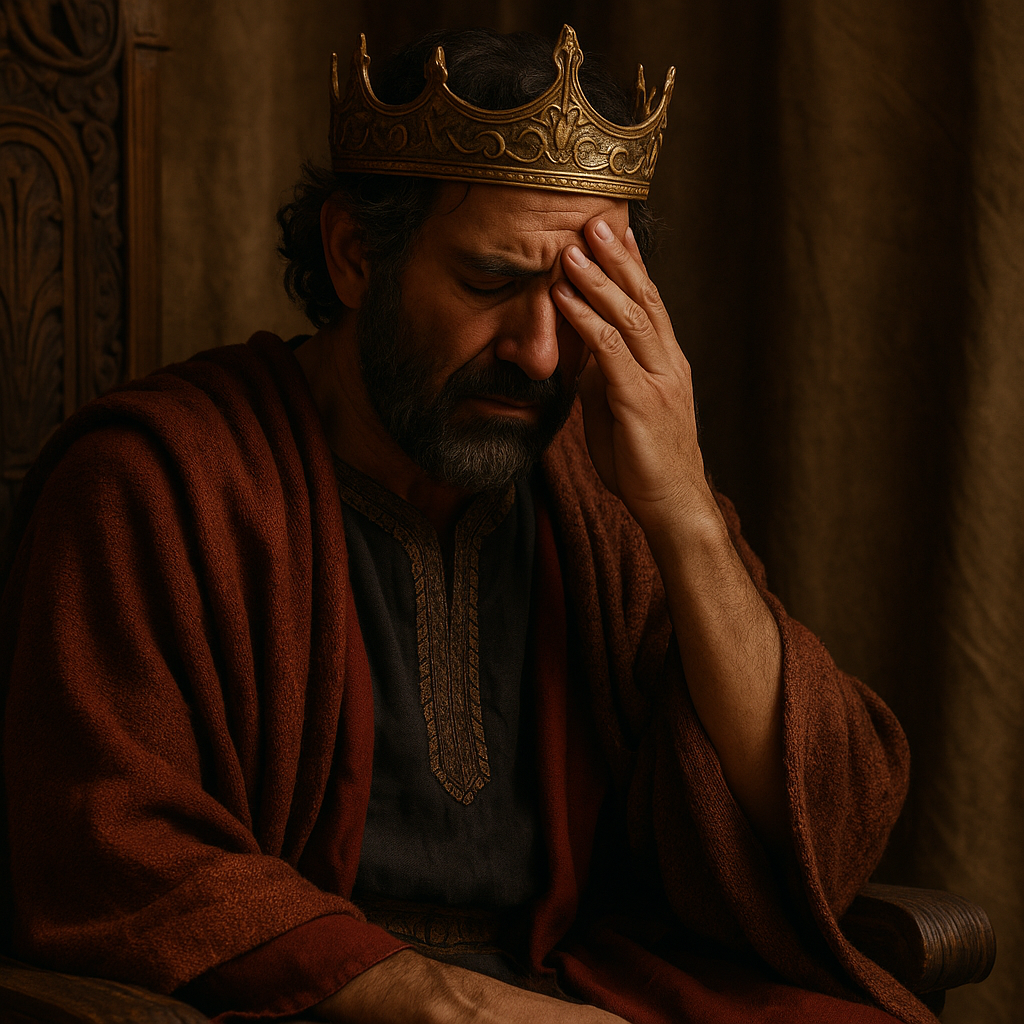
2 Samuel Study – Set 1 (Chapters 1–5)
David’s Rise to Kingship: Grief, Grace, and the Establishment of God’s Anointed
1. Summary of the Chapters
- Chapter 1 – David Mourns Saul and Jonathan:
A messenger comes to David reporting Saul and Jonathan’s deaths.
Instead of rejoicing, David tears his clothes, fasts, and weeps.
He honours Saul — the man who hunted him — and composes “The Song of the Bow” to lament their loss.
David’s grief shows his heart’s purity and his refusal to let bitterness define him. - Chapter 2 – David Anointed King of Judah:
Following God’s instruction, David goes to Hebron and is anointed king — but only over Judah.
Meanwhile, Saul’s commander Abner sets up Saul’s son Ish-Bosheth as king over the rest of Israel, creating a divided kingdom.
Conflict erupts between David’s men and Abner’s, marking the beginning of a long civil struggle. - Chapter 3 – The War Between the Houses:
As the war continues, “David grew stronger, and the house of Saul grew weaker.”
Abner, offended by Ish-Bosheth’s accusations, defects to David’s side and promises to unite Israel under his rule.
But Joab, David’s commander, murders Abner out of revenge.
David mourns Abner publicly, refusing to let vengeance pollute his leadership. - Chapter 4 – Ish-Bosheth’s Death:
Two men assassinate Ish-Bosheth, hoping to gain David’s favour.
Instead, David condemns them and has them executed for their treachery.
He honours Ish-Bosheth in death, demonstrating again that his kingship rests on righteousness, not ambition. - Chapter 5 – David Becomes King Over All Israel:
At last, all the tribes come to Hebron and anoint David as king.
He captures Jerusalem, making it his capital, and calls it the City of David.
The Lord is with him, and his reign begins in divine strength — founded on humility and dependence on God’s presence.
2. Key Themes and Lessons
| Theme | Lesson |
|---|---|
| Grace Over Revenge | David’s mercy toward Saul’s house reveals a heart shaped by God’s love. |
| Righteous Leadership | True authority is established through integrity, not ambition. |
| God’s Timing | David waited years for this moment — showing that waiting never wastes time in God’s plan. |
| Unity in the Spirit | The uniting of Israel under one king foreshadows Christ’s unifying work in His Church. |
| God’s Presence as Foundation | David’s success flows from living under the Lord’s favour, not his own strength. |
3. Encouragement
Oh, this beginning of 2 Samuel — it’s pure beauty!
You see what the Kingdom looks like when a man’s heart is ruled by love, not offence.
Saul spent years trying to destroy David, and yet when Saul dies, David weeps.
Why? Because love never celebrates someone’s fall.
That’s what a heart after God looks like — it keeps honour even when wronged.
And look at how David rises — slowly, righteously, with no shortcuts.
He’s not climbing the ladder; he’s walking the path God carved.
So often, we want to force open doors, but when God opens them, you don’t have to fight to keep them open.
David’s refusal to take vengeance, his patience, and his deep compassion are all proof of maturity —
the kind that only grows in caves.
You don’t get this kind of heart by winning battles; you get it by surrendering in secret.
And when David finally takes the throne, he doesn’t boast — he builds.
He captures Jerusalem, not to make his name great, but to establish a place for God’s name.
That’s the Kingdom way: God’s glory first, always.
So here’s the truth —
Don’t push for promotion; prepare for it.
Don’t live reacting to others; live responding to God.
And when your time comes, rule from love, not from pain.
Because when your identity’s rooted in God, your influence will heal, not hurt.
4. Reflection Questions
- How do I respond when those who hurt me experience hardship or loss?
- In what ways might God be asking me to wait rather than push ahead?
- How can I model David’s mercy and integrity in leadership or relationships?
- What does it look like for me to build “Jerusalem” in my own life — a place where God’s presence reigns first?
- Am I allowing past wounds to shape my actions, or am I letting God’s love define my future?
2 Samuel Study – Set 2 (Chapters 6–10)
The Ark of God, the Covenant of Grace, and the Victorious Kingdom
1. Summary of the Chapters
- Chapter 6 – The Ark Brought to Jerusalem:
David longs to bring the Ark of the Covenant — the symbol of God’s presence — into Jerusalem.
But when Uzzah touches it irreverently, he dies instantly. David, stunned and afraid, halts the procession.
Three months later, seeing the blessings on Obed-Edom’s household where the Ark rested, David realises the Ark represents life, not danger, when approached with reverence.
He brings it to Jerusalem with joyful dancing, wearing a linen ephod. His wife Michal despises him for it, but David declares:
“I will become even more undignified than this!”
It’s a powerful picture of worship born from love, not formality.
- Chapter 7 – God’s Covenant with David:
David desires to build a house for God, but God flips the script — He promises to build David’s house instead.
Through the prophet Nathan, God declares:
“Your house and your kingdom will endure forever before Me; your throne will be established forever.”
This becomes one of the greatest covenants in Scripture — fulfilled ultimately in Jesus Christ, the Son of David.
David responds with a prayer of humility and awe, acknowledging God’s faithfulness.
- Chapter 8 – David’s Victories:
David wins victory after victory over Israel’s enemies — Philistines, Moabites, Syrians, and Edomites.
He reigns with justice and righteousness, fulfilling his calling as a king under God’s authority.
The chapter concludes:
“The Lord gave David victory wherever he went.”
This reflects that his success is not from might, but from the favour of God.
- Chapter 9 – David and Mephibosheth:
David seeks to show kindness to anyone left of Saul’s house for Jonathan’s sake.
He finds Mephibosheth, Jonathan’s crippled son, and restores to him all of Saul’s land, inviting him to eat continually at the king’s table.
This scene is a breathtaking picture of grace and covenant love — a reflection of how God invites us, once broken and undeserving, to dine continually at His table. - Chapter 10 – Victory Over Ammon and Aram:
David sends envoys to comfort the Ammonite king, but they are humiliated.
The Ammonites and Arameans wage war against Israel but are defeated.
Even amid misunderstanding and hostility, David’s kingdom remains strong because God’s hand rests upon him.
2. Key Themes and Lessons
| Theme | Lesson |
|---|---|
| The Presence of God | God’s presence is both holy and life-giving — to be approached with reverence and joy. |
| Covenant Relationship | God’s promises to David reveal His faithfulness and His plan for eternal redemption. |
| Worship and Humility | True worship flows from love and freedom, not fear or appearance. |
| Grace Toward the Broken | David’s kindness to Mephibosheth reflects the heart of God toward His children. |
| Divine Favour in Obedience | When we walk under God’s authority, His victories become ours. |
3. Encouragement
Oh, I love these chapters! This is the Kingdom in full bloom —
worship, covenant, grace, and victory all flowing from one thing: relationship!
David’s not chasing blessings — he’s chasing presence.
The Ark isn’t about power; it’s about God-with-us.
And when Uzzah touches it, it’s not punishment for effort — it’s a revelation of holiness.
God’s presence isn’t a thing to control; it’s a heart to honour.
Then David’s dancing — come on! That’s what love looks like when it’s unashamed.
He’s not thinking about who’s watching — he’s thinking about Who’s worthy.
That’s freedom! And Michal misses it because she’s more focused on dignity than devotion.
Don’t ever let the fear of people silence your praise.
And that covenant in Chapter 7 — wow.
God flips the script: David wants to build for God, but God says, ‘No, I’ll build through you.’
That’s grace. That’s the Gospel. God’s always the initiator of love.
Then Mephibosheth — oh, that scene gets me every time.
Broken, forgotten, crippled — and the king says, ‘Bring him to my table.’
That’s you and me! We had nothing to offer, but Jesus said, ‘You belong here. Sit and eat.’
It’s the heart of redemption — mercy pulling up a chair for the undeserving.
So what’s the takeaway?
Celebrate His presence, not your performance.
Worship like no one’s watching.
Treat others with the same grace you’ve been shown.
And never forget — every victory, every blessing, every breath flows from covenant love.
Because once grace finds you, you’ll never live from fear again.
4. Reflection Questions
- What does the Ark’s story teach me about honouring God’s presence in my own life?
- How can I worship with the same freedom and humility as David?
- In what ways has God “built my house” instead of me trying to build His?
- Who in my life needs to experience the kind of covenant kindness David showed to Mephibosheth?
- How can I live from God’s favour without striving — simply walking in His presence and trust?
2 Samuel Study – Set 3 (Chapters 11–15)
The Fall, Repentance, and Restoration of the Heart
1. Summary of the Chapters
- Chapter 11 – David and Bathsheba:
While his army is at war, David remains in Jerusalem. From his rooftop, he sees Bathsheba, the wife of Uriah, bathing.
He sends for her, commits adultery, and later learns she is pregnant.
To cover his sin, David brings Uriah home, hoping he’ll sleep with his wife — but Uriah refuses, honouring his fellow soldiers still in battle.
David then orders Uriah placed on the front line, where he is killed.
The chapter ends chillingly:
“But the thing David had done displeased the Lord.”
- Chapter 12 – Nathan Confronts David:
God sends the prophet Nathan with a parable about a rich man who steals a poor man’s lamb. David is outraged — until Nathan declares, “You are the man!”
David’s sin is exposed, and though judgment is pronounced, David immediately confesses:
“I have sinned against the Lord.”
Nathan tells him his life will be spared, but the child born to Bathsheba dies.
David grieves, then worships, saying, “I will go to him, but he will not return to me.”
Later, Bathsheba bears another son — Solomon, whom God loves.
- Chapter 13 – Amnon and Tamar:
David’s son Amnon violates his half-sister Tamar, and David, though furious, does nothing.
Tamar’s brother Absalom bides his time and eventually kills Amnon in revenge.
Absalom flees, and the family fracture deepens — the seeds of David’s sin bear bitter fruit in his household. - Chapter 14 – Absalom’s Return:
Through Joab’s mediation, Absalom returns to Jerusalem but is not welcomed into David’s presence for two years.
Eventually, David kisses his son — a fragile reconciliation without true repentance. - Chapter 15 – Absalom’s Rebellion:
Absalom wins the hearts of the people and declares himself king.
David, betrayed by his son, flees Jerusalem barefoot and weeping.
Shimei curses him along the way, but David restrains his men, saying, “Let him curse; it may be that the Lord will look upon my affliction.”
David’s humility in sorrow reveals that even in failure, his heart remains tender toward God.
2. Key Themes and Lessons
| Theme | Lesson |
|---|---|
| The Deceptive Nature of Sin | Temptation begins subtly but destroys deeply when left unchecked. |
| The Power of Repentance | Genuine repentance restores relationship, even when consequences remain. |
| The Ripple Effect of Choices | Sin doesn’t stay private — it spreads through generations if unaddressed. |
| Mercy in Judgment | Even in correction, God’s mercy prevails and offers hope of restoration. |
| Brokenness Before God | True humility accepts discipline and seeks fellowship, not justification. |
3. Encouragement
Oh, this part of David’s story — it’s heavy, but it’s full of redemption if you see through God’s eyes.
David was on the mountain — victories, favour, worship — but in one moment of compromise, everything crumbles. Why?
Because when we take our eyes off relationship, our desires start steering the ship.
But I love how God doesn’t leave him there. He sends Nathan — not to destroy him, but to rescue him!
That’s mercy in action. God’s correction isn’t rejection — it’s restoration.
And David — come on, look at his heart.
He doesn’t argue, doesn’t justify — he breaks. ‘I have sinned against the Lord.’
That’s not guilt talking — that’s love realising it hurt Love.
That’s what repentance is: not just sorrow for wrong, but sorrow for distance.
Even when the consequences come, David worships. Wow. He worships in loss.
That’s what a man after God’s heart does — he runs to God, not from Him.
But here’s the thing — sin still ripples. We see it in Amnon, Tamar, Absalom.
Pain repeats where healing hasn’t been received.
Yet through all that brokenness, God’s covenant doesn’t crumble.
Solomon’s born, and through that line comes Jesus — redemption Himself.
That’s the Gospel right there — God writing mercy into the middle of our mess.
So what’s the takeaway?
Guard your heart when things are easy — temptation thrives in comfort.
When you fall, run to God, not away.
Let conviction lead you to cleansing, not condemnation.
And never forget — grace isn’t a pass for sin, it’s power to live free from it.
Because even after the fall, God’s still saying, ‘I’m not done with you.’
4. Reflection Questions
- What patterns of compromise do I need to confront honestly before they take root?
- How do I respond when God exposes an area of sin — with defence or repentance?
- What can David’s humility after failure teach me about true relationship with God?
- In what ways might my choices influence those who look up to me or follow me?
- How can I receive God’s mercy deeply enough that it transforms rather than merely comforts?
2 Samuel Study – Set 4 (Chapters 16–20)
Absalom’s Rebellion, David’s Return, and the Restoration of the Kingdom
1. Summary of the Chapters
- Chapter 16 – David’s Humility in Exile:
As David flees from Absalom, he meets Ziba, who deceives him about Mephibosheth’s loyalty, and Shimei, who curses him publicly, calling him a man of blood.
David’s men want to strike Shimei down, but David refuses, saying:
“Let him curse; perhaps the Lord will look upon my misery and restore me.”
David’s heart posture reveals deep humility — even in humiliation, he trusts God’s justice.
- Chapter 17 – Absalom’s Counsel:
Absalom listens to Ahithophel’s advice to pursue David immediately, but God turns Absalom’s heart to favour Hushai’s opposing counsel, who secretly works for David.
This divine intervention gives David time to regroup, showing that even in rebellion, God is still orchestrating protection for His anointed. - Chapter 18 – The Death of Absalom:
David’s forces defeat Absalom’s army in the forest of Ephraim.
During the battle, Absalom’s hair catches in a tree, and Joab kills him against David’s command to “deal gently” with his son.
When David hears of Absalom’s death, he weeps uncontrollably, crying:
“O my son Absalom! My son, my son Absalom! If only I had died instead of you!”
This moment exposes David’s father-heart and the tragic cost of sin’s ripple effect.
- Chapter 19 – David’s Return to Jerusalem:
Joab rebukes David for excessive mourning, reminding him that victory has been won.
David resumes leadership and shows mercy to his enemies — sparing Shimei, restoring Mephibosheth, and honouring Barzillai the Gileadite for his loyalty.
His forgiveness and grace toward former adversaries reveal a heart anchored in God’s compassion. - Chapter 20 – Sheba’s Rebellion:
A man named Sheba stirs another uprising, declaring, “We have no share in David!”
Joab pursues him, and the revolt ends when Sheba is executed in Abel.
The nation is finally restored to order, and David’s reign is re-established — but scarred by the pain of what disunity and pride can cost.
2. Key Themes and Lessons
| Theme | Lesson |
|---|---|
| Humility Under Fire | When falsely accused or cursed, humility invites God’s vindication. |
| God’s Sovereign Protection | Even betrayal cannot overturn God’s promises or providence. |
| Mercy Over Judgment | Forgiveness reflects the heart of God more than vengeance ever can. |
| The Pain of Rebellion | Pride divides, but repentance restores. |
| Leadership Through Compassion | True authority is exercised through grace, not domination. |
3. Encouragement
Oh, this section breaks your heart and heals it all at once —
because it’s raw, real, and full of God’s mercy shining through human pain.
David’s not sitting on a throne here — he’s walking barefoot in sorrow, being cursed and betrayed.
But what’s he do? He doesn’t fight back; he surrenders. Why? Because he knows God’s the Judge.
That’s maturity — when you don’t need to defend yourself because you know Who defends you.
And look at that moment with Shimei — come on!
Most kings would’ve silenced him in a heartbeat, but David says, ‘Let him curse; maybe God will look and bless me instead.’
That’s Kingdom perspective! He’s more interested in his heart staying right than in being right.
Then Absalom — oh, what pain. A son betraying his father.
And even though Absalom’s rebellion costs thousands of lives, David still cries, ‘If only I had died instead of you!’
That’s a picture of the Father’s love — it’s Jesus crying over humanity. It’s mercy weeping over rebellion.
When David returns, he doesn’t take revenge. He restores. He forgives.
That’s what love looks like when it’s tested and proven.
Grace doesn’t ignore wrong; it overcomes it with goodness.
So what’s the message?
Don’t waste your wilderness defending your reputation — let God do that.
When people curse, keep your heart soft.
When rebellion breaks your heart, let it drive you deeper into God’s.
And when God restores you, let mercy be your throne.
Because love wins more battles than pride ever will.
4. Reflection Questions
- How do I respond when I’m wronged, misunderstood, or falsely accused?
- What does David’s reaction to Shimei teach me about humility and trust in God’s justice?
- How can I reflect God’s mercy toward those who have betrayed or hurt me?
- Where do I need to let go of pride and invite unity back into my relationships or community?
- What might God be teaching me through seasons of exile, loss, or waiting for restoration?
2 Samuel Study – Set 5 (Chapters 21–24)
Restoration, Worship, and God’s Unfailing Covenant
1. Summary of the Chapters
- Chapter 21 – Justice and Mercy in the Land:
A famine strikes Israel for three years, and God reveals it’s due to Saul’s unatoned violence against the Gibeonites.
David makes restitution, giving seven of Saul’s descendants to the Gibeonites for justice.
Afterward, God heals the land.
The chapter closes with heroic accounts of David’s warriors defeating giants — a reminder that God’s promises of protection and victory still stand. - Chapter 22 – David’s Song of Deliverance:
David sings a long, beautiful psalm of praise to God for rescuing him from his enemies.
It mirrors Psalm 18 and overflows with gratitude:
“The Lord is my rock, my fortress, and my deliverer.”
He celebrates God’s faithfulness through every storm — from caves to crowns — acknowledging that God’s strength made him strong, and God’s mercy made him safe.
- Chapter 23 – David’s Last Words and Mighty Men:
David declares his final words — a prophetic reflection of God’s covenant faithfulness:
“The God of Israel spoke… He who rules over men must be just, ruling in the fear of God.”
He honours his mighty men — loyal warriors who risked their lives for him.
This chapter reminds us that even a king depends on others and that legacy is built through shared devotion and courage.
- Chapter 24 – David’s Census and the Altar of Mercy:
In a moment of pride, David orders a census of Israel, counting his strength instead of trusting God’s.
Afterward, his conscience is stricken. He confesses and chooses to fall into the hands of God rather than man.
A devastating plague sweeps the land, but when David builds an altar on the threshing floor of Araunah, the plague stops.
That site — Mount Moriah — will later become the location of Solomon’s Temple, the symbol of God’s dwelling with His people.
Even in judgment, God’s mercy triumphs, reminding us that sacrifice and repentance restore fellowship with Him.
2. Key Themes and Lessons
| Theme | Lesson |
|---|---|
| God’s Justice and Mercy | True restoration requires both righteousness and grace. |
| Gratitude and Worship | Praise anchors the heart in remembrance of God’s faithfulness. |
| Legacy and Leadership | The Kingdom thrives on loyalty, humility, and shared courage. |
| Pride vs. Dependence | Counting our own strength leads to loss; trusting God brings restoration. |
| Covenant Faithfulness | God’s promises stand firm even when His people stumble. |
3. Encouragement
Oh, what a way to close this story — it’s full of redemption! You can feel God’s heart through every line.
First the famine — it’s not punishment, it’s correction. God’s calling Israel back to justice.
See, His heart is never to destroy — it’s to restore alignment.
When David makes things right, blessing flows again.
That’s how repentance works — it clears the way for grace to reign.
Then that song in chapter 22 — come on! You can feel David’s gratitude pulsing through every word.
He’s not thanking God for a perfect life — he’s thanking Him for constant presence. ‘The Lord is my rock.’
That’s not theory — that’s testimony!
You’ve got to know your God like that: not distant, but daily; not abstract, but alive.
And those mighty men — oh, what a picture of Kingdom community!
No one becomes great alone. David’s story isn’t just about a man and his God —
it’s about a family of faith who risk everything for love. That’s the Body of Christ. That’s covenant loyalty.
Then the census — wow, what a mirror moment. Pride creeps in even for the humble.
But look at how David responds — he falls on mercy!
‘Let me fall into the hands of the Lord, for His mercy is great.’
That’s the heart that never disqualifies itself — repentance that runs back to love.
And that threshing floor — come on, that’s prophetic!
The very place of broken grain becomes the site of God’s dwelling.
That’s what He does with our hearts — He turns the place of breaking into the altar of His presence.
So here’s the takeaway, sister:
Don’t be afraid of correction — it’s God’s love in disguise.
Never stop thanking Him — gratitude keeps your heart alive.
Surround yourself with covenant people — love thrives in unity.
And when pride whispers, fall on mercy — because His hands always catch you.
The throne was David’s position, but worship was his posture.
And that’s how the story ends — with mercy reigning where sin once ruled.
4. Reflection Questions
- How do I respond when God reveals areas in need of correction — with fear or faith?
- What “songs of deliverance” could I sing to remember God’s faithfulness in my own journey?
- Who are my “mighty men and women” — the people God has placed in my life for Kingdom partnership?
- Where might pride be tempting me to rely on self instead of God’s sufficiency?
- How can I turn my own “threshing floors” — places of breaking or loss — into altars of worship and surrender?
Book of 2 Samuel – Overview Summary
Theme: The Reign of the Anointed King — Falling, Rising, and Restored by Grace
1. Summary of the Book
The Book of 2 Samuel opens in lament and closes in worship — a breathtaking journey of the human heart learning to walk with a holy and merciful God.
After the deaths of Saul and Jonathan, David rises from exile to become king over all Israel. His leadership brings unity, victory, and peace. He captures Jerusalem, brings the Ark of God into the city, and establishes his throne on the foundation of worship and obedience.
God rewards David’s humility with one of the most profound covenants in Scripture — promising that his throne will endure forever through his lineage, fulfilled ultimately in Jesus Christ, the Son of David.
Under David’s leadership, Israel becomes a flourishing kingdom marked by justice, righteousness, and favour.
But even the greatest hearts are vulnerable when comfort replaces dependence.
David’s sin with Bathsheba and the murder of Uriah mark a dark turning point. His repentance is deep and genuine, yet the consequences ripple through his family — bringing tragedy, betrayal, and heartbreak.
Absalom’s rebellion tests David’s humility and faith. Even when driven from his throne, David chooses mercy over vengeance, trusting God to restore what is lost.
Through sorrow and loss, his character is refined — proving that God’s covenant love remains stronger than human failure.
The book closes with David’s psalm of thanksgiving, his last words, and the purchase of a threshing floor that will one day become the site of Solomon’s Temple.
From that place of repentance and worship, God’s story of redemption continues — revealing that His Kingdom is not built on perfection but on broken hearts made whole through grace.
2. Key Themes and Lessons
| Theme | Lesson |
|---|---|
| God’s Covenant Faithfulness | God’s promises stand unbroken, even when His people fall. |
| The Power of Worship | True strength is found in humility, surrender, and continual praise. |
| The Consequences of Sin | Grace forgives, but disobedience still bears fruit — teaching holiness and reverence. |
| Repentance and Restoration | God delights to restore those who return to Him with sincerity. |
| Mercy Over Vengeance | David’s response to enemies and rebels reveals God’s heart of forgiveness. |
| God’s Sovereignty | Even rebellion and pain serve His redemptive purpose. |
| Leadership Through Love | The greatest authority flows from compassion and dependence on God. |
3. Encouragement
Oh, I love this book — it’s the Gospel in motion!
It’s not just history; it’s a revelation of a Father who never gives up on His children.
Look at David — from shepherd to king, from caves to crowns.
He’s a picture of every believer’s journey — chosen, called, refined, and redeemed.
But here’s the beauty: God doesn’t define him by his failure; He defines him by His covenant.
When David falls, God doesn’t destroy him — He restores him. That’s what mercy looks like!
Grace doesn’t pretend sin didn’t happen — it steps right into the middle of it and redeems it.
You see, God’s not afraid of your mess — He’s committed to your transformation.
And when David sings, ‘The Lord is my rock,’ he’s not quoting a theology — he’s declaring testimony!
He’s saying, ‘I’ve been weak, I’ve been wrong, I’ve been broken, but I’ve met a love that never lets go.’
That’s the kind of love that changes everything.
Even in his discipline, God’s mercy shines. The threshing floor becomes an altar. The pain becomes worship.
That’s what happens when your heart belongs to Him — nothing gets wasted.
So what’s the takeaway, friend?
Don’t let your failures tell you who you are — let His faithfulness do that.
When life breaks you, build an altar.
When you fall, fall into His arms.
And when He restores you, sing again — louder than before.
Because 2 Samuel isn’t the story of a perfect king —
it’s the story of a perfect God writing redemption through a surrendered heart.
And that same God is writing through you.
4. Reflection Questions
- How can I keep my heart humble and dependent on God in seasons of success or favour?
- What does David’s repentance teach me about trusting God’s mercy after failure?
- How can I lead others — in my home, work, or community — with the same compassion and integrity David modelled?
- Where do I need to build an “altar” in my own life — turning pain or pride into worship?
- How can I live each day conscious of God’s covenant faithfulness, even when I stumble?