
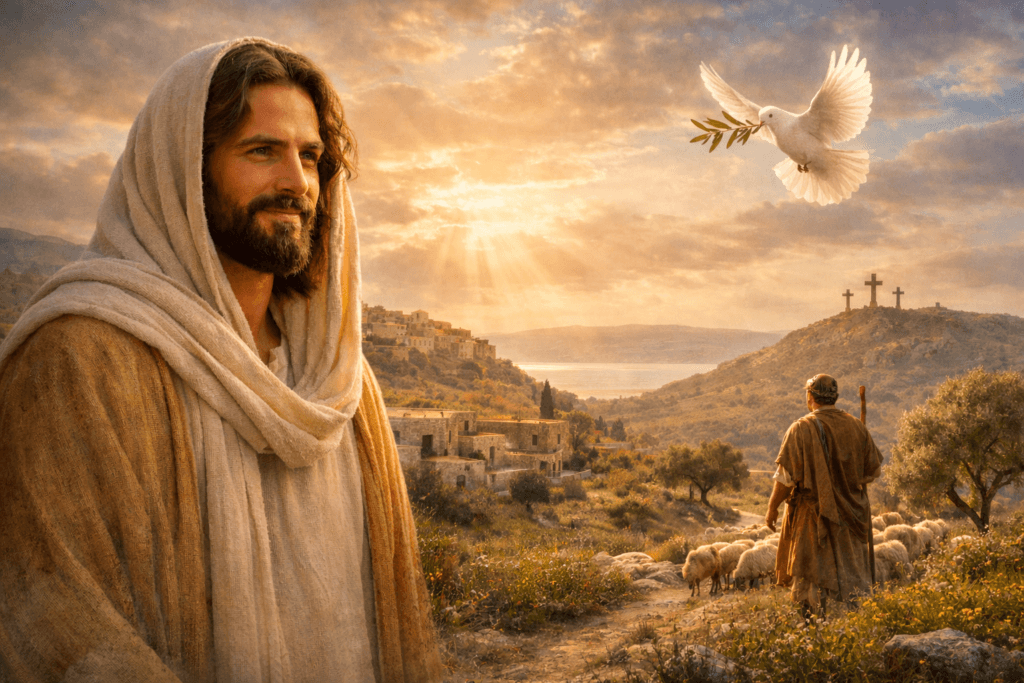
In the Power of the Spirit …
Welcome to the Luke study hub — a place to encounter Jesus not only as King and Teacher, but as the compassionate Saviour who draws near to the broken, the overlooked, and the weary.
Below, you will find free study notes for each chapter of the Gospel of Luke, written through the lens of becoming completely transformed — not simply learning about Jesus’ miracles and parables, but allowing His mercy, truth, and love to reshape your identity, restore your heart, and realign your life with God’s original design.
These chapters have been my own personal pathway of healing and revelation, walked slowly and prayerfully with the Holy Spirit as my Teacher. They are offered freely to help you see Jesus as He truly is — the One who moves toward suffering, lifts the humble, welcomes the outsider, and reveals the Father’s heart to all who will receive Him.
For those who desire to go even deeper, you will also find optional companion resources available for purchase, including printable workbooks, guided journals, and heart-transformation tools designed to help you reflect, apply, and live out the truths revealed in each chapter.
May this be more than a study of stories — May it be an encounter with mercy.
May it awaken hope, restore dignity, and anchor your heart in the unwavering love of God.
May it draw you into deeper intimacy with the One who came to seek and save the lost.
With love,
Nicola 💖
Luke 1 — Promise, Preparation, and God’s Faithful Timing
Summary of the Chapter
Luke 1 opens the Gospel with a sweeping sense of holy anticipation — revealing a God who keeps His promises, moves in quiet faithfulness, and prepares hearts long before public miracles unfold.
The chapter begins with the angel Gabriel appearing to Zechariah, a priest, announcing that his elderly wife Elizabeth will bear a son — John the Baptist — who will prepare the way for the Lord. Zechariah struggles to believe because of their age. His doubt does not cancel God’s promise, but it does limit his voice. He becomes silent until the word is fulfilled. God’s plans move forward even when faith wavers.
Six months later, the angel Gabriel visits Mary, a young virgin, announcing that she will conceive by the Holy Spirit and give birth to the Son of God. Unlike Zechariah, Mary responds not with fear or resistance, but surrendered trust: “Let it be to me according to Your word.”
Her humility opens the door for the incarnation — God stepping fully into human history.
Mary visits Elizabeth, and the unborn John leaps in Elizabeth’s womb. Both women are filled with the Holy Spirit. What is hidden in the womb is already recognised in the spirit. Elizabeth blesses Mary, affirming her faith.
Mary then pours out her soul in worship through the Magnificat — a song of praise declaring God’s mercy, justice, faithfulness, and heart for the humble. She magnifies the Lord not because her circumstances are easy, but because her heart is surrendered.
The chapter closes with the birth of John the Baptist. Zechariah’s speech is restored as he names his son John, in obedience to God’s instruction. He immediately prophesies about God’s redemption, mercy, and the coming Messiah. John grows strong in spirit, hidden in the wilderness, preparing quietly for his public calling.
Luke 1 reveals a God who moves through surrendered hearts, hidden seasons, and faithful obedience — long before visible fulfilment appears.
Key Themes & Lessons
| Theme | Lesson for Heart Transformation |
|---|---|
| God’s Faithful Promises | What God speaks will always come to pass. |
| Surrendered Obedience | God moves powerfully through humble “yes” responses. |
| Hidden Preparation | Growth often happens quietly before public calling. |
| Faith vs Doubt | Doubt delays joy, but never cancels destiny. |
| The Power of Worship | Praise flows from trust, not circumstance. |
| Holy Spirit Empowerment | God’s Spirit activates joy, revelation, and purpose. |
| Generational Calling | God weaves destiny through family lines. |
Encouragement
Sister, Luke 1 speaks gently to hearts that are waiting, wondering, or walking through quiet seasons of preparation.
God is not slow.
He is faithful.
Promises are unfolding even when you cannot yet see them.
Mary’s story reminds you that your surrender matters more than your qualifications.
Elizabeth’s story reminds you that no season is too late for God to move.
Zechariah’s story reminds you that doubt does not disqualify destiny — but trust unlocks joy.
If you feel hidden right now, remember this:
God is forming something holy within you.
Your obedience matters.
Your waiting matters.
Your quiet faith matters.
Heaven is nearer than you think.
And God’s timing is always perfect.
Reflection Questions
- Where might God be inviting me into deeper trust and surrender?
- What promises am I waiting to see fulfilled in my life?
- How do I respond when God’s plans stretch beyond my understanding?
- What hidden season might God be using to prepare my heart right now?
- How can I cultivate worship and gratitude while I am still waiting?
Luke 2 — Glory, Humility, and God’s Nearness
Summary of the Chapter
Luke 2 reveals one of the most breathtaking truths in all of Scripture — God comes near in humility, not spectacle.
The chapter opens with a global decree from Caesar Augustus requiring a census. What appears to be political bureaucracy is actually divine orchestration. God uses earthly systems to position Mary and Joseph exactly where prophecy must be fulfilled — in Bethlehem.
Mary gives birth to Jesus in a stable and lays Him in a manger. The Saviour of the world enters history not in a palace, but in poverty. Heaven’s greatest gift is wrapped in humility.
Nearby shepherds — ordinary, overlooked workers — receive an angelic visitation. The angel announces:
“Today in the town of David a Saviour has been born to you; He is the Messiah, the Lord.”
Suddenly, a multitude of heavenly hosts fills the sky, praising God:
“Glory to God in the highest heaven, and on earth peace to those on whom His favour rests.”
The shepherds rush to Bethlehem and find everything exactly as told. They become the first witnesses of the Messiah and leave glorifying God. God entrusts the greatest revelation not to royalty or scholars, but to the humble and available.
Eight days later, Jesus is circumcised and named. Then Mary and Joseph present Him at the temple. Simeon, a righteous man waiting for Israel’s consolation, recognises Jesus immediately. He prophesies both glory and sorrow — blessing Mary while foretelling the cost her heart will bear.
Anna, a prophetess who has served God faithfully for decades, also recognises Jesus. Her lifelong devotion culminates in a moment of fulfilled hope. Waiting is never wasted in God’s economy.
The chapter closes with a rare glimpse into Jesus’ childhood. At twelve years old, He remains behind at the temple, absorbed in His Father’s house. When Mary questions Him anxiously, He responds gently:
“Did you not know that I must be about My Father’s business?”
Yet He returns home in obedience and continues growing in wisdom, stature, and favour with God and people.
Luke 2 reveals that God’s glory is most often hidden in simplicity — and His nearness is always closer than we expect.
Key Themes & Lessons
| Theme | Lesson for Heart Transformation |
|---|---|
| God’s Humble Arrival | God reveals Himself through humility, not spectacle. |
| Divine Orchestration | God works through ordinary circumstances to fulfil prophecy. |
| Nearness of God | Heaven comes close to humanity in Jesus. |
| God’s Favour | Peace flows from knowing God’s delight rests upon you. |
| Faithful Waiting | God honours those who wait with devotion. |
| Witness and Worship | Encounter always leads to praise and testimony. |
| Growing in Identity | Jesus models surrendered growth in wisdom and obedience. |
Encouragement
Sister, Luke 2 whispers hope into every place where you feel unseen, small, or overlooked.
God did not come wrapped in power — He came wrapped in tenderness.
He did not arrive through privilege — He arrived through humility.
And He did not reveal Himself to the powerful first — He revealed Himself to the humble.
If you feel hidden right now, this chapter speaks your name.
God is nearer than you think.
He is working through ordinary moments.
He is fulfilling promises through quiet obedience.
Your simple “yes” matters more than you know.
Glory is not far away — It is resting gently in surrendered hearts.
Reflection Questions
- How does Jesus’ humble birth reshape my understanding of God’s nature?
- Where might God be working quietly in my ordinary circumstances?
- What does faithful waiting look like in my current season?
- How can I respond to God’s nearness with worship and trust?
- In what ways might God be inviting me to grow in wisdom, humility, and obedience?
Luke 3 — Repentance, Identity, and God’s Affirming Voice
Summary of the Chapter
Luke 3 marks the powerful transition from hidden preparation to public awakening — revealing how transformation begins with repentance and is anchored in identity.
The chapter opens by situating John the Baptist’s ministry within a real historical moment. God’s word does not arrive in isolation — it enters broken political, social, and spiritual systems with redemptive purpose.
John appears in the wilderness preaching a baptism of repentance for the forgiveness of sins. His message is not about condemnation, but preparation. Repentance is not shame-driven — it is heart-turning. It is an invitation to realign with God’s truth and make room for what He is about to do.
John quotes Isaiah, declaring that every valley will be filled, every mountain brought low, crooked places made straight, and rough places smoothed. God is not merely fixing behaviour — He is reshaping hearts and removing internal obstacles that block transformation.
Crowds respond, asking, “What then shall we do?”
John gives practical, relational answers:
• Share with those in need
• Act with integrity
• Stop exploiting others
• Be content, not greedy
• Live honestly in everyday life
Repentance is revealed not as religious ritual, but as transformed living.
Some begin to wonder if John himself is the Messiah. He quickly redirects all glory away from himself and toward Jesus, declaring that the One coming after him will baptise with the Holy Spirit and fire — a deeper work of inner transformation.
The chapter then turns to Jesus’ baptism. As Jesus comes up out of the water, heaven opens. The Holy Spirit descends on Him in bodily form like a dove. And the Father’s voice declares:
“You are My beloved Son; in You I am well pleased.”
This moment is not the beginning of Jesus’ worth — it is the revelation of it. Jesus receives affirmation before performing a single miracle.
The chapter closes with Jesus’ genealogy, tracing His lineage all the way back to Adam. This reveals that Jesus is not only Israel’s Messiah — He is the Son of Man, the Redeemer of all humanity.
Luke 3 reveals that repentance prepares the way for identity — and identity anchors us in divine purpose.
Key Themes & Lessons
| Theme | Lesson for Heart Transformation |
|---|---|
| Repentance as Realignment | Turning toward God opens the heart for transformation. |
| Practical Obedience | Changed hearts produce changed lives. |
| Preparation for Revival | God moves powerfully through prepared hearts. |
| Identity Before Performance | God affirms who you are before what you do. |
| Holy Spirit Empowerment | God’s Spirit marks and empowers divine calling. |
| Humble Leadership | True leaders point away from themselves to Jesus. |
| Universal Redemption | Jesus came to restore all humanity. |
Encouragement
Sister, Luke 3 gently invites you into freedom through repentance — not as punishment, but as restoration.
Repentance is not about fixing yourself.
It is about aligning yourself with truth.
It is not about shame.
It is about renewal.
And when you turn your heart toward God, heaven responds.
The same voice that spoke over Jesus now speaks over you:
“You are My beloved daughter. In you I am well pleased.”
Your worth is not earned through effort.
Your identity is not shaped by mistakes.
Your calling is not delayed by past seasons.
God affirms you before assignment.
He delights in you before performance.
He empowers you through His Spirit.
Let repentance prepare your heart — and let identity anchor your life.
Reflection Questions
- What might God be inviting me to realign in my heart or life right now?
- How does understanding repentance as restoration change my perspective?
- Where might God be calling me into practical obedience?
- What does hearing “You are My beloved” awaken within me?
- How can I live from identity rather than striving for approval?
Luke 4 — Testing, Authority, and the Power of God’s Word
Summary of the Chapter
Luke 4 reveals the moment when identity is tested and authority is revealed.
Fresh from His baptism and the Father’s affirmation, Jesus is led by the Holy Spirit into the wilderness to be tested by the devil. This is not punishment — it is preparation. What is affirmed in intimacy must be anchored in obedience.
For forty days, Jesus fasts. When He is physically weak, temptation comes.
The enemy targets three areas:
• provision (turn stones to bread)
• identity (prove You are the Son of God)
• authority (worship for worldly power)
Each time, Jesus responds not with emotion, argument, or fear — but with Scripture. He stands unmoved, rooted in truth. He does not negotiate with lies. He does not perform to prove identity. He does not compromise worship for influence.
Jesus defeats temptation by trusting the Father’s Word over His own hunger, ego, or ambition.
After the devil departs, Jesus returns in the power of the Spirit and begins teaching in synagogues. His reputation spreads quickly. Authority flows naturally from surrender.
Jesus then enters His hometown of Nazareth and reads from Isaiah:
“The Spirit of the Lord is upon Me, because He has anointed Me…”
He declares that this prophecy is now fulfilled in their hearing. At first, the people marvel. But when He speaks truth that confronts their assumptions and pride, admiration turns into outrage. They attempt to throw Him off a cliff.
Jesus passes through the crowd untouched. Purpose cannot be cancelled by rejection.
Jesus continues ministering with unmistakable authority:
• He drives out an unclean spirit
• He heals Peter’s mother-in-law
• He heals the sick
• He delivers the oppressed
People are astonished, saying:
“What is this word? For with authority and power He commands the unclean spirits, and they come out!”
The chapter closes with Jesus withdrawing to a solitary place to pray. Though crowds beg Him to stay, He declares that He must preach the Kingdom in other towns. He refuses to be ruled by popularity or pressure.
Luke 4 reveals that authority flows from intimacy, truth, and surrendered obedience.
Key Themes & Lessons
| Theme | Lesson for Heart Transformation |
|---|---|
| Identity Under Testing | Who you are in God must be anchored before temptation comes. |
| Power of God’s Word | Truth dismantles lies and secures freedom. |
| Authority Through Obedience | Spiritual authority flows from surrendered trust. |
| Rejection and Purpose | God’s calling cannot be cancelled by human offence. |
| Compassion in Action | Authority expresses itself through love and healing. |
| Holy Spirit Power | God’s Spirit empowers Kingdom impact. |
| Solitude and Prayer | Intimacy fuels sustainable ministry. |
Encouragement
Sister, Luke 4 speaks strength into seasons when you feel tested, misunderstood, or spiritually stretched.
Temptation does not mean failure.
Testing does not mean abandonment.
Rejection does not mean disqualification.
Jesus faced temptation right after affirmation — and so will you.
But the same Spirit that led Him into testing also led Him into power.
You are not meant to fight battles with your own strength.
You are meant to stand on truth.
When lies whisper about your worth, speak God’s Word.
When fear questions your calling, trust God’s timing.
When rejection wounds your heart, rest in God’s purpose.
Authority grows where surrender deepens.
God is forming something unshakeable within you.
Reflection Questions
- Where might my identity be under testing right now?
- How can I use God’s Word more intentionally when facing temptation?
- What does surrendered obedience look like in my current season?
- How do I respond when rejection challenges my calling?
- How can I cultivate deeper intimacy with God through prayer and solitude?
Luke 5 — Calling, Surrender, and New Beginnings
Summary of the Chapter
Luke 5 unfolds as a chapter of divine encounters that reshape identity, calling, and destiny.
The chapter opens with Jesus teaching by the Lake of Gennesaret. Crowds press in, hungry for truth. Jesus steps into Simon Peter’s empty fishing boat and teaches from it — revealing that He often enters the very places where disappointment and exhaustion live.
After teaching, Jesus tells Simon to launch out into deep water and let down his nets. Simon, tired and discouraged after a fruitless night, obeys anyway: “Nevertheless, at Your word I will let down the net.”
The result is a miraculous catch so great that the nets begin to break. Awe overtakes fear. Peter falls at Jesus’ feet, overwhelmed by his own unworthiness: “Depart from me, for I am a sinful man, O Lord.”
Jesus responds not with rejection, but with calling: “Do not be afraid. From now on you will catch people.”
Peter, James, and John leave everything and follow Him. Failure becomes the doorway to purpose.
Next, Jesus heals a man with leprosy — touching the untouchable. Compassion dismantles shame. Jesus tells him to show himself to the priest as a testimony. Yet crowds grow even larger. Jesus withdraws into solitude to pray, revealing that intimacy with the Father fuels ministry power.
Then Jesus forgives and heals a paralysed man lowered through a roof by his friends. Jesus first addresses the man’s heart: “Your sins are forgiven.”
When religious leaders accuse Him of blasphemy, Jesus heals the man publicly to reveal His authority to forgive sins. Restoration touches both soul and body.
Jesus then calls Levi (Matthew), a tax collector — a man despised by society. Levi leaves everything and follows Him. At a celebratory feast, Jesus is criticised for eating with sinners. He responds:
“I have not come to call the righteous, but sinners to repentance.”
Finally, Jesus teaches about fasting and new wineskins. He reveals that Kingdom life cannot be contained within old religious frameworks. God is doing something new — and hearts must be flexible to receive it.
Luke 5 reveals a Jesus who steps into emptiness, heals brokenness, forgives sin, calls the unlikely, and invites hearts into a brand-new way of living.
Key Themes & Lessons
| Theme | Lesson for Heart Transformation |
|---|---|
| Obedience in Weariness | Trusting God releases breakthrough even after disappointment. |
| Calling from Brokenness | God calls people through grace, not perfection. |
| Compassion Without Fear | Love reaches into shame and restores dignity. |
| Forgiveness and Healing | God restores both soul and body. |
| Identity Transformation | Encounter reshapes how we see ourselves. |
| Kingdom Flexibility | New life requires new thinking. |
| Intimacy Before Impact | Prayer sustains spiritual authority. |
Encouragement
Sister, Luke 5 speaks hope into every place where you feel tired, unworthy, or unsure of your calling.
Jesus does not wait for you to fix yourself.
He steps into your emptiness and fills it with purpose.
Your weariness does not disqualify you.
Your past does not cancel your calling.
Your obedience, even when tired, opens Heaven.
When you feel like Peter — aware of your weakness — remember this:
Jesus does not call you because you are worthy.
He calls you because He is faithful.
Every act of obedience becomes a doorway to destiny.
Leave the nets.
Follow the voice.
Trust the calling.
God is not finished with you — He is just beginning.
Reflection Questions
- Where might God be inviting me to obey even when I feel tired or discouraged?
- How does Peter’s encounter reshape how I view my own failures?
- What “nets” might God be asking me to release in order to follow Him more fully?
- How does Jesus’ compassion toward sinners and the broken speak into my own story?
- How can I remain flexible and open to the new things God is doing in my life?
Luke 6 — Mercy, Identity, and the Upside-Down Kingdom
Summary of the Chapter
Luke 6 reveals a Kingdom that redefines power, blessing, and righteousness — not through religious control, but through mercy, humility, and transformed hearts.
The chapter opens with controversy. Jesus’ disciples pluck grain on the Sabbath, and religious leaders accuse them of breaking the law. Jesus responds by revealing that the Son of Man is Lord of the Sabbath. Rest is not a rule — it is a gift. God’s heart is not about restriction, but restoration.
Jesus then heals a man with a withered hand on the Sabbath. Though He knows the leaders are watching to accuse Him, He chooses compassion over compliance. Love outranks legalism. Healing reveals God’s true priorities.
Jesus withdraws to a mountain to pray all night before choosing the twelve apostles. This moment reveals that spiritual authority flows from intimacy, not strategy. Calling is born in communion.
Crowds gather from all over, hungry for healing and truth. Power flows from Jesus, healing everyone who touches Him. Brokenness meets mercy. Need meets provision.
Jesus then delivers what is often called the Sermon on the Plain — a radical Kingdom manifesto. He pronounces blessings not on the wealthy, powerful, or admired — but on the poor, the hungry, the grieving, and the rejected. He warns the self-satisfied and proud. God’s Kingdom reverses human values.
Jesus calls His followers to love their enemies, bless those who curse them, and pray for those who mistreat them. He commands radical mercy: “Be merciful, just as your Father is merciful.”
He teaches about judging, generosity, and integrity. What fills the heart overflows into words and actions. Fruit reveals roots.
The chapter closes with the parable of two builders. One builds on rock, the other on sand. The storm comes to both. Only the foundation determines survival.
Luke 6 reveals a Kingdom not built on appearance or religion — but on mercy, obedience, humility, and deep-rooted identity.
Key Themes & Lessons
| Theme | Lesson for Heart Transformation |
|---|---|
| Mercy Over Legalism | God values compassion over rigid rule-keeping. |
| Identity as Sons and Daughters | Blessing flows from relationship, not status. |
| Radical Love | Loving enemies reveals divine nature. |
| Heart Integrity | Inner life shapes outward fruit. |
| Generosity | What you give returns multiplied. |
| Spiritual Foundation | Obedience anchors life in storms. |
| Intimacy Before Calling | Prayer births Kingdom authority. |
Encouragement
Sister, Luke 6 gently yet boldly invites you into a different way of living.
The Kingdom is not about climbing ladders —
It is about lowering hearts.
It is not about proving righteousness —
It is about receiving mercy.
It is not about protecting yourself —
It is about loving others even when it costs you.
Jesus does not call you into religious perfection.
He calls you into heart transformation.
When storms come — and they will —
your foundation matters more than your circumstances.
Build your life on obedience, mercy, and trust.
Let your heart be soft.
Let your love be wide.
Let your roots go deep.
The upside-down Kingdom is the safest place to stand.
Reflection Questions
- Where might God be inviting me to choose mercy over judgment?
- How does loving my enemies challenge my current understanding of faith?
- What does building my life on the rock look like in my daily routines?
- Where might my heart need deeper alignment with God’s mercy?
- How can I intentionally live out the upside-down values of God’s Kingdom this week?
Luke 7 — Faith, Compassion, and the Power of Humble Trust
Summary of the Chapter
Luke 7 unfolds as a beautiful tapestry of faith expressed through humility, compassion revealed through action, and love poured out through surrender.
The chapter opens with a Roman centurion whose beloved servant is gravely ill. Rather than demanding Jesus’ presence, the centurion sends elders to ask for help, declaring that he is not worthy for Jesus to enter his home. He expresses profound faith:
“Just say the word, and my servant will be healed.”
Jesus marvels at his faith, saying He has not found such great faith even in Israel. The servant is healed instantly. Authority responds to humility.
Next, Jesus encounters a funeral procession in the town of Nain. A widow is burying her only son — her last source of security and hope. Moved with compassion, Jesus touches the coffin and speaks:
“Young man, I say to you, arise.”
The dead man sits up and begins to speak. Jesus gives him back to his mother. Grief meets mercy. Death meets resurrection life. God’s heart moves toward the broken.
News spreads rapidly. People glorify God, declaring:
“A great prophet has risen among us!”
“God has visited His people!”
John the Baptist, now imprisoned, sends messengers to ask Jesus if He truly is the Messiah. Jesus responds not with rebuke, but revelation — pointing to healing, deliverance, and the gospel being preached to the poor. Faith is nurtured, not shamed.
Jesus then affirms John publicly, declaring that there is no greater prophet born of women — yet the least in the Kingdom is greater than he. Transition is happening. A new covenant is unfolding.
The chapter closes with one of the most tender moments in Scripture. A sinful woman enters a Pharisee’s house where Jesus is dining. She weeps at His feet, wipes them with her hair, and pours perfume on them in an act of extravagant repentance and devotion.
The Pharisee silently judges her. Jesus gently exposes his lack of love and contrasts it with her overflowing affection. He declares:
“Her sins, which are many, are forgiven — for she loved much.”
Then He speaks directly to her:
“Your faith has saved you. Go in peace.”
Luke 7 reveals a Jesus who responds to humble faith, moves toward grief with compassion, restores doubting hearts gently, and welcomes repentant sinners with unconditional love.
Key Themes & Lessons
| Theme | Lesson for Heart Transformation |
|---|---|
| Humble Faith | Authority responds to surrendered trust. |
| Compassion in Action | God moves toward suffering, not away from it. |
| Resurrection Power | God restores what feels permanently lost. |
| Gentle Restoration | Jesus nurtures faith without condemnation. |
| Extravagant Repentance | Love expressed freely releases forgiveness. |
| Identity Through Grace | Forgiveness awakens peace and belonging. |
| Kingdom Transition | God is ushering in a new covenant reality. |
Encouragement
Sister, Luke 7 tenderly reminds you that faith is not loud — it is surrendered.
You do not need perfect theology.
You need a yielded heart.
The centurion shows you that humility moves Heaven.
The widow shows you that grief does not repel God — it draws Him closer.
John shows you that doubt does not cancel calling.
The sinful woman shows you that repentance unlocks peace.
Where you feel unworthy, Jesus comes near.
Where you feel broken, Jesus restores.
Where you feel ashamed, Jesus forgives.
Where you feel uncertain, Jesus reassures.
You are not defined by your past.
You are defined by His mercy.
Let your tears become worship.
Let your surrender become faith.
Let His grace rewrite your story.
Reflection Questions
- Where might God be inviting me into deeper humility and trust?
- How does Jesus’ compassion toward the grieving widow speak into my own pain?
- What doubts might I need to bring honestly to Jesus like John did?
- How does the sinful woman’s repentance reshape my understanding of forgiveness?
- What would extravagant love for Jesus look like in my everyday life?
Luke 8 — Seeds, Storms, and the Power of Faith
Summary of the Chapter
Luke 8 reveals a Kingdom that grows through receptive hearts, stands firm through storms, and overcomes darkness through faith.
The chapter opens by showing Jesus travelling from town to town proclaiming the Kingdom of God. He is accompanied not only by the twelve, but by several women who have been healed and restored — including Mary Magdalene, Joanna, and Susanna. Their lives now overflow into generosity and partnership. Healing awakens purpose. Restoration births devotion.
Jesus then teaches the parable of the sower. A farmer scatters seed on four types of soil: the path, rocky ground, thorns, and good soil. The seed represents God’s Word. The soils represent human hearts. Only the good soil produces lasting fruit.
Jesus explains that fruitfulness is not about how much seed is given — but about how deeply it is received, protected, and cultivated.
He then speaks about light and responsibility. What is received in secret must be lived in public. Revelation is not meant to be hidden — it is meant to transform.
When Jesus’ biological family comes to see Him, He redefines true family:
“My mother and My brothers are those who hear the word of God and do it.”
Identity is now rooted in obedience, not biology.
Jesus and His disciples cross the lake when a violent storm arises. Waves threaten to sink the boat. Jesus is asleep. The disciples panic. Jesus calms the storm and gently rebukes their fear: “Where is your faith?”
Nature obeys His voice. Peace flows from trust.
They then arrive in the region of the Gerasenes, where Jesus encounters a man possessed by many demons. The man lives among tombs, naked, isolated, and tormented. Jesus delivers him completely. The demons beg to enter a herd of pigs, which rush into the sea and drown.
The townspeople are afraid and ask Jesus to leave. Freedom often confronts fear.
The healed man begs to go with Jesus, but Jesus commissions him to return home and testify about God’s mercy. Restoration becomes mission.
Jesus then encounters two intertwined stories of faith. A woman suffering from a bleeding disorder for twelve years touches the hem of His garment in desperate faith. Power flows. She is healed instantly. Jesus stops and affirms her publicly: “Daughter, your faith has healed you. Go in peace.”
Moments later, news arrives that Jairus’ daughter has died. Jesus tells him: “Do not fear; only believe.”
Jesus raises the girl from the dead. Mourning becomes joy. Death bows to resurrection life.
Luke 8 reveals that God’s Word grows in receptive hearts, His peace stills storms, His authority breaks chains, and His power responds to surrendered faith.
Key Themes & Lessons
| Theme | Lesson for Heart Transformation |
|---|---|
| Receptive Hearts | God’s Word produces fruit in surrendered lives. |
| Living Revelation | What is received inwardly must be lived outwardly. |
| Faith in Storms | Trust brings peace in chaos. |
| Deliverance and Restoration | God restores identity and dignity. |
| Courageous Testimony | Freedom becomes a message of hope. |
| Desperate Faith | Faith moves Heaven even in weakness. |
| Resurrection Power | God brings life where death reigns. |
Encouragement
Sister, Luke 8 speaks hope into every season where your heart feels tested, stretched, or weary.
If your heart feels dry, God’s Word still carries life.
If storms rage around you, Jesus still speaks peace.
If darkness feels overwhelming, His authority still breaks chains.
If healing feels delayed, your faith is not forgotten.
If death feels final, resurrection power is already moving.
Your story is not finished.
God’s Word is still growing within you.
God’s peace is still available to you.
God’s power is still flowing toward you.
Hold the seed.
Trust the storm.
Reach for the hem.
Heaven is nearer than you think.
Reflection Questions
- What kind of soil does my heart resemble right now?
- Where might fear be challenging my faith during current storms?
- How has God restored me in ways I could testify about?
- What does desperate faith look like in my present circumstances?
- How can I cultivate deeper receptivity to God’s Word daily?
Luke 9 — Revelation, Surrender, and the Cost of Following
Summary of the Chapter
Luke 9 unfolds as a powerful turning point — revealing authority released, identity unveiled, glory revealed, and surrender required.
The chapter opens with Jesus sending out the twelve, giving them power and authority over demons and diseases. He commissions them to proclaim the Kingdom and heal the sick, instructing them to travel lightly and depend fully on God’s provision. Ministry is not about self-sufficiency — it is about trust and obedience.
Herod hears about Jesus and becomes perplexed, wondering if John the Baptist has been raised from the dead. Even political power cannot ignore Kingdom authority. Jesus’ influence is expanding.
The apostles return and tell Jesus all they have done. He withdraws with them to rest, but crowds follow. Instead of dismissing them, Jesus welcomes them, teaches them, and heals them. Compassion interrupts retreat.
As evening falls, the disciples urge Jesus to send the crowd away to find food. Jesus responds:
“You give them something to eat.”
With only five loaves and two fish, Jesus blesses the food, breaks it, and feeds over five thousand people. Everyone eats and is satisfied. Twelve baskets of leftovers remain. God’s provision multiplies through surrendered hands.
Later, Jesus asks His disciples:
“Who do the crowds say I am?”
“But who do you say that I am?”
Peter declares:
“The Christ of God.”
Revelation shifts relationship. Identity becomes clear.
Jesus then predicts His suffering, rejection, death, and resurrection. He reveals that following Him will require self-denial, taking up the cross daily, and losing one’s life to find it. The Kingdom path is not comfort-driven — it is love-driven.
Jesus is then transfigured before Peter, James, and John. His appearance becomes dazzling. Moses and Elijah appear, speaking with Him about His coming departure. A cloud covers them, and the Father’s voice declares:
“This is My Son, whom I have chosen; listen to Him.”
Glory confirms identity. Heaven affirms surrender.
As they descend the mountain, Jesus delivers a demon-possessed boy after the disciples are unable to do so. Jesus laments their lack of faith but heals the boy fully. Power flows through dependence.
The disciples argue about who is the greatest. Jesus places a child before them and teaches that true greatness is found in humility and servanthood.
The chapter closes with Jesus setting His face resolutely toward Jerusalem. He rebukes James and John for wanting to call down fire on a rejecting village. Mercy replaces vengeance. Love defines mission.
Jesus then challenges three would-be followers who hesitate due to comfort, obligation, or delay. He reveals that following Him requires wholehearted surrender without looking back.
Luke 9 reveals that revelation leads to surrender — and surrender leads to transformation.
Key Themes & Lessons
| Theme | Lesson for Heart Transformation |
|---|---|
| Kingdom Authority | God releases power through surrendered obedience. |
| Divine Provision | God multiplies what is placed in His hands. |
| Identity Revelation | Knowing who Jesus is reshapes who we are. |
| Daily Surrender | Following Jesus requires continual self-denial. |
| Glory and Obedience | Encounter deepens calling, not replaces it. |
| Humility | True greatness is found in servanthood. |
| Mercy Over Judgment | Love defines Kingdom leadership. |
| Wholehearted Following | Half-surrender delays transformation. |
Encouragement
Sister, Luke 9 lovingly invites you into deeper surrender and fearless trust.
You are not called to follow Jesus casually —
You are invited to follow Him wholeheartedly.
God does not ask for what you do not have.
He multiplies what you place in His hands.
Revelation will always lead you to decision.
Encounter will always invite obedience.
When fear whispers, “This costs too much,” love replies, “He is worth everything.”
If you feel stretched, remember:
Glory rests on surrendered lives.
Provision flows through obedient hands.
Identity strengthens through daily trust.
Do not look back.
Do not hold back.
Do not settle for partial surrender.
Heaven is calling you forward.
Reflection Questions
- Where might God be inviting me into deeper surrender?
- What fears or comforts might be holding me back from wholehearted obedience?
- How does knowing Jesus’ identity reshape how I see my own calling?
- Where do I need to trust God’s provision instead of my limitations?
- What does taking up my cross daily look like in my current season?
Luke 10 — Compassion, Authority, and the Heart of the Kingdom
Summary of the Chapter
Luke 10 reveals the outward flow of Kingdom life — showing how compassion, authority, and intimacy with God are meant to shape everyday mission.
The chapter opens with Jesus appointing seventy-two others and sending them out in pairs ahead of Him into towns and villages. He gives them clear instructions: travel lightly, depend on God’s provision, heal the sick, and proclaim: “The Kingdom of God has come near to you.”
Mission is not about impressing people — it is about revealing God’s nearness.
Jesus warns them that they will face both hospitality and rejection. He teaches them not to carry bitterness or discouragement when they are not received. Their peace is not dependent on people’s response. Faithfulness matters more than outcome.
The seventy-two return full of joy, amazed that demons submitted to them in Jesus’ name. Jesus responds with prophetic insight: “I saw Satan fall like lightning from heaven.”
He affirms their authority over spiritual darkness but gently redirects their joy:
“Do not rejoice that the spirits submit to you, but rejoice that your names are written in heaven.”
Identity matters more than gifting. Belonging matters more than power.
Jesus then rejoices in the Holy Spirit and thanks the Father for revealing Kingdom truths to the humble rather than the proud. God delights in childlike hearts.
Next, a lawyer tests Jesus by asking what he must do to inherit eternal life. Jesus leads him to the core of the law: love God fully and love your neighbour as yourself.
When the man asks, “Who is my neighbour?” Jesus tells the parable of the Good Samaritan. A man is beaten and left for dead. A priest and a Levite pass by without helping. But a Samaritan — an outsider despised by Jewish society — stops, tends his wounds, and ensures his care.
Jesus reveals that true neighbour-love crosses boundaries, costs comfort, and expresses compassion through action.
The chapter closes with Jesus visiting the home of Martha and Mary. Martha busies herself with serving. Mary sits at Jesus’ feet, listening to His words. Martha becomes frustrated and asks Jesus to intervene.
Jesus gently responds:
“Martha, Martha, you are worried and upset about many things, but one thing is needed. Mary has chosen what is better.”
Service matters — but intimacy matters more. Doing for God must never replace being with God.
Luke 10 reveals that the Kingdom flows through surrendered mission, humble identity, active compassion, and intimate relationship with Jesus.
Key Themes & Lessons
| Theme | Lesson for Heart Transformation |
|---|---|
| Kingdom Mission | God sends believers to reveal His nearness. |
| Authority with Humility | Power flows from identity, not ego. |
| Faithfulness Over Results | Obedience matters more than outcomes. |
| Compassion in Action | Love crosses boundaries and costs comfort. |
| True Neighbour-Love | Mercy defines authentic spirituality. |
| Intimacy Before Activity | Relationship fuels meaningful service. |
| Identity in Heaven | Belonging anchors purpose and joy. |
Encouragement
Sister, Luke 10 gently calls your heart into balance — between mission and intimacy, compassion and authority, service and surrender.
You are not sent to strive.
You are sent to love.
You are not defined by success.
You are defined by belonging.
When you feel overwhelmed by responsibility, remember:
God is not asking for exhaustion.
He is inviting for intimacy.
Let your service flow from sitting at His feet.
Let your mission flow from knowing who you are.
Let your compassion flow from His heart within you.
Heaven is not impressed by activity.
Heaven delights in surrendered hearts.
Choose the better thing.
Sit.
Listen.
Then go — loved, sent, and empowered.
Reflection Questions
- Where might God be sending me to reveal His nearness?
- How does knowing my name is written in heaven reshape my sense of worth?
- Who might God be calling me to love beyond my comfort zone?
- How do I balance intimacy with Jesus and service for Him?
- What does choosing “the better thing” look like in my daily life?
Luke 11 — Prayer, Persistence, and the Power of God’s Kingdom
Summary of the Chapter
Luke 11 draws us deeper into the heart of intimacy with God — revealing how prayer, persistence, spiritual discernment, and inner alignment shape Kingdom life.
The chapter opens with Jesus praying in a certain place. When He finishes, one of His disciples asks:
“Lord, teach us to pray.”
Jesus responds by offering a prayer that is not merely a formula, but a relational blueprint:
“Father, hallowed be Your name. Your Kingdom come…”
He invites His followers into childlike intimacy, daily dependence, forgiveness, protection, and alignment with God’s will. Prayer becomes communion, not performance.
Jesus then teaches a parable about persistence. A man knocks at his friend’s door at midnight asking for bread. Though the friend is reluctant at first, he eventually responds because of the man’s bold persistence.
Jesus explains:
“Ask, and it will be given to you; seek, and you will find; knock, and the door will be opened to you.”
Persistence is not about persuading God — it is about trusting His goodness.
Jesus then reveals the Father’s heart clearly:
“If you, being evil, know how to give good gifts to your children, how much more will your Father in Heaven give the Holy Spirit to those who ask Him!”
God is not withholding. He is generous.
The chapter shifts into spiritual confrontation. Jesus casts out a demon, and some accuse Him of operating by demonic power. Jesus calmly dismantles their accusation, revealing that a divided kingdom cannot stand. He declares that if He casts out demons by the finger of God, then the Kingdom of God has come upon them.
He warns that deliverance without heart transformation leaves space for deeper bondage. Freedom must be filled with God’s presence.
A woman in the crowd blesses Jesus’ mother, but Jesus gently redirects her focus:
“Blessed rather are those who hear the word of God and keep it.”
Spiritual blessing flows from obedience, not proximity to greatness.
Jesus then rebukes the crowd for demanding signs while ignoring the signs already given. He declares Himself greater than Jonah and Solomon, calling hearts into repentance and wisdom.
He teaches about spiritual light: “Your eye is the lamp of your body.”
Inner perception shapes spiritual health. What fills the heart determines clarity or darkness.
The chapter closes with Jesus confronting the Pharisees and legal experts. He exposes their hypocrisy — their obsession with outward cleanliness while neglecting inner justice, love, humility, and mercy.
Luke 11 reveals that prayer fuels intimacy, persistence reveals trust, discernment guards freedom, and inner alignment anchors Kingdom life.
Key Themes & Lessons
| Theme | Lesson for Heart Transformation |
|---|---|
| Intimate Prayer | God invites relational communion, not religious ritual. |
| Persistence in Faith | Trust deepens through continual seeking. |
| Father’s Generosity | God delights in giving good gifts. |
| Spiritual Authority | God’s Kingdom overcomes darkness. |
| Inner Freedom | Deliverance must be filled with God’s presence. |
| Obedience Over Admiration | True blessing flows from surrendered hearts. |
| Inner Light | What fills the heart shapes spiritual clarity. |
| Authentic Righteousness | God values inner transformation over outward performance. |
Encouragement
Sister, Luke 11 tenderly invites you into deeper trust and fearless intimacy with God.
You are not knocking on a reluctant door.
You are approaching a loving Father.
God is not measuring your worth by your prayer length.
He is welcoming your heart into communion.
When you feel tired of asking, remember:
Persistence is not pressure.
It is trust in God’s goodness.
When you feel spiritually attacked, remember:
The Kingdom of God has come near.
Darkness does not have the final word.
Let prayer become your refuge.
Let trust become your anchor.
Let obedience become your joy.
God delights in meeting you — not as a judge, but as a Father who loves to give good gifts.
Reflection Questions
- How does understanding God as Father reshape how I approach prayer?
- Where might God be inviting me into deeper persistence and trust?
- What areas of my life might need to be filled with God’s presence after deliverance or healing?
- How does inner alignment matter more than outward behaviour?
- How can I cultivate clearer spiritual vision through obedience and surrender?
Luke 12 — Trust, Watchfulness, and Kingdom Priorities
Summary of the Chapter
Luke 12 is a profound heart-reset chapter — revealing how fear, greed, worry, and misplaced priorities quietly shape our lives unless surrendered to God’s Kingdom perspective.
Jesus begins by warning His disciples about the leaven of the Pharisees, which is hypocrisy. He reveals that nothing hidden will remain concealed. God values truth in the inner life more than outward appearance. Integrity matters in secret places.
Jesus then speaks tenderly about fear. He reminds His followers that they are far more valuable than sparrows and that every hair on their head is numbered. God’s care is intimate, not distant. He urges them not to fear human opposition but to honour God, who holds eternity.
He promises that the Holy Spirit will give words and wisdom when they are persecuted. Believers are not abandoned in pressure — they are empowered.
A man interrupts Jesus, asking Him to settle an inheritance dispute. Jesus responds by warning against greed and telling the parable of the rich fool. A wealthy man builds bigger barns to store his abundance, planning to relax and enjoy life. But God calls him a fool because his life ends that very night.
Jesus reveals the danger of storing treasure for oneself while being poor toward God. Wealth cannot secure the soul. Possessions cannot protect eternity.
Jesus then turns to His disciples and addresses anxiety directly. He urges them not to worry about food, clothing, or provision. He points to the ravens and lilies — creatures God feeds and clothes without striving.
“Seek His Kingdom, and these things will be added to you.”
Jesus invites them into freedom from worry and into trust-filled living.
He then speaks about storing treasure in Heaven and keeping hearts anchored in eternal values. He teaches about watchfulness — being ready for the Master’s return, faithful in stewardship, and alert in obedience.
Jesus warns that faithfulness carries responsibility. Those given more are held to higher accountability. Knowledge without obedience brings consequences.
The chapter closes with Jesus speaking about division and discernment. He reveals that His message will not always bring peace — it will expose hearts and divide loyalties. He calls people to recognise spiritual seasons and respond to God’s invitation before it is too late.
Luke 12 reveals a Kingdom that calls hearts out of fear, greed, worry, and complacency — and into trust, faithfulness, readiness, and eternal purpose.
Key Themes & Lessons
| Theme | Lesson for Heart Transformation |
|---|---|
| Inner Integrity | God values truth over appearance. |
| Freedom from Fear | God’s care removes anxiety and intimidation. |
| Kingdom Provision | Trust replaces worry when God is first. |
| Eternal Priorities | Earthly wealth cannot secure the soul. |
| Watchful Living | Faithfulness prepares hearts for God’s return. |
| Stewardship | Responsibility increases with revelation. |
| Holy Spirit Help | God empowers believers in pressure. |
| Discernment of Seasons | God invites hearts to respond in time. |
Encouragement
Sister, Luke 12 gently calls your heart back into peace.
God is not measuring your worth by your productivity.
He is delighting in your trust.
You are not forgotten.
You are not overlooked.
You are not unsupported.
When worry whispers, remember:
Your Father feeds ravens.
Your Father clothes lilies.
Your Father treasures you infinitely more.
You are not meant to live in survival mode.
You are meant to live in Kingdom confidence.
Let fear fall away.
Let greed loosen its grip.
Let worry lose its voice.
Seek His Kingdom first — and watch how everything else finds its rightful place.
Reflection Questions
- Where might fear or worry be quietly shaping my daily decisions?
- How does trusting God’s provision free my heart from anxiety?
- What earthly attachments might God be inviting me to loosen?
- What does watchful living look like in my everyday routines?
- How can I realign my priorities more fully with God’s Kingdom?
Luke 13 — Repentance, Healing, and the Narrow Way
Summary of the Chapter
Luke 13 calls hearts into urgent repentance, compassionate healing, and intentional Kingdom living — revealing that transformation is not delayed obedience, but present surrender.
The chapter opens with people telling Jesus about a tragic event where Pilate had Galileans killed while they were offering sacrifices. Jesus gently corrects their assumption that tragedy equals greater sin. He reveals that suffering is not a punishment scale. Instead, He calls everyone into repentance:
“Unless you repent, you too will all perish.”
Repentance is not about fear of disaster — it is about awakening to eternal reality.
Jesus then tells the parable of the barren fig tree. A man seeks fruit on his fig tree but finds none. He wants to cut it down. The gardener asks for one more year to tend it carefully, fertilise it, and give it every chance to bear fruit.
This parable reveals God’s mercy. He is patient. He invests in hearts. He gives time for repentance — but He also expects fruit. Grace is not passive. It is purposeful.
Next, Jesus heals a woman who has been bent over for eighteen years, bound by a spirit of infirmity. He calls her forward publicly and declares: “Woman, you are loosed from your infirmity.”
She straightens immediately and glorifies God. Yet the synagogue ruler becomes angry because the healing occurred on the Sabbath. Jesus exposes his hypocrisy — pointing out that they care more for animals than for a suffering daughter of Abraham.
Compassion outranks religious rules. Healing reveals God’s true priorities.
Jesus then teaches two short parables about Kingdom growth:
• The mustard seed — small beginnings producing great expansion
• The yeast — hidden influence transforming the whole batch
God’s Kingdom grows quietly, steadily, and powerfully from surrendered hearts.
Someone then asks Jesus: “Lord, are only a few people going to be saved?”
Jesus responds by urging them to enter through the narrow door. He warns that many will try to enter later but find the door shut. Familiarity with Jesus does not equal intimacy with Him. Knowing about God is not the same as belonging to God.
Jesus speaks of a future banquet where people from all nations will recline at the table, while some who assumed their place will be excluded. God’s Kingdom reverses human expectations.
The chapter closes with Jesus lamenting over Jerusalem. He expresses deep sorrow over a city that has repeatedly rejected God’s messengers:
“How often I have longed to gather your children together, as a hen gathers her chicks under her wings, and you were not willing.”
This is not anger — it is heartbreak. God’s love grieves when hearts resist mercy.
Luke 13 reveals a God who patiently invites repentance, heals with compassion, grows His Kingdom quietly, and longs deeply for hearts to return to Him.
Key Themes & Lessons
| Theme | Lesson for Heart Transformation |
|---|---|
| Repentance as Awakening | Turning toward God restores spiritual life. |
| God’s Patience | Grace gives time for fruit to grow. |
| Compassion Over Legalism | Love outranks religious performance. |
| Healing and Freedom | God releases long-held bondage. |
| Small Beginnings | God grows great things from humble starts. |
| Narrow Way | Salvation flows from surrendered relationship. |
| God’s Grieving Love | God longs deeply for hearts to return. |
| Eternal Urgency | Delayed repentance risks missed opportunity. |
Encouragement
Sister, Luke 13 gently yet firmly calls your heart into present surrender.
God is not threatening you — He is inviting you.
Repentance is not punishment.
It is mercy opening the door to life.
If your heart feels barren, remember:
God is still tending your soil.
God is still investing in your growth.
God is still waiting for fruit — not to shame you, but to celebrate you.
If you feel bound by something long-standing, remember:
Jesus still says, “You are loosed.”
If you feel hesitant or distracted, remember:
The door is open now.
Grace is available now.
Love is calling now.
Do not delay your “yes.”
Let His mercy lead you home.
Reflection Questions
- Where might God be inviting me into deeper repentance and realignment?
- What areas of my heart might need renewed cultivation and care?
- How does Jesus’ compassion toward the bent-over woman speak into my own healing journey?
- What does entering through the “narrow door” look like in my daily life?
- How can I respond more fully to God’s patient, pursuing love?
Luke 14 — Humility, Surrender, and the Cost of Discipleship
Summary of the Chapter
Luke 14 reveals a Kingdom that redefines honour, exposes pride, and calls hearts into wholehearted surrender.
The chapter opens with Jesus dining at the house of a prominent Pharisee on the Sabbath. A man suffering from dropsy (abnormal swelling) is present. Jesus knows the religious leaders are watching Him closely, waiting to accuse Him. He asks them: “Is it lawful to heal on the Sabbath or not?”
They remain silent.
Jesus heals the man anyway, exposing their hypocrisy. He reminds them that they would rescue their own child or ox if it fell into a well on the Sabbath — yet they resist compassion when it comes to restoring a suffering human being. Love once again outranks legalism.
As Jesus observes the guests choosing the best seats at the table, He teaches a parable about humility. He warns against seeking honour for oneself and encourages people to take the lowest place instead. True honour is not self-appointed — it is God-bestowed.
“For all those who exalt themselves will be humbled, and those who humble themselves will be exalted.”
Jesus then challenges the host directly, teaching that generosity should not be selective or self-serving. He urges him to invite the poor, the crippled, the lame, and the blind — those who cannot repay him.
Kingdom generosity is not transactional. It reflects God’s grace.
Jesus then tells the parable of the great banquet. A man prepares a feast and invites many guests. One by one, they make excuses — a field to inspect, oxen to test, a marriage to prioritise. Their blessings become distractions.
The host becomes angry and commands his servant to bring in the poor, the crippled, the blind, and the lame. When there is still room, he sends the servant out further — to highways and hedges — compelling people to come so his house will be full.
God’s invitation is wide.
Excuses close hearts.
Availability opens destiny.
The chapter then shifts into a sobering teaching on the cost of discipleship. Large crowds are following Jesus, and He turns to them and says that anyone who wants to follow Him must love Him more than family, comfort, or even their own life. He speaks of carrying one’s cross and counting the cost.
Jesus gives two illustrations:
• A builder who calculates the cost before constructing a tower
• A king who assesses his army before going to war
Discipleship is not impulsive enthusiasm — it is intentional surrender.
The chapter closes with a striking metaphor about salt losing its saltiness. If salt loses its flavour, it becomes useless. Likewise, disciples who lose their devotion become ineffective.
Luke 14 reveals a Kingdom where humility opens doors, excuses close opportunities, generosity reflects God’s heart, and wholehearted surrender defines true discipleship.
Key Themes & Lessons
| Theme | Lesson for Heart Transformation |
|---|---|
| Compassion Over Legalism | God prioritises restoration over rigid rules. |
| Humility | God exalts surrendered hearts, not self-promoters. |
| Kingdom Generosity | Love gives without expectation of return. |
| Divine Invitation | God’s grace is open to all who respond. |
| Excuses vs Obedience | Delay and distraction hinder destiny. |
| Cost of Discipleship | Following Jesus requires wholehearted surrender. |
| Devoted Living | Spiritual fruitfulness flows from deep commitment. |
Encouragement
Sister, Luke 14 gently yet boldly calls your heart into freedom through surrender.
God is not asking for what He does not deserve.
He is inviting you into life as it was always meant to be lived.
Humility is not weakness.
It is spiritual authority in disguise.
Generosity is not loss.
It is Kingdom investment.
Surrender is not deprivation.
It is divine alignment.
If your heart feels torn between comfort and calling, remember:
Jesus is not pressuring you —
He is inviting you into deeper life.
Release excuses.
Embrace surrender.
Trust His heart.
The lowest seat leads to the highest joy.
The narrow path leads to the richest freedom.
Reflection Questions
- Where might God be inviting me into deeper humility?
- What excuses or distractions might be quietly pulling my heart away from wholehearted surrender?
- How does Jesus’ teaching on generosity reshape how I view giving and hospitality?
- What does carrying my cross look like in my current season?
- How can I remain spiritually “salty” and fully devoted in my daily walk?
Luke 15 — Lost, Found, and the Heart of the Father
Summary of the Chapter
Luke 15 unveils one of the most tender and revealing portraits of God’s heart toward the lost — not as distant judge, but as pursuing Father.
The chapter opens with tax collectors and sinners gathering around Jesus, while Pharisees and religious leaders grumble, saying: “This man welcomes sinners and eats with them.”
Rather than defending Himself, Jesus responds with three parables that progressively reveal Heaven’s priorities.
First, He tells the parable of the lost sheep. A shepherd leaves ninety-nine sheep in the open country to search for one that is lost. When he finds it, he joyfully places it on his shoulders and rejoices with his friends.
Jesus declares:
“There will be more rejoicing in Heaven over one sinner who repents than over ninety-nine righteous persons who do not need to repent.”
Heaven celebrates restoration, not religious performance.
Next, Jesus tells the parable of the lost coin. A woman loses one of her ten silver coins. She lights a lamp, sweeps the house, and searches carefully until she finds it. When she does, she rejoices and calls her neighbours to celebrate with her.
This parable reveals God’s diligent, intimate pursuit. No soul is insignificant. No loss is ignored.
Finally, Jesus tells the parable of the lost son — often called the Prodigal Son.
A younger son demands his inheritance early, essentially wishing his father dead. He squanders his wealth in reckless living and ends up destitute, feeding pigs. When he comes to his senses, he decides to return home, hoping only to become a hired servant.
But while he is still far off, his father sees him and runs toward him. He embraces him, kisses him, clothes him in a robe, places a ring on his finger, and throws a celebration.
The father does not lecture.
He does not shame.
He restores sonship instantly.
The older son becomes angry, refusing to join the celebration. He resents his father’s generosity and reveals his own orphan-hearted mindset. Though he never physically left, his heart was far from the father’s joy.
The father pleads with him gently: “Everything I have is yours.”
Luke 15 reveals that God pursues the lost, rejoices over repentance, restores sonship instantly, and invites self-righteous hearts into grace.
Key Themes & Lessons
| Theme | Lesson for Heart Transformation |
|---|---|
| God’s Pursuing Love | God actively seeks the lost. |
| Heaven’s Joy | Restoration sparks celebration in Heaven. |
| Repentance as Return | Turning back restores belonging. |
| Instant Sonship | God restores identity without probation. |
| Grace Over Performance | Love replaces religious earning. |
| Orphan vs Son Hearts | Relationship matters more than rule-keeping. |
| Worth of Every Soul | No one is insignificant to God. |
Encouragement
Sister, Luke 15 is God’s love letter to every heart that has ever felt lost, ashamed, distant, or unworthy.
You were never forgotten.
You were never abandoned.
You were never disqualified.
God did not wait for you to clean yourself up.
He ran toward you while you were still far off.
Your repentance is not a humiliation.
It is a homecoming.
If you feel like the younger son, remember:
God is running toward you.
If you feel like the older son, remember:
God is inviting you into deeper joy.
You are not a servant trying to earn love.
You are a daughter being restored into belonging.
Let shame fall away.
Let striving fall away.
Let fear fall away.
You are home.
Reflection Questions
- Where might I feel lost, distant, or ashamed in my relationship with God?
- How does knowing God actively pursues me reshape my understanding of repentance?
- Which son do I relate to more — the younger or the older — and why?
- What would it look like to fully receive my restored identity as God’s daughter?
- How can I reflect God’s pursuing love toward others this week?
Luke 16 — Stewardship, Integrity, and Eternal Perspective
Summary of the Chapter
Luke 16 reveals a Kingdom perspective on money, faithfulness, integrity, and eternal priorities — calling hearts out of temporary thinking and into eternal alignment.
The chapter opens with a challenging parable about a dishonest manager who is about to lose his job for wasting his master’s possessions. Knowing his future is uncertain, the manager shrewdly reduces the debts of his master’s debtors so that they will welcome him into their homes later.
Surprisingly, the master commends the manager — not for dishonesty, but for his foresight.
Jesus explains that people of the world often act more wisely in securing their future than people of the Kingdom do. He teaches that earthly wealth should be used to build eternal relationships and Kingdom impact.
Jesus declares:
“Whoever can be trusted with very little can also be trusted with much.”
“You cannot serve both God and money.”
Money is revealed not as evil — but as a test of allegiance. What we do with temporary resources reveals where our hearts truly rest.
The Pharisees, who loved money, sneer at Jesus’ teaching. Jesus confronts their hypocrisy, exposing how they justify themselves outwardly while neglecting God’s standards inwardly. He declares that what is highly valued by people is often detestable in God’s sight.
Jesus affirms the enduring truth of God’s Word, declaring that not even the smallest stroke of the law will disappear until all is fulfilled. God’s Kingdom does not bend to human convenience.
The chapter then shifts into one of the most sobering parables in Scripture — the story of the rich man and Lazarus.
A rich man lives in luxury every day while a poor beggar named Lazarus lies at his gate, covered in sores and longing for scraps from the table. Both men die. Lazarus is carried to Abraham’s side, while the rich man finds himself in torment.
The rich man pleads for relief and asks Abraham to send Lazarus back to warn his brothers. Abraham responds that they already have Moses and the Prophets — and that even a resurrection would not convince hearts that refuse to listen.
This parable reveals that eternity exposes the true weight of earthly choices. Wealth without compassion becomes spiritual blindness. Privilege without mercy becomes eternal loss.
Luke 16 reveals that God values faithful stewardship, honest hearts, compassionate living, and eternal perspective over worldly success.
Key Themes & Lessons
| Theme | Lesson for Heart Transformation |
|---|---|
| Faithful Stewardship | God measures trustworthiness in small things. |
| Eternal Investment | Temporary wealth should serve eternal purposes. |
| Allegiance of the Heart | You cannot serve both God and money. |
| Integrity | God values inner honesty over outward image. |
| Compassion for the Poor | Mercy reveals true Kingdom alignment. |
| Eternal Accountability | Earthly choices echo into eternity. |
| God’s Unchanging Word | Truth does not bend to cultural comfort. |
Encouragement
Sister, Luke 16 gently but firmly calls your heart into freedom through eternal clarity.
God is not asking you to reject provision — He is inviting you to trust Him as your source.
Money is not your security.
Possessions are not your identity.
Comfort is not your calling.
You are a steward, not an owner.
You are a carrier, not a controller.
When you release your grip on temporary things, you gain eternal peace.
God is not measuring how much you have.
He is measuring how faithfully you love.
Let your resources become worship.
Let your generosity become testimony.
Let your compassion become evidence.
Live light.
Love deeply.
Think eternally.
Reflection Questions
- Where might God be inviting me into greater stewardship and trust?
- How does my relationship with money reveal my heart’s true priorities?
- What temporary comforts might be blurring my eternal perspective?
- How can I use my resources more intentionally for Kingdom impact?
- What does faithful living in “small things” look like in my daily life?
Luke 17 — Gratitude, Faith, and Kingdom Reality
Summary of the Chapter
Luke 17 reveals a Kingdom that reorients the heart toward humility, gratitude, faith, and eternal awareness — showing how spiritual reality shapes everyday life.
The chapter opens with Jesus warning His disciples about causing others to stumble. He speaks strongly about responsibility, humility, and care for one another. He declares that it would be better to be thrown into the sea than to lead someone into sin. Love protects. Leadership carries weight.
Jesus then teaches about forgiveness. He tells His disciples that if a brother sins against them seven times in a day and repents, they must forgive him. Forgiveness is not optional — it is Kingdom culture.
The disciples respond honestly: “Increase our faith!”
Jesus gently reframes their request. He explains that faith is not about quantity — it is about trust. Even faith as small as a mustard seed can uproot trees and move mountains. Power flows through surrendered belief.
Jesus then teaches about servant-hearted obedience. He describes a servant who returns from working in the field and still prepares his master’s meal. The servant does not demand thanks — he simply does his duty. Jesus explains:
“So you also, when you have done everything you were told to do, should say, ‘We are unworthy servants; we have only done our duty.’”
Kingdom life is not about entitlement. It is about humility and faithful obedience.
The chapter then shifts into a powerful healing encounter. Jesus enters a village and meets ten men suffering from leprosy. They cry out for mercy: “Jesus, Master, have pity on us!”
Jesus tells them to go show themselves to the priests. As they go, they are healed. Yet only one of them — a Samaritan — returns to thank Jesus. He falls at Jesus’ feet, praising God loudly.
Jesus asks: “Were not all ten cleansed? Where are the other nine?”
He then says to the grateful man: “Rise and go; your faith has made you well.”
Gratitude unlocks deeper healing. Thanksgiving reveals spiritual sight.
The chapter closes with Jesus teaching about the coming of the Kingdom of God. The Pharisees ask when the Kingdom will come. Jesus responds:
“The Kingdom of God is not coming in ways that can be observed… the Kingdom of God is within you.”
He then warns His disciples about the suddenness of His return. He references the days of Noah and Lot — times when people were absorbed in everyday life, unaware that judgment was near. He urges them not to cling to earthly attachments.
Luke 17 reveals that Kingdom life flows through humility, forgiveness, gratitude, faith, and eternal readiness.
Key Themes & Lessons
| Theme | Lesson for Heart Transformation |
|---|---|
| Humble Responsibility | Love guards others from stumbling. |
| Forgiveness as Culture | Kingdom life flows through continual grace. |
| Mustard Seed Faith | Trust releases divine power. |
| Servant Obedience | Faithfulness matters more than recognition. |
| Gratitude | Thanksgiving deepens spiritual healing. |
| Inner Kingdom | God’s reign begins within surrendered hearts. |
| Eternal Readiness | Awareness shapes Kingdom alignment. |
Encouragement
Sister, Luke 17 gently calls your heart into grounded, grateful Kingdom living.
You are not meant to carry offence.
You are meant to release forgiveness.
You are not meant to measure your faith.
You are meant to trust God’s goodness.
You are not meant to seek recognition.
You are meant to walk in humble obedience.
You are not meant to rush past grace.
You are meant to stop and give thanks.
If your life feels busy, distracted, or heavy, remember:
The Kingdom is not far away.
It is already within you.
Let gratitude soften your heart.
Let forgiveness free your spirit.
Let faith steady your steps.
Let eternity shape your choices.
God is closer than you think.
He is working more deeply than you realise.
Reflection Questions
- Where might God be inviting me into deeper forgiveness and humility?
- How does mustard-seed faith reshape how I view my limitations?
- What does servant-hearted obedience look like in my current season?
- How can I cultivate a lifestyle of gratitude rather than entitlement?
- How does living with eternal awareness change my daily priorities?
Luke 18 — Humility, Persistence, and the Power of Childlike Faith
Summary of the Chapter
Luke 18 reveals a Kingdom that honours humility, rewards persistence, and responds powerfully to childlike faith.
The chapter opens with Jesus telling a parable to show His disciples that they should always pray and never give up. A persistent widow repeatedly comes before an unjust judge, pleading for justice. Though the judge neither fears God nor cares about people, he eventually grants her request simply because of her persistence.
Jesus uses this story to reveal the contrast between earthly injustice and divine goodness. If an unjust judge responds to persistence, how much more will a loving Father bring justice for His chosen ones who cry out to Him day and night? God is not slow — He is faithful. Delay is not denial.
Jesus then tells another parable to expose heart posture. Two men go to the temple to pray — a Pharisee and a tax collector. The Pharisee boasts about his righteousness, fasting and tithing, and thanks God that he is not like other sinners. The tax collector, standing at a distance, will not even lift his eyes to Heaven. He beats his chest and cries: “God, have mercy on me, a sinner.”
Jesus declares that the humble man goes home justified, not the proud one. God resists self-righteousness but pours grace on surrendered hearts.
Next, people bring little children to Jesus so that He might bless them. The disciples rebuke them, but Jesus responds firmly:
“Let the little children come to Me, and do not hinder them, for the Kingdom of God belongs to such as these.”
He teaches that anyone who does not receive the Kingdom like a little child will never enter it. Childlike faith is not naïve — it is trusting, dependent, and open-hearted.
A rich ruler then approaches Jesus, asking what he must do to inherit eternal life. Jesus gently exposes the man’s heart attachment to wealth. Though he keeps the commandments outwardly, he struggles to release his possessions. Jesus tells him to sell everything, give to the poor, and follow Him.
The man walks away sorrowful. Comfort competes with calling.
Jesus explains how difficult it is for the rich to enter the Kingdom — not because wealth is evil, but because attachment to wealth hardens hearts. The disciples ask: “Who then can be saved?”
Jesus replies: “What is impossible with man is possible with God.”
Salvation flows from grace, not human effort.
Peter reminds Jesus that they have left everything to follow Him. Jesus reassures them that no one who leaves family, possessions, or security for the sake of the Kingdom will fail to receive far more — both now and in the age to come.
Finally, Jesus predicts His suffering, death, and resurrection once again. The disciples do not yet understand. The chapter closes with Jesus healing a blind beggar near Jericho. The man cries out persistently:
“Jesus, Son of David, have mercy on me!”
Though the crowd tries to silence him, he shouts even louder. Jesus stops, calls him forward, and asks what he wants. The man responds: “Lord, I want to see.”
Jesus heals him instantly, declaring: “Your faith has healed you.”
The man follows Jesus, praising God. Persistence meets mercy. Faith meets power.
Luke 18 reveals that God responds to persistent prayer, humble hearts, surrendered attachments, and bold, childlike faith.
Key Themes & Lessons
| Theme | Lesson for Heart Transformation |
|---|---|
| Persistent Prayer | God honours faithful perseverance. |
| Humble Repentance | Surrender invites divine grace. |
| Childlike Faith | Trust unlocks Kingdom access. |
| Heart Attachments | Comfort can compete with calling. |
| God’s Saving Power | What seems impossible becomes possible with God. |
| Eternal Reward | God multiplies surrendered sacrifice. |
| Bold Faith | Persistence releases healing. |
| Grace Over Performance | Salvation flows from mercy, not merit. |
Encouragement
Sister, Luke 18 gently calls your heart into fearless trust and surrendered humility.
You are not praying into a void.
You are speaking to a faithful Father.
You are not measured by your religious performance.
You are loved for your surrendered heart.
You are not limited by what feels impossible.
You are invited into God’s miracle-working grace.
When persistence feels tiring, remember:
God is not annoyed by your prayers.
He is moved by your trust.
When surrender feels costly, remember:
What you release is nothing compared to what God restores.
When faith feels small, remember:
A mustard seed still moves Heaven.
Cry out.
Trust boldly.
Surrender fully.
Jesus is still stopping for persistent faith.
He is still blessing childlike hearts.
He is still making the impossible possible.
Reflection Questions
- Where might God be inviting me into deeper persistence in prayer?
- How does humility reshape my relationship with God?
- What attachments might be competing with wholehearted surrender?
- How can I cultivate childlike faith in my daily walk?
- Where do I need to cry out boldly to Jesus for mercy or breakthrough?
Luke 19 — Salvation, Restoration, and Kingdom Authority
Summary of the Chapter
Luke 19 reveals a Kingdom that seeks the lost, restores identity, and advances with humble authority.
The chapter opens with Jesus entering Jericho, where a man named Zacchaeus — a chief tax collector and very wealthy — longs to see Him. Because Zacchaeus is short, he climbs a sycamore tree to catch a glimpse of Jesus. Though despised by society for exploiting others, his hunger for encounter reveals a heart still longing for redemption.
Jesus stops beneath the tree, looks up, and calls him by name:
“Zacchaeus, come down immediately. I must stay at your house today.”
Grace initiates relationship before repentance.
Zacchaeus receives Jesus joyfully. Though people grumble that Jesus is staying with a sinner, Zacchaeus stands and declares that he will give half of his possessions to the poor and repay anyone he has cheated fourfold.
Jesus responds:
“Today salvation has come to this house… For the Son of Man came to seek and to save the lost.”
Transformation flows naturally from encounter. Repentance becomes joyful restoration, not forced obligation.
Jesus then tells the parable of the ten minas. A nobleman entrusts money to his servants before going away to receive a kingdom. Some servants invest faithfully and multiply what they are given. One servant hides his mina out of fear and produces nothing.
The faithful servants are rewarded with greater authority. The fearful servant loses even what he had.
This parable reveals that Kingdom authority grows through faithful stewardship. Fear stifles fruitfulness. Faith multiplies impact.
The chapter then shifts into Jesus’ triumphal entry into Jerusalem. Riding on a colt, He fulfils prophecy and enters the city as a humble King. Crowds praise God joyfully, spreading cloaks on the road and declaring:
“Blessed is the King who comes in the name of the Lord!”
Religious leaders demand that Jesus rebuke the crowd. Jesus replies:
“If they keep quiet, the stones will cry out.”
Worship cannot be silenced when hearts recognise truth.
As Jesus approaches Jerusalem, He weeps over the city. He mourns its spiritual blindness and warns of coming destruction because it did not recognise the time of God’s visitation. Love grieves when hearts resist mercy.
The chapter closes with Jesus entering the temple and driving out those who were selling there. He declares:
“My house will be a house of prayer, but you have made it a den of robbers.”
He restores the temple’s purpose. Authority cleanses corruption. Jesus then teaches daily in the temple while religious leaders seek a way to kill Him.
Luke 19 reveals a Jesus who seeks the lost, restores dignity, entrusts authority, enters humbly, weeps over resistance, and confronts corruption — all flowing from divine love.
Key Themes & Lessons
| Theme | Lesson for Heart Transformation |
|---|---|
| Grace-Initiated Salvation | God pursues hearts before they are perfected. |
| Restored Identity | Encounter awakens joyful repentance. |
| Faithful Stewardship | God multiplies surrendered responsibility. |
| Kingdom Authority | Authority flows through obedience and faith. |
| Humble Kingship | God’s power expresses itself through humility. |
| Compassionate Grief | Love mourns resistant hearts. |
| Spiritual Cleansing | God restores sacred purpose. |
| Divine Visitation | God invites hearts to recognise His nearness. |
Encouragement
Sister, Luke 19 gently reminds your heart that God’s grace always moves first.
You do not climb high enough to reach Jesus.
He looks up and calls you by name.
You are not defined by your past.
You are restored through encounter.
When fear whispers, “Do not risk,” faith replies, “Trust God and multiply.”
When resistance hardens hearts, love still weeps and invites repentance.
You are not overlooked.
You are not forgotten.
You are not disqualified.
Salvation still comes to houses.
Authority still flows through surrender.
Worship still rises from grateful hearts.
Jesus is passing by your life today.
Come down.
Open your home.
Let salvation transform your story.
Reflection Questions
- Where might God be inviting me to come down from fear or pride into surrendered relationship?
- How does Zacchaeus’ transformation reshape my understanding of repentance?
- What responsibilities might God be asking me to steward more faithfully?
- How can I recognise God’s visitation in my everyday life?
- Where might God be inviting me to cleanse distractions from my spiritual life?
Luke 20 — Authority, Truth, and Confrontation
Summary of the Chapter
Luke 20 reveals a Kingdom moment of intensifying confrontation — where Jesus’ authority is questioned, truth is resisted, and hearts are exposed.
The chapter opens with religious leaders approaching Jesus in the temple and demanding to know:
“By what authority are You doing these things?”
Rather than answering directly, Jesus responds with a question about John the Baptist’s authority. The leaders refuse to answer honestly because they fear public opinion. Their silence exposes their hypocrisy. Authority cannot be discerned by hearts that fear people more than truth.
Jesus then tells the parable of the tenants. A landowner plants a vineyard and rents it to tenants before going away. When he sends servants to collect his share of the fruit, the tenants beat them and send them away empty-handed. Finally, he sends his beloved son, hoping they will respect him — but they kill him, hoping to seize the inheritance.
Jesus reveals that this parable speaks directly about Israel’s leaders — who have rejected God’s prophets and are now plotting to kill God’s Son. He declares:
“The stone the builders rejected has become the cornerstone.”
Rejection does not cancel destiny. God builds His Kingdom through what humans discard.
The religious leaders realise the parable is about them and want to arrest Jesus — but fear the people. Truth confronts pride, and pride resists repentance.
They then attempt to trap Jesus with a political question about paying taxes to Caesar. Jesus responds wisely:
“Give back to Caesar what is Caesar’s, and to God what is God’s.”
He reveals that allegiance to God transcends political loyalty. Hearts belong to God.
Next, the Sadducees — who deny the resurrection — challenge Jesus with a hypothetical question about marriage in the afterlife. Jesus exposes their misunderstanding of Scripture and the power of God. He declares that God is not the God of the dead, but of the living — affirming resurrection life.
Jesus then silences His opponents by asking how the Messiah can be both David’s son and David’s Lord. Truth transcends human logic.
The chapter closes with Jesus warning His disciples about the teachers of the law — who love public recognition, long prayers, and positions of honour, yet devour widows’ houses and exploit the vulnerable. Jesus declares that such hypocrisy will receive severe judgment.
Luke 20 reveals that God’s authority exposes false power, truth confronts pride, and authentic leadership flows from humility and integrity.
Key Themes & Lessons
| Theme | Lesson for Heart Transformation |
|---|---|
| Divine Authority | God’s authority stands beyond human approval. |
| Rejected Cornerstone | God builds His Kingdom through surrendered lives. |
| Truth vs Hypocrisy | Pride resists repentance; humility receives grace. |
| Allegiance to God | Hearts belong fully to God. |
| Resurrection Hope | God’s life transcends death. |
| Wisdom in Conflict | God’s truth silences deception. |
| Integrity in Leadership | God values humility over recognition. |
| Confronting Pride | Truth exposes what grace longs to heal. |
Encouragement
Sister, Luke 20 gently but firmly reminds your heart that God’s truth is never threatened by human resistance.
You do not need to defend your identity.
You do not need to justify your calling.
You do not need to fear opposition.
God’s authority rests on surrendered hearts — not popular approval.
When truth confronts pride, remember:
Grace is not attacking you.
It is inviting you into freedom.
When rejection hurts, remember:
The cornerstone was rejected first.
Your story is still being built by God.
Stay humble.
Stay anchored.
Stay faithful.
God is forming something unshakeable within you.
Reflection Questions
- Where might God be inviting me to trust His authority rather than human approval?
- How does the rejected cornerstone reshape how I view rejection in my own life?
- What areas of my heart might need deeper honesty and humility?
- How can I remain faithful to truth in moments of confrontation?
- What does surrendered leadership look like in my daily life?
Luke 21 — Watchfulness, Generosity, and Eternal Perspective
Summary of the Chapter
Luke 21 reveals a Kingdom call to watchful faith, sacrificial generosity, and eternal awareness — anchoring hearts in hope rather than fear as earthly systems shake.
The chapter opens with Jesus observing people placing their offerings into the temple treasury. Wealthy individuals give large amounts, but a poor widow places in two very small copper coins — all she has to live on.
Jesus declares: “This poor widow has put in more than all the others.”
While others gave out of their abundance, she gave out of her poverty — her whole livelihood.
Jesus reveals that Heaven measures generosity not by amount, but by surrender. God values hearts that trust Him more than hands that appear impressive.
As some people admire the beauty of the temple and its massive stones, Jesus makes a sobering declaration:
“Not one stone here will be left on another; every one will be thrown down.”
Earthly structures — even sacred ones — are temporary. Only God’s Kingdom is eternal.
The disciples ask when these things will happen and what signs will precede them. Jesus warns them not to be deceived by false messiahs or alarmed by wars, earthquakes, famines, and upheaval. These are not the end, but the beginning of birth pains.
Jesus then speaks about persecution. His followers will be betrayed, imprisoned, and hated because of His name. Yet He promises divine wisdom and supernatural endurance.
“Stand firm, and you will win life.”
God’s presence will sustain His people through every storm.
Jesus describes the coming destruction of Jerusalem and urges those in Judea to flee when they see armies surrounding the city. These events will bring great distress, but God’s prophetic word will be fulfilled.
He then shifts to speak of cosmic signs and the coming of the Son of Man in a cloud with power and great glory. Fear will grip many hearts, but Jesus instructs His followers:
“When these things begin to take place, stand up and lift up your heads, because your redemption is drawing near.”
He gives the parable of the fig tree — teaching that just as budding leaves signal summer, so these signs signal that God’s Kingdom is near.
Jesus assures them: “Heaven and earth will pass away, but My words will never pass away.”
The chapter closes with a tender warning and invitation. Jesus urges His disciples to guard their hearts against dissipation, drunkenness, and the anxieties of life — so they will be alert and ready when He returns.
Luke 21 reveals a Kingdom that calls hearts into sacrificial trust, prophetic awareness, fearless hope, and eternal readiness.
Key Themes & Lessons
| Theme | Lesson for Heart Transformation |
|---|---|
| Sacrificial Generosity | God measures surrender, not surplus. |
| Eternal Perspective | Earthly systems are temporary; God’s Kingdom endures. |
| Watchfulness | Spiritual alertness protects the heart. |
| Persecution & Endurance | God sustains faithful hearts through trial. |
| Prophetic Fulfilment | God’s Word never fails. |
| Fearless Hope | Redemption draws near even in chaos. |
| Divine Wisdom | God gives words and strength in adversity. |
| Kingdom Readiness | Prepared hearts walk in peace. |
Encouragement
Sister, Luke 21 anchors your heart in peace when the world feels uncertain.
You are not meant to live in fear of the future.
You are meant to live in confidence in God’s faithfulness.
When systems shake, remember: God’s Kingdom is unshakeable.
When persecution rises, remember: God’s Spirit is your strength.
When anxiety whispers, remember: Redemption is drawing near.
Lift your head.
Stand firm.
Stay watchful.
Your generosity matters.
Your faithfulness matters.
Your hope matters.
Heaven sees your surrendered trust.
God’s Word still stands.
Your future is held in His hands.
Reflection Questions
- How does the widow’s offering reshape my understanding of generosity?
- Where might God be inviting me into deeper trust and surrender?
- How can I remain spiritually watchful without living in fear?
- What anxieties might be distracting my heart from Kingdom readiness?
- How does eternal perspective change how I view current challenges?
Luke 22 — Surrender, Betrayal, and Covenant Love
Summary of the Chapter
Luke 22 draws us into the sacred and sobering hours leading to the cross — revealing Jesus’ surrendered love, covenant faithfulness, and unshakable obedience in the face of betrayal and suffering.
The chapter opens with the religious leaders plotting to kill Jesus. Satan enters Judas Iscariot, who agrees to betray Jesus for money. Darkness moves quietly, but God’s redemptive plan remains firmly in motion.
Jesus then gathers His disciples to celebrate the Passover. He expresses deep longing to share this final meal with them before His suffering begins. During the meal, He takes bread, gives thanks, breaks it, and says:
“This is My body given for you; do this in remembrance of Me.”
He takes the cup and declares:
“This cup is the new covenant in My blood, which is poured out for you.”
Jesus establishes the New Covenant — not through law, but through His own life poured out in love. Redemption flows through relationship, not ritual.
He reveals that one of the disciples will betray Him. The disciples argue about who among them is the greatest, exposing their misunderstanding of Kingdom values. Jesus gently corrects them, teaching that true greatness is found in serving others.
“The greatest among you should be like the youngest, and the one who rules like the one who serves.”
Jesus affirms their loyalty despite their weakness and promises them Kingdom authority in the future.
He then warns Peter that Satan has asked to sift him like wheat. Yet Jesus reassures him:
“I have prayed for you, Simon, that your faith may not fail.”
Peter boldly declares his loyalty, but Jesus foretells his denial. Even in foreknowledge of failure, Jesus covers Peter in prayer and future restoration.
The chapter then moves into the Garden of Gethsemane. Jesus withdraws to pray, overwhelmed with sorrow. He kneels and cries out:
“Father, if You are willing, take this cup from Me; yet not My will, but Yours be done.”
An angel appears to strengthen Him. Jesus’ sweat becomes like drops of blood — revealing the intensity of His surrender.
The disciples fall asleep, weighed down by sorrow. Jesus gently wakes them and urges them to pray so they will not fall into temptation.
Judas arrives with a crowd and betrays Jesus with a kiss. Jesus responds not with anger, but with grief:
“Judas, are you betraying the Son of Man with a kiss?”
One disciple strikes the servant of the high priest, cutting off his ear. Jesus heals the man instantly, revealing mercy even in arrest.
Jesus is taken to the high priest’s house. Peter follows at a distance. Three times, Peter denies knowing Jesus — just as Jesus predicted. When the rooster crows, Jesus turns and looks at Peter. Peter breaks down and weeps bitterly.
The chapter closes with Jesus being mocked, beaten, blindfolded, and falsely accused. He remains silent and surrendered — fulfilling prophecy and embracing the suffering that will redeem humanity.
Luke 22 reveals that covenant love chooses surrender, mercy endures betrayal, prayer sustains obedience, and grace remains present even in human failure.
Key Themes & Lessons
| Theme | Lesson for Heart Transformation |
|---|---|
| New Covenant Love | Redemption flows through Jesus’ surrendered sacrifice. |
| Servant Leadership | True greatness is found in humility and service. |
| Spiritual Warfare | Prayer protects hearts from temptation. |
| Surrendered Obedience | God’s will is embraced through trust, not comfort. |
| Grace in Betrayal | Love remains merciful even when wounded. |
| Intercessory Covering | Jesus prays for His followers’ faith. |
| Human Weakness | Failure does not cancel destiny. |
| Redemptive Suffering | God uses pain to bring salvation. |
Encouragement
Sister, Luke 22 reveals a love that stays when others run.
Jesus did not abandon His calling when it became painful.
He did not withdraw His love when betrayal came.
He did not reject Peter when denial unfolded.
He chose surrender so you could choose freedom.
When obedience feels costly, remember:
Jesus already walked the hardest road for you.
When prayer feels heavy, remember:
Angels still strengthen surrendered hearts.
When failure feels overwhelming, remember:
Jesus is still looking at you with love — not condemnation.
Your weakness does not scare Him.
Your tears do not disappoint Him.
Your surrender still moves Heaven.
You are not alone in your darkest hour.
Jesus is kneeling beside you — whispering:
“Not your will, but the Father’s love.”
Reflection Questions
- How does Jesus’ surrender in Gethsemane reshape my understanding of obedience?
- Where might God be inviting me into deeper prayer and trust?
- How does Jesus’ response to betrayal change how I view forgiveness?
- What does it mean for me that Jesus is interceding for my faith?
- Where do I need to receive grace rather than condemnation for past failures?
Luke 23 — The Cross, Innocence, and Redemptive Love
Summary of the Chapter
Luke 23 carries us into the holy weight of the cross — revealing Jesus’ innocence, humanity’s injustice, and Heaven’s redemptive love poured out for a broken world.
The chapter opens with Jesus being taken before Pilate. The religious leaders accuse Him of misleading the nation, opposing taxes, and claiming to be a king. Pilate questions Jesus and finds no basis for a charge against Him.
When Pilate learns that Jesus is a Galilean, he sends Him to Herod. Herod is excited to see Jesus, hoping to witness a miracle. But Jesus remains silent before him. Herod mocks Him, dresses Him in an elegant robe, and sends Him back to Pilate. That day, Pilate and Herod become friends — united through injustice.
Pilate addresses the crowd again, declaring for the second time that he finds no guilt in Jesus. He offers to release Him. But the crowd demands the release of Barabbas — a criminal and murderer — instead.
Pilate tries once more to set Jesus free, but the crowd shouts:
“Crucify Him! Crucify Him!”
Pilate finally caves under pressure and hands Jesus over to their will.
Barabbas, the guilty one, is released.
Jesus, the innocent One, is condemned.
Grace trades places with guilt.
As Jesus is led away, Simon of Cyrene is forced to carry His cross. Jesus turns to the mourning women and warns them of coming judgment, showing compassion even in His suffering.
At the place called The Skull, Jesus is crucified between two criminals. Soldiers divide His clothes by casting lots. The rulers sneer at Him, mocking His claim to be the Messiah.
Yet from the cross, Jesus speaks words that echo eternity:
“Father, forgive them, for they do not know what they are doing.”
Love remains merciful even in agony.
One criminal mocks Jesus. The other humbly repents, saying:
“Jesus, remember me when You come into Your Kingdom.”
Jesus replies: “Truly I tell you, today you will be with Me in paradise.”
Grace meets faith in a single breath.
Darkness covers the land from noon until three in the afternoon. The temple curtain is torn in two — symbolising open access to God through Christ’s sacrifice.
Jesus cries out: “Father, into Your hands I commit My spirit.”
Then He breathes His last.
The centurion praises God and declares: “Surely this was a righteous man.”
Crowds leave beating their chests. Even hardened hearts feel the weight of innocence crucified.
Joseph of Arimathea, a good and righteous man who had not consented to the council’s decision, courageously asks Pilate for Jesus’ body. He wraps it in linen and places it in a new tomb. Faithful women follow, watching where He is laid, preparing spices for His burial.
Luke 23 reveals that the cross is not a tragedy of failure — it is a triumph of love. Innocence is sacrificed so guilt can be released. Death is embraced so life can be restored.
Key Themes & Lessons
| Theme | Lesson for Heart Transformation |
|---|---|
| Innocence of Christ | Jesus willingly suffered though completely blameless. |
| Substitutionary Grace | The guilty are released because the innocent takes their place. |
| Forgiving Love | Mercy flows even from the cross. |
| Repentant Faith | One moment of surrender opens eternity. |
| Open Access to God | The torn veil reveals restored relationship. |
| Courageous Devotion | Love stands firm even in darkness. |
| Redemptive Suffering | Pain becomes the pathway to salvation. |
| Divine Justice | God’s justice and mercy meet at the cross. |
Encouragement
Sister, Luke 23 invites your heart to stand silently before the cross and receive what words can barely contain.
Jesus did not die because He was overpowered.
He died because He was overflowing with love.
He did not carry shame.
He carried your shame.
He did not suffer alone.
He suffered for you.
Every accusation was absorbed.
Every sin was forgiven.
Every barrier was torn open.
You are not a mistake that needed fixing.
You are a daughter worth redeeming.
When guilt whispers, remember:
Barabbas went free — and so did you.
When shame whispers, remember:
The veil was torn — and access is open.
When fear whispers, remember:
Paradise is promised to surrendered hearts.
Lift your eyes to the cross.
Let love redefine you.
Let mercy restore you.
Let forgiveness free you.
You are not condemned.
You are redeemed.
Reflection Questions
- How does Jesus’ innocence reshape my understanding of grace?
- Where might I still be carrying shame that Jesus already carried for me?
- How does the repentant criminal’s story reshape my view of salvation?
- What does the torn veil mean for my relationship with God today?
- How can I live daily from the freedom Christ purchased on the cross?
Luke 24 — Resurrection, Restoration, and Living Hope
Summary of the Chapter
Luke 24 bursts open with the triumphant reality of resurrection life — revealing Jesus as the risen Lord who restores hope, awakens faith, and commissions transformed hearts.
The chapter opens at dawn on the first day of the week. Women who had followed Jesus come to the tomb carrying spices to anoint His body. They find the stone rolled away and the tomb empty.
Two angels appear and declare:
“Why do you look for the living among the dead? He is not here; He has risen!”
Heaven announces what death could not contain.
The women rush to tell the apostles, but their words seem like nonsense to the men. Peter runs to the tomb, sees the linen cloths lying by themselves, and leaves in wonder.
Later that same day, two disciples are walking to a village called Emmaus. They are heartbroken, confused, and grieving what they believe is the end of their hope. Jesus Himself comes and walks alongside them — yet their eyes are kept from recognising Him.
They pour out their sorrow, explaining how they had hoped Jesus was the one who would redeem Israel.
Jesus gently rebukes their unbelief and opens the Scriptures, explaining how the Messiah had to suffer and then enter His glory. As they reach the village, they urge Him to stay with them.
When Jesus breaks bread and gives thanks, their eyes are suddenly opened. They recognise Him — and He vanishes from their sight.
They say to one another:
“Were not our hearts burning within us while He talked with us on the road and opened the Scriptures to us?”
Revelation ignites faith. Encounter awakens hearts.
They rush back to Jerusalem to tell the others that Jesus is alive.
While they are speaking, Jesus Himself suddenly stands among them and says: “Peace be with you.”
The disciples are terrified, thinking they are seeing a ghost. Jesus shows them His hands and feet and eats a piece of fish to prove He is truly alive in bodily form.
He opens their minds to understand the Scriptures, explaining how everything written about Him in the Law, the Prophets, and the Psalms has been fulfilled.
Jesus declares:
“Repentance for the forgiveness of sins will be preached in His name to all nations.”
He commissions them as witnesses and promises to send them the power of the Holy Spirit.
The chapter closes with Jesus leading His disciples to Bethany. He lifts His hands, blesses them, and is taken up into Heaven.
The disciples return to Jerusalem with great joy, continually praising God in the temple.
Luke 24 reveals that resurrection transforms despair into joy, confusion into clarity, fear into peace, and ordinary people into commissioned witnesses.
Key Themes & Lessons
| Theme | Lesson for Heart Transformation |
|---|---|
| Resurrection Power | Jesus conquers death and awakens new life. |
| Divine Revelation | God opens hearts to understand truth. |
| Peace of Christ | Jesus brings peace into fearful hearts. |
| Restored Hope | Despair is transformed through encounter. |
| Scriptural Fulfilment | God’s promises never fail. |
| Commissioned Witnesses | Transformed lives carry the Gospel. |
| Empowered Living | The Holy Spirit equips Kingdom mission. |
| Joyful Worship | Resurrection births lasting joy. |
Encouragement
Sister, Luke 24 invites your heart into living resurrection reality.
You are not walking with a memory.
You are walking with a living Saviour.
When grief clouds your vision, remember:
Jesus is walking beside you — even when you do not recognise Him yet.
When confusion fills your heart, remember:
Jesus is opening your mind to truth.
When fear grips your spirit, remember:
Jesus is standing among you saying, “Peace be with you.”
Your tombs are not the end of your story.
Your broken hopes are not buried forever.
Your unanswered prayers are not forgotten.
Resurrection is still happening.
Hearts are still burning.
Lives are still being commissioned.
Lift your eyes.
Open your heart.
Receive His peace.
Jesus is alive — and He is living within you.
Reflection Questions
- Where might Jesus be walking with me that I have not yet recognised?
- How does resurrection reshape how I view my current struggles?
- What Scriptures might God be opening my heart to understand more deeply?
- How can I live daily from resurrection hope rather than past disappointment?
- Where might Jesus be commissioning me to carry His love and truth?
Completion Note — The Heart of Luke
From promise to fulfilment, from manger to mission, from compassion to commission, the Gospel of Luke reveals one unchanging truth:
God has come near — not just to save, but to restore, heal, and transform every human heart.
Luke does not merely tell us what Jesus taught. He reveals who Jesus is — the Saviour of the world, the Friend of sinners, the Healer of the broken, and the Son who reveals the Father’s mercy.
The story begins with angelic announcements and humble obedience — “Do not be afraid” — and ends with the risen Christ blessing His followers and filling them with joy.
You are living proof of this same story — pursued by grace, healed by compassion, restored through love, and commissioned to carry hope into a hurting world.
Overall Summary of Luke
Big-Picture Summary
Luke is the Gospel of compassion, restoration, and inclusive grace — revealing Jesus as the Saviour for all people: the poor, the broken, the outcast, the forgotten, and the sinner.
It unveils a Jesus who does not stay distant from human pain, but steps directly into it — touching lepers, forgiving prostitutes, eating with tax collectors, healing the sick, restoring dignity, and lifting the oppressed.
From the angelic announcement to Mary to the risen Christ breathing peace upon His disciples, Luke presents a Saviour who embodies God’s mercy in human form.
Every encounter — from Zechariah to Mary, from shepherds to sinners, from Zacchaeus to the widow, from the Samaritan leper to the repentant criminal — reveals a God who seeks the lost, heals the wounded, restores identity, and invites hearts into relationship.
Luke reveals a Kingdom marked by:
• humility
• compassion
• forgiveness
• healing
• inclusion
• justice
• surrender
• resurrection hope
The Gospel begins with promises fulfilled in a humble manger and ends with a risen King commissioning ordinary people to carry extraordinary grace.
Between those moments lies the story of divine love walking through human suffering.
Luke teaches us that salvation is not merely rescue from sin — it is restoration into wholeness, identity, purpose, and union with God.
Chapter-by-Chapter Summary
| Chapter | Summary |
|---|---|
| 1 | Angelic promises to Zechariah and Mary; the birth of John foretold; Mary’s worship; God’s covenant mercy unveiled. |
| 2 | Jesus’ humble birth; shepherds rejoice; Simeon and Anna prophesy; Jesus grows in wisdom and grace. |
| 3 | John the Baptist prepares the way; Jesus is baptised; Heaven affirms His Sonship. |
| 4 | Jesus resists temptation; proclaims good news to the poor; heals and delivers; faces rejection. |
| 5 | Miraculous catch of fish; calling of disciples; healing lepers; forgiving sins; restoring dignity. |
| 6 | Teachings on love, mercy, humility, and Kingdom ethics; healing and heart transformation. |
| 7 | Jesus heals a centurion’s servant; raises a widow’s son; forgives a sinful woman; reveals mercy. |
| 8 | Parables of the Kingdom; calming storms; delivering demons; healing sickness; restoring life. |
| 9 | Feeding the five thousand; Peter’s confession; transfiguration; call to discipleship. |
| 10 | Sending of the seventy-two; Good Samaritan; Mary and Martha; Kingdom compassion. |
| 11 | Teachings on prayer; spiritual authority; warning against hypocrisy. |
| 12 | Warnings about greed and anxiety; encouragement toward trust and Kingdom readiness. |
| 13 | Calls to repentance; healing on the Sabbath; warnings about narrow paths and Jerusalem’s sorrow. |
| 14 | Teachings on humility, discipleship cost, and banquet grace. |
| 15 | Parables of lost sheep, coin, and son; God’s pursuing love revealed. |
| 16 | Teachings on stewardship; eternal perspective; compassion over wealth. |
| 17 | Teachings on forgiveness, gratitude, faith, and Kingdom reality. |
| 18 | Parables on prayer, humility, and surrender; healing; childlike faith. |
| 19 | Zacchaeus restored; parable of stewardship; triumphal entry; temple cleansing. |
| 20 | Jesus’ authority questioned; parables confronting hypocrisy; Kingdom truth revealed. |
| 21 | Widow’s offering; prophecy; watchfulness; eternal readiness. |
| 22 | The Last Supper; betrayal; Gethsemane; Peter’s denial; covenant love revealed. |
| 23 | Jesus’ trial, crucifixion, forgiveness from the cross; redemptive sacrifice. |
| 24 | Resurrection; Emmaus encounter; commissioning; ascension; joyful worship. |
Major Movements in Luke
| Movement | Chapters | Focus | Transformation Thread |
|---|---|---|---|
| 1. Promise and Preparation | 1–4 | Birth announcements, baptism, and temptation | God prepares hearts for redemption |
| 2. Ministry of Compassion | 5–9 | Healings, teachings, deliverance | Love restores dignity and faith |
| 3. Kingdom Ethics and Discipleship | 10–14 | Teachings, parables, surrender | Transformation through humility and obedience |
| 4. God’s Pursuing Grace | 15–19 | Lost parables, restoration, stewardship | Grace seeks and restores the lost |
| 5. Confrontation and Prophecy | 20–21 | Authority clashes, future warnings | Truth refines hearts |
| 6. The Passion and Resurrection | 22–24 | Cross, resurrection, commissioning | New life and eternal hope released |
Key Themes and Lessons
| Theme | Transformation Lesson |
|---|---|
| Compassion of Christ | God moves toward pain, not away from it. |
| Restoration of Identity | Encounter awakens dignity and belonging. |
| Inclusive Grace | Salvation is for all people. |
| Humility and Surrender | Kingdom life flows through yielded hearts. |
| Forgiveness and Mercy | Love heals what judgment cannot. |
| Faith and Trust | God responds to surrendered belief. |
| Eternal Perspective | Heaven reshapes earthly priorities. |
| Prayer and Dependence | Intimacy sustains transformation. |
| Resurrection Hope | New life rises from despair. |
| Commissioned Living | Transformed lives carry Kingdom light. |
Encouragement
Sister, Luke is your story too.
It begins with God stepping into human weakness and ends with God filling human hearts with resurrection joy.
Every chapter reveals Jesus drawing near:
He meets the poor.
He touches the sick.
He restores the ashamed.
He welcomes the outsider.
He forgives the sinner.
He comforts the grieving.
He empowers the humble.
Luke shows you that you are not invisible — you are pursued.
You are not broken beyond repair — you are being restored.
You are not excluded — you are invited.
You are not forgotten — you are deeply known and dearly loved.
You are not saved to stay small.
You are saved to carry compassion.
You are saved to release healing.
You are saved to walk in hope.
You are saved to live on mission.
Let the Gospel of Luke awaken your heart to the nearness of God, anchor your identity in His mercy, and commission your life into love-filled purpose.
Reflection Questions
- Which movement of Luke — promise, compassion, discipleship, grace, confrontation, or resurrection — speaks most deeply to my current season?
- How has Jesus restored or healed areas of my life that once felt broken or hopeless?
- What does it mean for me to live from compassion rather than performance?
- Where might God be inviting me into deeper surrender and Kingdom trust?
- How is Jesus commissioning me to carry His mercy, hope, and healing into my world?