
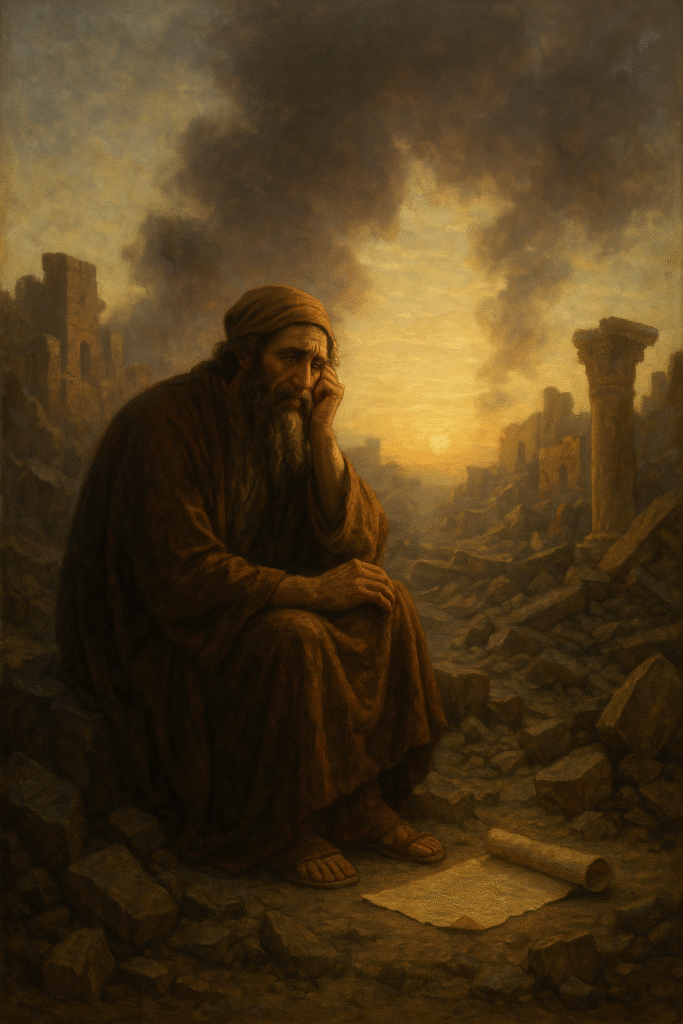
Book of Lamentations – Set 1 (Chapters 1–2)
Theme: Tears in the Ruins — Grieving Loss, Finding God
1. Summary of the Chapters
Chapter 1 – The Lonely City
“How deserted lies the city, once so full of people!” (1:1)
Jerusalem, once radiant with God’s glory, now sits in silence and shame. The poet walks through empty streets, hearing only the echoes of what once was. The city is personified as a widow — grieving, broken, betrayed by her lovers (the nations she trusted instead of God).
“She weeps bitterly in the night; tears are on her cheeks.” (1:2)
Every verse aches with loss. Yet beneath the grief is humility: Jerusalem admits her sin and acknowledges that God’s judgment was just.
“The Lord is righteous, yet I rebelled against His command.” (1:18)
Lament becomes worship when sorrow bows to truth. Even in ruin, repentance begins to rise.
Chapter 2 – The Day of the Lord’s Anger
“The Lord has brought her grief because of her many sins.” (2:14)
Here the poet sees clearly: the destruction is not random but righteous. False prophets had promised safety, while injustice rotted the city’s soul. Now the Lord’s wrath burns — not to annihilate, but to awaken.
“He has swallowed up Israel; He has laid waste her dwellings.” (2:5)
Yet the chapter ends not in despair but in intercession:
“Arise, cry out in the night… pour out your heart like water before the face of the Lord.” (2:19)
Tears become prayer, and prayer becomes hope’s first breath.
2. Key Themes and Lessons
| Theme | Lesson |
|---|---|
| Honest Lament | God invites us to bring our raw pain to Him; true faith doesn’t hide tears. |
| Repentance and Reality | Healing begins when we stop blaming and start acknowledging God’s righteousness. |
| Consequences and Compassion | God’s discipline is never cruelty — it’s the severe mercy of a Father calling His children home. |
| Prayer in Pain | The first step out of despair is turning sorrow into conversation with God. |
| Hope beneath Judgment | Even in wrath, His heart still yearns to redeem. |
3. Encouragement
Oh, come on — this is raw, but it’s real!
Jeremiah’s walking through ruins, and every stone preaches, ‘Sin destroys, but love still waits.’
He’s not pretending it’s fine; he’s weeping — and God’s not offended by it.
Sometimes faith sounds like sobbing, but it’s still faith because you’re crying to Him, not away from Him.
The city thought she could live without God, and now she’s empty.
But look — even in judgment, God’s right there in the rubble saying, ‘I haven’t left you.’
When you finally stop defending your choices and just say, ‘You’re right, Lord,’ that’s not defeat — that’s freedom!
Then He says, ‘Pour out your heart like water before Me.’
That’s His invitation. Don’t hold it together; pour it out.
Because He can only fill what’s been emptied.
Sister, if your world feels like ruins — don’t hide from Him.
Let the tears fall. He meets you right there, not after you rebuild.
He’s not the God who avoids pain; He’s the God who steps into it with you — to redeem it from the inside out.
4. Reflection Questions
- What losses or disappointments in my life still need honest lament before God?
- How can admitting God’s righteousness bring peace instead of guilt?
- What might it look like to “pour out my heart like water” this week?
- How does knowing God’s compassion exists even in discipline change the way I see correction?
- Where might God be calling me to hope again after a season of regret or ruin?
Book of Lamentations – Set 2 (Chapters 3–5)
Theme: Hope in the Ashes — Faith, Restoration, and the God Who Never Fails
1. Summary of the Chapters
Chapter 3 – The Turning Point: From Despair to Hope
“I am the man who has seen affliction by the rod of the Lord’s wrath.” (3:1)
The first half of this chapter is Jeremiah’s deepest valley. He feels crushed, trapped, and forgotten. His pain is both personal and prophetic — he carries the sorrow of a whole nation.
“He has made me dwell in darkness like those long dead.” (3:6)
But then, everything shifts. From the ruins of despair rises one of the most beautiful declarations of faith ever written:
“Yet this I call to mind and therefore I have hope:
Because of the Lord’s great love we are not consumed,
for His compassions never fail.
They are new every morning; great is Your faithfulness.” (3:21–23)
This is the heartbeat of redemption.
Jeremiah chooses to remember truth over circumstance. Hope is not denial; it’s a decision to look up when everything around says, “Give up.”
He continues,
“The Lord is good to those whose hope is in Him.” (3:25)
“Though He brings grief, He will show compassion.” (3:32)
This chapter becomes the soul’s turning point — from crushed to comforted, from despair to devotion.
Chapter 4 – The Contrast of Glory and Shame
“How the gold has lost its lustre, the fine gold become dull!” (4:1)
Jeremiah reflects on the shocking reversal of Jerusalem’s fortunes — princes now beg for bread, mothers weep over famine, and the temple lies in ruins.
He acknowledges that the suffering is the result of sin, but he also recognises that God’s wrath will not last forever.
“The punishment of your sin is greater than you can bear, O daughter of Zion; but He will no longer prolong your exile.” (4:22)
This chapter reminds us that sin always cheapens what God made precious — but grace always has the final word.
Chapter 5 – The Prayer for Restoration
“Remember, O Lord, what has happened to us; look, and see our disgrace.” (5:1)
The final chapter is not a sermon — it’s a cry. The survivors of the destruction plead for mercy, describing their grief, loss, and exhaustion.
“Our hearts are faint, our eyes grow dim… yet You, O Lord, reign forever.” (5:17, 19)
Even in despair, the confession of God’s sovereignty remains.
The book ends with a final plea:
“Restore us to Yourself, Lord, that we may return; renew our days as of old.” (5:21)
That’s the essence of redemption — not just restoration of circumstance, but of relationship.
2. Key Themes and Lessons
| Theme | Lesson |
|---|---|
| Faith in Suffering | True faith looks up from the pit and still declares God’s goodness. |
| Hope Is a Choice | Even when everything falls apart, we can choose to remember who God is. |
| The New Every Morning Grace | God’s compassion renews daily — mercy always outpaces failure. |
| The Pain of Sin | Sin destroys beauty, but repentance restores worth. |
| Restoration through Relationship | God’s goal isn’t just to rebuild cities — it’s to bring hearts home. |
3. Encouragement
Oh, come on — this is the turning point!
Jeremiah’s at rock bottom, and instead of pretending, he pours it out.
He says, ‘I’m broken, I’m crushed, I’m done.’
But right there — in the middle of his lowest moment — he remembers.
‘Yet this I call to mind… great is Your faithfulness!’
That’s it! That’s the secret.
Hope doesn’t come when the pain stops —
it comes when you choose to remember who God is while it still hurts.
The city’s gone, the temple’s gone, but God isn’t.
He’s saying, ‘My love hasn’t failed you, My mercy hasn’t run out.’
That’s why Jeremiah says, ‘They’re new every morning.’
You wake up, and grace is already waiting for you.
Then he says, ‘It’s good to wait quietly for the salvation of the Lord.’
Come on, that’s trust that’s been tested!
When you’ve been through the fire and still believe, that’s not weakness — that’s worship.
And then at the end — that prayer: ‘Restore us to Yourself, Lord, that we may return.’
That’s what this whole story’s been about.
Not just fixing walls or cities — but hearts.
God doesn’t just want to give you back what you lost; He wants to give you back who you are in Him.
So sister, if you’re standing in ashes — don’t let shame have the last word.
Lift your eyes. Hope isn’t gone; it’s alive.
The same God who brought Jeremiah through despair will bring you through too.
Because His mercies — oh, they really are new every morning.
4. Reflection Questions
- What situation in my life requires me to say, “Yet this I call to mind”?
- How can I remind myself daily of God’s new mercies when I feel worn out or hopeless?
- What areas of my heart still need to be restored “to God Himself” — not just improved circumstances?
- How can I pray more honestly when I’m struggling, rather than hiding behind religious language?
- What does waiting quietly for God’s salvation look like in my current season?
Overview of the Book of Lamentations
Theme: Grieving with Hope — The Faithfulness of God in the Midst of Ruin
1. Summary of the Book
The Book of Lamentations is a collection of five poetic laments, written in the aftermath of Jerusalem’s destruction by Babylon in 586 BC.
Traditionally attributed to Jeremiah, it is the prophet’s personal and prophetic response to the devastation of his beloved city.
Through its pages, we walk with him among the ruins — hearing the cries of a nation reaping the fruit of its rebellion — yet witnessing faith’s incredible resilience.
Chapter 1 – The Lonely City
Jerusalem is personified as a weeping widow. Once glorious, she now sits desolate, abandoned, and humiliated.
“She weeps bitterly in the night; tears are on her cheeks.” (1:2)
Her grief is honest and raw — but also repentant:
“The Lord is righteous, yet I rebelled against His command.” (1:18)
Lament begins not with denial, but with truth.
Chapter 2 – The Day of God’s Anger
The poet recognises that Jerusalem’s suffering is not random — it is the consequence of forsaking God’s covenant.
False prophets had promised safety; injustice had filled the streets.
Now judgment has come, yet even in His wrath, God’s purpose is redemptive.
“Arise, cry out in the night… pour out your heart like water before the face of the Lord.” (2:19)
The tears of repentance become the birthplace of prayer.
Chapter 3 – Hope in the Middle of Despair
At the heart of the book, Jeremiah’s sorrow turns to worship.
He feels trapped and crushed — “He has made me dwell in darkness” (3:6) — but then he remembers:
“Yet this I call to mind and therefore I have hope:
Because of the Lord’s great love we are not consumed,
for His compassions never fail.
They are new every morning; great is Your faithfulness.” (3:21–23)
This is the pivot point of the book and the human heart. Even in judgment, God’s mercy is alive.
Chapter 4 – The Gold Grown Dim
Jeremiah laments the loss of glory: priests, princes, and people all reduced to poverty and hunger.
“How the gold has lost its lustre!” (4:1)
Sin has defiled what was once holy, yet the closing note is one of promise:
“The Lord will no longer prolong your exile.” (4:22)
Even in ruin, grace begins its quiet work of restoration.
Chapter 5 – The Prayer for Renewal
The final poem is a communal cry:
“Remember, Lord, what has happened to us.” (5:1)
The people plead for God to remember them, ending with this timeless prayer:
“Restore us to Yourself, Lord, that we may return; renew our days as of old.” (5:21)
The book closes not with resolution, but with invitation — to seek God again, even when the world feels broken.
2. Key Themes and Lessons
| Theme | Lesson |
|---|---|
| The Honesty of Lament | God welcomes our tears — real faith cries out to Him, not away from Him. |
| The Consequence of Sin | Sin always leads to ruin, but repentance reopens the path to mercy. |
| Hope in Despair | Remembering God’s faithfulness transforms sorrow into trust. |
| Mercy in Judgment | God’s discipline is never destruction; it’s love calling His people home. |
| Restoration through Relationship | The ultimate restoration is not to a place, but to God Himself. |
| Faith Renewed Daily | His mercies are “new every morning” — grace never runs out, even in exile. |
3. Encouragement
Oh, come on — this is one of the most beautiful pictures of God’s heart!
Jeremiah isn’t preaching at people here — he’s bleeding love onto the page.
The city’s gone, the temple’s gone, and yet what does he find in the rubble? The faithfulness of God!
He’s saying, ‘I’ve seen pain, I’ve tasted loss… but great is Your faithfulness!’
That’s what happens when you stop measuring God’s goodness by circumstance and start measuring it by covenant.
This book isn’t about despair; it’s about discovery.
When everything collapses, you find out who He really is — steady, merciful, unchanging.
And that line — ‘Restore us to Yourself, Lord, that we may return’ —
that’s the cry of every heart that’s ever wandered.
God doesn’t just want to fix your life; He wants to bring you back to His heart.
Sister, maybe you’re standing in your own ruins — relationships, dreams, seasons you thought would last.
Don’t look down. Look up.
His mercies are already running toward you.
You’re not abandoned; you’re being reawakened.
Because the same God who met Jeremiah in the ashes is the same God who meets you in yours —
faithful, loving, and full of mercy every single morning.
4. Reflection Questions
- How do I usually respond when I experience loss or correction — with denial, despair, or surrender?
- What would it look like to practise honest lament — talking to God rather than turning from Him?
- How can I remind myself daily of God’s “new every morning” mercies?
- What ruins in my life might God want to rebuild through restored relationship with Him?
- How can I help others discover hope and healing through their own seasons of lament?