
Reconsidering the Names, Expectations and Limitations That Have Shaped Your Identity

The Real-Life Struggle
Have you ever noticed how easily a few words spoken about you can become part of the way you understand yourself?
Sometimes those words were spoken so long ago that you can barely remember when you first heard them.
Perhaps you were described as the shy one in your family.
The difficult one.
The responsible one.
The emotional one.
The clever one.
The child who always needed extra help.
Or perhaps you were the one who was expected to cope, organise, understand and never cause any trouble.
At first, these descriptions may have seemed relatively harmless.
Some may even have sounded complimentary.
But over time, they began influencing what you believed about yourself and what you thought other people expected from you.
If you were repeatedly described as shy, perhaps you stopped considering opportunities that involved speaking in front of others.
If you were called difficult whenever you expressed an opinion, perhaps you learned to remain silent even when something genuinely mattered.
If you were praised for always being responsible, perhaps you gradually came to believe that needing help was a personal failure.
If you were labelled overly sensitive, perhaps you began questioning whether your feelings deserved consideration.
And if you were repeatedly told that you were clever or capable, perhaps you developed an exhausting fear of making mistakes because you believed you had to maintain that identity.
Not every label is unkind.
Not every description is inaccurate.
But even a description that contains some truth can become restrictive when we begin treating it as the whole truth about who we are.
A woman may genuinely be quiet by nature without being incapable of meaningful conversation.
She may be particularly sensitive to certain environments without being weak.
She may have limitations that require practical support without being less valuable.
She may be highly capable without being responsible for everyone else’s wellbeing.
The difficulty begins when a characteristic, experience, diagnosis, failure or expectation becomes the defining explanation for everything about us.
Sometimes these labels come from other people.
A parent who repeatedly criticised us.
A teacher who misunderstood the way we learned.
A partner who described our needs as unreasonable.
A workplace where our contribution was overlooked.
A family system in which we were assigned a particular role.
But sometimes the labels we carry are ones we have quietly given ourselves.
I’m not good with people.
I’m always the one who gets things wrong.
I’m too much.
I’m not enough.
I’m just someone who struggles.
I’m the person who has to hold everything together.
And because these descriptions have been repeated for years, they can begin to feel less like interpretations and more like facts.
We stop noticing that we are using them.
We simply say, “That’s just who I am.”
Yet there is an important question worth asking.
Is this description helping me understand something true about myself, or has it become a limitation that I no longer know how to question?
For a woman seeking to grow in biblical wisdom, this question is not simply about developing better self-esteem.
It is about learning to understand herself accurately before God.
Scripture does not encourage us to invent an impressive identity or deny our weaknesses.
It invites us to recognise that human beings are created by God, accountable to Him, deeply affected by sin and suffering, and offered redemption and new life through Jesus Christ.
Our identity is therefore more substantial than the descriptions other people have given us.
And learning to distinguish those descriptions from biblical truth can profoundly influence how we understand our worth, responsibilities, relationships and possibilities.
Discover the Truth
A Description Is Not the Same as an Identity
Words help us understand the world.
We use descriptions to communicate differences, recognise patterns and explain experiences.
Some descriptions are useful and necessary.
A medical diagnosis may help someone understand why particular activities are difficult and what support would be appropriate.
A personality description may help explain why someone prefers quiet environments or enjoys working with others.
A professional title may describe a person’s responsibilities.
A family role may explain important relationships.
None of these descriptions is automatically wrong.
The difficulty arises when a description is treated as though it contains everything worth knowing about a person.
Consider the difference between these statements.
I find unfamiliar social situations difficult.
I am incapable of developing meaningful relationships.
The first describes a particular challenge.
The second makes a much broader claim about identity and possibility.
Or consider:
I have a disability that affects how I manage certain activities.
My disability makes me less valuable than other people.
The first acknowledges a genuine aspect of someone’s life.
The second attaches a judgement about human worth that does not follow from the description.
This distinction matters because the labels we use can quietly shape our expectations.
They influence what we attempt, what we avoid, what we tolerate and what we believe we deserve.
Biblical wisdom invites us to examine whether these conclusions accurately reflect what God has revealed about human beings.
Our Worth Begins With God’s Creation, Not Human Evaluation
Read Genesis 1:26–27.
In the opening chapter of Genesis, God creates human beings in His image.
The passage describes both male and female as bearing that image.
This is a foundational statement about human dignity.
Human worth is not presented as something earned through intelligence, physical ability, productivity, appearance, social acceptance or achievement.
It is grounded in God’s act of creation.
Being made in God’s image does not mean that every human characteristic perfectly reflects His nature.
Nor does it mean that human beings possess unlimited abilities or divine qualities.
The passage establishes that humanity occupies a distinctive place within God’s creation, bearing responsibilities and dignity that arise from our relationship to our Creator.
This has important implications for the labels we carry.
A woman who struggles academically is no less human than someone with exceptional intellectual ability.
A woman who requires daily assistance is not less valuable than someone who lives independently.
A woman who has experienced rejection has not lost the dignity given to her as a human being.
And a woman whose life looks different from society’s expectations does not need to achieve a particular standard of success before she becomes worthy of respectful treatment.
Human dignity is not awarded by the people who evaluate us. It is grounded in the God who created us.
This does not eliminate meaningful differences between people.
It places those differences within a larger understanding of human worth.
God Knows Us More Fully Than Other People Can
Read Psalm 139:1–18.
David reflects upon God’s complete knowledge of him.
The psalm describes the Lord’s awareness of his actions, thoughts, words and circumstances.
David also reflects upon God’s involvement in his formation before birth.
The language is deeply personal and poetic, expressing wonder at God’s knowledge and creative power.
This passage is sometimes used to suggest that every aspect of our personality or every circumstance of our lives must be exactly as God desires.
That would go beyond what the psalm establishes.
Scripture recognises that human life is affected by sin, suffering, injustice and the brokenness of creation.
Nevertheless, Psalm 139 reveals something important.
God’s knowledge of us is not partial in the way human knowledge is.
Other people encounter us within particular circumstances.
A teacher may know how we performed in a classroom.
An employer may know how we handled a particular responsibility.
A family member may remember how we behaved during childhood.
A friend may know how we respond in certain relationships.
These observations may contain useful information.
But no individual possesses complete knowledge of who we are.
Even our own understanding is limited.
We may misinterpret our motives, overlook our strengths or misunderstand the reasons behind particular responses.
God’s knowledge is different.
He sees what human observers cannot fully see.
That does not mean we should dismiss constructive feedback or assume our own interpretation is always correct.
It means that no human assessment should be treated as the final authority over our identity.
Scripture Distinguishes Between Who We Are and What We Have Done
One of the most damaging ways labels can influence us is when an action becomes a permanent description of the person.
Someone makes a mistake and begins calling herself a failure.
Someone behaves selfishly and concludes that she is incapable of genuine love.
Someone struggles with a responsibility and decides that she is useless.
Scripture takes human actions seriously.
It does not suggest that our behaviour is irrelevant.
We are accountable for how we live, how we treat others and how we respond to God’s commands.
Yet the biblical story also reveals that failure and sin do not place a person beyond the possibility of repentance, forgiveness and transformation through Christ.
Read Luke 19:1–10.
Zacchaeus was a chief tax collector and was wealthy.
Tax collectors in that historical setting were frequently associated with exploitation and were socially despised.
When Jesus entered Zacchaeus’s home, the crowd complained that He had gone to be the guest of a sinner.
Jesus did not pretend that Zacchaeus’s conduct was unimportant.
Zacchaeus responded by declaring his intention to give generously to the poor and repay those he had defrauded.
The encounter involved genuine moral change.
But Jesus did not treat the man’s existing reputation as a reason to exclude him from the call to repentance and salvation.
He declared that the Son of Man had come to seek and save the lost.
This account does not teach that our actions have no consequences.
It demonstrates that Jesus’s saving mission reaches people whose lives require genuine change.
A person’s previous conduct may need to be acknowledged, corrected and sometimes repaired.
But the possibility of repentance and redemption means that the past need not become an unchangeable definition of the future.
Our Identity in Christ Is Received Through Grace
Read Ephesians 1:3–14.
Paul opens his letter by describing the spiritual blessings believers have received in Christ.
He speaks of God’s gracious purposes, adoption, redemption, forgiveness and the sealing of believers with the Holy Spirit.
These blessings are not presented as rewards for achieving an impressive personal identity.
They arise from God’s grace and His saving work through Jesus Christ.
This is important because Christian teaching about identity can sometimes become another form of pressure.
A woman may feel that she must constantly declare herself confident, fearless, successful or strong in order to demonstrate faith.
But Scripture does not require believers to deny their limitations or manufacture a particular personality.
Our standing before God in Christ rests upon His grace.
It does not depend upon our ability to appear emotionally confident or consistently capable.
Read 2 Corinthians 5:17.
Paul describes those who are in Christ as part of the new creation.
In the wider passage, he is explaining the reconciling work of Christ and the transformed perspective that flows from it.
This is not a promise that every personality characteristic, painful memory or practical limitation disappears at conversion.
It is a statement about the new reality established through Christ’s saving work.
Believers are called to live in response to that reality.
We continue learning, repenting, growing and becoming increasingly conformed to Christ.
Our identity in Christ is not an improved label we must perform. It is a relationship established through God’s grace that reshapes how we understand and live our lives.
We Are Members of One Body, Not Copies of One Another
Read 1 Corinthians 12:12–27.
Paul describes the church as one body with many members.
His purpose is to explain the unity and diversity of believers within the body of Christ.
Different members have different functions, yet each belongs to the body.
Paul challenges the idea that one member is unnecessary because it does not perform the same function as another.
He also challenges the idea that one member can claim independence from the others.
This passage does not mean that every person has identical abilities or responsibilities.
Quite the opposite.
Paul recognises genuine differences.
Yet those differences do not justify treating some members as though they have no value.
This is particularly meaningful for women who have spent years comparing themselves with others.
Perhaps you cannot manage the same workload as someone else.
Perhaps you need more time to process information.
Perhaps your strengths are different from those your family or community values most highly.
Perhaps your contribution is quiet and largely unseen.
The body of Christ is not strengthened by requiring every member to become identical.
It is strengthened when its members live faithfully, care for one another and recognise their mutual dependence upon Christ.
Your differences may require wisdom, support, boundaries or growth.
They do not automatically establish inferiority.
See the Father’s Heart
One of the most significant things we discover about God throughout Scripture is that He does not evaluate people according to the same superficial standards that often dominate human relationships.
Read 1 Samuel 16:1–13.
When Samuel was sent to anoint a new king from Jesse’s family, he initially assumed that Eliab’s impressive appearance made him the likely choice.
But God corrected Samuel’s judgement.
In verse 7, the Lord explained that human beings look upon outward appearance, while He looks upon the heart.
The immediate context concerns God’s selection of David as king.
It is not a promise that God will choose every overlooked person for a prominent role.
Nevertheless, it reveals the inadequacy of judging a person solely by outward characteristics.
Human evaluations can be incomplete.
We may notice confidence and overlook humility.
We may admire eloquence and fail to recognise wisdom.
We may interpret quietness as weakness.
We may confuse visible success with faithfulness.
God’s understanding is not restricted to those appearances.
Jesus Saw People Beyond Their Social Reputations
Consider the account of Bartimaeus in Mark 10:46–52.
Bartimaeus was blind and sat begging beside the road.
When he cried out to Jesus for mercy, many people rebuked him and told him to be quiet.
His voice was treated as an interruption.
But Jesus stopped and called for him.
Jesus asked what Bartimaeus wanted Him to do.
The account records Bartimaeus receiving his sight and following Jesus.
The passage is primarily a testimony to Jesus’s mercy and authority, not a general promise that every disability will be healed in this life.
Yet notice how Jesus responded to a man whom others attempted to silence.
He did not treat Bartimaeus as an inconvenience.
He attended to him.
We also see Jesus interacting meaningfully with people whose social position, reputation or circumstances caused others to overlook them.
He spoke with the Samaritan woman in John 4.
He welcomed children when His disciples attempted to prevent them from approaching Him in Mark 10:13–16.
He called Levi, a tax collector, to follow Him in Mark 2:13–17.
These accounts are not identical, and each has its own theological purpose.
Together, however, they reveal that Jesus did not simply accept the social judgements surrounding the people He encountered.
He saw people truthfully.
He addressed sin where necessary.
He showed compassion.
He called people to respond to Him.
And He did not allow the contempt of others to determine whom He would engage.
The Father Does Not Require Us to Pretend We Have No Limitations
Sometimes the labels we carry are connected to genuine limitations.
Perhaps you have a chronic illness.
Perhaps you live with a disability.
Perhaps you process information differently from other people.
Perhaps anxiety, sensory sensitivities or previous trauma affect what you can comfortably manage.
Perhaps your energy is limited, or you need more rest and support than you once did.
These realities should not be dismissed as merely negative beliefs.
Read Psalm 103:13–14.
David describes the Lord’s compassion towards those who fear Him and reminds us that God knows our frame.
He remembers that we are dust.
This passage presents a God who understands human frailty.
He does not confuse creaturely limitations with moral failure.
That distinction matters.
Needing help is not necessarily a lack of faith.
Having different capacities does not make someone spiritually inferior.
Recognising that a particular environment is overwhelming does not mean a person has failed to renew her mind.
Sometimes growth involves developing new abilities.
Sometimes it involves learning to accept appropriate support.
Sometimes it involves recognising that a responsibility genuinely exceeds our present capacity.
And sometimes it involves refusing to measure our worth against someone else’s abilities.
God’s compassion gives us room to acknowledge our humanity honestly.
God’s Grace Frees Us From Performing an Identity
Read Romans 8:14–17.
Paul describes believers who are led by the Spirit of God as children of God.
He speaks of adoption and the Spirit’s testimony to our relationship with the Father.
This is not a statement that every person automatically possesses the same relationship with God regardless of faith in Christ.
Paul is addressing those who belong to Christ and live by His Spirit.
For believers, however, the passage provides a deeply meaningful foundation for identity.
We are not required to establish our standing before God by continually proving that we are impressive, indispensable or without weakness.
Our relationship with Him rests upon His gracious work.
We are called to live as His children.
This changes how we approach the expectations we have carried.
The woman who has always been labelled responsible can learn that she is not required to control every outcome.
The woman who has been called difficult can examine whether she is genuinely behaving unkindly or simply expressing an appropriate boundary.
The woman who has been described as weak can learn to distinguish real limitations from judgements about her worth.
The woman who has been praised for her achievements can begin recognising that her value before God is not dependent upon maintaining an unbroken record of success.
The Father’s heart is not revealed through an invitation to invent a more impressive version of ourselves.
It is revealed through His grace, truth, compassion and call to live faithfully before Him.
Recognise the Old Pattern
Labels often become powerful because they are repeated.
A description heard once may be forgotten.
But a description heard throughout childhood, repeated in relationships or reinforced by familiar experiences can gradually become part of our internal understanding.
Eventually, we may stop asking whether it is accurate.
We simply organise our decisions around it.
When Family Roles Become Personal Identities
Perhaps you grew up as the responsible child.
You were praised for being mature, helpful and dependable.
Those qualities may genuinely describe important strengths.
But perhaps you also learned that other people’s needs should always come before your own.
You became uncomfortable asking for help.
You felt guilty resting.
You believed that disappointing someone meant you had failed.
What began as a description of your behaviour gradually became a rule governing your life.
I must always be the strong one.
Or perhaps you were described as the difficult child.
You asked questions.
You challenged expectations.
You struggled in environments that seemed manageable for your siblings.
You may have had genuine behavioural difficulties, unmet needs or simply a different temperament.
But over time, you began assuming that your presence created problems.
You learned to apologise before expressing an opinion.
You hesitated to ask for what you needed.
You expected others to become frustrated with you.
The original label may have reflected a particular situation.
But you began carrying it into circumstances where it no longer provided an accurate understanding.
When Other People’s Expectations Become Our Boundaries
Sometimes we avoid opportunities not because we have carefully considered our abilities, but because we have accepted someone else’s assessment of them.
Perhaps a teacher once told you that you were not academically capable.
Years later, you still hesitate to undertake study.
Perhaps a family member repeatedly described you as impractical.
You now question your judgement even when you have researched a decision carefully.
Perhaps someone criticised your communication style.
You assume that expressing yourself will always lead to misunderstanding.
These experiences can influence what we believe is possible.
But other people’s assessments are not infallible.
Some may contain helpful observations.
Others may reflect misunderstanding, prejudice, frustration or incomplete information.
And even an assessment that was accurate at one stage of life may not describe every future circumstance.
We can examine feedback thoughtfully without surrendering our entire understanding of ourselves to it.
When Positive Labels Become Heavy Expectations
Not every restrictive label sounds negative.
Sometimes the most exhausting expectations are attached to qualities that other people admire.
You’re always so strong.
You never let anything bother you.
You’re the one everyone can depend on.
You’re naturally gifted.
You always know what to do.
These descriptions may have been intended as encouragement.
But they can become burdensome when we believe we must continually live up to them.
A woman praised for being strong may feel ashamed when she struggles.
A woman admired for her generosity may find it difficult to establish boundaries.
A woman known for her competence may avoid unfamiliar activities because she fears appearing inexperienced.
A woman described as spiritually mature may hesitate to admit that she has questions or needs support.
The problem is not that strength, generosity, competence or maturity are undesirable.
It is that no human being possesses these qualities perfectly or without limitation.
We are called to grow in character, not to maintain an impossible performance.
When a Diagnosis Becomes Either a Stigma or a Complete Explanation
Medical, psychological and developmental diagnoses deserve particular care.
A diagnosis can provide important understanding.
It may explain patterns that were previously confusing.
It can help someone access treatment, adjustments, support and appropriate expectations.
For some women, receiving a diagnosis brings considerable relief.
Experiences that were previously interpreted as laziness, disobedience or personal failure may finally be understood more accurately.
We should not dismiss that value.
At the same time, a diagnosis does not describe every aspect of a person.
A woman with autism is not only autistic.
A woman with ADHD is not only her attention difficulties.
A woman living with anxiety is not only her anxiety.
A woman with a physical disability is not only the activities she cannot perform.
These conditions may be significant and enduring aspects of life.
Some people also understand neurodivergence as an important and valued part of their identity.
Recognising biblical human dignity does not require anyone to reject that understanding or pretend their differences can simply disappear.
It means that no diagnosis, whether useful or limiting, exhausts the full truth about a person’s humanity.
We can acknowledge genuine differences and support needs while refusing to attach judgements of lesser worth.
When We Begin Speaking to Ourselves Through Old Labels
Perhaps the clearest sign that a label has become deeply established is the way we speak to ourselves.
You make a small mistake and immediately think, I’m hopeless.
You become overwhelmed and think, I’m so weak.
You misunderstand something and think, I’m stupid.
You need help and think, I’m a burden.
These statements may arise so quickly that they feel automatic.
But notice what has happened.
A particular experience has become a judgement about the whole person.
You did not simply recognise that you made a mistake.
You concluded that you are a mistake.
You did not simply acknowledge that you need assistance.
You concluded that needing assistance makes you less valuable.
This is where renewing our thinking can become deeply practical.
We begin learning to describe our experiences accurately without turning every difficulty into a statement about our identity.
Renew Your Thinking
Renewing our understanding does not mean replacing every uncomfortable description with an exaggerated positive declaration.
It means learning to recognise what is true, what is incomplete and what Scripture teaches about our worth and responsibilities before God.
Here are five examples.
1. When You Have Been Labelled Difficult
Old thought: I have always been called difficult, so there must be something wrong with me whenever I disagree or express my needs.
Renewed understanding: Disagreement and the expression of legitimate needs are not automatically wrong. I can examine my behaviour honestly, communicate respectfully and recognise that healthy relationships allow room for differences.
Read Ephesians 4:15 and 4:25–32.
Paul calls believers to speak truthfully and to conduct their relationships with love, kindness and self-control.
These passages do not suggest that we must avoid every disagreement.
They call us to communicate in ways consistent with Christian character.
I can therefore examine whether my words are respectful without assuming that another person’s discomfort proves I have behaved wrongly.
2. When You Have Been Labelled Weak
Old thought: Because I struggle with things other people manage easily, I am weak and less valuable.
Renewed understanding: My limitations may be real and may require support or adjustments, but they do not determine my human worth or exclude me from meaningful participation in the body of Christ.
Read 1 Corinthians 12:21–26.
Paul challenges members of the church who consider others unnecessary.
His teaching emphasises mutual care and the importance of different members within the body.
The passage does not erase differences in capacity.
It challenges the assumption that those differences justify contempt or exclusion.
I can acknowledge my needs without accepting the judgement that they make me less valuable.
3. When You Have Been Labelled a Failure
Old thought: I have made serious mistakes, so failure is simply who I am.
Renewed understanding: My actions matter, and I may need to repent, repair harm or learn from consequences. But through Christ, forgiveness and genuine change are possible. My previous failures do not have to become the whole definition of my life.
Read 1 John 1:8–9.
John teaches believers to acknowledge sin honestly rather than deny it.
He also speaks of God’s faithfulness and justice in forgiving and cleansing those who confess their sins.
This passage does not remove every earthly consequence of wrongdoing.
It reminds us that confession and forgiveness are central to Christian life.
I can take responsibility for what I have done without concluding that I am beyond God’s grace.
4. When You Have Been Labelled the Strong One
Old thought: Everyone depends on me, so I must never need help or admit that I am struggling.
Renewed understanding: Responsibility can be a valuable expression of love, but I am still a human being with limitations. Receiving appropriate help and sharing burdens can be consistent with biblical wisdom.
Read Galatians 6:2–5.
Paul instructs believers to carry one another’s burdens while also recognising personal responsibility.
The passage holds mutual support and individual accountability together.
It does not require one person to carry everything.
I can act responsibly without assuming that I must manage every difficulty alone.
5. When You Have Been Labelled Not Good Enough
Old thought: I have never measured up to other people’s expectations, so I will never be enough.
Renewed understanding: Human expectations may reveal areas where I need to grow, but they are not the ultimate measure of my standing before God. In Christ, my acceptance rests upon His grace rather than my ability to satisfy every demand.
Read Ephesians 2:8–10.
Paul teaches that salvation is by grace through faith, not the result of works.
He also explains that believers are created in Christ Jesus for good works.
Grace does not make growth or obedience irrelevant.
It establishes the foundation from which Christian obedience flows.
I do not need to earn salvation through performance, and I do not need to treat every human expectation as though it possesses divine authority.
The goal is not to discover a more flattering label. It is to develop a more truthful understanding of who you are before God.
Walk It Out
Imagine walking into The Gallery of True Identity within The Garden of Living Truth.
Beautiful cream-stone arches rise above the pathway.
Lilac wisteria cascades between carved pillars, while roses soften the edges of the old stone walls.
Along the gallery are elegant, empty frames.
Some are large and elaborate.
Others are smaller, their surfaces marked by the passing years.
Each frame seems to invite a picture, a name or a description.
Perhaps you can imagine the labels you have carried being placed inside them.
The responsible one.
The difficult one.
The shy one.
The failure.
The strong one.
The one who needs too much.
But as you continue through the gallery, you begin to recognise something important.
A frame can draw attention to one particular feature.
It cannot contain the entirety of a human life.
The labels you have carried may describe experiences, characteristics, responsibilities or limitations.
Some may contain useful information.
Others may be incomplete or inaccurate.
But none should be accepted without examination simply because it has occupied a familiar place in your understanding.
This Week’s Garden Study Practice: Looking Beyond the Label
This week’s practice is designed to help you identify one familiar label, examine its influence and develop a more accurate understanding through Scripture.
Choose a label that feels manageable to explore.
You do not need to begin with your most painful experience.
First — Notice the label you have been carrying.
Think about a description you frequently use about yourself.
It may be something another person repeatedly said.
Or it may be a conclusion you developed through your own experiences.
Write it down.
Then consider:
Where did I first encounter this description?
Who used it?
Was it connected to a particular event, repeated experience or family role?
Does it describe something specific, or does it make a sweeping claim about who I am?
For example:
Familiar label: I’m the one who always has to cope.
Possible origin: I was praised for being mature and responsible from a young age.
Current influence: I feel guilty asking for help, even when I genuinely need it.
Read Proverbs 18:13.
This proverb warns against forming judgements before understanding a matter.
Its immediate concern is careful listening, but the principle encourages us to examine information before reaching conclusions.
Rather than accepting the label automatically, begin considering what it actually describes.
Second — Separate the description from the judgement.
Now ask whether the label contains a genuine observation, an unsupported judgement or a mixture of both.
For example:
I prefer quiet environments.
This may be an accurate description.
I am incapable of contributing meaningfully because I prefer quiet environments.
This is a much broader judgement.
Or:
I need additional time to understand unfamiliar information.
This may describe a genuine learning difference.
I am unintelligent because I need additional time.
This conclusion does not automatically follow.
Consider what Scripture teaches about human dignity, grace and the diversity of the body of Christ.
Read Genesis 1:26–27 and 1 Corinthians 12:12–27.
These passages provide important foundations for understanding human worth and the value of different members within the community of believers.
They do not remove every limitation or guarantee every opportunity.
They help us recognise that differences in ability, temperament and circumstance do not establish differences in fundamental human dignity.
Write a more accurate statement about yourself.
For example:
I have learned to take responsibility, but I am also allowed to recognise my limitations and receive appropriate help.
Or:
I find some social situations difficult, but that does not mean I am incapable of meaningful relationships.
The purpose is accuracy, not exaggerated encouragement.
Third — Practise responding without returning to the old label.
During the coming week, notice when the familiar description appears in your thinking.
Perhaps you make a mistake.
Perhaps someone asks you to do something difficult.
Perhaps you feel overwhelmed.
Perhaps you find yourself comparing your abilities with someone else’s.
When the old label appears, pause.
Ask yourself whether it accurately describes the present situation.
Then consider what a truthful response would look like.
If you made a mistake, acknowledge the mistake without condemning your entire character.
If you need assistance, consider asking for appropriate help.
If someone expresses disappointment, examine whether you have acted wrongly without assuming that every negative response proves you are difficult.
If you encounter a genuine limitation, respond with wisdom rather than shame.
Read Colossians 3:12–17.
Paul calls believers, as God’s chosen and beloved people, to put on compassion, kindness, humility, gentleness and patience.
He also encourages them to allow the word of Christ to dwell richly among them.
These qualities are not reserved for the way we treat other people.
They should also shape the honesty, humility and care with which we examine our own lives.
At the end of the week, consider what you noticed.
Did you recognise a label that had become broader than the evidence supported?
Did you discover that a positive description had become an exhausting expectation?
Did you begin distinguishing genuine limitations from judgements about your worth?
Did you find one opportunity to respond more wisely?
Remember that deeply familiar beliefs may take time to reconsider.
You are not required to change your entire understanding of yourself in a single week.
You are learning to examine what you have carried and recognise what deserves to remain.
Pause and Reflect
Find a quiet moment to consider these questions.
You may find it helpful to write your responses in a journal.
Approach them with curiosity and honesty rather than criticism.
1. What labels have I carried for many years, and which of them have become part of the way I describe myself?
Consider descriptions from childhood, family relationships, education, work, health experiences or your own internal dialogue.
2. Which labels contain genuinely useful information, and which have become broader judgements about my worth or abilities?
Remember that acknowledging a limitation is not the same as accepting a judgement of inferiority.
3. Have any positive labels created expectations that make it difficult for me to rest, ask for help, make mistakes or express my needs?
Consider whether being known as responsible, capable, generous or strong has become a burden.
4. How does Scripture challenge or clarify the way I have understood myself through these descriptions?
Return to the relevant passages in their context and consider what they genuinely teach about human dignity, grace, responsibility and belonging in Christ.
5. What is one practical way I could begin responding to myself and others without allowing an old label to determine my behaviour automatically?
Choose a small, realistic action that reflects truthful understanding and appropriate wisdom.
A Prayer of Response
Heavenly Father,
Thank You that You know me more fully than anyone else ever could.
You know the experiences that have shaped my understanding of myself.
You know the words that were spoken over me, the expectations I learned to carry and the conclusions I formed along the way.
Some of those words encouraged me.
Others left me feeling inadequate, misunderstood or ashamed.
And some became so familiar that I stopped recognising how deeply they influenced my thinking.
Father, please help me examine these beliefs with honesty and wisdom.
Where a description contains something true and useful, help me receive that understanding without allowing it to become a judgement about my entire identity.
Where I have accepted unfair or inaccurate labels, help me recognise them.
Where I have made mistakes, give me the humility to acknowledge them and the wisdom to learn.
Where I have sinned, lead me towards genuine repentance and the forgiveness You offer through Jesus Christ.
Where I have been hurt or misunderstood, help me respond with truth rather than allowing those experiences to determine everything I believe about myself.
Thank You that my human dignity is grounded in Your creation rather than in the approval of other people.
Thank You that Your Word teaches me to recognise both the responsibilities and the limitations of being human.
Help me understand that needing support does not make me less valuable.
That having different abilities does not make me inferior.
That making a mistake does not require me to condemn my entire character.
And that being capable does not mean I must carry every responsibility alone.
Father, where I have allowed the expectations of others to become more influential than Your truth, please renew my understanding.
Teach me to distinguish constructive guidance from unfair judgement.
Help me receive correction without shame and encouragement without turning it into pressure.
Give me the courage to establish appropriate boundaries when necessary.
Help me recognise the ways You have equipped me to contribute, while remaining honest about the areas where I need growth or assistance.
Most of all, draw me into a deeper understanding of who I am in Christ.
May my confidence rest increasingly upon Your grace rather than upon my performance.
May I grow in humility without despising myself.
May I develop wisdom without becoming harsh.
May I learn to see other people with the same dignity and compassion that Your Word teaches me to recognise in myself.
Continue renewing my mind through Scripture.
Help me release conclusions that are not true and hold firmly to what You have revealed.
And as I continue growing, may my life reflect not the pressure of maintaining an impressive identity, but the freedom of belonging to You and learning to walk faithfully in Your ways.
In Jesus’ name,
Amen.
Before You Continue Along the Path
There is something deeply meaningful about discovering that a familiar description does not have to become the whole story of who you are.
Perhaps you have spent years believing that you are difficult because someone repeatedly described you that way.
Perhaps you have assumed that you are incapable because certain activities have always been challenging.
Perhaps you have carried the expectation that you must remain strong, responsible or endlessly available because that is how others have come to know you.
Some of these descriptions may contain elements of truth.
Others may have been unfair from the beginning.
But none should be allowed to determine your entire identity without careful examination.
You are a human being created in God’s image.
Your life has dignity that does not depend upon achievement, approval or independence.
If you belong to Christ, your relationship with the Father is established through His grace, not through your ability to maintain a particular reputation.
And as you grow in biblical understanding, you can learn to recognise the difference between a useful description and a limiting judgement.
Imagine standing once more within The Gallery of True Identity.
The elegant stone frames remain along the garden walls.
But they no longer seem quite so powerful.
You can appreciate the details they reveal without assuming they contain everything worth knowing.
Beyond the frames, the garden continues.
There are new perspectives to discover, different pathways to explore and places where understanding can continue to grow.
You do not need to invent a completely different personality.
You do not need to deny your history, abilities or limitations.
You can simply begin learning to understand yourself more accurately through the truth of God’s Word.
If you would like to continue exploring how familiar beliefs influence your understanding of God, yourself and everyday life, you are warmly invited to visit The Garden Study, where biblical wisdom and the renewing of the mind are at the heart of the journey.
You may carry many descriptions, but no single label can contain the full truth of a life known by God.
A Little Gift From The Garden Study
Some truths are worth keeping close.
We’ve created a beautiful, printable companion guide to help you revisit the biblical truths, gentle reflections and practical steps from this article.
Print it for your favourite quiet space, tuck it into your Bible or share it with someone who may be encouraged.
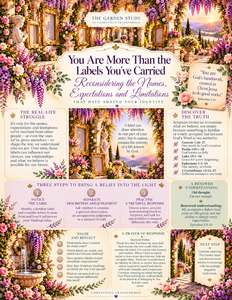
Download Your Free Companion Guide
🌸 Download A4 Version — Ideal for Australia, New Zealand, the UK and many other countries.
🌸 Download US Letter Version — Ideal for the United States and Canada.
Beautifully designed, free printable gifts. No email sign-up required.
May these gentle reminders of God’s truth continue to encourage you long after you’ve finished reading.