
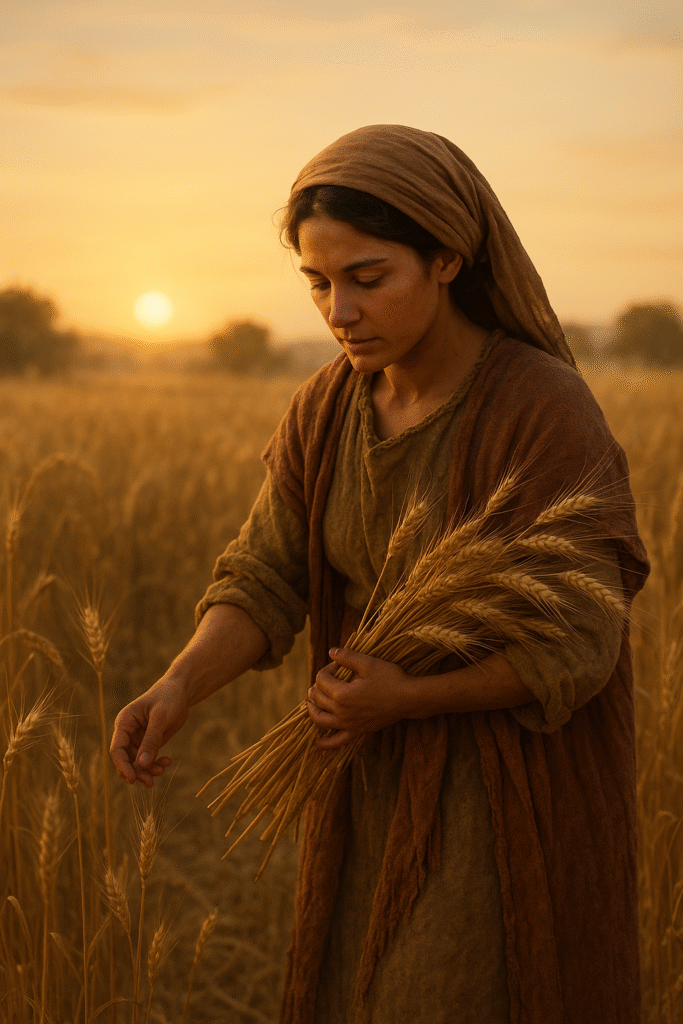
Ruth Study – Set 1 (Chapters 1–2)
From Loss to Loyalty: The Beginning of Redemption
1. Summary of the Chapters
- Chapter 1 – From Moab to Bethlehem:
During a famine, Elimelech and his wife Naomi leave Bethlehem for Moab with their two sons, who marry Moabite women — Orpah and Ruth.
After the deaths of Elimelech and both sons, Naomi decides to return to Bethlehem.
She urges her daughters-in-law to stay behind, but Ruth refuses, uttering the timeless words of covenant loyalty:
“Where you go I will go, and where you stay I will stay. Your people will be my people, and your God my God.”
Naomi returns bitter, saying, “The Lord has dealt bitterly with me,” but Ruth’s faithfulness becomes the seed of Naomi’s redemption.
- Chapter 2 – Divine Provision in a Field:
Ruth goes to glean grain in the fields — a humble act of service — and “happens” to find herself in the field of Boaz, a relative of Naomi’s late husband.
Boaz shows extraordinary kindness and generosity, ensuring Ruth’s protection and provision.
Through what looks like coincidence, God’s providence is quietly at work.
2. Key Themes and Lessons
| Theme | Lesson |
|---|---|
| Loyalty in Love | Faithfulness in relationships reflects God’s covenant nature. |
| God’s Hand in the Ordinary | Divine purpose often hides behind everyday moments. |
| Redemption Begins with Relationship | God’s restoration starts when we choose faithfulness over fear. |
| Bitterness vs. Trust | Like Naomi, we must not let disappointment blind us to God’s unfolding plan. |
| Grace for the Outsider | Ruth, a Moabite, reveals that God’s love extends beyond borders and backgrounds. |
3. Encouragement
Oh, I love this story! You can feel God’s heart all through it — quiet, gentle, unstoppable love in motion.
Here’s Naomi — broken, bitter, convinced she’s been forgotten. But God’s writing a story she can’t see yet.
Isn’t that like life? Sometimes the darkest chapters are the setup for redemption.
And Ruth — come on! This woman’s a picture of covenant faith.
She’s not following Naomi for what she’ll get — she’s following love.
She’s saying, ‘Your people will be my people, your God my God.’ That’s surrender. That’s union.
And then she goes out to work — just being faithful — and she “happens” to end up in Boaz’s field.
There are no accidents when your heart is surrendered. Faithfulness attracts favour.
You just keep showing up with love, and God orchestrates the rest.
Boaz notices Ruth because love always sees what the world overlooks. That’s how God sees you!
He sees the small faith, the quiet serving, the hidden loyalty — and He says, ‘That’s mine.’
So what’s the lesson?
Stay faithful when life feels empty.
Keep showing up when it feels unseen.
Because the Redeemer is already working in your field.
4. Reflection Questions
- What can Ruth’s loyalty teach me about steadfast love and covenant commitment in my own relationships?
- Where might I be tempted to interpret pain as abandonment, rather than preparation?
- How can I practice faithfulness in the “ordinary fields” of daily life while trusting God’s unseen plan?
- In what ways do I see God’s hand guiding me even through loss or uncertainty?
- How can I reflect God’s inclusive love toward outsiders or those different from me?
Ruth Study – Set 2 (Chapters 3–4)
The Kinsman-Redeemer and the Fulfilment of Redemption
1. Summary of the Chapters
- Chapter 3 – Ruth at the Threshing Floor:
Naomi, now filled with hope, instructs Ruth to approach Boaz at the threshing floor, a place of harvest celebration.
In an act of humility and faith, Ruth uncovers his feet and lies down — a symbolic gesture asking for protection, redemption, and covenant covering.
She says, “Spread the corner of your garment over me, since you are a kinsman-redeemer.”
Boaz is deeply moved by her virtue and faith. He promises to redeem her if the nearer kinsman declines.
This chapter overflows with purity, reverence, and faith-led initiative — a moment where surrender and trust meet divine order. - Chapter 4 – The Redemption and Restoration:
Boaz meets the nearer relative at the city gate (the place of legal authority) and offers him the right to redeem Naomi’s land and Ruth.
When the man declines, Boaz steps forward and redeems both, publicly declaring his covenant:
“You are witnesses this day that I have bought all that was Elimelech’s… and have acquired Ruth the Moabitess as my wife.”
Ruth and Boaz marry, and God blesses them with a son, Obed, who becomes the grandfather of King David — and ancestor of Jesus Christ.
The story ends with Naomi’s arms full of the child who symbolises restoration, hope, and the unbroken thread of God’s redemptive plan.
2. Key Themes and Lessons
| Theme | Lesson |
|---|---|
| Redemption Through Relationship | God’s redemption is personal, not transactional. |
| Rest Under Covenant Covering | True rest comes from trusting the Redeemer’s provision. |
| God Rewards Integrity and Faith | Faith-led actions open the door to divine favour. |
| Restoration Beyond Imagination | God doesn’t just restore what was lost — He multiplies it. |
| Christ Our Kinsman-Redeemer | Boaz foreshadows Jesus, who redeems us fully, lovingly, and eternally. |
3. Encouragement
Oh, this ending — it’s not just a love story, it’s the gospel wrapped in flesh and faith!
Naomi thought her story was over — famine, loss, bitterness. But look at God!
He didn’t just fix her pain; He rewrote her legacy.
And Ruth — a foreigner, an outsider — gets written right into the lineage of Jesus Christ.
Tell me that’s not grace!
That’s God saying, ‘No one is too far, no heart is too lost, no story is too broken for My redemption.’
Look at Ruth’s posture — she lies at Boaz’s feet, not demanding, not manipulating, just trusting.
That’s worship! That’s what faith looks like — resting at the Redeemer’s feet, knowing He’ll do what’s right.
And Boaz? Oh, he’s a picture of Jesus! He steps in when others step back. He redeems fully, not partially.
He doesn’t just buy the land — he restores the family.
That’s what Jesus did for you. He didn’t just forgive your sin; He restored your inheritance.
And Naomi — come on! The woman who called herself bitter ends up holding joy in her arms.
God didn’t change her circumstances first — He changed her perspective.
And when her heart turned, His hand moved.
So what’s the call?
Stay faithful in the waiting.
Rest under His covering.
And let the Redeemer write your story into His redemption plan.
Because when Jesus steps in, loss turns into legacy — and grace always has the final word.
4. Reflection Questions
- What does Ruth’s posture at Boaz’s feet teach me about surrender and trust in God’s timing?
- How can I place my own “requests for redemption” at the feet of Jesus rather than trying to control outcomes?
- Where might God be calling me to act in quiet faith, like Ruth, rather than striving in my own strength?
- How does Boaz’s faithfulness help me see Jesus’ heart more clearly as my Redeemer and Restorer?
- In what ways has God already taken areas of loss in my life and begun to rewrite them with grace?
Book of Ruth – Overall Summary
Theme: Redemption Through Relentless Love
1. Overview and Context
The Book of Ruth takes place “in the days when the judges ruled,” a time of widespread moral decline in Israel.
Yet unlike the chaos and rebellion of Judges, this story unfolds quietly — in homes, harvest fields, and hearts.
Ruth, a Moabite widow, leaves her homeland to follow her mother-in-law Naomi back to Bethlehem after devastating loss.
Through her steadfast loyalty and faith, God weaves her life into His eternal redemption plan.
At just four chapters, Ruth is a masterpiece of divine simplicity — showing that God’s providence often hides in everyday faithfulness.
The book moves from:
- Famine to Fulness
- Sorrow to Joy
- Barrenness to Fruitfulness
- Loss to Legacy
And it ends with a genealogy leading to King David — and ultimately, to Jesus Christ, the Redeemer of all.
2. Structure of the Book
- Chapter 1: Ruth’s Loyalty — Choosing faith over familiarity.
- Chapter 2: Divine Providence — God’s favour revealed through humble obedience.
- Chapter 3: The Kinsman-Redeemer — Rest found in trust and covenant covering.
- Chapter 4: Redemption Fulfilled — Restoration through love and lineage leading to Christ.
3. Key Messages
- Faithfulness Opens the Door to Favour
Ruth’s commitment to Naomi and to God positioned her in the flow of divine destiny.
God doesn’t require perfection — just loyalty and trust. - God Works Behind the Scenes
What seems like coincidence (“she happened to come to Boaz’s field”) is actually divine orchestration.
God is never absent — He’s always arranging grace in the background. - Redemption Comes Through Relationship
Boaz’s role as kinsman-redeemer points to Christ, our Redeemer, who restores us through covenant love, not transaction. - God Restores What Seems Irredeemable
Naomi’s bitterness turns to joy; Ruth’s loss becomes legacy.
God specialises in rewriting stories that seem beyond repair. - The Power of Covenant Love
Ruth’s “Where you go, I will go” is more than loyalty — it’s a reflection of God’s own heart toward His people: faithful, steadfast, unbreakable.
4. Key Themes and Lessons
| Theme | Lesson |
|---|---|
| Loyalty and Faith | Steadfast love in hard times reveals the nature of God. |
| Divine Providence | God’s hand guides even the smallest steps of obedience. |
| Redemption and Restoration | God turns brokenness into blessing for those who trust Him. |
| Grace for the Outsider | Ruth, a foreigner, reminds us that God’s mercy welcomes all. |
| Christ Foreshadowed | Boaz’s redeeming love prefigures Jesus, the ultimate Kinsman-Redeemer. |
5. The Heart of the Message
Ruth is not just a love story between two people — it’s a love story between God and humanity.
Through Ruth’s loyalty and Boaz’s redemption, we see the gospel in miniature: a foreign bride brought into covenant through grace, restored by the love of her Redeemer.
This book reveals the tenderness of God’s heart:
He doesn’t just redeem nations — He redeems individuals.
He doesn’t just restore circumstances — He restores hearts.
Every detail — the barley fields, the night at the threshing floor, the baby in Naomi’s arms — whispers of a God who sees, provides, and fulfils.
Where Judges ends with “everyone doing what is right in their own eyes,” Ruth begins with one woman doing what is right in God’s eyes — and from her obedience flows the lineage of the Messiah.
6. Encouragement
Oh, this book wrecks me in the best way — it’s a story of love that never gives up!
Ruth doesn’t follow God because it’s convenient — she follows Him because love compels her. That’s the gospel!
When she says, ‘Your God will be my God,’ that’s a picture of conversion — a heart leaving the old life behind to be joined with the heart of God.
And Boaz — come on! He’s a snapshot of Jesus. He’s not obligated to redeem her — he chooses to.
He doesn’t cover Ruth because she’s perfect — he covers her because she’s precious. That’s redemption.
That’s what Jesus did for us. He saw our need and said, ‘I’ll pay the price.’
And Naomi — oh, how her story turns! She calls herself bitter, but God calls her blessed.
He takes her emptiness and fills it with joy again. It’s proof that no life is too broken for restoration.
Do you see the rhythm?
Faithfulness opens favour.
Obedience births opportunity.
And grace always finds the humble heart.
So what’s the takeaway?
Keep walking in love even when life feels small.
Keep trusting when you can’t see the plan.
Because God’s writing something eternal through your ordinary.
The Redeemer hasn’t forgotten your field — He’s already on His way to meet you in it.
7. Reflection Questions
- How can I show Ruth-like faithfulness and covenant love in my relationships today?
- Where might I be overlooking God’s quiet providence in the everyday details of my life?
- How does Boaz’s redemption help me understand Jesus’ love and grace on a deeper level?
- In what areas of my life do I need to invite God to turn bitterness into joy and loss into legacy?
- How can I participate in extending redemption — through forgiveness, compassion, or restoration — to others?