
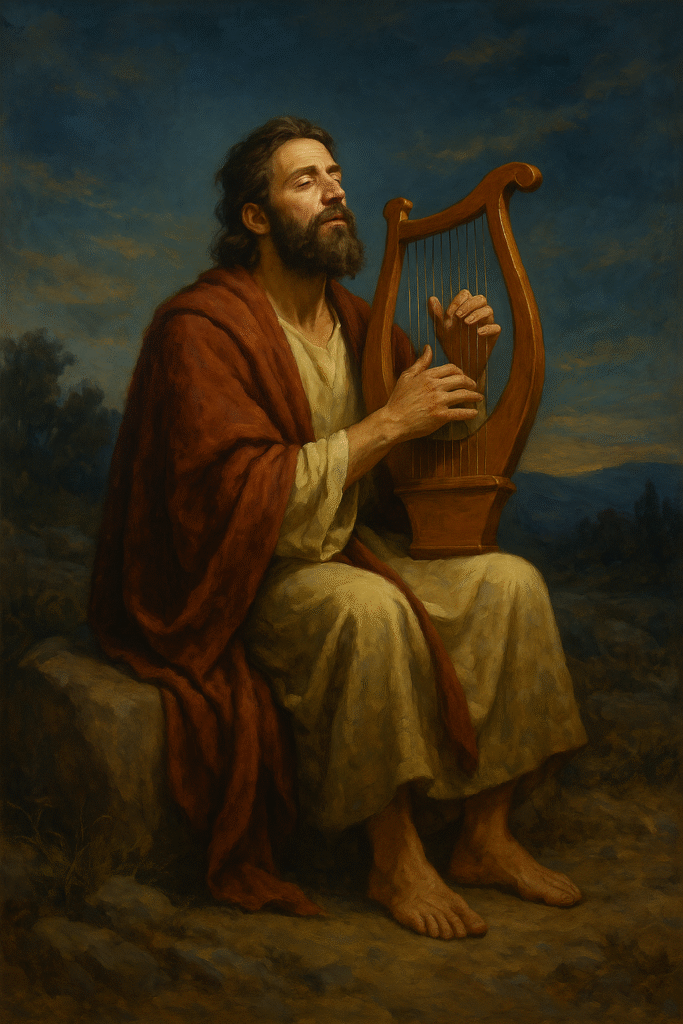
Book of Psalms – Set 1 (Chapters 1–8)
Theme: The Way of the Righteous — Worship, Trust, and God’s Glory in Every Season
1. Summary of the Chapters
Psalm 1 – The Two Paths
The opening psalm stands as the gateway to the entire collection.
It contrasts the way of the righteous and the way of the wicked.
The righteous delight in the law of the Lord — meditating on it day and night — and are compared to a tree planted by streams of water, fruitful and unshakable.
The wicked, however, are like chaff — weightless, blown away by the wind.
This psalm defines the foundation of all worship: a life rooted in communion with God.
Psalm 2 – The Reign of God’s Anointed
Here, the psalmist lifts our gaze to God’s sovereignty over the nations.
Earthly rulers conspire against the Lord and His Anointed (a prophetic reference to Christ), but Heaven laughs at their rebellion.
God declares, “I have installed My King on Zion, My holy hill.”
This psalm foreshadows the ultimate triumph of Jesus, reminding us that the Kingdom cannot be shaken by the schemes of men.
Psalm 3 – Confidence in the Midst of Danger
Written during David’s flight from Absalom, this psalm gives voice to faith in fear.
Surrounded by enemies, David declares, “You, O Lord, are a shield around me, my glory, and the lifter of my head.”
It’s the sound of trust that rises higher than circumstance.
Even while fleeing, David rests — “I lay down and slept; I awoke, for the Lord sustained me.”
Psalm 4 – Peace in the Night
This evening psalm continues the theme of trust.
David calls out to God in distress and ends in quiet confidence: “I will lie down and sleep in peace, for You alone, Lord, make me dwell in safety.”
True peace is not the absence of trouble but the presence of God in the midst of it.
Psalm 5 – Morning Prayer of the Righteous
A companion to Psalm 4, this psalm greets the dawn with expectation.
David contrasts the destiny of the wicked with the blessing of those who walk in reverence.
He prays, “Lead me, Lord, in Your righteousness because of my enemies.”
Morning and evening — this rhythm of prayer forms the heartbeat of intimacy with God.
Psalm 6 – Mercy in Affliction
Here David pleads for mercy under the weight of both sin and sorrow.
His cry, “Be gracious to me, O Lord, for I am weak,” reveals the vulnerability of the worshipper who knows that repentance is not despair — it’s relationship.
By the end, the psalm turns from anguish to assurance: “The Lord has heard my weeping.”
Psalm 7 – Refuge in Righteousness
David cries for justice while trusting that God will defend him against false accusation.
His declaration, “My defence is of God, who saves the upright in heart,” reveals how righteousness is not proven by words, but by endurance in integrity.
Psalm 8 – The Majesty of God and the Dignity of Man
This psalm bursts into worship.
David gazes at creation and marvels that the God who set the stars in place is mindful of humanity.
“What is man that You are mindful of him,
the son of man that You care for him?” (8:4)
Crowned with glory and honour, man is made to reflect God’s image on earth.
This psalm celebrates both divine majesty and human purpose — a harmony between Creator and creation.
2. Key Themes and Lessons
| Theme | Lesson |
|---|---|
| Righteousness and Rootedness | The life grounded in God’s Word stands firm, nourished, and fruitful through every season. |
| God’s Sovereign Reign | The nations may rage, but Christ’s Kingdom is unshakeable and eternal. |
| Trust in Turmoil | True faith is proven in adversity; peace flows from presence, not circumstances. |
| Rhythms of Prayer | Morning and evening communion keep the heart aligned with Heaven’s heartbeat. |
| Mercy and Repentance | God’s correction is redemptive; His mercy meets us in weakness and restores joy. |
| Human Dignity under Divine Majesty | We are small before creation, yet chosen to carry God’s image and authority on earth. |
3. Encouragement
Oh, come on — this opening section is incredible!
Right from Psalm 1, God’s setting the tone: ‘Delight yourself in Me, and you’ll become like a tree that never withers.’
He’s not saying, ‘Try harder.’ He’s saying, ‘Stay planted.’
Psalm 2? That’s Kingdom vision — no matter what the world looks like, Jesus is on the throne!
Nations may plot, politics may rage, but Heaven’s not nervous. The King already reigns.
And look at David in Psalms 3 and 4 — danger all around him, yet he says, ‘I lay down and sleep.’
That’s trust that rests, not wrestles.
When God becomes your shield, fear loses its grip.
Then Psalm 6 — the heart cry of repentance. David’s not hiding his weakness; he’s bringing it into love’s light.
And God doesn’t reject it — He redeems it. He hears every tear as prayer.
And Psalm 8 — oh, that’s where it all comes together!
The One who made galaxies looks at you and says, ‘You’re My image-bearer.’
That’s the gospel before the gospel!
Friend, these psalms teach us something powerful —
worship isn’t about escaping life; it’s about seeing God in it.
The righteous life isn’t about perfection; it’s about connection.
When you meditate on His Word, trust through trial, and stay aware of His glory, you’re living exactly as you were created to: rooted, radiant, and reigning with Him.
4. Reflection Questions
- What “streams of water” — rhythms of prayer, Scripture, or worship — keep me spiritually nourished?
- How can I rest in God’s sovereignty when the world around me feels chaotic?
- In what area of my life is God inviting me to trust Him instead of fear?
- What does David’s example teach me about praying honestly through both joy and sorrow?
- How does Psalm 8 reshape the way I see my worth and purpose in God’s Kingdom?
Book of Psalms – Set 2 (Chapters 9–16)
Theme: Praise, Protection, and the Path of Trust — Worship That Outlasts Every Trial
1. Summary of the Chapters
Psalm 9 – Praise for God’s Justice
David exalts God as the righteous Judge who defends the oppressed and remembers those who cry out to Him.
He declares, “The Lord is a refuge for the oppressed, a stronghold in times of trouble.” (9:9)
David looks beyond his present battles to the ultimate reign of God’s justice. Worship becomes warfare — faith proclaiming victory before it’s visible.
Psalm 10 – The Cry Against Injustice
Psalm 10 continues seamlessly, expressing deep anguish over the apparent triumph of the wicked.
“Why, Lord, do You stand far off?” David asks — giving voice to every believer who has ever felt abandoned amid evil.
Yet he ends with confidence: “The Lord is King forever and ever.” (10:16)
Even when evil seems strong, God’s throne remains secure.
Psalm 11 – Confidence in God’s Foundation
When others say, “Flee like a bird to your mountain,” David replies, “The Lord is in His holy temple; the Lord’s throne is in Heaven.”
This psalm is a declaration that righteousness, not fear, determines direction.
Even when foundations shake, God’s throne does not.
Psalm 12 – The Faithful God in a Faithless Generation
Here, David laments a culture where truth has fallen and flattering tongues dominate.
He pleads for God’s intervention, and God answers: “Because the poor are plundered and the needy groan, I will now arise.” (12:5)
The purity of God’s words becomes the believer’s anchor when human words deceive.
Psalm 13 – From Despair to Song
A brief but powerful psalm, it opens in pain — “How long, O Lord?” — and ends in praise — “I will sing to the Lord, for He has been good to me.”
This is the anatomy of faith: honesty before God, then surrender, then song.
Lament becomes worship when love refuses to let go.
Psalm 14 – The Folly of Godlessness
“The fool says in his heart, ‘There is no God.’” (14:1)
David observes the moral decay of those who deny the Lord. Yet even in corruption, he sees hope: God is with the generation of the righteous.
Humanity’s depravity only highlights the brilliance of divine mercy.
Psalm 15 – The Character of the Righteous
This psalm outlines what it means to dwell in God’s presence: walking blamelessly, speaking truth, honouring others, and keeping one’s word.
Integrity, not status, is Heaven’s currency.
“Whoever does these things will never be shaken.” (15:5)
Psalm 16 – Confidence in God’s Presence
A psalm of trust and prophetic hope, it begins, “Keep me safe, my God, for in You I take refuge.”
David delights in the Lord as his portion, inheritance, and guide.
He declares, “You make known to me the path of life; in Your presence is fullness of joy, at Your right hand are pleasures forevermore.” (16:11)
This verse looks beyond David to Christ — the resurrected One whose life secures our eternal joy.
2. Key Themes and Lessons
| Theme | Lesson |
|---|---|
| God’s Justice and Sovereignty | God defends the weak, judges the wicked, and reigns eternally — even when unseen. |
| Faith Over Fear | True courage comes not from circumstances but from confidence in God’s throne. |
| The Power of Honest Prayer | David’s transparency shows that lament can coexist with worship — honesty deepens intimacy. |
| Integrity in a Corrupt World | The righteous are called to stand firm in truth and character when deception abounds. |
| Joy in God’s Presence | Lasting security is found not in possessions or safety, but in communion with the Living God. |
3. Encouragement
Oh, these psalms are packed with faith that’s been through fire!
Psalm 9 and 10? They show you what real praise looks like — it’s not waiting for life to be easy; it’s declaring God’s goodness when everything screams otherwise.
David’s not pretending the wicked don’t exist; he’s remembering that they don’t reign.
Come on — that’s perspective!
Psalm 11 — the world says, ‘Run!’ but David says, ‘God’s still on the throne!’
That’s how faith talks. It refuses to let fear make the plan.
And Psalm 13? That’s one of my favourites — it starts with ‘How long?’ and ends with ‘I will sing.’
That’s transformation right there.
Faith isn’t denial; it’s defiance — defying despair with trust.
Then Psalm 16 — oh, that’s pure gospel!
David says, ‘You make known to me the path of life.’
He’s prophetically seeing resurrection — Christ rising from the tomb, securing eternal joy for us.
Sister, if life feels unstable, these psalms are your lifeline.
They remind you that even when your world trembles, Heaven doesn’t.
God’s throne never moves — and if you stay close to His heart, neither will you.
4. Reflection Questions
- Where do I find refuge when I feel surrounded by fear or uncertainty?
- How can I turn my laments — my “How long, O Lord?” — into songs of faith?
- What does integrity look like for me in a world that prizes image over truth?
- When have I experienced the peace of knowing that God still reigns even when evil seems to prevail?
- How does Psalm 16’s promise of “fullness of joy” in God’s presence shape my daily perspective?
Book of Psalms – Set 3 (Chapters 17–24)
Theme: Deliverance, Worship, and the King of Glory — The Heart That Trusts and the Reign That Never Ends
1. Summary of the Chapters
Psalm 17 – The Prayer of the Innocent
David pleads for God’s vindication, declaring, “You have tested my heart; You have tried me and found nothing.”
He asks God to keep him as the “apple of Your eye” and to hide him under the shadow of His wings.
Though pursued by enemies, his security rests not in his innocence but in God’s faithfulness.
The psalm ends with this assurance: “I shall be satisfied when I awake in Your likeness.” (17:15)
A whisper of resurrection hope already stirs.
Psalm 18 – God My Deliverer
This magnificent psalm of praise celebrates God’s mighty deliverance.
David recounts how the Lord rescued him from every enemy — how He “parted the heavens and came down” to fight on his behalf.
“The Lord is my rock, my fortress and my deliverer.” (18:2)
Through poetic imagery of thunder, lightning, and smoke, David portrays a God who moves heaven and earth for those who trust Him.
The psalm climaxes in victory and ends in gratitude: “You save the humble but bring low those whose eyes are haughty.”
Psalm 19 – The Glory of God in Creation and His Word
This psalm is a song of revelation — first through the heavens, then through Scripture.
“The heavens declare the glory of God;
the skies proclaim the work of His hands.” (19:1)
But greater still is God’s law — perfect, trustworthy, radiant, and pure.
David prays that both his words and his heart’s meditations would be pleasing to the Lord.
This psalm reveals that true worship begins with awe and ends with alignment.
Psalm 20 – The Prayer Before Battle
A prayer for victory, often used as a blessing over the King before war.
David declares, “Some trust in chariots and some in horses, but we trust in the name of the Lord our God.” (20:7)
This psalm sets faith as the true weapon of warfare — dependence, not might.
Psalm 21 – The Song of Triumph
This is the post-battle psalm — a joyful praise for answered prayer and divine strength.
David rejoices that God grants the desires of the King’s heart and crowns him with glory.
It foreshadows Christ’s ultimate kingship and victory.
Psalm 22 – The Suffering Messiah
One of the most prophetic psalms in all Scripture, this psalm begins with Jesus’ own words on the cross:
“My God, My God, why have You forsaken Me?” (22:1)
David describes piercing, mockery, and garments divided — centuries before crucifixion existed.
Yet midway, despair turns to triumph: “You have answered Me.”
The psalm ends in victory, proclaiming that “all the ends of the earth shall remember and turn to the Lord.”
This is the gospel hidden in song — suffering turned to salvation.
Psalm 23 – The Shepherd and the Soul
Perhaps the most beloved of all psalms, it reveals the Lord’s tender care:
“The Lord is my Shepherd; I shall not want.”
In green pastures, through dark valleys, and even in the presence of enemies, God’s goodness and mercy follow His children forever.
It’s a picture of trust that transcends circumstance — contentment anchored in communion.
Psalm 24 – The King of Glory
This psalm celebrates the entrance of the true King.
It opens with creation’s declaration — “The earth is the Lord’s, and everything in it.” — and crescendos into a triumphant procession:
“Lift up your heads, you gates!
Be lifted up, you ancient doors,
that the King of glory may come in!” (24:7)
This points prophetically to Christ’s ascension — the victorious Redeemer returning in majesty.
2. Key Themes and Lessons
| Theme | Lesson |
|---|---|
| God Our Defender | The Lord fights for His children — His power and presence are our ultimate protection. |
| Revelation Through Creation and Scripture | Nature reveals God’s glory; His Word reveals His character. Both invite awe and obedience. |
| Faith as the True Weapon | Victory comes not from strength but from surrender — trusting in God’s name, not our might. |
| The Prophecy of Redemption | Psalm 22 unveils the cross — suffering transformed into salvation. |
| The Shepherd’s Care | God’s leadership is personal, constant, and tender — guiding us through every valley. |
| The King of Glory Reigns | Christ is both Shepherd and King — humble in care, mighty in victory. |
3. Encouragement
Oh, come on — this section is overflowing with revelation!
Psalm 18 — can you feel it? God doesn’t just watch from Heaven; He moves on behalf of His kids!
He rides the storm for you. He’s not distant — He’s deliverance Himself.
Then Psalm 19 — wow! The heavens shout His glory, and His Word transforms your heart.
Creation reveals His power, but the Word reveals His nature. You were made to live in both awe and intimacy.
And Psalm 22? That’s the gospel right there!
David’s crying out prophetically the very words Jesus would later speak.
What looked like defeat became redemption — come on, that’s God’s pattern every time!
He takes the darkest moment and turns it into resurrection.
Then Psalm 23 — oh, that’s daily relationship!
You’re not a survivor trying to get by; you’re a sheep with a Shepherd who never leaves your side.
You lack nothing because He’s everything.
And Psalm 24 — the crescendo!
‘Lift up your heads, O gates!’
That’s Heaven announcing the risen Christ — the King of Glory entering in triumph.
Friend, this section teaches you how to live — surrounded by chaos but secure in covenant.
God’s not only your Shepherd in the valley; He’s your Warrior in the storm and your King on the throne.
Worship isn’t about escape — it’s about awareness.
Once you see who walks with you, fear has no voice left.
4. Reflection Questions
- How has God shown Himself as my Defender in seasons of fear or opposition?
- In what ways do I see His glory revealed in creation and His character in His Word?
- What does Psalm 22 teach me about God’s ability to redeem suffering?
- How can I cultivate Psalm 23–style peace — resting in the Shepherd’s care each day?
- What does it mean for me personally to “lift up the gates” of my heart and welcome the King of Glory within?
Book of Psalms – Set 4 (Chapters 25–32)
Theme: Repentance, Renewal, and the Joy of Forgiveness — Resting Again in the Smile of God
1. Summary of the Chapters
Psalm 25 – A Prayer for Guidance and Forgiveness
David lifts his soul to God, asking for leading and mercy: “Show me Your ways, Lord, teach me Your paths.”
He acknowledges both his dependence and his past failures, trusting God’s covenant love to cover them.
This psalm intertwines humility with hope — revealing that guidance flows from a surrendered heart.
Psalm 26 – Integrity Before God
David declares his commitment to walk in innocence and truth, saying, “I have trusted in the Lord without wavering.”
He invites divine examination: “Test me, Lord, and try me.”
Righteousness here is not pride but transparency — the willingness to live open before God’s eyes.
Psalm 27 – Fearless Faith
A triumphant declaration: “The Lord is my light and my salvation — whom shall I fear?”
David expresses confidence that even if war rises against him, his heart will not fear.
His one desire is intimacy — “That I may dwell in the house of the Lord all the days of my life.”
Faith replaces fear when fellowship becomes the focus.
Psalm 28 – From Plea to Praise
David cries for help but ends rejoicing: “Blessed be the Lord, for He has heard the voice of my supplications.”
He calls God his strength and shield.
Every prayer becomes a bridge between desperation and thanksgiving.
Psalm 29 – The Voice of the Lord in the Storm
This psalm thunders with majesty!
The “voice of the Lord” echoes seven times — over waters, forests, flames, and mountains.
It declares God’s authority over creation and chaos alike.
At its end comes peace: “The Lord gives strength to His people; the Lord blesses His people with peace.”
Psalm 30 – From Mourning to Dancing
Written for the dedication of David’s house, this psalm celebrates restoration after discipline.
He proclaims, “Weeping may endure for a night, but joy comes in the morning.”
God turns sackcloth into garments of praise.
The psalm shows that gratitude grows deepest in hearts once broken.
Psalm 31 – Trust Amid Betrayal
A cry for deliverance that Jesus Himself echoed on the cross: “Into Your hands I commit My spirit.” (31:5)
David feels forgotten, yet clings to truth — “My times are in Your hand.”
Faith persists when trust outlasts understanding.
Psalm 32 – The Blessedness of Forgiveness
One of the great penitential psalms, it begins: “Blessed is the one whose transgression is forgiven.”
David describes the weight of unconfessed sin — “my bones wasted away” — and the relief when he finally confessed.
Forgiveness brings freedom, joy, and renewed fellowship with God.
2. Key Themes and Lessons
| Theme | Lesson |
|---|---|
| Repentance Restores Relationship | Confession isn’t condemnation; it’s returning to intimacy. |
| Integrity of Heart | True righteousness is living open before God, not pretending perfection. |
| Fearless Trust | Confidence grows when love replaces fear and God’s presence becomes home. |
| God’s Voice in Chaos | His authority reigns even in life’s storms — every thunder carries His peace. |
| Joy After Sorrow | Divine correction is temporary; restoration always follows repentance. |
| The Freedom of Forgiveness | Guilt shackles the soul, but grace makes it dance again. |
3. Encouragement
Oh, these psalms — they’re drenched with redemption!
Look at Psalm 25: David’s not hiding; he’s leaning in.
That’s what repentance really is — running to God, not from Him.
And Psalm 27 — come on!
The whole world’s shaking, but David’s saying, ‘One thing I want — just to be with You.’
That’s victory before the battle even ends.
Psalm 29? That’s Heaven’s surround sound! The storm’s raging, but the voice of the Lord is louder.
When you realise He’s Lord over the storm, peace stops being optional — it becomes natural.
Then Psalm 30 — what a promise!
You might cry through the night, but joy always clocks in for the morning shift.
God doesn’t just fix situations; He transforms hearts.
And Psalm 32 — that’s the gospel in song form!
David’s bones ached under guilt until he confessed, and then — freedom!
He learned that forgiveness isn’t a doctrine; it’s an embrace.
Sister, let these psalms teach you this: failure doesn’t end the story — grace does.
You were never meant to live under condemnation. The same God who convicts also cleanses.
When you let Him lift the weight, joy becomes your default posture again.
4. Reflection Questions
- What does repentance look like for me — running from fear or running into the Father’s arms?
- How can I invite God to “test and try” my heart like David did in Psalm 26?
- Where in my life do I need to trade fear for intimacy, as in Psalm 27?
- When has God’s voice brought peace to my personal storm?
- How can I live daily in the joy and freedom that comes from full forgiveness?
Book of Psalms – Set 5 (Chapters 33–41)
Theme: Praise, Providence, and the Blessed Life — Trusting the Faithful God Who Rules and Restores
1. Summary of the Chapters
Psalm 33 – The Song of Creation’s Praise
This psalm bursts with joy, inviting all the earth to praise God: “Sing joyfully to the Lord, you righteous.”
It celebrates His creative power and faithful plans: “By the word of the Lord the heavens were made.”
The psalm reminds us that no army, nation, or human plan compares to the Lord’s sovereignty.
“The eyes of the Lord are on those who fear Him, on those whose hope is in His unfailing love.” (33:18)
This is worship grounded in trust — joy rooted in divine stability.
Psalm 34 – Taste and See That the Lord Is Good
Written after David’s escape from Abimelech, this psalm transforms deliverance into worship.
It begins, “I will bless the Lord at all times; His praise will continually be in my mouth.”
David testifies that God saves the brokenhearted and delivers those who fear Him.
The invitation is personal: “Taste and see that the Lord is good.”
Faith becomes experiential — not theory, but encounter.
Psalm 35 – The Cry for Justice
Here David pleads for God’s intervention against deceitful enemies.
He asks, “Contend, Lord, with those who contend with me.”
Though wrongly accused, he leaves vengeance in God’s hands.
The psalm ends in triumph: “My tongue will proclaim Your righteousness and Your praises all day long.”
Even in conflict, praise becomes his anchor.
Psalm 36 – The Contrast Between Wickedness and Divine Love
This psalm contrasts human corruption with God’s unfathomable mercy:
“Your love, Lord, reaches to the heavens, Your faithfulness to the skies.” (36:5)
It’s a reminder that sin may run deep, but grace runs deeper still.
God’s presence is a fountain of life, where light and love never run dry.
Psalm 37 – Trusting God in a Troubled World
One of the most comforting wisdom psalms, it teaches patience and trust when evil seems to prosper.
“Do not fret because of evildoers… trust in the Lord and do good.” (37:1–3)
David contrasts the fleeting success of the wicked with the enduring inheritance of the righteous.
“Delight yourself in the Lord, and He will give you the desires of your heart.” (37:4)
This is not a formula for gain, but a call to rest — where delight in God reshapes desire itself.
Psalm 38 – A Cry for Mercy
A penitential psalm expressing deep sorrow and physical suffering due to sin.
David’s words are raw and vulnerable — he feels abandoned, yet his hope remains:
“Lord, I wait for You; You will answer, Lord my God.” (38:15)
Repentance once again becomes the path to peace.
Psalm 39 – The Brevity of Life
David meditates on life’s fragility: “You have made my days a mere handbreadth.”
He prays for wisdom to measure his days rightly and to set his hope fully on God.
This psalm reminds us that humility and perspective keep the soul anchored in eternity.
Psalm 40 – The Song of Deliverance
David rejoices that God lifted him out of a “miry pit” and set his feet upon a rock.
“He put a new song in my mouth, a hymn of praise to our God.” (40:3)
He also foreshadows Christ’s obedience and sacrifice: “Here I am — I have come; it is written about Me in the scroll.”
Worship here becomes testimony — gratitude that proclaims redemption.
Psalm 41 – The Blessedness of Compassion and Integrity
This psalm blesses those who consider the poor and declares God’s protection over them.
It also contains a prophetic echo of betrayal: “Even my close friend, whom I trusted, who shared my bread, has turned against me.” (41:9)
Yet David ends with praise: “Praise be to the Lord, the God of Israel, from everlasting to everlasting.”
2. Key Themes and Lessons
| Theme | Lesson |
|---|---|
| The Sovereignty of God | True peace flows from knowing that God rules above all human plans and powers. |
| Experiencing God’s Goodness | Faith grows when we taste and see — when worship becomes personal encounter. |
| Patience in Injustice | God’s timing and justice are perfect; we can rest instead of striving. |
| The Enduring Mercy of God | His steadfast love is higher than the heavens — endless, unearned, and unstoppable. |
| Repentance and Renewal | Honest confession leads to peace, while self-reliance breeds despair. |
| The Blessed Life | Compassion, integrity, and trust define those who walk in divine favour. |
3. Encouragement
Oh, come on — these psalms are full of life and perspective!
Psalm 33 says, ‘Sing joyfully, you righteous!’ Why?
Because Heaven’s not worried — and if you’re His, you shouldn’t be either.
When you realise God’s plans stand firm forever, fear loses its voice.
Psalm 34 — that’s a personal invitation! ‘Taste and see that the Lord is good.’
He’s not asking you to understand Him — He’s inviting you to experience Him.
Once you taste His goodness, you’ll never be satisfied with empty religion again.
And Psalm 37 — oh, this one is gold.
David’s watching wicked people succeed and says, ‘Don’t fret. Trust. Dwell. Delight.’
That’s Kingdom living!
You don’t let the world’s noise steal your peace because your roots go deeper.
Then Psalm 40 — come on, what a picture of grace!
God doesn’t just pull you out of the pit; He teaches you to sing again.
And the song isn’t about your struggle; it’s about His faithfulness.
Sister, these psalms remind you that life with God isn’t fragile — it’s fortified.
He’s not looking for perfect people; He’s shaping trusting ones.
You can rest, worship, and live free knowing that every breath of praise joins Heaven’s eternal song:
‘The Lord reigns forever.’
4. Reflection Questions
- How can I more intentionally “sing joyfully” and choose gratitude, even before I see breakthrough?
- What does it mean for me to truly “taste and see” the Lord’s goodness in daily life?
- Where do I need to stop striving and start trusting that God’s timing and justice are perfect?
- How does remembering life’s brevity (Psalm 39) shift the way I prioritise what matters most?
- What “new song” has God placed in my heart — and how can I share it to inspire others?
Book of Psalms – Set 6 (Chapters 42–49)
Theme: Thirst for God, Refuge in Trouble, and the Majesty of His Kingdom — The Soul That Finds Strength in His Presence
1. Summary of the Chapters
Psalm 42 – The Thirsting Soul
A cry of holy longing:
“As the deer pants for streams of water, so my soul pants for You, O God.”
The psalmist remembers the joy of worship but now feels distant and downcast.
Yet hope remains alive: “Why, my soul, are you downcast? Put your hope in God.”
Faith speaks to feelings — reminding the heart who still reigns.
Psalm 43 – Light and Truth
A continuation of Psalm 42, this prayer asks: “Send forth Your light and Your truth; let them lead me.”
When darkness and injustice surround, divine truth becomes the guide back into joy.
The refrain repeats: “I will yet praise Him, my Saviour and my God.”
Psalm 44 – Remembering and Wrestling
The nation recalls past victories by God’s hand but now feels abandoned in defeat.
“Awake, Lord! Why do You sleep?”
This psalm gives voice to the mystery of collective suffering while clinging to covenant love:
“In God we make our boast all day long, and we will praise Your name forever.”
It’s faith that refuses to forget, even when understanding fails.
Psalm 45 – The Wedding Song of the King
A majestic psalm celebrating the beauty and authority of the King — prophetically pointing to Christ, the Bridegroom.
“You are the most excellent of men, and Your lips have been anointed with grace.”
The psalm ends with the bride’s exaltation — “The King is enthralled by your beauty; honour Him, for He is your Lord.”
This is covenant love in royal imagery — the union of Christ and His people.
Psalm 46 – God Our Refuge and Strength
A song of unshakable faith:
“God is our refuge and strength, an ever-present help in trouble. Therefore we will not fear.”
Even if the earth gives way or mountains fall, God’s presence remains steadfast.
The psalm climaxes in stillness:
“Be still, and know that I am God.” (46:10)
Psalm 47 – The King of All the Earth
A jubilant declaration that God reigns over all nations.
“Clap your hands, all you nations; shout to God with cries of joy!”
It anticipates Christ’s ascension and universal rule — the victory of Heaven celebrated on earth.
Psalm 48 – The City of God
A hymn of Zion’s strength: “Great is the Lord, and greatly to be praised in the city of our God.”
The psalm describes Jerusalem’s beauty and security as a symbol of God’s eternal Kingdom.
It closes with confidence: “This God is our God forever and ever; He will be our guide even to the end.”
Psalm 49 – The Vanity of Riches and the Hope of Redemption
A wisdom psalm teaching that wealth cannot save or secure eternity.
“No one can redeem the life of another or give to God a ransom for them.” (49:7)
But faith pierces mortality with hope:
“God will redeem me from the realm of the dead; He will surely take me to Himself.” (49:15)
This psalm shifts our perspective from temporary gain to eternal glory.
2. Key Themes and Lessons
| Theme | Lesson |
|---|---|
| Thirst for God’s Presence | True life and joy flow only from communion with God; distance awakens desire. |
| Faith Through Darkness | When feelings fail, the soul must speak truth and hope to itself. |
| God as Refuge | In chaos and calamity, God alone remains unshaken — our steady strength. |
| Christ the Bridegroom-King | Psalm 45 foreshadows the union of Christ and His Church in perfect covenant love. |
| Eternal Perspective | Riches, power, and fame fade, but the redeemed soul endures forever with God. |
| Worship and Sovereignty | The psalms teach that praise and trust are the rightful response to divine kingship. |
3. Encouragement
Oh, come on — these psalms are loaded with life!
Psalm 42 — that’s every believer’s cry at some point: ‘Where are You, God?’
But the answer isn’t absence — it’s deeper hunger.
When you feel dry, it’s not punishment — it’s invitation. God’s pulling you deeper into presence.
Psalm 45 — oh, that’s a picture of Jesus and His bride! The King is captivated by you!
You’re not tolerated; you’re treasured. He’s not ashamed to call you His own.
That’s the gospel wrapped in royal language!
And Psalm 46 — come on!
The mountains can crumble, the world can shake, but your heart can stay still because He’s your refuge.
‘Be still and know that I am God’ — that’s not quiet resignation; it’s confident rest.
It’s Heaven saying, ‘Stop striving — I’ve got this.’
Then Psalm 49 — what a reality check! You can’t buy eternal life, but you can receive it.
The world measures worth by possessions; Heaven measures worth by redemption.
You’ve been purchased by blood, not by silver.
Sister, these psalms pull your eyes off circumstances and fix them on eternity.
They teach you how to drink deeply from God’s presence until your soul sings again.
He’s not just the God who rescues —
He’s the God who reigns, restores, and romances the heart back into worship.
4. Reflection Questions
- When have I most felt like the psalmist in Psalm 42 — longing for God’s presence more than anything else?
- How can I speak hope to my own soul when emotions feel low or faith feels distant?
- What does it mean for me to “be still and know” that He is God in times of chaos?
- How does seeing Christ as my Bridegroom (Psalm 45) change the way I view intimacy with Him?
- What temporary things might I need to release to live with Psalm 49’s eternal perspective?
Book of Psalms – Set 7 (Chapters 50–57)
Theme: The Call to True Worship and the God Who Delivers — Heart Religion, Not Empty Ritual
1. Summary of the Chapters
Psalm 50 – The Call to Genuine Worship
God Himself speaks as Judge, summoning His people:
“The Mighty One, God, the Lord, speaks and summons the earth.”
He rebukes hollow sacrifices, declaring that He desires thanksgiving and obedience more than offerings.
“He who sacrifices thank offerings honours Me.” (50:23)
This psalm reveals that true worship flows from gratitude, not performance — relationship, not religion.
Psalm 51 – The Prayer of Repentance
David’s cry after his sin with Bathsheba — one of the most heartfelt confessions in Scripture.
“Have mercy on me, O God, according to Your unfailing love.”
He asks God to cleanse him, renew a right spirit, and restore the joy of salvation.
“Create in me a clean heart, O God.” (51:10)
Forgiveness here is deeply personal — not a ritual cleansing but a heart reborn.
Psalm 52 – The End of Boastful Evil
Written after Doeg’s betrayal, David contrasts the deceitful with the faithful.
While the wicked trust in riches and lies, David declares:
“I am like an olive tree flourishing in the house of God; I trust in God’s unfailing love for ever and ever.” (52:8)
The righteous life is rooted, not reactive — nourished by divine love.
Psalm 53 – The Fool’s Denial
“The fool says in his heart, ‘There is no God.’”
This psalm mirrors Psalm 14, showing humanity’s corruption and God’s mercy in salvation.
Even in human folly, divine grace still pursues restoration.
Psalm 54 – Help from Above
Written when David was betrayed by the Ziphites, he prays:
“Surely God is my help; the Lord is the one who sustains me.” (54:4)
Despite betrayal, David’s confidence never shifts from human loyalty to divine faithfulness.
Psalm 55 – Betrayal and Burden
A lament over the pain of betrayal — “If an enemy were insulting me, I could endure it… but it is you, my companion.” (55:12–13)
David finds peace in surrender:
“Cast your cares on the Lord and He will sustain you.” (55:22)
Faith doesn’t deny pain; it releases it to the One who carries it.
Psalm 56 – Trust in the Midst of Fear
Written while David was captured by the Philistines, this psalm declares faith over fear:
“When I am afraid, I put my trust in You.” (56:3)
David knows God keeps track of every tear — “You have collected all my tears in Your bottle.”
Every sorrow becomes sacred when entrusted to Him.
Psalm 57 – Worship in the Cave
Composed while hiding from Saul in the cave, David begins in fear but ends in praise.
“Have mercy on me, O God… I will take refuge in the shadow of Your wings.”
Even in hiding, he exalts:
“Be exalted, O God, above the heavens; let Your glory be over all the earth.” (57:5)
The cave becomes a cathedral — fear transformed into worship.
2. Key Themes and Lessons
| Theme | Lesson |
|---|---|
| True Worship | God desires grateful hearts and obedient lives, not hollow rituals. |
| Repentance and Renewal | Sin breaks fellowship, but confession restores joy and purity. |
| Trust in Betrayal | When people fail us, divine love sustains us. |
| Faith Over Fear | Courage is not the absence of fear, but faith that redefines it. |
| Worship in the Wilderness | Even caves and trials can become altars of praise. |
3. Encouragement
Oh, these psalms are fire for the soul!
Psalm 50 — God’s saying, ‘I don’t need your sacrifices; I want you!’
He’s after communion, not ceremony.
When worship comes from gratitude, not guilt, Heaven smells it as sweet incense.
And Psalm 51 — oh, come on! This is David at his most real.
He’s fallen, broken, ashamed — but not hopeless.
He doesn’t run from God; he runs to Him.
‘Create in me a clean heart, O God.’ That’s not a desperate beggar — that’s a son coming home.
Psalm 55 — you can almost feel the sting of betrayal, can’t you?
But then David says, ‘Cast your cares on the Lord.’
That’s not a cliché; that’s deliverance. God doesn’t just remove the burden; He holds the heart beneath it.
And Psalm 57 — the cave becomes a place of glory!
David’s hiding for his life, yet he sings, ‘Be exalted, O God.’
That’s it right there — worship doesn’t wait for daylight; it creates it.
Sister, these psalms are your roadmap for real relationship.
They show you that God’s not scared of your weakness, your tears, or your caves.
He’s not asking for perfection — He’s asking for honesty.
And when you bring Him the real you, He fills you with the real Him —
joy, peace, and the power to praise right in the middle of it all.
4. Reflection Questions
- How can I make my worship more genuine and rooted in gratitude rather than obligation?
- What areas of my life need a “Psalm 51” moment — a prayer of cleansing and renewal?
- How have I experienced God’s presence sustaining me when people have failed or betrayed me?
- What fears could I surrender today, trusting that He keeps every tear?
- How might I turn my “cave seasons” into altars of worship instead of places of despair?
Book of Psalms – Set 8 (Chapters 58–65)
Theme: Justice, Refuge, and the God Who Hears — Confidence in His Righteous Rule and Tender Mercy
1. Summary of the Chapters
Psalm 58 – The Cry for Righteous Judgment
David laments corrupt rulers who pervert justice and harm the innocent.
He declares that God will ultimately repay evil and vindicate the righteous:
“Surely there is a God who judges the earth.” (58:11)
This psalm reminds us that divine justice may seem delayed, but it is never denied.
Psalm 59 – Deliverance from Enemies
Written when Saul’s men surrounded David’s house, this psalm is both plea and praise.
He prays for rescue from bloodthirsty foes and ends rejoicing:
“But I will sing of Your strength; in the morning I will sing of Your love.” (59:16)
When fear presses in, worship becomes the weapon of faith.
Psalm 60 – Prayer for National Restoration
After military defeat, David cries out for renewal: “You have shaken the land and torn it open; now mend its fractures.” (60:2)
He declares confidence in God’s covenant — that through Him, Israel will triumph.
This psalm teaches us to see every loss through the lens of redemption.
Psalm 61 – Shelter Beneath His Wings
A prayer of quiet trust:
“From the ends of the earth I call to You… lead me to the rock that is higher than I.” (61:2)
David finds security not in power but in presence — abiding under God’s wings, singing vows of love and loyalty.
Psalm 62 – Rest in God Alone
This psalm is the anthem of calm trust.
“My soul finds rest in God alone; my salvation comes from Him.” (62:1)
David contrasts fleeting human strength with the unshakable foundation of divine power and mercy.
It’s the posture of faith that no longer strives — it rests.
Psalm 63 – The Soul That Thirsts for God
Written in the wilderness, this psalm overflows with passion for God’s presence:
“Because Your love is better than life, my lips will glorify You.” (63:3)
Even in desolation, David finds satisfaction in worship: “My soul will be satisfied as with the richest of foods.”
The wilderness becomes a sanctuary for intimacy.
Psalm 64 – Hidden from the Wicked, Heard by God
David prays for protection against malicious tongues and secret plots.
He trusts that God will turn their schemes back upon themselves.
“The righteous will rejoice in the Lord and take refuge in Him.” (64:10)
The believer’s defence is not retaliation but refuge.
Psalm 65 – The God Who Hears and Provides
A magnificent hymn of thanksgiving celebrating God’s mercy and provision:
“You answer us with awesome deeds of righteousness.” (65:5)
God’s care extends from forgiving sins to watering the earth.
The psalm closes in abundance — fields clothed with flocks and valleys shouting for joy.
It’s a vision of a world restored under divine goodness.
2. Key Themes and Lessons
| Theme | Lesson |
|---|---|
| Divine Justice | God will always vindicate truth and defend the innocent; His justice is both patient and perfect. |
| Worship in the Midst of Warfare | Singing through fear transforms anxiety into strength — worship disarms the enemy. |
| Restoration and Renewal | God mends what human hands break, bringing redemption even after loss. |
| God as Refuge | True safety is not found in control, but in surrender to His presence. |
| Stillness and Trust | Faith matures when it ceases striving and rests fully in God’s power and timing. |
| The God Who Hears | Every prayer, every tear, and every sigh are known and answered by the Father of mercy. |
3. Encouragement
Oh, these psalms — they carry such deep revelation of trust!
Psalm 58? It’s David saying, ‘God, You see it all — and You’ll set it right.’
That’s not revenge; that’s confidence in divine justice. You don’t have to carry what Heaven’s already settled.
Then Psalm 59 — David’s house is surrounded by enemies, and what does he do? He sings!
Come on — that’s faith!
He doesn’t let fear lead; he lets worship speak.
That’s what makes the morning dawn differently — not because the storm ends, but because your song rises.
Psalm 62 — oh, that’s maturity!
‘My soul finds rest in God alone.’ That’s not resignation; that’s revelation.
It’s the sound of someone who’s stopped trying to control outcomes and started trusting the One who holds them.
And Psalm 63 — come on, that’s intimacy!
David’s in the desert, hungry and tired, and says, ‘Your love is better than life!’
He’s saying, ‘Even if nothing changes out here, I have everything in here — because You’re with me.’
That’s what it means to be free.
Psalm 65 wraps it up with this truth: God not only hears — He answers with abundance.
He forgives sin, refreshes the land, and crowns the year with goodness.
That’s who He is — a God of mercy, movement, and multiplication!
Sister, these psalms invite you into a peace that doesn’t depend on outcomes.
You can rest, rejoice, and rebuild knowing that every prayer sown in faith will bloom in due season.
Because the same God who hears — also heals, restores, and reigns.
4. Reflection Questions
- How can I worship more intentionally in moments of fear or injustice, like David in Psalm 59?
- What situations in my life require me to rest instead of strive — to “wait silently” as in Psalm 62?
- How has God shown Himself as my rock, refuge, or restorer when everything else felt unstable?
- What does Psalm 63’s passion — “Your love is better than life” — reveal about the kind of relationship God desires with me?
- How can I thank God more often for the “ordinary miracles” of daily provision like Psalm 65 describes?
Book of Psalms – Set 9 (Chapters 66–72)
Theme: Praise, Deliverance, and the Reign of the Righteous King — From Personal Gratitude to Global Glory
1. Summary of the Chapters
Psalm 66 – Praise for God’s Mighty Works
This psalm calls all the earth to shout for joy to God.
It celebrates His awesome deeds — both in creation and in rescuing His people through trial.
“He turned the sea into dry land… come and see what God has done.” (66:6,5)
The psalmist offers a personal testimony: “I cried to Him with my mouth… but God has surely listened.” (66:17,19)
Praise becomes both communal and intimate — a declaration that God hears and answers prayer.
Psalm 67 – The Blessing to All Nations
A short yet powerful psalm that echoes the priestly blessing:
“May God be gracious to us and bless us and make His face shine on us.” (67:1)
Its purpose is missional — that all nations may know His salvation.
It looks forward prophetically to Christ’s Kingdom, where joy and justice fill the earth.
Psalm 68 – The Victorious Procession of God
A triumphant psalm of God’s power and presence leading His people through history.
“Let God arise, and let His enemies be scattered.” (68:1)
It depicts God as the defender of the fatherless and the One who daily bears our burdens.
The psalm ascends to glory — foreshadowing Christ’s resurrection and ascension:
“You ascended on high, leading captives in Your train.” (68:18, ESV)
Psalm 69 – The Suffering Servant’s Cry
One of the most prophetic psalms of the cross, describing both David’s anguish and Jesus’ future suffering.
“They gave me gall for my food, and vinegar for my thirst.” (69:21)
It moves from sorrow to hope — trusting that God’s salvation will yet be declared to future generations.
Even in pain, purpose shines through.
Psalm 70 – The Urgent Prayer for Help
A brief, urgent cry for deliverance:
“Hasten, O God, to save me; come quickly, Lord, to help me.” (70:1)
It’s a reminder that honest prayer doesn’t need eloquence — just dependence.
Psalm 71 – The Faithful God of Every Season
An older David looks back over his life and proclaims God’s lifelong faithfulness.
“You have been my hope, Sovereign Lord, my confidence since my youth.” (71:5)
He prays not to be cast aside in old age but to continue declaring God’s strength to the next generation.
“Even when I am old and grey, do not forsake me, my God, till I declare Your power to those to come.” (71:18)
This psalm celebrates a lifetime of trust — faith proven over decades of walking with God.
Psalm 72 – The Reign of the Righteous King
Traditionally attributed to Solomon, this psalm prophetically points to Christ’s eternal reign.
It describes the perfect King whose rule brings justice, compassion, and global peace.
“He will deliver the needy who cry out… He will save the weak and needy.” (72:12–13)
His dominion stretches “from sea to sea,” and all nations are blessed through Him.
The psalm ends with a doxology marking the close of Book II of Psalms:
“Praise be to His glorious name forever; may the whole earth be filled with His glory.” (72:19)
This is the Kingdom prayer of every heart aligned with Heaven.
2. Key Themes and Lessons
| Theme | Lesson |
|---|---|
| God’s Faithfulness and Power | He turns trials into testimonies — from Red Seas to personal breakthroughs. |
| Blessing for the Nations | God’s goodness toward His people is meant to reveal His glory to the world. |
| Victory Through His Presence | The Lord leads, defends, and dwells among His people — never distant, always active. |
| Suffering and Redemption | Pain becomes prophecy when endured with faith; every sorrow can point to salvation. |
| Faith Through the Generations | God’s faithfulness spans lifetimes — He remains steadfast in youth, age, and eternity. |
| The Reign of Christ | Jesus is the true King of Psalm 72 — righteous, merciful, and worthy of global praise. |
3. Encouragement
Oh, come on — this section overflows with Kingdom reality!
Psalm 66 — you can feel it, can’t you? God’s saying, ‘Come and see what I’ve done!’
He’s not just the God of ancient miracles; He’s the God of your story.
Every Red Sea you’ve crossed is a testimony waiting to be sung.
Psalm 67 — this is the heartbeat of Heaven!
God blesses you so the world can see Him through you.
That’s what grace does — it turns a blessed life into a shining witness.
Psalm 68 — wow, what a ride!
‘Let God arise!’
He’s marching through history, lifting the lonely, defending the broken, bearing our burdens daily.
And that verse — ‘You ascended on high…’ — that’s Jesus leading the victory parade out of the grave! Come on!
Psalm 69 — heavy but holy.
It’s Jesus suffering — the vinegar, the mockery — but through it all, love stays the course.
That’s redemption in its rawest form: love that refuses to quit.
And Psalm 71 — that’s legacy!
David’s saying, ‘Even when I’m old, let me still tell Your story.’
Friend, that’s what life is for — not just surviving seasons, but declaring His faithfulness through every one of them.
Then Psalm 72 — oh, that’s the crescendo!
It’s not just Solomon’s reign; it’s a prophecy of Jesus — the Righteous King.
He’s ruling right now, not someday!
His Kingdom is justice, mercy, and peace — expanding through every life surrendered to His heart.
These psalms invite you to live in a bigger story —
one where worship is worldwide, redemption is unstoppable, and the King’s glory fills the earth.
You’re not just blessed to be comforted — you’re blessed to reveal the King.
4. Reflection Questions
- How has God turned a past trial into a “Psalm 66” testimony of praise?
- What does it mean for me personally to be part of God’s blessing “to all nations” (Psalm 67)?
- How can I rest in the assurance that Jesus already reigns as the victorious King (Psalm 68 & 72)?
- In what ways does Psalm 71 inspire me to keep declaring God’s faithfulness in every season of life?
- How might my daily life reflect the compassion and justice of Christ’s Kingdom described in Psalm 72?
Book of Psalms – Set 10 (Chapters 73–83)
Theme: The Battle Between Earthly Chaos and Divine Faithfulness — Learning to See From God’s Perspective
1. Summary of the Chapters
Psalm 73 – When the Wicked Seem to Prosper
Asaph begins with honesty: “But as for me, my feet had almost slipped; I envied the arrogant when I saw the prosperity of the wicked.”
He wrestles with why the ungodly thrive while the righteous suffer — until he enters God’s sanctuary.
There, perspective changes:
“Then I understood their final destiny.” (73:17)
Asaph ends in worship: “Whom have I in heaven but You?… God is the strength of my heart and my portion forever.”
Clarity comes not from answers but from presence.
Psalm 74 – A Cry for the Ruined Sanctuary
This national lament grieves the destruction of God’s temple and the oppression of His people.
“Why have You rejected us forever, O God?” (74:1)
Yet it also remembers His past deliverance — parting the sea, crushing Leviathan — declaring hope that He will act again.
It’s the cry of faith refusing to let go of covenant promise.
Psalm 75 – The God Who Judges Uprightly
A declaration that God alone holds the power to raise up or bring down.
“It is God who judges; He brings one down, He exalts another.” (75:7)
This psalm celebrates divine justice — not random or delayed, but perfectly timed.
Psalm 76 – The Warrior God of Peace
A song of victory declaring that God has broken the weapons of war and reigns from Zion in power.
“You are radiant with light, more majestic than mountains rich with game.” (76:4)
He silences human pride with holy awe.
Psalm 77 – Remembering in the Dark Night
Asaph pours out anguish — “Has His unfailing love vanished forever?” — but then remembers God’s past wonders.
“I will remember the deeds of the Lord.” (77:11)
Memory becomes medicine.
He ends in awe of God’s unseen footprints through the Red Sea — proof that God’s silence is never absence.
Psalm 78 – Lessons from History
A long and powerful psalm recounting Israel’s repeated rebellion and God’s patient mercy.
It warns future generations to remember His works and remain faithful.
“He established a testimony in Jacob… that they should make them known to their children.” (78:5–6)
God’s compassion triumphs over their failures, proving His covenant love endures.
Psalm 79 – Prayer for National Mercy
Amid devastation, the psalmist pleads for forgiveness and restoration.
“Help us, O God of our salvation, for the glory of Your name.” (79:9)
Even judgment becomes a doorway for repentance and revival.
Psalm 80 – Restore Us, O God
This psalm repeats the refrain three times:
“Restore us, O God; make Your face shine on us, that we may be saved.” (80:3,7,19)
It pictures God as a Shepherd called to awaken and renew His people once more.
Psalm 81 – The Call to Listen and Obey
God laments that His people refused to listen: “If My people would only listen to Me… I would quickly subdue their enemies.” (81:13–14)
This psalm reveals how obedience opens the door to protection and abundance.
Psalm 82 – God’s Justice Over All Powers
God stands among earthly rulers and rebukes them for oppressing the poor and needy.
“Defend the weak and the fatherless; uphold the cause of the poor and the oppressed.” (82:3)
It’s a reminder that leadership is stewardship — and God will hold every authority accountable.
Psalm 83 – Prayer Against Conspiracy
The final psalm in this set cries out for deliverance from nations plotting against Israel.
The psalmist asks that God’s enemies would recognise His supremacy:
“Let them know that You, whose name is the Lord — that You alone are the Most High over all the earth.” (83:18)
It ends with faith that God’s glory, not vengeance, will have the final word.
2. Key Themes and Lessons
| Theme | Lesson |
|---|---|
| Perspective Through Presence | Like Asaph, clarity comes not from understanding life’s unfairness but from being near to God. |
| God’s Covenant Faithfulness | Even when nations fall and temples crumble, God’s promises remain unbroken. |
| The Power of Remembrance | Recalling God’s past works strengthens faith for present trials. |
| Justice and Leadership | Earthly power is accountable to divine authority; true strength serves the weak. |
| Restoration Through Repentance | Every cry for mercy invites God’s renewal — both personally and nationally. |
| God’s Ultimate Supremacy | No conspiracy, rebellion, or injustice can overthrow the Most High. |
3. Encouragement
Oh, come on — these psalms are real, raw, and redemptive!
Psalm 73? That’s Asaph being brutally honest — ‘God, why do the wicked prosper?’
But then, he steps into the sanctuary, and everything changes.
That’s the key, friend — perspective shifts in His presence!
Psalm 77 — I love that one. Asaph’s questioning everything, but then he remembers,
‘You led Your people like a flock, though Your footprints were unseen.’
That’s faith right there — trusting when you can’t trace Him, believing when you can’t see Him.
Psalm 78 — what a legacy psalm! It says, ‘Teach your children.’
That’s our call — to pass on revelation, not just religion.
We don’t just tell stories about God; we show a life that proves He’s still faithful!
Psalm 80 — ‘Restore us, O God.’ You can almost hear the longing.
He’s saying, ‘Shine Your face on us again.’ And you know what?
That’s exactly what God did in Jesus — His face has shone upon us forever through Christ!
Then Psalm 82 — God stands up among rulers and says, ‘Defend the poor!’
Come on — that’s Kingdom justice. Real power protects, it doesn’t exploit.
Sister, these psalms are training your heart to see above the storm — to look from Heaven’s vantage point.
When everything below looks broken, God says, ‘Lift your eyes — I still reign.’
Faith doesn’t deny reality; it redefines it through His faithfulness.
4. Reflection Questions
- When have I, like Asaph, struggled to understand why injustice seems to prevail — and how did God bring me back to His perspective?
- How can I intentionally “remember the deeds of the Lord” during difficult times?
- What areas of my life or nation need the prayer of Psalm 80 — “Restore us, O God, and make Your face shine”?
- How can I model Psalm 82’s call to defend the weak and uphold justice in my community?
- What does it mean to live as someone who trusts that God’s covenant never fails, even when the world shakes?
Book of Psalms – Set 11 (Chapters 84–89)
Theme: The Glory of His Presence and the Faithfulness of His Covenant — Dwelling, Delighting, and Trusting in the Eternal King
1. Summary of the Chapters
Psalm 84 – Longing for God’s Dwelling Place
A psalm of the sons of Korah, overflowing with love for the presence of God:
“How lovely is Your dwelling place, Lord Almighty! My soul yearns, even faints, for the courts of the Lord.” (84:1–2)
Even the sparrow and swallow find refuge near His altar.
The psalm declares that strength is found not in comfort, but in pilgrimage:
“Blessed are those whose strength is in You, whose hearts are set on pilgrimage.” (84:5)
The psalm closes with this treasure of truth:
“Better is one day in Your courts than a thousand elsewhere.” (84:10)
True joy is not in what we possess but in where we dwell — in Him.
Psalm 85 – Restoration and Righteousness
A national prayer for revival:
“You, Lord, showed favour to Your land… restore us again.” (85:1,4)
The psalmist recalls past mercy as a foundation for present hope.
It ends with a prophetic vision of unity:
“Love and faithfulness meet together; righteousness and peace kiss each other.” (85:10)
In Christ, this verse finds fulfilment — the cross becomes the place where justice and mercy embrace.
Psalm 86 – A Personal Prayer of Dependence
David cries out with humility and trust:
“Hear me, Lord, and answer me, for I am poor and needy.” (86:1)
Despite distress, he praises God’s goodness and steadfast love:
“You, Lord, are forgiving and good, abounding in love to all who call to You.” (86:5)
It’s a portrait of intimacy — of walking closely with a Father who never rejects a contrite heart.
Psalm 87 – The City of God
This psalm exalts Zion as the dwelling place of God’s glory:
“Glorious things are spoken of you, city of God.” (87:3)
It foresees the inclusion of all nations, as people from Egypt, Babylon, and beyond are said to be “born in Zion.”
It’s a prophetic picture of the Church — one family under one King.
Psalm 88 – The Darkest Night of the Soul
A deeply sorrowful psalm — possibly the most desolate in all Scripture.
The writer cries from a pit of anguish, feeling abandoned and unheard.
“Darkness is my closest friend.” (88:18)
Yet even in despair, he prays — proving that faith persists when hope feels lost.
This psalm reminds us that honesty before God is still worship.
Psalm 89 – Covenant and Kingship
A majestic hymn celebrating God’s eternal covenant with David — then lamenting the apparent collapse of that promise.
“I will sing of the Lord’s great love forever.” (89:1)
The psalm recounts God’s faithfulness and mighty deeds, then mourns the fall of the Davidic throne.
But hidden within the lament lies prophecy — pointing to the coming Messiah, the true and everlasting King.
“I will not lie to David… his throne will endure forever.” (89:35–36)
Book 111 ends not in despair, but in anticipation — that the covenant will be fulfilled in Christ alone.
2. Key Themes and Lessons
| Theme | Lesson |
|---|---|
| Longing for God’s Presence | True satisfaction comes not from circumstance but communion — dwelling with God is life itself. |
| Revival and Restoration | God’s past faithfulness fuels present hope — He restores the humble and revives His people. |
| Intimacy in Prayer | God delights in dependence; the cry of the needy is precious to Him. |
| The Global Kingdom | Zion is more than a place — it’s the heart of God’s people from every nation. |
| Faith Through Darkness | Even when light feels gone, faith keeps speaking — darkness cannot silence prayer. |
| The Everlasting Covenant | God’s promises are never broken; His covenant endures through Christ, the eternal King. |
3. Encouragement
Oh, these psalms — they’re pure gold for your spirit!
Psalm 84 — come on, can you feel that hunger?
‘Better is one day in Your courts than a thousand elsewhere.’ That’s the heartbeat of revival right there!
It’s not about church attendance — it’s about presence. When you taste Him, nothing else compares.
Psalm 85 — what a picture!
‘Love and faithfulness meet, righteousness and peace kiss.’
That’s Jesus on the cross — God’s justice and mercy colliding in perfect harmony.
He didn’t compromise truth to show love; He revealed love by fulfilling truth.
Psalm 86 — David’s crying out, but there’s no hopelessness in his tone.
He’s needy, yes — but he knows where to go! Dependence isn’t weakness; it’s wisdom.
Psalm 87 — that’s a vision of Heaven’s city.
It’s saying, ‘Hey, everyone can be born in Zion!’
That’s the Gospel! You’ve got a new birth certificate written in grace, not geography.
Then Psalm 88 — it’s dark, raw, almost painful to read. But here’s the beauty: the man’s still talking to God.
When you can’t see Him, keep speaking. That’s faith in its purest form — trusting when there’s no visible light.
Psalm 89 seals it. God says, ‘My covenant I will not break.’
It looked like the promise had failed when David’s line fell — but it didn’t.
It was waiting. Jesus is the fulfilment of that covenant!
He’s the eternal King sitting on the throne of David forever!
Sister, your circumstances might look like Psalm 88, but your story ends in Psalm 89.
God’s covenant hasn’t failed — it’s fulfilled in Christ.
So lift your eyes! Even in the valley, His faithfulness is writing your victory.
4. Reflection Questions
- What does Psalm 84 teach me about the joy and strength found in simply dwelling with God?
- Where in my life do I need to pray, like Psalm 85, for restoration and revival — personally or for my community?
- How does Psalm 86 remind me that dependence on God is a mark of maturity, not weakness?
- In what ways does Psalm 88’s honesty encourage me to keep praying through dark or confusing seasons?
- How does Psalm 89 deepen my understanding of Jesus as the fulfilment of God’s everlasting covenant?
Book of Psalms – Set 12 (Chapters 90–100)
Theme: The Majesty, Mercy, and Eternal Reign of God — From Generation to Generation He Is God
1. Summary of the Chapters
Psalm 90 – The Eternal God and Mortal Man
A prayer of Moses — the oldest psalm in Scripture.
It contrasts the eternal nature of God with the frailty of humanity:
“Before the mountains were born… from everlasting to everlasting, You are God.” (90:2)
Moses pleads for wisdom to live meaningfully:
“Teach us to number our days, that we may gain a heart of wisdom.” (90:12)
The psalm closes with hope — that God’s favour would “establish the work of our hands.”
It’s the perfect beginning to a new movement in Psalms: the humble heart standing before the Ancient of Days.
Psalm 91 – The Shelter of the Most High
A psalm of divine protection and intimacy.
“Whoever dwells in the shelter of the Most High will rest in the shadow of the Almighty.” (91:1)
It paints the picture of total security — under His wings, no fear, no plague, no night terror can stand.
It ends with God’s personal promise:
“Because he loves Me, I will rescue him… I will be with him in trouble, I will deliver him and honour him.” (91:14–15)
This psalm remains a timeless anthem of trust and covenant protection.
Psalm 92 – The Song of the Sabbath
A psalm of gratitude celebrating the goodness and faithfulness of God.
“It is good to praise the Lord and make music to Your name.” (92:1)
The righteous are compared to palm trees and cedars — flourishing, fruitful, and steadfast even in old age.
Praise here is not just expression; it’s strength renewed through gratitude.
Psalm 93 – The Lord Reigns
A short yet thunderous declaration of God’s sovereignty:
“The Lord reigns, He is robed in majesty.” (93:1)
Amid chaos, floods, and nations in turmoil, His throne remains unshaken.
This psalm anchors us in eternal stability — the King still reigns.
Psalm 94 – The God Who Sees and Defends
A cry for justice — yet full of confidence that God will defend His people.
“The Lord will not reject His people; He will never forsake His inheritance.” (94:14)
Even in the tension between injustice and faith, the psalmist concludes,
“When anxiety was great within me, Your consolation brought me joy.” (94:19)
This is trust refined through trial.
Psalm 95 – The Call to Worship and Obedience
A joyful invitation:
“Come, let us sing for joy to the Lord; let us shout aloud to the Rock of our salvation.” (95:1)
Yet it warns not to harden hearts as Israel did in the wilderness.
Worship and obedience are inseparable — true praise flows from surrendered hearts.
Psalm 96 – Declare His Glory Among the Nations
A global song of evangelism and adoration:
“Sing to the Lord, all the earth… declare His glory among the nations.” (96:1–3)
It calls creation itself into worship — the forests, seas, and heavens rejoicing because the Lord is coming to judge in righteousness.
Psalm 97 – The Lord’s Reign Revealed in Fire and Light
The imagery of God’s rule blazes with glory:
“Clouds and thick darkness surround Him; righteousness and justice are the foundation of His throne.” (97:2)
The psalm contrasts the idols of earth with the majesty of the living God.
His light scatters darkness — and those who love Him rejoice in holiness.
Psalm 98 – The Song of Salvation
A jubilant hymn celebrating God’s victory:
“Sing to the Lord a new song, for He has done marvellous things.” (98:1)
It anticipates the coming of Christ — salvation made visible to all nations.
The rivers clap, the hills sing — creation joins the redeemed chorus of praise.
Psalm 99 – The Holy King
A majestic vision of God’s holiness:
“Exalt the Lord our God and worship at His footstool; He is holy.” (99:5)
The psalm recalls Moses, Aaron, and Samuel — leaders who interceded before Him — showing that holiness and mercy walk hand in hand in His Kingdom.
Psalm 100 – The Joyful Call to Enter His Presence
The final psalm in this set — short, radiant, overflowing with thanksgiving:
“Enter His gates with thanksgiving and His courts with praise; give thanks to Him and praise His name.” (100:4)
It concludes with one of Scripture’s most beautiful truths:
“For the Lord is good and His love endures forever; His faithfulness continues through all generations.” (100:5)
From Moses to the Messiah, from creation to eternity — His goodness remains unchanged.
2. Key Themes and Lessons
| Theme | Lesson |
|---|---|
| The Eternal Nature of God | Our lives are fleeting, but His presence and promises are everlasting. |
| Divine Protection | Those who dwell in intimacy with God find safety, peace, and strength amid turmoil. |
| Praise and Sabbath Rest | Worship renews strength; gratitude anchors the soul in joy. |
| The Reign of God | No force on earth can dethrone Him — His rule is absolute and benevolent. |
| Justice and Holiness | God’s holiness demands righteousness but reveals mercy through His faithfulness. |
| Universal Worship | All creation is invited into the joy of proclaiming His glory — worship unites Heaven and earth. |
| Generational Faithfulness | God’s goodness endures across every generation — He is the same yesterday, today, and forever. |
3. Encouragement
Oh, come on — these psalms roar with confidence!
Psalm 90 — that’s perspective! Moses is saying, ‘You’re eternal, we’re momentary — teach us to live wisely!’
That’s humility that turns into wisdom.
Psalm 91 — who doesn’t love this one? It’s not just a promise of safety — it’s an invitation to abide.
You can’t claim the protection without living in the presence. God’s shadow only covers those who stay close!
Psalm 93 to 99 — wow! Every one of them declares, ‘The Lord reigns!’
You can almost hear Heaven echoing. No government, no chaos, no storm changes that truth.
He’s not nervous on His throne — and neither should you be.
And Psalm 95 — come on, that’s revival wrapped in a song! ‘Don’t harden your hearts!’ Why?
Because worship without surrender is just noise. Real worship says, ‘You’re King, I’m Yours.’
Psalm 98 — that’s the Gospel being sung before it ever happened!
‘He has revealed His salvation to the nations.’ That’s Jesus!
The hills, the rivers, the seas — they’re all celebrating the same thing we are: redemption has come.
Psalm 100 ties it all up like a bow — gratitude, joy, and generational faithfulness.
It says, ‘The Lord is good, and His love endures forever.’
That’s your foundation. That’s your identity.
You’re safe because He reigns. You’re secure because He’s faithful.
So keep singing — your praise aligns you with the eternal rhythm of Heaven itself!
4. Reflection Questions
- How does Psalm 90 challenge me to live wisely and purposefully in light of eternity?
- What does Psalm 91 teach me about abiding in God’s presence, not just seeking His protection?
- In what ways does regular worship (Psalm 92–95) renew my perspective and strengthen my faith?
- How can I join in declaring God’s glory among the nations like Psalm 96–98 describe?
- What practical ways can I express gratitude and faith in God’s unchanging goodness as Psalm 100 encourages?
Book of Psalms – Set 13 (Chapters 101–110)
Theme: The King’s Integrity, Power, and Prophetic Reign of Christ — The Rule of Righteousness and the Triumph of the Messiah
1. Summary of the Chapters
Psalm 101 – The Integrity of a King
David declares his commitment to rule with holiness and integrity:
“I will sing of Your love and justice; to You, Lord, I will sing praise.” (101:1)
He vows to walk blamelessly, refuse deceit, and surround himself with the faithful.
This psalm is both a leader’s code and a believer’s call to purity of heart.
It reminds us that authority in God’s Kingdom flows through righteousness.
Psalm 102 – A Cry from Affliction and the Assurance of Eternal Hope
A deeply moving lament — the psalmist pours out his heart in distress, describing days fading like smoke.
Yet even in anguish, faith rises:
“But You, Lord, sit enthroned forever; Your renown endures through all generations.” (102:12)
The psalm ends with hope that transcends mortality — God will rebuild Zion and appear in glory.
It looks beyond personal suffering to the restoration of all things.
Psalm 103 – Bless the Lord, O My Soul
One of the most beloved psalms of praise and gratitude.
“Bless the Lord, O my soul, and forget not all His benefits.” (103:2)
David lists God’s goodness — forgiveness, healing, redemption, compassion — and proclaims,
“As far as the east is from the west, so far has He removed our transgressions from us.” (103:12)
This psalm is a treasure chest of grace — a song that lifts weary hearts into joyful remembrance.
Psalm 104 – The Majesty of Creation
A hymn celebrating God’s creative power and providence:
“You are clothed with splendour and majesty, covering Yourself with light as with a garment.” (104:1–2)
Every creature, mountain, and ocean lives by His breath.
The psalm closes with praise: “May the Lord rejoice in His works!”
Creation itself becomes a living testimony to the Creator’s glory.
Psalm 105 – Remember His Wonderful Works
A historical psalm recounting God’s covenant faithfulness — from Abraham to the Exodus.
It celebrates His mighty acts and calls His people to remember:
“He remembers His covenant forever, the word He commanded, for a thousand generations.” (105:8)
Remembering God’s past faithfulness strengthens present faith.
Psalm 106 – Confession and Covenant Mercy
A mirror to Psalm 105 — it recounts Israel’s failures and God’s endless mercy.
“We have sinned, even as our ancestors did.” (106:6)
Despite rebellion, God repeatedly saves, proving His steadfast love endures.
It ends with a cry that still echoes through time:
“Save us, Lord our God, and gather us from the nations.” (106:47)
Mercy, not merit, holds the covenant together.
Psalm 107 – The Redeemed of the Lord Say So
A jubilant call for the redeemed to testify:
“Let the redeemed of the Lord tell their story.” (107:2)
The psalm describes deliverance from four crises — wandering, captivity, sickness, and storms — ending each with the refrain:
“Let them give thanks to the Lord for His unfailing love.”
No matter the circumstance, His mercy meets every need.
Psalm 108 – A Song of Steadfast Faith
David declares unshakable trust:
“My heart, O God, is steadfast; I will sing and make music with all my soul.” (108:1)
Even when facing battle, he exalts God’s rule over all the earth.
Faith here is not denial of danger but confidence in divine sovereignty.
Psalm 109 – A Cry Against False Accusers
David laments betrayal and slander, entrusting justice to God rather than revenge.
“But You, Sovereign Lord, help me for Your name’s sake; out of the goodness of Your love, deliver me.” (109:21)
Though intense in tone, this psalm reveals the raw honesty of prayer — inviting God’s vindication while resting in His righteousness.
Psalm 110 – The Reign of the Messiah
One of the most quoted psalms in the New Testament — a prophetic vision of Jesus Christ.
“The Lord said to my Lord: ‘Sit at My right hand until I make Your enemies a footstool for Your feet.’” (110:1)
It reveals the Messiah as both King and Priest:
“You are a priest forever, in the order of Melchizedek.” (110:4)
Here David sees beyond his own reign to the eternal rule of Christ — victorious, holy, and unending.
2. Key Themes and Lessons
| Theme | Lesson |
|---|---|
| Integrity and Leadership | God’s authority flows through hearts aligned with His righteousness. |
| Faith Through Suffering | Trials refine perspective — His throne remains firm even when life feels fragile. |
| God’s Compassion and Grace | His mercy not only forgives sin but renews the soul with divine love. |
| The Majesty of Creation | The world reflects His glory; creation itself is a constant act of worship. |
| Covenant Faithfulness | God’s promises outlast human failure — He remains faithful to a thousand generations. |
| Redemption and Thanksgiving | Every deliverance is a call to testify of His goodness. |
| Prophetic Kingship of Christ | Jesus fulfils the royal and priestly promises of David — the eternal King who reigns in righteousness. |
3. Encouragement
Oh, this section — it’s fire!
Psalm 101 starts it off strong — integrity in leadership! David’s saying, ‘I’ll rule with purity.’
That’s not legalism; that’s love in action. When your heart is clean, your authority carries Heaven’s fragrance.
Psalm 103 — oh come on, who doesn’t love this one?
‘Bless the Lord, O my soul!’ David’s not just singing; he’s commanding his soul to remember!
You’ve got to talk to yourself sometimes — remind your heart who your Father is!
Psalm 104 — creation is worshipping! The seas, the mountains, the winds — they all shout His glory.
You were made for that same song — to live aware of His majesty in everything around you.
Then 105 and 106 — back-to-back reminders!
One says, ‘Remember what God has done.’
The other says, ‘Remember where you fell — and how mercy lifted you again.’
That’s the rhythm of relationship — gratitude and grace.
Psalm 107 — love this one!
‘Let the redeemed of the Lord say so!’ You’ve got a story — tell it!
Your testimony is someone else’s invitation to hope.
And Psalm 110? Come on — that’s Jesus, enthroned in majesty!
King and Priest forever — reigning not from a palace but from a cross that turned into a throne.
You’re seated with Him, sister!
That means you don’t fight for victory; you live from it.
So worship, remember, declare, and reign — because the same God who ruled David’s days reigns in you today.
4. Reflection Questions
- What personal commitments of integrity can I renew before God, like David in Psalm 101?
- How does remembering God’s faithfulness (Psalms 103–106) shape my trust in His future promises?
- What story of redemption can I “say so” to others (Psalm 107) to glorify His mercy?
- How do I see Christ revealed as both my King and Priest through Psalm 110?
- How can I live more consciously from my position of victory rather than striving for it?
Book of Psalms – Set 14 (Chapters 111–118)
Theme: The Hallelujah Psalms — Praise, Deliverance, and Covenant Celebration
1. Summary of the Chapters
Psalm 111 – Great Are the Works of the Lord
A psalm of pure adoration that opens with “Praise the Lord!”
It celebrates God’s righteousness, compassion, and covenant faithfulness:
“He has caused His wonders to be remembered; the Lord is gracious and compassionate.” (111:4)
It concludes with timeless wisdom:
“The fear of the Lord is the beginning of wisdom; all who follow His precepts have good understanding.” (111:10)
This psalm teaches that praise and wisdom flow from knowing the goodness of God.
Psalm 112 – The Blessings of the Righteous
A mirror to Psalm 111, showing how God’s character reflected in His people produces blessing and stability.
“Even in darkness light dawns for the upright.” (112:4)
The righteous person is generous, steadfast, and fearless — their heart is secure because it trusts in the Lord.
This psalm describes the fruit of living under divine order: peace, influence, and enduring legacy.
Psalm 113 – The God Who Lifts the Lowly
A song of praise celebrating God’s majesty and mercy:
“He raises the poor from the dust and lifts the needy from the ash heap.” (113:7)
It declares that the One who dwells on high stoops low to transform lives.
It’s a picture of grace — the exalted God who delights to dwell with the humble.
Psalm 114 – The God of Power and Presence
A vivid poetic retelling of the Exodus:
“When Israel came out of Egypt… Judah became God’s sanctuary.” (114:1–2)
Mountains skipped, seas fled — creation trembled before the Lord.
This psalm reminds us that when God is with His people, nothing stands in His way.
Psalm 115 – Glory to God Alone
A powerful declaration against idolatry:
“Not to us, Lord, not to us, but to Your name be the glory.” (115:1)
The psalm contrasts the living God with lifeless idols, affirming that our God is in heaven; He does whatever pleases Him. (115:3)
It calls believers to trust and bless the Lord who remembers and multiplies His people.
Psalm 116 – Love for the God Who Saves
A deeply personal psalm of thanksgiving:
“I love the Lord, for He heard my voice; He heard my cry for mercy.” (116:1)
The psalmist recalls being near death and finding deliverance.
“You, Lord, have delivered me from death, my eyes from tears, my feet from stumbling.” (116:8)
It’s a testimony of intimate gratitude — the heart’s response to mercy.
Psalm 117 – All Nations Praise the Lord
The shortest psalm — only two verses — but its message is vast:
“Praise the Lord, all you nations; extol Him, all you peoples. For great is His love toward us.” (117:1–2)
It prophetically looks to Christ, through whom salvation extends to every nation.
It’s the global heartbeat of the Gospel in miniature form.
Psalm 118 – The Song of Victory and the Cornerstone
A grand psalm of thanksgiving and triumph, sung as pilgrims entered Jerusalem:
“Give thanks to the Lord, for He is good; His love endures forever.” (118:1)
It recounts deliverance from distress:
“The Lord is my strength and my defence; He has become my salvation.” (118:14)
This psalm prophetically reveals Jesus:
“The stone the builders rejected has become the cornerstone.” (118:22)
“Blessed is He who comes in the name of the Lord.” (118:26)
Psalm 118 is the crescendo of the Hallelujah Psalms — victory, mercy, and messianic promise all in one.
2. Key Themes and Lessons
| Theme | Lesson |
|---|---|
| Praise as Wisdom | To know God rightly is to praise Him wholly — gratitude anchors the heart in truth. |
| Righteous Legacy | Those who trust in God shine even in darkness; their influence endures beyond generations. |
| Divine Humility | The Almighty stoops to raise the lowly — His greatness is revealed in grace. |
| God’s Delivering Power | When God dwells among His people, creation itself bows to His presence. |
| Glory to God Alone | True faith gives God all credit; pride and idolatry crumble before His sovereignty. |
| Personal Thanksgiving | Testimony keeps faith alive — gratitude turns memory into worship. |
| Universal Salvation | God’s love reaches beyond Israel to embrace all nations through Christ. |
| Christ the Cornerstone | Jesus fulfils the promise — rejected by men, yet chosen by God as the foundation of salvation. |
3. Encouragement
Oh, these psalms — they’re an explosion of gratitude!
Psalm 111 says, ‘Praise the Lord — His works are wonderful!’ and
Psalm 112 says, ‘Now look — that same goodness shows up in His people!’
That’s transformation! You become what you behold.
Psalm 113 — oh, that’s the Gospel right there!
The God who’s enthroned above the heavens bends down to lift the poor from the dust.
That’s what Jesus did — Heaven reached into the dirt to raise sons and daughters to glory!
Psalm 114 — creation’s dancing because God’s on the move!
Seas part, mountains skip, and fear turns into awe. When He’s present, everything changes.
Then Psalm 115 — come on, that’s humility in worship: ‘Not to us, Lord, but to Your name be the glory.’
You can’t mix pride with praise — one cancels the other. Worship keeps the heart pure.
Psalm 116 — that’s personal.
‘I love the Lord, for He heard my cry.’
It’s your testimony — love responding to mercy. Every rescued heart sings that song.
Psalm 117 — two verses that change the world! ‘Let all nations praise Him.’
That’s the mission — the Gospel was never meant to stay in one place;
it’s Heaven’s invitation to every tribe and tongue.
And Psalm 118 — come on, that’s victory!
‘The stone the builders rejected has become the cornerstone.’ That’s Jesus!
The same one they cast aside became the foundation of everything new.
This is the day the Lord has made — not just a date on a calendar, but the day salvation broke into history!
Sister, these psalms are your Hallelujah training ground.
They teach you to praise in the valley, to rejoice in redemption, and to live amazed by grace.
When your heart gets full of thanks, fear loses its grip — because love has taken its place.
4. Reflection Questions
- How can I practice the rhythm of daily praise as shown in Psalms 111–112?
- What does Psalm 113 reveal about God’s humility and care for the lowly?
- How can I remember God’s deliverance in my own “Psalm 116” moments and share that testimony with others?
- What idols or distractions in my life need to bow before the truth of Psalm 115 — “Not to us, Lord, but to Your name be the glory”?
- How does seeing Jesus as the Cornerstone in Psalm 118 shape my confidence and purpose today?
Book of Psalms – Set 15 (Psalm 119)
Theme: The Word That Transforms the Heart — Living in the Light of Divine Truth
1. Summary of the Psalm
Psalm 119 is an alphabet of devotion.
Each section begins with a successive Hebrew letter (Aleph to Tav), expressing how every word, thought, and breath can align with God’s truth.
It mentions God’s Word through synonyms such as law, precepts, statutes, commands, decrees, and promises — all showing the richness and depth of divine revelation.
Below is a devotional overview of each section, highlighting its spiritual heartbeat and life application.
Aleph (Verses 1–8) — The Blessed Life of Obedience
“Blessed are those whose way is blameless, who walk according to the law of the Lord.” (v.1)
The psalm opens by defining true blessing — a life ordered by God’s Word.
Obedience is not obligation but alignment; it leads to joy, peace, and purity.
Beth (Verses 9–16) — Keeping the Heart Pure
“How can a young person stay on the path of purity? By living according to Your word.” (v.9)
The psalmist treasures Scripture as a safeguard.
God’s Word doesn’t just correct — it preserves. Hiding it in the heart builds strength against temptation.
Gimel (Verses 17–24) — Sojourners Guided by Revelation
“Open my eyes that I may see wonderful things in Your law.” (v.18)
The believer is a traveller on earth, dependent on divine insight.
Scripture is a lamp that turns wandering into wisdom.
Daleth (Verses 25–32) — Strength in Sorrow
“My soul clings to the dust; give me life according to Your word.” (v.25)
The Word becomes breath in despair — it revives the weary and restores courage to persevere.
He (Verses 33–40) — The Cry for Understanding
“Teach me, Lord, the way of Your decrees, that I may follow it to the end.” (v.33)
The psalmist longs not just to know truth but to walk in it.
Obedience here flows from desire, not duty.
Waw (Verses 41–48) — Confidence in God’s Promises
“May Your unfailing love come to me, Lord, Your salvation, according to Your promise.” (v.41)
The Word becomes both defence and delight — a source of confidence before enemies and kings alike.
Zayin (Verses 49–56) — Comfort in Affliction
“My comfort in my suffering is this: Your promise preserves my life.” (v.50)
The psalmist sings in the night because Scripture sustains him when nothing else can.
Heth (Verses 57–64) — The Lord My Portion
“You are my portion, Lord; I have promised to obey Your words.” (v.57)
The Word reminds the soul that God Himself is the reward.
Obedience flows from love, not fear.
Teth (Verses 65–72) — Affliction as a Teacher
“It was good for me to be afflicted so that I might learn Your decrees.” (v.71)
Pain becomes revelation — suffering drives the believer deeper into truth.
The psalmist learns that even trials are tools in the hand of grace.
Yodh (Verses 73–80) — Formed by His Hands
“Your hands made me and formed me; give me understanding to learn Your commands.” (v.73)
The Creator who formed us also shapes our understanding through His Word.
Those who fear Him find unity, peace, and purpose.
Kaph (Verses 81–88) — Waiting in Hope
“My soul faints with longing for Your salvation, but I have put my hope in Your word.” (v.81)
When God seems silent, His Word remains sure.
Hope rooted in truth endures even in delay.
Lamedh (Verses 89–96) — The Word That Stands Forever
“Your word, Lord, is eternal; it stands firm in the heavens.” (v.89)
Everything else fades, but His Word never fails.
It is the foundation beneath every faithful heart.
Mem (Verses 97–104) — Wisdom Through Meditation
“Oh, how I love Your law! I meditate on it all day long.” (v.97)
The Word renews the mind — granting wisdom greater than teachers or enemies.
Meditation transforms truth into revelation.
Nun (Verses 105–112) — The Lamp for the Journey
“Your word is a lamp to my feet and a light to my path.” (v.105)
God’s Word illuminates daily steps and eternal direction.
Obedience brings clarity where the world offers confusion.
Samekh (Verses 113–120) — Standing Firm in Awe
“You are my refuge and my shield; I have put my hope in Your word.” (v.114)
The psalmist stands unshaken amid opposition.
Reverence keeps the heart aligned with holiness.
Ayin (Verses 121–128) — Justice and Discernment
“Deal with Your servant according to Your love and teach me Your decrees.” (v.124)
The Word trains the heart to judge rightly — valuing truth over convenience.
Pe (Verses 129–136) — The Entrance of Light
“The unfolding of Your words gives light; it gives understanding to the simple.” (v.130)
God’s Word doesn’t just inform — it transforms.
Its light reveals both the path ahead and the heart within.
Tsadhe (Verses 137–144) — The Righteousness of God
“You are righteous, Lord, and Your laws are right.” (v.137)
The psalmist finds joy in divine justice.
Even in distress, truth remains a delight.
Qoph (Verses 145–152) — The Word That Answers in the Night
“I rise before dawn and cry for help; I have put my hope in Your word.” (v.147)
In sleepless nights and anxious hours, the Word becomes prayer’s companion and peace-giver.
Resh (Verses 153–160) — Revive Me According to Your Word
“Great is Your mercy, Lord; preserve my life according to Your laws.” (v.156)
The psalmist finds that revival doesn’t begin in emotion but in truth revealed and believed.
Shin (Verses 161–168) — Peace Through Love of the Word
“Great peace have those who love Your law, and nothing can make them stumble.” (v.165)
Love for truth brings stability — not because life is easy, but because the heart is anchored in trust.
Tav (Verses 169–176) — A Final Cry of Devotion
“Let my cry come before You, Lord; give me understanding according to Your word.” (v.169)
The psalm closes with surrender — a shepherded heart asking never to stray.
It ends not with perfection but with pursuit: “I have strayed like a lost sheep. Seek Your servant.” (v.176)
This final prayer captures the essence of faith: the humble heart continually drawn back by divine love.
2. Key Themes and Lessons
| Theme | Lesson |
|---|---|
| Delight in the Word | God’s Word is not a rulebook but a relationship — delight grows where love leads. |
| Purity and Protection | Scripture guards the heart and renews the mind against deception. |
| Endurance in Affliction | The Word sustains and strengthens the soul through trials. |
| Wisdom and Illumination | Meditation brings divine insight — light for each step and understanding for each season. |
| Faithful Obedience | Obedience is the fruit of love, not fear — living truth brings freedom. |
| Revival Through Scripture | True spiritual renewal begins with rediscovering the living Word of God. |
3. Encouragement
Oh, come on — this psalm is a love song!
You can almost feel the heartbeat behind every verse:
‘God, I love Your Word because it’s You — Your nature, Your heart, Your voice.’
Psalm 119 isn’t about memorising rules; it’s about falling in love with the One who wrote them.
Every line says, ‘I don’t just want to read truth — I want to live it.’
Look at verse 11 — ‘I’ve hidden Your word in my heart that I might not sin.’
That’s not behaviour control; that’s identity transformation!
When truth fills your heart, lies lose their power.
And verse 105 — ‘Your Word is a lamp to my feet.’
He’s not promising you the whole map, just the next step.
That’s trust — walking one revelation at a time.
Then verse 165 — ‘Great peace have those who love Your law.’
When love leads your obedience, peace follows your steps.
Sister, this psalm invites you into more than study — it invites you into union.
The Word is alive because it’s the heart of God spoken to His children.
So don’t just read it — abide in it.
Let every verse draw you deeper into the One who is the Word made flesh — Jesus Himself.
When you love the Word, you’re learning to love the Living One.
4. Reflection Questions
- What sections or verses of Psalm 119 resonate most deeply with where I am in life right now?
- How can I cultivate a deeper delight in reading and living God’s Word daily?
- When has God’s Word strengthened me during a time of affliction or confusion?
- What does it mean for me personally that “the unfolding of His words gives light”?
- How might I practice meditating on Scripture so that it becomes part of how I think, speak, and respond each day?
Book of Psalms – Set 16 (Chapters 120–134)
Theme: The Songs of Ascents — Pilgrimage, Unity, and Worship on the Journey
1. Summary of the Chapters
Psalm 120 – The Cry from a Troubled Land
“I call on the Lord in my distress, and He answers me.” (120:1)
The pilgrim begins in a place of conflict and deceit, longing for peace.
This psalm reminds us that every journey toward God begins with honesty and need.
Psalm 121 – The Lord My Keeper
“I lift up my eyes to the mountains — where does my help come from?” (121:1)
The answer is immediate and profound: “My help comes from the Lord.”
He watches over our coming and going — the faithful Keeper who never sleeps.
Psalm 122 – Joy in the House of the Lord
“I rejoiced with those who said to me, ‘Let us go to the house of the Lord.’” (122:1)
A psalm of worshipful anticipation, celebrating unity and peace in Jerusalem.
It reminds us that God’s presence is found where His people dwell in harmony.
Psalm 123 – Eyes Fixed on the Lord
“As the eyes of servants look to the hand of their master… so our eyes look to the Lord our God.” (123:2)
The pilgrim humbly waits on God’s mercy amid contempt and opposition.
Dependence becomes the posture of worship.
Psalm 124 – The Lord Our Deliverer
“If the Lord had not been on our side…” (124:1)
A triumphant remembrance that survival and success belong solely to God’s help.
“Our help is in the name of the Lord, the Maker of heaven and earth.” (124:8)
Psalm 125 – The Unshakable People of God
“Those who trust in the Lord are like Mount Zion, which cannot be shaken but endures forever.” (125:1)
Faith makes the believer immovable — surrounded by divine protection like mountains encircling Jerusalem.
Psalm 126 – Restored Joy
“When the Lord restored the fortunes of Zion, we were like those who dreamed.” (126:1)
This song celebrates restoration and harvest after captivity.
Tears become seeds for joy — “Those who sow with tears will reap with songs of joy.”
Psalm 127 – Building and Blessing
“Unless the Lord builds the house, the builders labour in vain.” (127:1)
A psalm of dependence — success, family, and legacy flourish only when rooted in God’s partnership.
Children are called a heritage from the Lord — His reward, not our achievement.
Psalm 128 – Blessings for the God-Fearing Life
“Blessed are all who fear the Lord, who walk in obedience to Him.” (128:1)
This psalm paints the picture of a fruitful home and community where reverence governs relationships and work.
Psalm 129 – Perseverance Through Opposition
“They have greatly oppressed me from my youth… but they have not gained the victory over me.” (129:2)
God’s people bear scars of endurance, but they stand victorious through His sustaining grace.
Psalm 130 – Redemption Out of the Depths
“Out of the depths I cry to You, Lord.” (130:1)
This heartfelt psalm ascends from despair to forgiveness.
“With the Lord is unfailing love and with Him is full redemption.” (130:7)
It’s the song of repentance that leads to freedom.
Psalm 131 – The Calm of a Childlike Heart
“I have calmed and quieted myself, like a weaned child with its mother.” (131:2)
One of the most intimate psalms — resting in trust, not striving.
Spiritual maturity looks like childlike dependence.
Psalm 132 – The Covenant with David
“For the Lord has chosen Zion… ‘This is My resting place forever.’” (132:13–14)
This psalm recalls David’s desire to build a dwelling for God and God’s promise to establish his throne forever — pointing prophetically to Christ, the true King.
Psalm 133 – The Beauty of Unity
“How good and pleasant it is when God’s people live together in unity!” (133:1)
Unity is likened to precious oil — consecrating, healing, and overflowing.
Where unity dwells, “the Lord commands the blessing — life forevermore.”
Psalm 134 – The Final Blessing of Worship
“Praise the Lord, all you servants of the Lord who minister by night in the house of the Lord.” (134:1)
The Songs of Ascents end in the sanctuary — the pilgrim’s journey complete.
Night worshippers lift their hands, and God blesses them from Zion.
It’s the culmination of every step: distress → trust → joy → peace → worship.
2. Key Themes and Lessons
| Theme | Lesson |
|---|---|
| Pilgrimage of the Heart | The journey toward God begins with need and ends with worship. |
| Divine Protection | God’s watchful care surrounds every step — He is the Keeper who never sleeps. |
| Joy of Worship | True joy is found in gathering to praise and dwell in His presence. |
| Dependence and Trust | Looking to God brings mercy and strength in every trial. |
| Restoration and Renewal | God turns sorrow into joy and captivity into freedom. |
| Unity and Blessing | Harmony among God’s people releases His commanded blessing. |
| Childlike Rest | Spiritual maturity is learning to rest, not strive. |
| Covenant Fulfilment in Christ | The promise to David finds completion in Jesus — the eternal King who dwells among His people. |
3. Encouragement
Oh, come on — these psalms are like the soundtrack of the believer’s walk!
Psalm 120 — you can almost hear the sigh: ‘God, I’m surrounded by lies and trouble!’
And the next line? ‘I called on the Lord — and He answered.’ That’s the starting point of every ascent!
Psalm 121 — that’s faith talking! ‘My help comes from the Lord!’
Not the mountains, not the government, not your own strength — but the One who made Heaven and earth.
He’s not asleep. He’s keeping you right now.
Psalm 126 — oh, I love this one. ‘Those who sow in tears will reap with joy.’
You’ve got to understand — God never wastes a tear. Every prayer sown in pain blooms into testimony.
Psalm 127 — come on, that’s Kingdom wisdom!
You can build a thousand things, but if God’s not the foundation, it’s all straw.
When He builds, your rest is multiplied, not your stress.
Then Psalm 131 — oh, this is the posture of transformation.
‘Like a weaned child with its mother.’ That’s peace that doesn’t demand understanding — it just trusts.
Psalm 133 — that’s revival in one sentence: ‘How good and pleasant it is when brothers dwell in unity!’
Heaven commands a blessing where hearts are one. You can’t fake that — it’s the fragrance of love itself.
And Psalm 134 — this is the finale!
Night worshippers — still singing! That’s perseverance and devotion.
Sister, your journey with God doesn’t end in striving — it ends in stillness and praise.
So keep ascending — one psalm, one step, one surrender at a time.
You’re not just going up a hill; you’re becoming a temple where His presence dwells forever.
4. Reflection Questions
- Where am I in my own spiritual “ascent” — beginning in distress, walking in trust, or resting in peace?
- How can I make Psalm 121’s truth (“My help comes from the Lord”) a daily declaration over my life?
- What does Psalm 126 teach me about hope and God’s power to turn mourning into joy?
- How can I cultivate childlike trust and calmness like Psalm 131 describes?
- What practical steps can I take to promote unity and blessing in my family, church, or community as Psalm 133 encourages?
Book of Psalms – Set 17 (Chapters 135–150)
Theme: The Final Hallelujah — Worship, Warfare, and Eternal Praise
1. Summary of the Chapters
Psalm 135 – Praise the Sovereign God
“Praise the Lord, for the Lord is good; sing praise to His name, for that is pleasant.” (135:3)
This psalm recalls God’s mighty acts — creation, deliverance, and judgment.
It contrasts the living God with lifeless idols, affirming:
“The Lord does whatever pleases Him in the heavens and on the earth.” (135:6)
Worship here is grounded in memory — remembering what God has done fuels praise for who He is.
Psalm 136 – His Love Endures Forever
Every verse ends with the same resounding refrain:
“His love endures forever.”
This psalm recounts the whole story of redemption — from creation to the Exodus, to victory and provision.
It’s a reminder that history itself sings of mercy.
God’s covenant love never quits — it’s the unbroken thread woven through all of time.
Psalm 137 – Lament in Exile
A haunting psalm of grief and longing:
“By the rivers of Babylon we sat and wept when we remembered Zion.” (137:1)
The exiles hang their harps on trees — torn between memory and pain.
It’s a powerful reminder that even when God’s people are far from home, their hearts still belong to Him.
Psalm 138 – Thanksgiving for God’s Faithfulness
“I will praise You, Lord, with all my heart… for Your unfailing love and Your faithfulness.” (138:1–2)
David exalts God for answered prayer and divine protection.
Even when surrounded by enemies, he declares:
“The Lord will fulfil His purpose for me.” (138:8)
Faith celebrates before the full victory appears.
Psalm 139 – Known, Formed, and Loved by God
One of the most intimate psalms ever written:
“You have searched me, Lord, and You know me.” (139:1)
It celebrates God’s omniscience, omnipresence, and personal care:
“You knit me together in my mother’s womb… I am fearfully and wonderfully made.” (139:13–14)
This psalm shows that divine knowledge isn’t surveillance — it’s love that sees and stays.
Psalm 140 – Deliverance from Evil
A cry for protection against violent men and deceitful tongues.
“Rescue me, Lord, from evildoers.” (140:1)
It’s the prayer of one who trusts God’s justice amid wickedness, refusing to repay evil for evil.
Psalm 141 – Guard My Heart and Lips
“Set a guard over my mouth, Lord; keep watch over the door of my lips.” (141:3)
The psalmist prays for purity — not only from outward evil but from inward temptation.
True warfare begins with self-surrender.
Psalm 142 – The Cave Prayer
A psalm of David when hiding in a cave:
“I cry aloud to the Lord… when my spirit grows faint within me, it is You who watch over my way.” (142:1–3)
Even in isolation, David finds that God is his refuge.
When all else fails, His presence remains.
Psalm 143 – Teach Me to Do Your Will
“Let the morning bring me word of Your unfailing love.” (143:8)
A humble plea for guidance and revival.
David prays not merely for rescue, but for realignment — “Teach me to do Your will, for You are my God.”
Psalm 144 – The Warrior’s Praise
“Praise be to the Lord my Rock, who trains my hands for war, my fingers for battle.” (144:1)
David rejoices in God’s empowering grace — He equips the faithful for both battle and blessing.
The psalm ends in peace and prosperity, showing that God’s strength always leads to security.
Psalm 145 – The Greatness and Goodness of God
An acrostic psalm of pure worship:
“Great is the Lord and most worthy of praise; His greatness no one can fathom.” (145:3)
Every generation is called to declare His mighty acts.
“The Lord is gracious and compassionate, slow to anger and rich in love.” (145:8)
It’s the heartbeat of Heaven — gratitude that never ends.
Psalm 146 – Trust in the Eternal God
“Do not put your trust in princes… but in the Lord your God.” (146:3,5)
This psalm contrasts human frailty with divine faithfulness.
God upholds the oppressed, feeds the hungry, and sets prisoners free.
Psalm 147 – The God Who Heals and Provides
“He heals the brokenhearted and binds up their wounds.” (147:3)
God’s power is both cosmic and compassionate — He names the stars yet stoops to heal the hurting.
It’s a vision of majesty clothed in mercy.
Psalm 148 – All Creation Praise the Lord
“Praise Him, sun and moon, praise Him, all you shining stars.” (148:3)
From heaven to earth, every element of creation joins in praise — from angels to animals, mountains to seas.
Everything made is designed to magnify the Maker.
Psalm 149 – Worship as Warfare
“Let the high praises of God be in their mouths and a double-edged sword in their hands.” (149:6)
This psalm reveals that praise itself is a weapon — it dethrones darkness and enthrones truth.
Joyful worship becomes a declaration of victory.
Psalm 150 – The Final Hallelujah
“Let everything that has breath praise the Lord.” (150:6)
The Psalter ends with an orchestra of worship — every instrument, every voice, every heartbeat joined in praise.
It’s not just the end of the book — it’s the eternal beginning of Heaven’s song.
2. Key Themes and Lessons
| Theme | Lesson |
|---|---|
| Sovereign Lordship | God’s power rules creation and history — no rival stands beside Him. |
| Enduring Mercy | His covenant love remains unbroken — “His love endures forever.” |
| Intimacy with the Creator | God’s knowledge of us is not distant but deeply personal — He formed and knows us. |
| Victory in Worship | Praise is not passive; it’s warfare that silences fear and darkness. |
| Faith Through Exile and Trial | Even in despair, the faithful cling to God’s purpose and promise. |
| Healing and Compassion | The Almighty stoops to heal the brokenhearted — greatness expressed through gentleness. |
| Universal Praise | From angels to atoms, all creation exists to glorify the Lord. |
| Eternal Hallelujah | The end of worship on earth is the beginning of worship in eternity. |
3. Encouragement
Oh, come on — these psalms are Heaven on fire!
Psalm 136 — you’ve got to feel it: ‘His love endures forever!’ That’s not repetition; that’s revelation!
The writer’s saying, ‘I’ve seen it everywhere — creation, rescue, forgiveness, deliverance — His love never quits!’
Psalm 139 — wow, what intimacy!
You’re not just known; you’re cherished.
God’s not watching from a distance — He’s involved in your design!
When you understand that, insecurity loses its voice
Psalm 144 — I love this picture! God doesn’t just fight for you; He trains your hands for the fight.
You’re not a victim; you’re equipped. You stand in victory because His strength flows through you.
Then Psalm 145 — every verse drips with glory!
‘The Lord is gracious and compassionate.’
That’s not a theory — that’s the Father’s heart revealed!
Every generation should know that — that’s why your story matters.
And Psalm 150 — the finale!
‘Let everything that has breath praise the Lord.’
That’s it. That’s the meaning of life.
When you breathe, you praise. Every inhale says, ‘Thank You,’ every exhale says, ‘You are worthy.’
Sister, you’re part of that eternal symphony.
Your worship doesn’t end when the song stops — it becomes your life.
The final Hallelujah isn’t just written — it’s lived through every heart that knows His love never ends.
4. Reflection Questions
- What past deliverances in my life remind me, like Psalm 135–136, that “His love endures forever”?
- How does Psalm 139 reshape my view of myself as someone intimately known and designed by God?
- How can I turn moments of hardship or fear into worshipful warfare, as Psalm 149 teaches?
- What areas of my life can I yield to God’s compassionate healing (Psalm 147)?
- How can I make every breath — every day — part of my own “Psalm 150” of praise?
Overview of the Book of Psalms
Theme: The Heart of Worship — Honest Prayer, Holy Praise, and the Journey into God’s Presence
1. Summary of the Book
The Book of Psalms is the songbook of Heaven written in the language of earth.
It gathers the full range of human experience — joy and sorrow, fear and faith, confession and celebration — and lifts them into dialogue with God.
Written over a span of centuries by David, Asaph, the sons of Korah, Moses, Solomon, and others, these 150 psalms form five distinct books within one divine symphony.
Each section ends with a doxology (a burst of praise), reminding us that no matter where we begin — we end in worship.
The Psalms move through five grand movements:
- Book I (Psalms 1–41) – The Foundations of Faith:
The individual soul’s walk with God — trust amid trials, righteousness over rebellion, and intimacy born from dependence.
The tone: deeply personal, like David’s journal of the heart.
Key verse: “The Lord is my shepherd; I lack nothing.” (23:1) - Book II (Psalms 42–72) – Deliverance and Kingship:
The cry of the nation and the victory of the King. These psalms move from despair to hope, showing God’s faithfulness in leadership, battle, and covenant.
Key verse: “Why, my soul, are you downcast?… Put your hope in God.” (42:5) - Book III (Psalms 73–89) – The Crisis of Covenant:
Here, Israel wrestles with disappointment and exile. Questions rise, but faith prevails — reminding us that even when everything collapses, God’s promises stand firm.
Key verse: “Whom have I in heaven but You? And earth has nothing I desire besides You.” (73:25) - Book IV (Psalms 90–106) – The Reign of the Eternal God:
As the psalmists look beyond human frailty, they rediscover the unshakable sovereignty of the Lord.
These psalms declare, “The Lord reigns!” — history’s true anchor and Heaven’s eternal refrain.
Key verse: “From everlasting to everlasting, You are God.” (90:2) - Book V (Psalms 107–150) – Restoration and Hallelujah:
The final crescendo of praise! God’s people rejoice in deliverance, declare His enduring mercy, and invite all creation to join the song.
Key verse: “Let everything that has breath praise the Lord.” (150:6)
Together, these five books form a spiritual progression:
From distress to trust → from trust to praise → from praise to eternal joy.
2. Key Themes and Lessons
| Theme | Lesson |
|---|---|
| Honest Prayer | God welcomes every emotion — fear, anger, grief, and joy — and transforms them through relationship. |
| God’s Covenant Faithfulness | Even when His people stumble or suffer, His steadfast love never fails. |
| Worship in Every Season | Praise isn’t reserved for peace; it’s the pathway through pain into promise. |
| The Sovereignty of God | The Psalms teach that the Lord reigns above nations, nature, and time itself. |
| Messianic Hope | Many psalms prophesy the coming of Christ — the rejected cornerstone, the suffering servant, and the risen King. |
| The Power of Remembrance | Recalling God’s works strengthens faith and fuels fresh hope. |
| Transformation Through Presence | Every psalm, whether cry or chorus, ultimately draws the heart nearer to God. |
3. Encouragement
Oh, this book — it’s the heartbeat of relationship!
The Psalms teach us that faith isn’t about pretending; it’s about communing.
David cries, ‘How long, O Lord?’ one moment and shouts, ‘You are my rock!’ the next.
That’s not contradiction — that’s transformation in real time!
God’s not afraid of your honesty; He meets you right in it and turns pain into praise.
From Psalm 1 — ‘Blessed is the one who delights in His law’ —
all the way to Psalm 150 — ‘Let everything that has breath praise the Lord!’ —
this book is one long journey from earth’s ache to Heaven’s anthem.
And Jesus? Oh, He’s everywhere in these pages!
He’s the Shepherd of Psalm 23, the Rejected Stone of Psalm 118, the Crucified One of Psalm 22,
and the Ascended King of Psalm 110.
Every lament finds resolution in Him.
Sister, the Psalms give language to your soul.
When you don’t know how to pray — pray a psalm.
When you can’t find words to praise — borrow theirs.
Because the same Spirit that inspired them now lives in you.
This book is God saying, ‘I’m with you in the valley, and I’m waiting for you on the mountaintop —
and through it all, My love endures forever.’
So sing, cry, laugh, shout, whisper — just stay real before Him.
That’s worship. That’s life in Him.
4. Reflection Questions
- What psalms have most deeply mirrored my own life — my prayers, fears, and joys?
- How can I use the Psalms as a daily rhythm of prayer and praise?
- Where in my life do I need to move from lament to thanksgiving, as the psalmists did?
- How do I see Jesus revealed in the Psalms — as Shepherd, King, Deliverer, or Friend?
- What new song might God be inviting me to sing from my own story of redemption?