
Numbers Study – Set 1 (Chapters 1–4)
Order, Calling, and God’s Presence Among His People
1. Summary of the Chapters
- Chapter 1 – The Census of Israel’s Armies:
God commands Moses to take a census of all men twenty years and older who can fight in Israel’s army. Each tribe is counted and positioned by name and family, revealing divine order and identity. The total is 603,550 fighting men — a vast army prepared for conquest. The Levites, however, are excluded from military service, set apart for ministry around the Tabernacle. - Chapter 2 – The Camp Arranged Around the Tabernacle:
God assigns each tribe a specific position around the Tabernacle. Judah, Issachar, and Zebulun camp to the east; Reuben, Simeon, and Gad to the south; Ephraim, Manasseh, and Benjamin to the west; and Dan, Asher, and Naphtali to the north. The arrangement forms a cross-like pattern, with God’s dwelling at the centre — symbolising His lordship over His people’s order, direction, and identity. - Chapter 3 – The Levites and Their Duties:
God appoints the Levites to serve the priests and care for the Tabernacle. Each family line — Gershon, Kohath, and Merari — receives specific responsibilities, from carrying the curtains to caring for the sacred furnishings. The Levites are substituted in place of the firstborn of Israel, belonging wholly to God as a living reminder of His redemption in Egypt. - Chapter 4 – The Responsibilities of the Kohathites, Gershonites, and Merarites:
Each Levitical clan is given detailed instructions on how to transport the sacred items of the Tabernacle. The Kohathites carry the most holy things (covered carefully), the Gershonites handle the fabrics, and the Merarites bear the framework. God’s order ensures that His holiness is honoured and His Presence is protected during the journey.
2. Key Themes and Lessons
| Theme | Lesson |
|---|---|
| God of Order, Not Chaos | God’s kingdom functions in harmony, purpose, and precision — every person has a place and role. |
| Identity and Belonging | Each tribe, name, and duty is known to God — no one is overlooked or unnecessary. |
| Holiness and Proximity | The Levites model how to serve near God’s Presence with reverence and responsibility. |
| God at the Centre | The entire nation camps around the Tabernacle — symbolising that life only flourishes when God is central. |
| Preparation for Purpose | Before Israel moves toward promise, God prepares their hearts and structures for the journey ahead. |
3. Encouragement
This isn’t just about numbers — it’s about names!
God knew every one of them, where they stood, and what they carried.
And He knows you the same way.
Before Israel ever fought a battle, God ordered their hearts.
He’s saying, ‘I’m not just sending you to a place; I’m shaping you for it.’
When the tribes camped around the Tabernacle, it wasn’t random — it was prophetic.
God was literally at the centre of their world. Every direction they faced, they saw Him.
That’s how life works best — when everything revolves around His Presence.
And the Levites? They remind us that serving God’s Presence is the highest honour.
You don’t have to be on a stage to be seen — you just have to be faithful in what He’s entrusted to you.
Every role matters. Every assignment carries His glory.
You’re part of His divine order — created, counted, and commissioned for a holy purpose!
4. Reflection Questions
- What does it mean for me to live with God truly at the centre of my daily life?
- How can I honour the unique role or calling God has entrusted to me within His greater plan?
- Where in my life is God bringing order before forward movement — and how can I cooperate with that process?
- How do the Levites’ example of reverence and service challenge my approach to ministry or work?
- What truths from this passage remind me of my identity, belonging, and purpose in God’s family?
Numbers Study – Set 2 (Chapters 5–8)
Purity, Dedication, and the Lighting of the Lampstand
1. Summary of the Chapters
- Chapter 5 – Purity in the Camp:
God commands that all unclean or defiled individuals be sent outside the camp temporarily, not as rejection but as protection — to preserve the holiness of His dwelling among them.
He also gives instructions for restitution when people wrong one another and for resolving accusations of marital unfaithfulness. This is not about control but about maintaining purity, justice, and restored trust within the community. God is teaching His people to protect what is sacred — both His Presence and one another. - Chapter 6 – The Nazirite Vow:
The Nazirite vow is introduced — a voluntary act of devotion where a man or woman sets themselves apart to the Lord for a time. Nazirites abstain from wine, avoid touching dead things, and do not cut their hair — all symbols of consecration and dependence on God’s strength, not their own.
At the end of the vow, they bring offerings of thanksgiving and fellowship. This chapter ends with the Aaronic Blessing, one of the most beautiful passages in Scripture:
“The Lord bless you and keep you;
the Lord make His face shine upon you and be gracious to you;
the Lord turn His face toward you and give you peace.” - Chapter 7 – Offerings of the Leaders:
Each tribe’s leader brings identical offerings for the dedication of the altar. The repetition may seem detailed, but it reflects unity — twelve tribes, one heart of worship. God values every gift equally, regardless of who brings it. - Chapter 8 – The Lampstand and the Levites:
God instructs Moses to set up the golden lampstand — its seven lamps symbolising divine light shining continually in the Tabernacle. The Levites are then purified and presented as living offerings, wholly dedicated to serve in God’s Presence. Their service begins after a ceremonial cleansing and laying on of hands, symbolising their role as mediators of light and holiness to the people.
2. Key Themes and Lessons
| Theme | Lesson |
|---|---|
| Purity and Presence | God’s holiness requires purity of heart, but He always provides a way for cleansing and restoration. |
| Personal Consecration | The Nazirite vow shows that intimacy with God is open to anyone willing to set themselves apart. |
| Unity in Worship | Every tribe’s offering mattered equally — in God’s kingdom, there are no favourites. |
| God’s Blessing and Peace | The Aaronic Blessing reveals God’s heart — not distant judgment, but shining grace and peace. |
| Light of the World | The lampstand points to Christ, the Light who now shines through His people, the living temples of His glory. |
3. Encouragement
Numbers 5–8 isn’t just ancient ceremony — it’s a blueprint for revival!
God’s showing us that purity, consecration, and light all flow from His Presence.
He wasn’t excluding people from camp — He was protecting His Presence among them.
Holiness isn’t rejection; it’s invitation.
Then the Nazirite vow — I love it!
Anyone could say, ‘Lord, I just want more of You.’ No titles, no positions, just hunger.
God still responds to that heart today. He doesn’t want part-time lovers; He wants wholehearted hearts.
And that blessing? Oh, that’s God’s tone toward you! ‘The Lord bless you and keep you.’
He’s not angry or distant — He’s shining His face upon you!
You’re His lampstand now. You carry His light into dark places, not to expose shame but to reveal grace.
The Levites didn’t serve for attention — they served for communion. And that’s your call too.
Keep your heart pure, your devotion personal, and your light burning.
The world needs to see His face shining through yours.
4. Reflection Questions
- How does God’s call to purity in these chapters speak to areas of my own life that need cleansing or restoration?
- What might a modern-day “Nazirite heart” look like — a season of setting myself apart for deeper intimacy with God?
- How can I reflect unity and equality in worship, valuing the gifts of others as much as my own?
- What does the Aaronic Blessing reveal about God’s heart toward me — and how can I bless others with that same peace?
- How can I keep the “lamp” of God’s Presence shining continually in my life, home, or ministry?
Numbers Study – Set 3 (Chapters 9–12)
Guidance, Complaint, and God’s Response in the Wilderness
1. Summary of the Chapters
- Chapter 9 – The Cloud and the Passover:
God commands Israel to celebrate the Passover at the appointed time, reminding them of their deliverance from Egypt. Even those who are ceremonially unclean or on a journey are offered a way to participate later — showing God’s mercy and inclusivity.
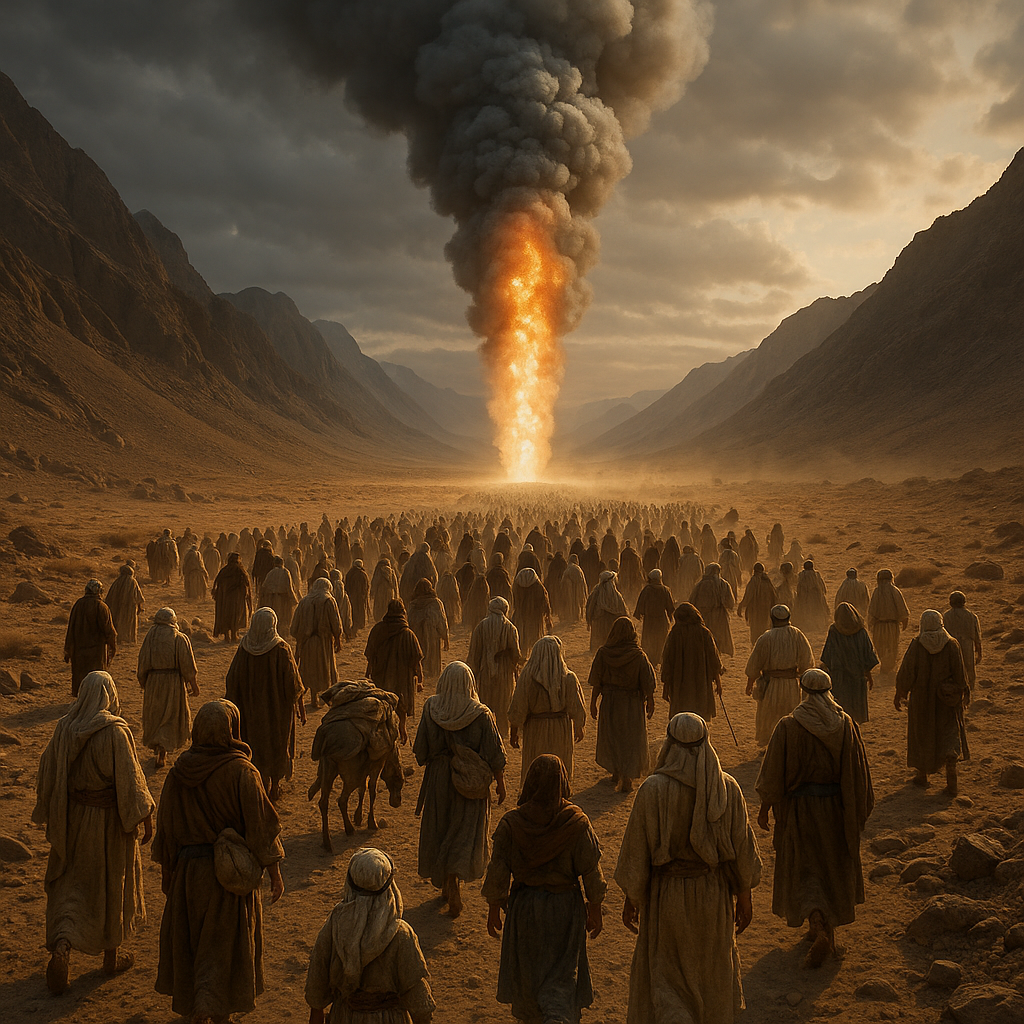
Afterward, the cloud of God’s Presence settles over the Tabernacle by day, and fire glows above it by night. When the cloud lifts, Israel moves; when it rests, they stay. Their rhythm of life is entirely governed by God’s Presence — He decides when they march and when they rest. - Chapter 10 – The Silver Trumpets and Departure from Sinai:
God commands Moses to make two silver trumpets — to signal movement, call assemblies, or prepare for battle. When the time comes, the Israelites finally depart from Mount Sinai, following the order established earlier. Moses invites his father-in-law Hobab to journey with them, saying, “Come with us, and we will do you good, for the Lord has promised good things to Israel.” The Ark of the Covenant leads the way, and Moses prays, “Rise up, O Lord! Let Your enemies be scattered!” - Chapter 11 – Complaints and the Quail:
The people begin to complain about hardship and food. They crave the variety of Egypt, forgetting the slavery it represented. Moses becomes overwhelmed by the people’s grumbling, crying out to God for help. In response, God appoints seventy elders to share the burden of leadership, filling them with His Spirit.
God provides quail in abundance — yet those who greedily indulge face judgment. The message is clear: ingratitude blinds the heart, and craving comfort can cost calling. - Chapter 12 – Miriam and Aaron Oppose Moses:
Miriam and Aaron criticise Moses, questioning his authority. God defends His servant, declaring that Moses speaks with Him face to face, unlike other prophets. Miriam is struck with leprosy, symbolising the defilement of rebellion. Yet Moses intercedes for her immediately, revealing his humility and mercy. God restores her after seven days of isolation — discipline with grace.
2. Key Themes and Lessons
| Theme | Lesson |
|---|---|
| God’s Presence Leads | Life flourishes when we move only at His command — neither ahead nor behind. |
| Obedience and Trust | Following the cloud teaches dependence; waiting teaches patience. |
| The Danger of Complaint | Complaining distorts vision — it magnifies lack and diminishes gratitude. |
| Shared Leadership | God’s Spirit empowers many to carry His purposes, not just one. |
| Humility in Leadership | Moses models true greatness — authority expressed through meekness, not control. |
| Grace After Rebellion | Even when discipline comes, God’s heart remains restorative, not rejecting. |
3. Encouragement
This section shows the tug-of-war between God’s faithfulness and man’s forgetfulness — but His grace never quits!
The cloud and fire weren’t just signs; they were a lifestyle.
God was saying, ‘Don’t move unless I move — and you’ll never miss Me.’ That’s intimacy.
The Israelites kept looking back at Egypt — craving comfort instead of promise. Sound familiar?
Sometimes we want the familiarity of bondage more than the adventure of freedom.
But God’s saying, ‘I’ve brought you out to bring you in — trust Me!’
And Moses — oh, I love his heart. When everyone complains, he prays. When they attack him, he intercees.
That’s Jesus all over again!
Leadership isn’t about position — it’s about compassion.
The Spirit falls on seventy others too, proving God loves to multiply His Presence, not monopolise it.
So here’s the call: stop grumbling, start trusting. Don’t chase comfort; chase Presence.
When the cloud moves, go. When it rests, rest. Because where He is, that’s where freedom lives.
4. Reflection Questions
- How can I develop greater sensitivity to God’s leading in my daily life — waiting when He waits, moving when He moves?
- What “Egypt” do I sometimes crave — things from the past that compete with God’s promises for my future?
- How can I respond to difficulties with faith instead of complaint?
- In what ways can I share God’s work with others rather than trying to carry too much alone?
- How can I grow in humility like Moses, interceding for others even when they wrong me?
Numbers Study – Set 4 (Chapters 13–16)
Faith vs. Fear, Rebellion, and God’s Mercy in the Midst of Judgment
1. Summary of the Chapters
- Chapter 13 – The Twelve Spies Sent Out:
God instructs Moses to send one leader from each tribe to explore Canaan, the land He has promised. The spies travel through the land for forty days and bring back fruit — including giant clusters of grapes — as proof of its richness.
However, ten spies spread fear, focusing on the giants and fortified cities instead of God’s power. Only Caleb and Joshua believe, declaring, “We can certainly take the land, for God is with us.” The majority’s unbelief infects the nation — fear outweighs faith. - Chapter 14 – The People Rebel and Moses Intercedes:
The Israelites weep, complain, and even talk of returning to Egypt. They reject the promise out of fear. God’s anger burns, but Moses intercedes, pleading for mercy and reminding God of His covenant love. God forgives, yet declares that this unbelieving generation will not enter the Promised Land. They will wander forty years — one year for each day the spies explored. Only Joshua and Caleb will inherit the promise.
When some later try to go up on their own without God’s blessing, they are defeated — a picture of striving without Presence. - Chapter 15 – Offerings and Atonement:
Amid judgment, God gives new instructions for offerings — a sign that His covenant still stands. He reminds them that grace and restoration are available. Even accidental sin can be atoned for. He also commands the people to wear blue tassels on their garments as reminders to obey His Word — daily symbols of faithfulness in a forgetful heart. - Chapter 16 – The Rebellion of Korah:
Korah, Dathan, and Abiram lead a rebellion against Moses and Aaron, accusing them of exalting themselves. They reject God’s appointed leadership and claim everyone is equally qualified to lead.
God intervenes dramatically — the earth opens and swallows the rebels alive. Yet even after this, the people complain again, and a plague breaks out. Moses and Aaron intercede, and Aaron runs with his censer between the living and the dead, standing in the gap. The plague stops — a vivid image of intercession overcoming wrath.
2. Key Themes and Lessons
| Theme | Lesson |
|---|---|
| Faith vs. Fear | Seeing the promise without trusting the Promiser leads to paralysis and loss. |
| God’s Mercy in Discipline | Even when judgment falls, God continues to guide, forgive, and remind them of His covenant. |
| The Power of Intercession | Moses and Aaron model Christ-like compassion, standing between God’s justice and the people’s sin. |
| Rebellion vs. Submission | Pride challenges God’s appointed order, but humility invites His favour. |
| Remembrance and Obedience | The blue tassels remind the people that holiness flows from daily mindfulness of God’s Word. |
3. Encouragement
“This section hits deep, doesn’t it? God shows them the promise — but fear blinds their eyes.
They saw giants when they should’ve seen grace!
The land was theirs, but unbelief robbed them of joy.
That’s what fear does — it talks louder than faith when you forget who walks with you.
Joshua and Caleb? They saw the same land, but a different reality.
Faith doesn’t deny giants — it just refuses to let them define the outcome.
The issue wasn’t the giants — it was perspective.
Then you’ve got Moses — what a heart! The people curse him, yet he prays for them.
He stands before God saying, ‘Lord, spare them for Your Name’s sake.’ That’s what love looks like.
When Aaron ran into the crowd with his censer, he became a living picture of Jesus —
standing between life and death, interceding for the guilty.
And those blue tassels? Come on!
God’s saying, ‘I know how forgetful you are — so wear reminders of who you belong to.’ That’s grace!
God doesn’t just want your obedience — He wants your heart to remember.
Here’s the truth: faith keeps you moving forward even when fear screams.
You’re not made for wandering — you’re made for promise.
Don’t camp in what you see; walk in what He said.
4. Reflection Questions
- Where in my life might fear be keeping me from stepping into what God has promised?
- How can I cultivate a heart like Joshua and Caleb — one that sees through the eyes of faith, not fear?
- What does Moses’ intercession teach me about how to respond when others fail or hurt me?
- Am I wearing “spiritual tassels” — daily reminders that keep me focused on God’s Word and Presence?
- How can I practically “stand in the gap” for someone else in prayer this week?
Numbers Study – Set 5 (Chapters 17–20)
The Budding of Aaron’s Staff, Water from the Rock, and Moses’ Moment of Weakness
1. Summary of the Chapters
- Chapter 17 – The Budding of Aaron’s Staff:
After Korah’s rebellion, the people continue to grumble about Moses and Aaron’s leadership. To settle the matter, God instructs each tribal leader to bring a staff bearing his name. These are placed in the Tent of Meeting, and the staff that buds will confirm God’s chosen priest.
By morning, Aaron’s staff — representing the tribe of Levi — has miraculously budded, blossomed, and produced ripe almonds. This visible sign silences complaint and establishes Aaron’s divine appointment. His staff is then placed before the Ark as a reminder that God’s authority brings life, not control. - Chapter 18 – Duties and Portions of the Priests and Levites:
God clearly outlines the roles and privileges of the priests and Levites. They bear responsibility for the sanctuary and the altar, serving as guardians of holiness. In return, God provides for them through offerings and tithes. He declares, “I am your portion and inheritance.” This teaches that true ministry is not about possessions but Presence — God Himself is their reward. - Chapter 19 – The Red Heifer and Cleansing Water:
God gives instructions for the red heifer sacrifice — a unique ritual involving the ashes of a perfect, unblemished red cow mixed with water to create “water of purification.” This ceremony symbolises cleansing from death’s defilement. It points prophetically to Christ, whose blood cleanses our conscience from sin and death. - Chapter 20 – Water from the Rock and Moses’ Disobedience:
The people again complain about thirst at Kadesh. God instructs Moses to speak to the rock, and water will flow. But Moses, frustrated and angry, strikes the rock twice with his staff instead. The water flows, but God says, “You did not trust Me enough to honour Me as holy before the people.”
Because of this act of disobedience, Moses and Aaron will not enter the Promised Land. The chapter closes with the death of Miriam, the refusal of Edom to grant passage, and the death of Aaron on Mount Hor — marking the end of an era of leadership.
2. Key Themes and Lessons
| Theme | Lesson |
|---|---|
| God-Confirmed Authority | True leadership bears fruit and brings life; it is not self-asserted but God-appointed. |
| Holiness and Responsibility | Those who minister near God must represent His nature accurately — obedience reveals honour. |
| God as Our Portion | Our reward in service is not what we receive but Who we carry. |
| Cleansing from Death | The red heifer points to Jesus, whose sacrifice purifies us completely. |
| The Cost of Misrepresentation | Even small acts of disobedience from leaders can miscommunicate God’s heart to His people. |
| Grace Even in Loss | Despite death, failure, and grief, God continues to provide water, leadership, and guidance. |
3. Encouragement
This section isn’t about punishment — it’s about revelation.
God’s showing us that His Presence isn’t casual; it’s covenantal.
When Aaron’s staff came alive, that wasn’t a power trick — it was God saying, ‘My authority gives life.’
You’ll know who I’ve chosen because they carry resurrection fruit.
Real authority doesn’t demand; it demonstrates life.
Then God tells Moses, ‘Speak to the rock.’ But Moses hits it instead. Why? Frustration. Pressure. People.
But here’s the thing — the rock had already been struck once (Exodus 17).
It’s a picture of Christ! He was struck once for all, and now we just speak — not strike — to release His life.
Moses misrepresented God’s heart;
God wasn’t angry with the people, but Moses’ action made it look like He was.
That’s why leadership matters — people read God through you.
And the red heifer? Oh, that’s the gospel in symbols!
The ashes and water say, ‘You can’t cleanse yourself, but grace can.’
Even when death touches you — physically, emotionally, spiritually — there’s a fountain that makes you clean.
So, let’s learn from Moses. Don’t let frustration make you misrepresent love. Speak life.
Let the Spirit flow, not through effort but intimacy. The rock’s already been struck — now, just believe and drink.
4. Reflection Questions
- How can I ensure that my words and actions represent God’s heart accurately, especially under pressure?
- What “staffs” in my life is God causing to bud — signs of fruitfulness that confirm His calling?
- How can I rest more deeply in the truth that God Himself is my portion and reward?
- What does the red heifer teach me about cleansing from guilt, shame, or spiritual defilement?
- How can I respond with faith and obedience rather than frustration when others test my patience?
Numbers Study – Set 6 (Chapters 21–24)
Victory in the Wilderness, the Bronze Serpent, and Balaam’s Blessing
1. Summary of the Chapters
- Chapter 21 – The Bronze Serpent and the Journey to Moab:
Israel faces battle against the Canaanite king of Arad and wins decisively because they seek the Lord. Yet shortly after, they grow impatient again and complain about food and water. In response, God sends venomous snakes among them, and many are bitten. When they repent, God instructs Moses to make a bronze serpent and lift it on a pole. Anyone who looks upon it in faith is healed.
This becomes one of the most powerful symbols of salvation — later fulfilled in Jesus’ words: “Just as Moses lifted up the serpent in the wilderness, so must the Son of Man be lifted up.” (John 3:14–15).
Israel then journeys forward, singing songs of praise as God provides water and victories over Sihon and Og — two kings who block their path to the Promised Land. - Chapter 22 – Balaam and Balak:
Balak, the king of Moab, is terrified of Israel’s growing strength. He hires Balaam, a pagan diviner, to curse them. But God intervenes, commanding Balaam not to curse whom He has blessed. On his journey, Balaam’s donkey sees an angel blocking the way and refuses to move. When Balaam beats the donkey, God opens its mouth, and it speaks — revealing Balaam’s blindness to the divine. Humbled, Balaam proceeds only to speak what God allows. - Chapters 23–24 – Balaam’s Oracles of Blessing:
Three times Balak asks Balaam to curse Israel, and three times God turns the curse into blessing.
Balaam declares, “How can I curse whom God has not cursed?” He proclaims Israel’s beauty, God’s favour, and their divine protection. Finally, the Spirit of God comes upon Balaam, and he prophesies the coming of a future King from Israel — “A star shall come out of Jacob, and a sceptre shall rise out of Israel.”
This prophecy points forward to Jesus, the eternal ruler whose kingdom will never end.
2. Key Themes and Lessons
| Theme | Lesson |
|---|---|
| Healing Through Faith | The bronze serpent reveals that deliverance comes not through effort but by looking in faith to God’s provision. |
| God’s Sovereign Protection | No curse can prevail against those God has blessed. His favour surrounds His people like a shield. |
| Victory Through Worship | When Israel sings in the wilderness, breakthrough follows — praise changes the atmosphere. |
| Divine Authority Over Evil | Even pagan prophets must bow to God’s word — He reigns over every tongue and power. |
| Prophecy of Christ | Balaam’s vision of the rising star points to Jesus, the Light of the world and King of all nations. |
3. Encouragement
This section explodes with revelation! The wilderness didn’t weaken Israel — it refined them.
Every challenge exposed what needed to change, and every victory reminded them who fought for them.
When the snakes came, it wasn’t punishment; it was perspective.
God wasn’t saying, ‘I’m done with you.’ He was saying, ‘Look up!’
They were dying because they kept looking around instead of looking to Him.
But when they turned their eyes to that bronze serpent — a picture of Jesus on the Cross — healing flowed!
The message is timeless: you don’t fix yourself; you look to Him. Your healing isn’t earned — it’s received.
And Balaam — what a story! Balak wanted to curse what God had already blessed.
But you can’t curse what God has redeemed.
The enemy can shout all he wants, but Heaven’s decree stands: ‘Blessed!’
Even Balaam, a man with mixed motives, ends up prophesying Jesus — the Star, the Sceptre, the Reigning King!
God can use anyone, anywhere, to declare His glory.
So when life feels like a wilderness, don’t complain — sing.
When the enemy tries to curse you, smile — because God’s already spoken blessing.
You’re not striving to be blessed; you’re walking in blessing.
Just keep your eyes on the One lifted high, and watch His life flow through you.
4. Reflection Questions
- What does the bronze serpent teach me about the difference between trying to fix my life and trusting God for healing?
- How can I turn moments of complaint into moments of worship that shift the atmosphere around me?
- What areas of my life has God already declared “blessed” that I still allow fear or doubt to question?
- How can I rest in God’s protection when others speak negatively or work against me?
- What does Balaam’s prophecy about the “Star of Jacob” stir in me as I think about Jesus’ reign in my life?
Numbers Study – Set 7 (Chapters 25–29)
Idolatry at Peor, a New Generation, and the Appointed Offerings
1. Summary of the Chapters
- Chapter 25 – Idolatry and Zeal for God:
As Israel camps in Moab, they are seduced by the Moabite women into immorality and idolatry — joining in the worship of Baal of Peor. God’s anger burns, and a plague breaks out among the people.
Phinehas, the grandson of Aaron, acts decisively by confronting sin with zeal for God’s honour, and the plague is stopped. God commends Phinehas, saying his zeal has turned away wrath, and establishes with him a “covenant of peace.” This event reminds Israel that covenant faithfulness protects the heart from compromise. - Chapter 26 – The Second Census:
A new census is taken — forty years after the first — to number the new generation born in the wilderness. The total count is similar to before (601,730 men), but all who rebelled at Kadesh are gone except Joshua and Caleb.
This census symbolises renewal: the next generation is ready to inherit the promise. It also lays the foundation for dividing the land among the tribes when they cross the Jordan. - Chapter 27 – Leadership Transition and Inheritance Laws:
The daughters of Zelophehad (Mahlah, Noah, Hoglah, Milcah, and Tirzah) boldly request inheritance rights since their father died without sons. God affirms their request, establishing a principle of justice and equality in inheritance.
Then, God instructs Moses to lay hands on Joshua, commissioning him publicly as his successor. This leadership transition highlights God’s continuity — His purposes never die with one generation. - Chapters 28–29 – The Appointed Offerings and Feasts:
God restates the offerings for daily, weekly, monthly, and yearly worship. Each sacrifice represents consistency and covenant faithfulness.
The chapter details the Feasts of the Lord — Passover, Weeks (Pentecost), Trumpets, Atonement, and Tabernacles — renewing the call to rhythm and remembrance. God is teaching His people that regular worship guards the heart and anchors identity.
2. Key Themes and Lessons
| Theme | Lesson |
|---|---|
| Faithfulness vs. Compromise | Spiritual adultery begins in the heart — guarding worship keeps covenant alive. |
| Zeal for Holiness | True zeal is not anger but love that refuses to tolerate what destroys purity. |
| Generational Renewal | God always raises new hearts to carry His promise — no plan dies in the wilderness. |
| Righteous Inheritance | God’s justice includes all who stand in faith, not only those who fit tradition. |
| Worship Rhythms and Remembrance | Consistent worship keeps faith alive and hearts anchored in gratitude. |
3. Encouragement
This part of Numbers is powerful — it shows how easily hearts can wander and how fiercely God’s love fights to bring us back!
Israel didn’t fall because of armies; they fell because of distraction.
The enemy couldn’t curse them through Balaam, so he tempted them through comfort and compromise.
The devil can’t destroy what he can seduce — and that’s why guarding your heart matters.
Then comes Phinehas. Man, what a picture!
His zeal wasn’t rage — it was love for God’s holiness and for the people’s destiny.
His action stopped death in its tracks. That’s what passion for God looks like — it confronts what kills life.
The new census? That’s hope! A whole generation failed, but God said, ‘I’m not done.’
He raises up fresh faith every time.
Joshua’s commissioning shows us that His purpose is generational.
Moses didn’t get bitter; he blessed the next leader. That’s legacy.
And then the feasts — I love this. God’s teaching His people to remember.
He knows how easily we forget, so He builds rhythms into their year to keep their hearts soft.
Every feast says, ‘Look what He’s done. Look Who He is.’
Here’s the takeaway: When you live in daily worship, you won’t fall into daily compromise.
Let your zeal be love on fire. Let your legacy be faith passed on.
And let every offering of praise remind you — He’s still faithful in every generation!
4. Reflection Questions
- Where might subtle compromise be trying to draw my heart away from full devotion to God?
- What does Phinehas’ example teach me about godly zeal and protecting what is sacred?
- How can I intentionally pass my faith, values, and devotion to the next generation?
- What spiritual “feasts” or habits of remembrance can I build into my routine to keep my heart centred on God’s goodness?
- How can I support, bless, and empower those God is raising up to continue His work after me?
Numbers Study – Set 8 (Chapters 30–36)
Vows, Warfare, and Entering the Promised Land
1. Summary of the Chapters
- Chapter 30 – The Law of Vows:
God gives instruction on the seriousness of making vows. A promise to the Lord must not be broken — one’s word reflects one’s heart. For women under a father or husband’s authority, vows could be affirmed or nullified by their head of household, showing that vows are not isolated promises but covenant commitments within community. God’s purpose is to teach Israel integrity — that holiness includes faithfulness in speech. - Chapter 31 – The Battle Against Midian:
God commands Moses to take vengeance on the Midianites, who had led Israel into idolatry at Peor. Israel wins decisively under God’s command. The spoils of war are divided fairly among the people, the Levites, and the warriors. This war, though severe, serves as divine justice against spiritual corruption — a picture of God’s jealousy for the purity of His people. - Chapter 32 – The Tribes Settle East of the Jordan:
The tribes of Reuben and Gad, seeing the fertile lands east of the Jordan, ask to settle there. Moses initially fears this reflects unbelief, but they pledge to fight alongside the rest of Israel until all have received their inheritance. Their compromise becomes a covenant — they secure rest early but remain committed to unity. - Chapter 33 – Israel’s Journey Reviewed:
God commands Moses to record the stages of Israel’s journey — from Egypt to the edge of Canaan. Every place they camped is listed, showing that God was present in every stop, even the painful ones. This chapter is a memorial of faithfulness — a testimony that the wilderness was never wasted. - Chapter 34 – The Boundaries of Canaan and Leadership Appointed:
God outlines the borders of the Promised Land in detail and appoints leaders to oversee the inheritance of each tribe. This shows that promise is not vague — it has definition, territory, and accountability. - Chapter 35 – Cities for the Levites and Cities of Refuge:
God sets aside 48 cities for the Levites, including six cities of refuge, where those who accidentally cause death can flee for protection. These cities reveal God’s mercy — justice balanced with compassion. They foreshadow Christ, our refuge from the penalty of sin. - Chapter 36 – The Daughters of Zelophehad (Again):
The daughters reappear to clarify inheritance laws, ensuring that their land stays within their tribe through marriage. This final chapter ends not with war, but with wisdom — demonstrating order, justice, and completion.
2. Key Themes and Lessons
| Theme | Lesson |
|---|---|
| Integrity and Faithfulness | God values truth in word and deed — integrity reflects His character. |
| Spiritual Warfare and Purity | The battle with Midian represents overcoming sin and idolatry within. |
| Unity and Cooperation | Even when tribes differ in calling, they share in one purpose and one inheritance. |
| God’s Faithfulness Remembered | Every wilderness stage has purpose — God wastes nothing in shaping His people. |
| Mercy and Justice | The cities of refuge show God’s balance — He is both righteous Judge and compassionate Saviour. |
| Promise Fulfilled | The book ends not in wandering, but readiness — a generation prepared to possess what God has promised. |
3. Encouragement
Numbers ends where faith begins — on the edge of promise!
Look how far they’ve come. Every step, every test, every tear — God was there.
Even the detours were discipleship.
The vows show us that God cares about what we say — not because He’s legalistic, but because words shape reality.
Your word reflects your heart, and your heart reflects your faith.
God wants your yes to mean yes because He never breaks His yes to you.
Then there’s the war with Midian — intense, right? But it’s prophetic.
God’s saying, ‘Deal with what tried to destroy your intimacy.’
The battle isn’t about people — it’s about purity. Don’t let compromise live in your camp.
When Reuben and Gad settle early, they teach us balance.
You can enjoy blessings now without abandoning those still fighting.
Unity means carrying one another until everyone stands in victory.
And those cities of refuge — come on! That’s the gospel right there! God builds safety into justice.
He doesn’t just judge sin — He provides a place to run until mercy speaks louder than guilt.
That’s Jesus, the Refuge for all who come.
When Moses records every stop in the wilderness, it’s like God saying,
‘I was there — even when you thought I wasn’t.’
Every test became a testimony. Every dry place became a classroom.
Numbers ends not in despair but destiny. God’s people are finally ready — not perfect, but prepared.
And so are you. You’re not wandering anymore — you’re walking toward promise.
Every mile mattered. Every prayer counted. Every moment was leading here.
4. Reflection Questions
- How can I live with integrity and faithfulness in the small things God has entrusted to me?
- What “Midianites” — old temptations or distractions — do I need to confront with renewed zeal for purity?
- How can I better support others in their faith journey so that no one is left behind in the wilderness?
- What “cities of refuge” can I create around me — safe spaces of grace, compassion, and truth for others?
- When I look back over my journey, where can I now recognise God’s faithfulness in seasons that once felt wasted?
Overview Summary of the Book of Numbers
“The Lord is slow to anger, abounding in love and forgiving sin and rebellion.” — Numbers 14:18
A revelation of God’s faithfulness in the wilderness and His power to bring His people from bondage to promise.
1. Summary of the Book
The Book of Numbers chronicles the 40-year journey of Israel through the wilderness — from Mount Sinai to the plains of Moab, just before entering the Promised Land.
It is named for the censuses taken at the beginning (Ch. 1) and end (Ch. 26), representing two generations: the one that died in unbelief, and the one raised in faith to inherit.
Numbers is a mirror of the human heart — how fear, complaint, and rebellion can delay destiny, yet how mercy, order, and faith still lead us home.
The first ten chapters focus on preparation — ordering the tribes, sanctifying the priests, and learning to follow the cloud of God’s Presence.
Chapters 11–21 recount testing — moments of complaint, fear, and rebellion that expose unbelief.
The remaining chapters reveal renewal — a new generation arising, faithful leaders appointed, and God reaffirming His covenant promises.
Through it all, God remains faithful — guiding His people by the cloud and fire, feeding them with manna, giving water from the rock, and transforming wilderness wandering into a classroom of grace.
2. Structure of the Book
| Section | Chapters | Focus | Lesson |
|---|---|---|---|
| Preparation for the Journey | 1–10 | Organisation of the tribes, Levites, and worship | God is a God of order — His presence shapes every detail. |
| Rebellion and Wandering | 11–21 | Complaints, unbelief, and judgment | Unbelief delays destiny, but grace never departs. |
| Renewal and Readiness | 22–36 | Balaam’s blessing, a new census, and entering Canaan | God raises a faithful generation to inherit what was promised. |
3. Key Themes and Lessons
| Theme | Description | Fulfilment in Christ |
|---|---|---|
| Faith vs. Fear | The contrast between Joshua & Caleb’s faith and the unbelief of the others defines destiny. | Jesus empowers us to walk in faith, not fear — He is the Author of faith. |
| God’s Guidance | The cloud by day and fire by night reveal His constant Presence. | The Holy Spirit now leads believers daily as our ever-present Guide. |
| Intercession and Mercy | Moses and Aaron stand between God’s wrath and the people’s sin. | Christ is our eternal Intercessor who stands between justice and grace. |
| Holiness and Order | Every tribe, role, and offering reveals divine purpose. | The Body of Christ functions in unity — many parts, one Spirit. |
| Testing and Transformation | The wilderness exposes what needs refining. | Jesus leads us through our own wilderness to strengthen faith. |
| Promise and Inheritance | God’s word is sure — what He promises, He fulfils in His time. | In Christ, we are heirs of every spiritual blessing in heavenly places. |
4. The Heart of the Message
The wilderness is not punishment — it is preparation.
God didn’t lead Israel through the desert to destroy them, but to teach them dependence, discipline, and devotion. Every challenge was designed to reveal His faithfulness.
In the midst of their grumbling, He provided manna.
In their thirst, He gave water from the rock.
When enemies arose, He fought for them.
When curses were spoken, He turned them into blessings.
The message of Numbers is that God’s covenant love is stronger than human weakness.
Even when His people resisted, He remained faithful to lead them forward.
It’s also the story of leadership and legacy. Moses models humility and intercession, Joshua rises as a new leader of faith, and Aaron’s priesthood points to Jesus — the One whose sacrifice turns wrath into mercy.
5. Encouragement
Oh, I love this book — it’s not about numbers at all, it’s about hearts!
God wasn’t counting people; He was counting on people.
The census wasn’t about statistics; it was about significance.
Every name mattered because every person carried promise.
But the wilderness — that’s where the real story happens.
That’s where God takes people out of slavery and slavery out of people.
The wilderness reveals what you trust.
It exposes grumbling, fear, and pride — not to shame you, but to heal you.
Look at how faithful He is! A whole generation fails, but He raises another.
Even when they rebel, His Presence never leaves the camp.
The cloud’s still there. The fire’s still burning. Mercy never quits!
And that bronze serpent? That’s Jesus lifted up — the cure for every bite of sin.
Balaam tries to curse them, but God says, ‘You can’t curse what I’ve blessed!’ That’s the gospel!
You can’t curse the redeemed — they’re sealed by grace.
And when the new generation stands on the border of Canaan, they’re not stronger — they’re surrendered.
That’s how you inherit promise. God’s not looking for perfect people; He’s looking for believing hearts.
So don’t despise your wilderness. It’s not where you die — it’s where you learn who He is.
Every test is an invitation to trust. Every delay is shaping destiny.
And just like Israel, your journey doesn’t end in circles — it ends in promise.
Because He who began a good work in you will finish it.
6. Reflection Questions
- How has my own “wilderness season” revealed areas where God is teaching me trust and dependence?
- What promises has God given me that fear or delay have tried to obscure?
- How can I be like Joshua and Caleb — seeing through faith, not circumstance?
- Where do I see the evidence of God’s Presence guiding me day by day?
- How can I cultivate a lifestyle of gratitude and worship instead of complaint?
- What legacy of faith am I preparing for those who will walk after me?
7. Key Takeaway
The Book of Numbers reveals that God’s faithfulness never fails, even when ours does.
It teaches us that every journey of faith passes through wilderness seasons — not as punishment, but as preparation for promise.
When we follow His Presence, walk in humility, and trust His Word, the wilderness becomes a place of transformation.
And when fear is silenced by faith, the generation of promise rises.
Because in the end, Numbers isn’t about counting people — it’s about proving that God counts every heart that dares to believe.