
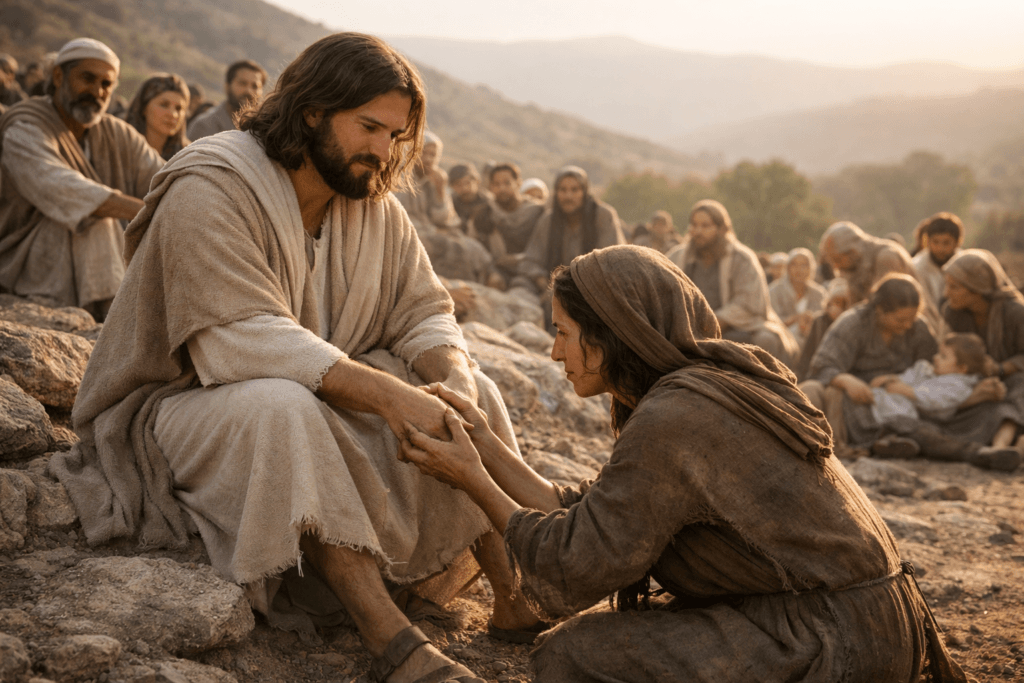
From Promise to Fulfilment …
Welcome to the Matthew study hub
Welcome to the Matthew study hub — a place to encounter Jesus as the promised King, the fulfiller of God’s covenant, and the One who reveals what life in God’s Kingdom truly looks like.
Here, you will find free study notes for each chapter of the Gospel of Matthew, written through the lens of becoming completely transformed — not simply learning what Jesus taught, but allowing His Kingdom truth to reshape your thinking, realign your heart, and form Christlike life from the inside out.
Matthew reveals Jesus as the long-awaited Messiah — rooted in promise, revealed in power, and expressed through love, humility, and authority. This Gospel shows us that God keeps His word, fulfils His promises, and invites us to live as citizens of His Kingdom now.
These chapters have been my own personal pathway of discovery, walked prayerfully and slowly with the Holy Spirit as my Teacher. They are offered freely to help you see Jesus clearly — not only as Saviour, but as King — and to understand who you are as one who belongs to His Kingdom.
For those who desire to journey deeper, you will also find optional companion resources available, including printable workbooks, guided journals, and heart-transformation tools designed to help you apply, embody, and live out the truths revealed in each chapter.
May this not simply be a study of Jesus’ teachings — May it become an awakening to Kingdom life.
May it anchor your identity, renew your thinking, and teach you how to live under Heaven’s rule while walking on earth.
With love,
Nicola 💖
Matthew 1 — The King Has Come
Summary of the Chapter
Matthew 1 opens not with a miracle or sermon, but with a genealogy — a deliberate declaration that Jesus is the fulfilment of God’s long-standing promises.
Through generations marked by faith, failure, exile, and restoration, God faithfully brings forth His Messiah. Matthew highlights that Jesus enters humanity’s story fully — not bypassing brokenness, but redeeming it.
The chapter then shifts to the miraculous conception of Jesus. Conceived by the Holy Spirit and born of the virgin Mary, Jesus is named Immanuel — God with us. Joseph’s obedience protects the unfolding plan, showing that righteousness flows from trust, not control.
Matthew 1 reveals that Jesus is not an interruption in history — He is its fulfilment. God has not forgotten His promises. He has kept every one of them.
Key Themes & Lessons
| Theme | Lesson for Heart Transformation |
|---|---|
| Jesus the Promised Messiah | God fulfils His promises fully and faithfully, even across generations. |
| God Working Through Broken Stories | Your past does not disqualify you — God weaves redemption through imperfection. |
| Immanuel — God With Us | God does not save from a distance; He comes near and remains present. |
| Identity Before Activity | Jesus’ identity is established before any public ministry begins. |
| Obedient Trust | Like Joseph, obedience flows from trust in God’s word, not understanding every detail. |
| Kingdom Fulfilment | Jesus is the King who brings God’s Kingdom to earth. |
Encouragement
Sister, Matthew 1 reassures your heart that God is never late — and never forgetful.
Every name in the genealogy tells a story of grace. Some names speak of courage. Others whisper of failure. Yet God weaves them all into the arrival of His Son.
Jesus steps into humanity not to avoid its mess, but to redeem it.
And He comes with a name that still changes everything: Immanuel — God with you.
If you have ever wondered whether God is truly present in your story, let this chapter settle that doubt. He is not distant. He is not disappointed. He has drawn near.
Jesus did not come because humanity was ready — He came because love could not stay away.
You are not living between promises and fulfilment — You are living in the reality that the King has come.
Reflection Questions
- How does seeing Jesus as the fulfilment of God’s promises strengthen my trust today?
- In what ways has God worked through imperfect or unexpected parts of my own story?
- What does “God with us” mean for my daily life, not just my theology?
- Where might God be inviting me to trust and obey even without full understanding?
- How does recognising Jesus as King reshape how I live, think, and choose?
Matthew 2 — The King Is Recognised and Resisted
Summary of the Chapter
Matthew 2 reveals an immediate tension that will follow Jesus throughout His life: some recognise Him and worship — others feel threatened and resist.
Wise men from the East arrive in Jerusalem, guided by a star and stirred by revelation. They are not part of Israel’s religious system, yet they recognise what the religious leaders overlook — the birth of a King. Their journey is costly, intentional, and faith-filled.
King Herod, however, responds very differently. Fear rises where control is threatened. Rather than rejoicing, he schemes. Deception, manipulation, and violence follow as Herod attempts to eliminate what he cannot control.
God intervenes through dreams, protecting Jesus and guiding Joseph to flee to Egypt. Even in exile, Scripture is fulfilled. Rachel’s weeping echoes through the land — grief interwoven with promise.
Matthew 2 shows us that Jesus enters a world divided by response. Some bow in worship. Others harden in fear. Yet God’s purpose moves forward untouched.
This chapter reveals a sobering truth: the presence of Jesus exposes hearts — not all opposition looks like disbelief; sometimes it looks like self-preservation.
Key Themes & Lessons
| Theme | Lesson for Heart Transformation |
|---|---|
| Revelation Recognised | Those who seek truth with humility will find Jesus, even from unexpected places. |
| Worship Versus Threat | Jesus is either welcomed as King or resisted as a threat to control. |
| Fear-Based Power | Fear seeks to destroy what it cannot dominate. |
| God’s Protective Guidance | God faithfully leads and protects those entrusted with His purposes. |
| Fulfilment Through Difficulty | God’s promises are often fulfilled through hardship, not avoidance of it. |
| Exile and Identity | Temporary displacement does not cancel divine calling. |
Encouragement
Sister, Matthew 2 gently prepares your heart for a lifelong truth:
Jesus will always draw response.
Some will worship with joy.
Some will resist in fear.
Some will appear curious yet remain unmoved.
This is not a failure of truth — it is the revealing of hearts.
If you have ever felt tension for choosing Jesus, misunderstood for following Him, or unsettled by opposition, let this chapter steady you. Resistance does not mean God is absent. It often means He is present.
Notice this:
God speaks guidance before danger arrives.
God protects before destruction unfolds.
God fulfils promises even through pain.
You do not need to fear opposition.
You do not need to control outcomes.
You are held by the same God who guided Joseph, warned the wise men, and preserved His Son.
Jesus is not fragile.
And neither is the purpose God has placed within you.
Reflection Questions
- How do I personally respond when Jesus challenges my sense of control or comfort?
- Where do I see the contrast between worship and fear in my own heart?
- How does God’s protection and guidance encourage me when life feels uncertain?
- In what ways might God be fulfilling promises through difficulty rather than ease?
- How can I remain faithful to Jesus even when His presence exposes tension around me?
Matthew 3 — Preparing the Way for the King
Summary of the Chapter
Matthew 3 marks a turning point — the King is no longer hidden. The time of preparation has arrived.
John the Baptist appears in the wilderness with a clear and confronting message: “Repent, for the Kingdom of Heaven has come near.” His call is not merely behavioural change, but heart realignment — a turning from self-rule toward God’s reign.
John’s life reflects his message. He lives simply, detached from status and approval, embodying the very repentance he proclaims. Crowds gather, confessing sin and being baptised as an outward sign of inward change.
Yet not all who come are ready. Religious leaders arrive, confident in heritage rather than humility. John exposes false security, declaring that lineage cannot replace transformation. True repentance bears fruit.
Then Jesus arrives.
The sinless King steps into the waters of repentance — not because He needs cleansing, but because He chooses identification. As Jesus is baptised, heaven opens, the Spirit descends, and the Father speaks:
“This is My beloved Son, in whom I am well pleased.”
Matthew 3 reveals that Kingdom life begins with preparation, humility, and identity anchored in the Father’s voice.
Key Themes & Lessons
| Theme | Lesson for Heart Transformation |
|---|---|
| Repentance as Realignment | Repentance is turning the heart toward God’s rule, not self-condemnation. |
| Preparing the Way | Transformation begins when the heart makes room for Jesus. |
| Fruit Over Appearance | Authentic change reveals itself through lived transformation. |
| Identity Before Ministry | Jesus’ identity is affirmed before any public works begin. |
| Humility of the King | True authority is revealed through humility, not self-exaltation. |
| The Father’s Voice | God’s pleasure rests on relationship, not performance. |
Encouragement
Sister, Matthew 3 gently but powerfully resets how transformation begins.
Before miracles.
Before ministry.
Before mission.
Jesus stands still and receives identity.
He does not earn the Father’s pleasure.
He does not prove His worth.
He receives love before doing anything publicly visible.
This is not accidental — it is foundational.
If you have ever believed you must change before God is pleased, let this chapter dismantle that lie completely. Repentance is not punishment — it is preparation. It clears space for intimacy, not distance.
The Father’s voice speaks the same truth over you:
Beloved.
Delighted in.
Fully accepted.
Let repentance become a gift, not a weight.
Let humility become strength, not shame.
Let identity anchor you before activity begins.
The Kingdom does not advance through striving hearts — It advances through surrendered ones.
Reflection Questions
- How do I personally understand repentance — as shame or as invitation?
- What areas of my heart might God be preparing for deeper Kingdom life?
- Where have I relied on spiritual appearance rather than inner transformation?
- How does Jesus’ baptism reshape my understanding of humility and leadership?
- What does it mean for me to live from the security of being God’s beloved child?
Matthew 4 — Tested in Identity, Established in Authority
Summary of the Chapter
Matthew 4 reveals what happens immediately after identity is affirmed — it is tested.
Jesus is led by the Spirit into the wilderness, not because He has failed, but because preparation for Kingdom authority requires refining. The wilderness is not punishment; it is formation.
Satan tempts Jesus in three specific areas: provision, protection, and power. Each temptation is an invitation to operate independently of the Father — to prove identity rather than trust it. Jesus resists not by argument or strength, but by anchoring Himself in God’s Word. He refuses shortcuts, spectacle, and self-rule.
After the testing, angels minister to Jesus, and He steps into public ministry with clarity and authority. He proclaims the same message John preached: “Repent, for the Kingdom of Heaven has come near.”
Jesus then calls His first disciples — ordinary men invited into extraordinary purpose. They leave their nets immediately, responding not to pressure, but to presence.
Matthew 4 closes with Jesus teaching, healing, and proclaiming the Kingdom — authority flowing naturally from surrendered identity.
Key Themes & Lessons
| Theme | Lesson for Heart Transformation |
|---|---|
| Identity Before Testing | Identity affirmed will always be identity tested. |
| Wilderness as Formation | God uses hidden seasons to establish depth and authority. |
| Trust Over Independence | True sonship refuses to act apart from the Father. |
| Power of God’s Word | Stability flows from truth internalised, not circumstances avoided. |
| Calling from Ordinary Life | Jesus calls people as they are, not after they are ready. |
| Authority from Alignment | Kingdom authority flows from surrendered trust, not self-effort. |
Encouragement
Sister, Matthew 4 speaks directly to seasons that feel quiet, confronting, or stretching.
If you have ever wondered why testing follows breakthrough, this chapter gently explains why.
Identity must be rooted before authority can be released.
Jesus does not enter temptation unsure of who He is.
He enters knowing who He is — and refuses to prove it.
The enemy’s voice always sounds like this: “If you really are…”
God’s voice has already spoken: “You are My beloved.”
You do not need to prove provision — trust invites provision.
You do not need to force protection — surrender receives protection.
You do not need to grasp power — alignment releases power.
And notice this: calling comes after testing, not before.
Jesus does not rush people into purpose. He invites them into relationship first.
If you are in a wilderness season, do not rush to escape it. Let it establish you.
God is not withholding — He is preparing.
Reflection Questions
- Where have I experienced identity being tested after affirmation?
- How do I typically respond to pressure — self-reliance or trust?
- What does Jesus’ use of Scripture teach me about anchoring my heart in truth?
- Where might God be forming depth in me before releasing greater authority?
- How can I respond more freely to Jesus’ invitation to “follow Me” in my daily life?
Matthew 5 — Living from the Values of the Kingdom
Summary of the Chapter
Matthew 5 opens the Sermon on the Mount — Jesus’ foundational teaching on what life looks like when God’s Kingdom governs the heart.
Jesus begins not with commands, but with blessing. The Beatitudes reveal that Kingdom life is not built on strength, success, or self-promotion, but on humility, hunger for righteousness, mercy, purity, and peace. These are not virtues to strive for — they are the fruit of hearts yielded to God.
Jesus then declares His followers to be salt and light — carriers of influence, preservation, and revelation in the world. Kingdom life is never meant to be hidden or passive.
He clarifies that He has not come to abolish the Law, but to fulfil it — shifting righteousness from external behaviour to internal transformation. Jesus addresses anger, lust, integrity, retaliation, and love for enemies, revealing that true obedience flows from the heart, not mere rule-keeping.
Matthew 5 reveals that Kingdom righteousness is not about being “better” than others — it is about being transformed from the inside out, living from love rather than control.
Key Themes & Lessons
| Theme | Lesson for Heart Transformation |
|---|---|
| The Beatitudes | Kingdom life begins with humility, dependence, and surrendered hearts. |
| Blessedness Defined by God | God’s blessing rests on inner posture, not outward status. |
| Salt and Light | Transformed hearts naturally influence the world around them. |
| Fulfilled Righteousness | Jesus fulfils the Law by restoring its heart-intent. |
| Inner Transformation | God cares about motives and desires, not just actions. |
| Radical Love | Kingdom love extends even to those who oppose us. |
Encouragement
Sister, Matthew 5 gently but profoundly redefines what it means to live well.
The world tells you to climb, compete, and protect yourself.
Jesus invites you to surrender, trust, and love.
The Beatitudes are not impossible standards — they are descriptions of hearts at rest in God. They show us what naturally flows when the Kingdom is allowed to rule within.
Jesus does not lower the bar — He moves it inward. He does not demand perfection — He invites transformation.
If you have ever felt overwhelmed by the idea of righteousness, let this chapter free you. God is not watching for flawless behaviour. He is shaping hearts that look like His.
You are not asked to manufacture Kingdom values.
You are invited to receive them.
When love governs your heart, obedience becomes natural.
When identity is secure, righteousness becomes relational.
Reflection Questions
- Which Beatitude most resonates with my current season of life?
- How does Jesus redefine what it means to be “blessed”?
- In what ways am I called to be salt and light right where I am?
- Where might God be inviting inner transformation rather than outward effort?
- How can I allow Kingdom love to reshape how I respond to difficult people?
Matthew 6 — Living from Trust, Not Performance
Summary of the Chapter
Matthew 6 continues Jesus’ Sermon on the Mount, moving from Kingdom values into Kingdom motivation — not just what we do, but why we do it.
Jesus addresses three core spiritual practices: giving, prayer, and fasting. In each, He exposes the danger of performance — doing spiritual things to be seen, validated, or affirmed by others. Kingdom life is not lived for applause; it is lived from intimacy.
Jesus then teaches His disciples how to pray — not as religious recitation, but as relational communion. The Lord’s Prayer reveals a rhythm of trust: honouring the Father, aligning with His will, receiving daily provision, walking in forgiveness, and depending on God’s protection.
The chapter shifts again as Jesus speaks about treasure, worry, and trust. He gently confronts divided hearts — reminding us that where our treasure is, our heart follows. Anxiety is revealed not as a moral failure, but as misplaced focus.
Matthew 6 closes with a liberating invitation: seek first the Kingdom of God. Trust replaces striving. The Father knows what you need.
Matthew 6 reveals that Kingdom life is sustained not by religious effort, but by childlike trust in a faithful Father.
Key Themes & Lessons
| Theme | Lesson for Heart Transformation |
|---|---|
| Motivation of the Heart | God looks beyond actions to the posture behind them. |
| Secret Place Living | Intimacy with God grows in unseen faithfulness. |
| Relational Prayer | Prayer is connection, not performance. |
| Daily Dependence | God invites us to live one day at a time in trust. |
| Undivided Loyalty | What we treasure shapes how we live. |
| Freedom from Worry | Trust in the Father dissolves anxiety. |
Encouragement
Sister, Matthew 6 gently releases you from the pressure to perform spiritually.
God is not impressed by visibility.
He is moved by sincerity.
Jesus invites you into a life where your worth is not measured by how much you do, but by who you trust. He pulls prayer out of obligation and places it back into relationship.
Notice this truth woven through the chapter:
Your Father sees.
Your Father knows.
Your Father provides.
You are not managing life alone.
You are not responsible for controlling outcomes.
You are invited to trust.
Seeking the Kingdom first is not about adding more to your life — it is about re-ordering your heart.
When God is trusted, worry loosens its grip.
When intimacy leads, provision follows.
Reflection Questions
- Where might I be tempted to live from spiritual performance rather than intimacy?
- How does Jesus’ teaching on prayer reshape my relationship with God?
- What worries or anxieties might be revealing misplaced trust?
- Where is my treasure currently directed — and how does that shape my focus?
- What would it look like for me to seek God’s Kingdom first in this season?
Matthew 7 — Building Life on a Secure Foundation
Summary of the Chapter
Matthew 7 brings the Sermon on the Mount to a searching and clarifying conclusion.
Jesus addresses judgement, discernment, prayer, and obedience — not as disconnected teachings, but as expressions of what kind of foundation we are building our lives upon.
He begins by confronting judgementalism, revealing that harsh judgement often flows from unhealed blindness within. Jesus does not forbid discernment; He restores it by calling for humility, self-awareness, and mercy.
Jesus then invites bold, trusting prayer: ask, seek, knock. The Father is not reluctant or distant — He is good, attentive, and generous to His children.
As the chapter progresses, Jesus draws clear lines. Not every path leads to life. Not every voice speaks truth. Not every appearance reflects reality. Fruit reveals what is genuine.
The sermon closes with a powerful image: two builders, two houses, one storm. The difference is not the storm — it comes to both — but the foundation.
Matthew 7 reveals that Kingdom life is not measured by words, intentions, or appearances, but by a life built on trusting obedience to Jesus’ words.
Key Themes & Lessons
| Theme | Lesson for Heart Transformation |
|---|---|
| Mercy Before Judgement | Healing begins when we allow God to address our own hearts first. |
| Discernment with Humility | Kingdom discernment flows from love, not superiority. |
| Persistent Prayer | God invites confident, ongoing trust in His goodness. |
| God as a Good Father | The Father delights in giving what is good to His children. |
| Fruit Reveals Reality | Inner life eventually expresses itself outwardly. |
| Obedience as Foundation | Stability comes from living what Jesus teaches. |
Encouragement
Sister, Matthew 7 lovingly but firmly asks a vital question:
What am I building my life on?
Jesus does not shame, threaten, or manipulate. He invites honesty. Storms are not signs of failure — they are part of life. What matters is what remains standing when they come.
Notice this grace-filled truth:
Both builders heard the same words.
Both experienced the same storm.
The difference was response.
Obedience is not about proving devotion — it is about choosing security. Jesus’ words are not heavy demands; they are anchors.
If you desire stability, peace, and resilience, this chapter offers reassurance:
You do not need perfect understanding — you need responsive trust.
When your life is built on Jesus, storms may shake you — but they will not undo you.
Reflection Questions
- How do I typically respond when Jesus’ teachings challenge my thinking or behaviour?
- Where might I need greater humility before offering discernment or judgement?
- How does Jesus’ teaching on prayer shape my confidence in God’s goodness?
- What “fruit” is currently visible in my life — and what does it reveal?
- What does it look like for me to actively build my life on Jesus’ words?
Matthew 8 — Authority Expressed Through Compassion
Summary of the Chapter
Matthew 8 marks a clear transition in the Gospel — the Kingdom Jesus has taught is now demonstrated in power and compassion.
Jesus descends from the mountain and immediately meets human need. A leper approaches Him — isolated, unclean, and desperate. Instead of withdrawing, Jesus touches him. With both authority and tenderness, Jesus heals, restoring dignity as well as health.
A Roman centurion then approaches, revealing extraordinary faith. He understands authority and trusts Jesus’ word alone. Jesus marvels at this faith — not found in religious proximity, but in humble trust.
Jesus continues healing the sick and oppressed, fulfilling Isaiah’s prophecy that He would bear our infirmities. Yet He also clarifies the cost of following Him. Discipleship is not convenience; it is surrender.
The chapter closes with two powerful demonstrations of authority: Jesus calms a violent storm with a word, and He delivers two demon-possessed men, restoring them to wholeness. Nature and darkness both submit to Him.
Matthew 8 reveals that Kingdom authority does not dominate — it restores. Jesus’ power is always expressed through compassion, presence, and love.
Key Themes & Lessons
| Theme | Lesson for Heart Transformation |
|---|---|
| Compassionate Authority | Jesus’ power restores dignity, not just circumstances. |
| Faith in His Word | Trusting Jesus’ word releases Kingdom power. |
| Inclusion Beyond Religion | Faith is not limited by background or status. |
| Cost of Discipleship | Following Jesus requires surrender, not convenience. |
| Authority Over Chaos | Jesus brings peace where fear and disorder reign. |
| Freedom from Oppression | Jesus restores identity where darkness has ruled. |
Encouragement
Sister, Matthew 8 gently reassures you that Jesus’ authority is never cold or distant.
He does not heal from afar to avoid contamination — He draws near.
He does not demand perfect faith — He responds to honest trust.
He does not avoid storms — He speaks peace into them.
Notice this truth:
Every person Jesus encounters is seen, valued, and restored.
If you feel unworthy, remember the leper — touched and cleansed.
If you feel distant, remember the centurion — honoured for faith.
If you feel overwhelmed, remember the storm — silenced by His voice.
If you feel bound, remember the deliverance — freedom fully restored.
The same authority that calms seas also calms hearts.
Jesus does not ask you to prove faith — He invites you to trust Him where you are.
Reflection Questions
- How does Jesus’ compassion reshape my understanding of God’s authority?
- Where am I being invited to trust Jesus’ word rather than visible outcomes?
- What storms in my life need to be surrendered to Jesus’ peace?
- How do I respond to the cost and invitation of following Jesus?
- In what areas might Jesus be restoring dignity and freedom in me?
Matthew 9 — Mercy That Restores and Calls
Summary of the Chapter
Matthew 9 reveals the heart of Jesus in motion — mercy meeting brokenness, authority restoring identity, and compassion calling people into new life.
The chapter opens with a paralysed man brought to Jesus. Before healing the body, Jesus speaks forgiveness — revealing that restoration begins within. When questioned by religious leaders, Jesus demonstrates that His authority reaches both heart and body.
Jesus then calls Matthew, a tax collector — a man defined by rejection and compromise. With a simple invitation, “Follow Me,” Jesus redefines Matthew’s identity. Grace interrupts reputation.
As Jesus eats with sinners, criticism arises again. Jesus responds with a defining statement of His mission: “I desire mercy, not sacrifice.” He is not drawn to the self-sufficient, but to the willing.
The chapter continues with miracles layered with compassion — a bleeding woman restored through faith, a dead girl raised to life, blind men receiving sight, and a mute man freed. Each encounter reveals Jesus’ attentiveness to personal pain, not just public display.
Matthew 9 closes with Jesus looking upon the crowds with compassion — not frustration. He sees them as sheep without a shepherd and invites His disciples to pray for workers to join the harvest.
This chapter reveals a Kingdom driven by mercy — one that heals, restores, and calls ordinary people into extraordinary purpose.
Key Themes & Lessons
| Theme | Lesson for Heart Transformation |
|---|---|
| Mercy Before Sacrifice | God prioritises compassion over religious performance. |
| Forgiveness and Healing | Inner restoration often precedes outward change. |
| Identity Through Invitation | Jesus calls people into who they can become, not who they have been. |
| Grace Over Reputation | Past labels dissolve in the presence of Jesus. |
| Faith that Reaches | Even quiet faith is fully seen and honoured by Jesus. |
| Compassion for the Harvest | God’s heart moves toward people who feel lost and unseen. |
Encouragement
Sister, Matthew 9 gently dismantles every lie that says you must be “better” before you belong.
Jesus forgives before He heals.
He calls before people are ready.
He dines with those others avoid.
Mercy is not something Jesus occasionally offers — it is the atmosphere He carries.
If you feel stuck, ashamed, overlooked, or weary, this chapter speaks hope. Jesus does not wait for perfection. He responds to faith, hunger, and openness — even when those come quietly.
When Jesus says, “Follow Me,” He is not inviting you to fix yourself. He is inviting you to walk with Him — and be transformed along the way.
And when He looks at you, He does not see inconvenience or burden.
He sees harvest.
Reflection Questions
- How does Jesus’ prioritising of mercy reshape my understanding of God?
- Where might I need to receive forgiveness or inner healing before outward change?
- How does Matthew’s calling challenge the way I see my own past?
- What quiet faith or hidden need in my life might Jesus be honouring right now?
- How can I partner with Jesus’ compassion for others who feel unseen or weary?
Matthew 10 — Sent with Authority and Compassion
Summary of the Chapter
Matthew 10 marks a significant shift — those who have been following Jesus are now sent out in His authority.
Jesus calls His twelve disciples by name, affirming that calling is personal before it is functional. He then entrusts them with authority to heal, restore, and proclaim the nearness of God’s Kingdom. What they have received freely, they are to give freely.
Jesus prepares them honestly. Mission will involve opposition, misunderstanding, and cost. Yet they are not sent alone or unprotected. The same Father who clothes the lilies watches over sparrows — and values His children far more.
Jesus reframes success. The goal is not popularity or comfort, but faithfulness. Peace is offered freely, rejection is not personal, and trust in God’s care replaces fear.
The chapter closes with a profound promise: those who receive Jesus’ messengers receive Him — and those who give even the smallest act of kindness in His name are fully seen and rewarded.
Matthew 10 reveals that Kingdom mission flows from intimacy and trust, not fear or self-reliance.
Key Themes & Lessons
| Theme | Lesson for Heart Transformation |
|---|---|
| Called by Name | God’s calling is relational, not generic. |
| Authority Given | Kingdom authority is entrusted, not achieved. |
| Freely Received, Freely Given | Ministry flows from grace, not striving. |
| Cost of Discipleship | Following Jesus may involve sacrifice and misunderstanding. |
| Freedom from Fear | God’s care anchors courage and peace. |
| Faithfulness Over Outcome | Obedience matters more than visible success. |
Encouragement
Sister, Matthew 10 gently but clearly reframes what it means to be “sent.”
You are not sent because you are flawless.
You are sent because you are loved and entrusted.
Jesus does not minimise difficulty — He prepares hearts for it. Yet He repeatedly anchors His disciples in this truth: do not be afraid.
Fear loses its power when love leads.
God sees what others overlook. He values your faithfulness more than your visibility. Even the smallest act done in His name carries eternal weight.
You are never sent without covering.
Never entrusted without provision.
Never seen as expendable.
The same Jesus who calls also sustains.
Reflection Questions
- How does knowing I am called by name affect my sense of purpose?
- Where might fear be holding me back from stepping into what God has entrusted to me?
- What does “freely received, freely given” look like in my daily life?
- How do I handle rejection or misunderstanding when following Jesus?
- In what small, faithful ways might God be inviting me to participate in His Kingdom work?
Matthew 11 — Rest for the Weary and Revelation for the Humble
Summary of the Chapter
Matthew 11 reveals a tender and honest moment in Jesus’ ministry — faith being questioned, hearts being invited, and rest being offered.
John the Baptist, now imprisoned, sends messengers to Jesus with a sincere question: “Are You the One who is to come, or should we expect another?” This is not rebellion, but honest uncertainty. Jesus responds not with rebuke, but with reassurance — pointing to the works of restoration unfolding.
Jesus then affirms John publicly, honouring his faithfulness and role, even while acknowledging the limitations of expectation. He reveals that God’s Kingdom does not always arrive in the way people anticipate.
Jesus speaks sternly to cities that witnessed miracles yet remained unmoved, exposing the danger of familiarity without transformation.
The chapter closes with one of the most compassionate invitations in all of Scripture:
“Come to Me, all who are weary and burdened, and I will give you rest.”
Jesus reveals that true rest is not found in escape or effort, but in relationship. His yoke is gentle. His burden is light.
Matthew 11 shows us that faith may waver, questions may arise, but Jesus remains steady — offering rest, not rejection.
Key Themes & Lessons
| Theme | Lesson for Heart Transformation |
|---|---|
| Honest Faith | God welcomes sincere questions rooted in trust. |
| Revelation Through Humility | Spiritual insight flows to receptive hearts. |
| Unmet Expectations | God’s work may differ from human assumptions. |
| Responsibility of Revelation | Exposure to truth invites response, not indifference. |
| Rest in Relationship | True rest is found in intimacy with Jesus. |
| Gentle Leadership | Jesus leads with kindness, not pressure. |
Encouragement
Sister, Matthew 11 speaks tenderly to tired hearts.
If you have ever wondered whether God is working the way you hoped — this chapter assures you that honest questions do not disqualify you.
Jesus does not shame John for asking.
He honours him.
Faith is not the absence of questions — it is the willingness to bring them to Jesus.
And when expectations feel heavy, Jesus does not demand more effort. He offers rest.
Rest is not passivity.
It is trust.
The yoke Jesus offers is not religious weight — it is relational guidance. You are not meant to carry life alone.
Come as you are.
Lay the weight down.
Let love lead.
Reflection Questions
- How do I respond when my expectations of God are challenged?
- What questions or weariness might I need to bring honestly to Jesus?
- How does Jesus’ invitation to rest reshape my understanding of discipleship?
- Where might familiarity with truth be dulling transformation in my life?
- What does it look like for me to take Jesus’ gentle yoke in this season?
Matthew 12 — Mercy, Authority, and the Heart of God
Summary of the Chapter
Matthew 12 reveals a deepening conflict between the heart of God and the systems built without it.
The chapter opens with Jesus’ disciples plucking grain on the Sabbath. What should be a moment of provision becomes a point of accusation. Jesus responds by revealing the true intention of God’s law: mercy, not sacrifice. The Sabbath was never meant to restrain life — it was created to restore it.
Jesus heals a man with a withered hand on the Sabbath, exposing hearts that value rules over restoration. Authority rooted in love confronts authority rooted in control.
As opposition intensifies, Jesus withdraws quietly, fulfilling prophecy — not striving for dominance, but continuing faithfully in compassion and humility.
The chapter then turns sharply as Jesus delivers a demon-possessed man. Religious leaders respond by attributing God’s work to darkness, revealing hearts hardened by fear.
Jesus exposes the danger of resisting truth once it is clearly revealed.
He teaches that words flow from the heart, and that what we speak reveals what we treasure within.
External alignment without inner transformation is exposed as hollow.
The chapter closes with a powerful redefinition of family.
When Jesus’ biological family seeks Him, He responds:
“Whoever does the will of My Father is My brother and sister and mother.”
Matthew 12 reveals that Kingdom belonging is formed through surrendered hearts, not bloodlines, performance, or religious proximity.
Key Themes & Lessons
| Theme | Lesson for Heart Transformation |
|---|---|
| Mercy Over Legalism | God’s heart prioritises restoration over rule-keeping. |
| Sabbath as Restoration | God’s rhythms are designed to heal, not constrain. |
| Authority Rooted in Love | True authority brings freedom, not fear. |
| Hardened Hearts | Resistance to truth can distort spiritual perception. |
| Words Reveal the Heart | Speech reflects inner alignment, not surface belief. |
| Redefined Family | Belonging is based on obedience and intimacy with God. |
Encouragement
Sister, Matthew 12 lovingly but firmly exposes a subtle danger: knowing God’s ways without sharing His heart.
Jesus does not reject the law — He fulfils it by restoring its purpose. He does not oppose authority — He redeems it through love.
If you have ever felt constrained by religion rather than freed by relationship, this chapter offers relief. God is not watching to catch you out. He is watching to restore you.
Jesus consistently chooses people over platforms, healing over hierarchy, mercy over measurement.
And He invites you into the same freedom.
Belonging in God’s family is not earned by proximity or perfection — it is formed through surrender, trust, and obedience flowing from love.
Reflection Questions
- Where might I be tempted to prioritise rules over relationship?
- How does Jesus’ understanding of the Sabbath reshape my view of rest?
- What do my words reveal about the state of my heart?
- Where might I need to soften my heart toward God’s work in unexpected forms?
- What does it mean for me to live as part of God’s Kingdom family today?
Matthew 13 — The Mysteries of the Kingdom Revealed
Summary of the Chapter
Matthew 13 marks a shift in how Jesus teaches — moving openly into parables to reveal the Kingdom to receptive hearts while concealing it from resistant ones.
Jesus begins with the Parable of the Sower, revealing that the same seed produces different outcomes depending on the condition of the soil. The issue is never the seed — it is the heart that receives it. Understanding flows not from intellect alone, but from openness, humility, and willingness to respond.
Jesus explains that parables are an act of mercy. They invite those who are hungry to lean in, while protecting truth from being trampled by hardened hearts. Revelation is relational, not automatic.
He continues with parables describing the Kingdom’s nature: wheat and weeds growing together, mustard seed beginnings expanding into great influence, yeast quietly transforming the whole, treasure hidden in a field, a pearl of great value, and a net gathering many kinds.
The chapter concludes with Jesus returning to His hometown, where familiarity breeds unbelief. Honour determines receptivity.
Matthew 13 reveals that the Kingdom of Heaven advances quietly, steadily, and powerfully — transforming hearts from the inside out.
Key Themes & Lessons
| Theme | Lesson for Heart Transformation |
|---|---|
| Condition of the Heart | Fruitfulness depends on receptivity, not exposure to truth. |
| Revelation Through Parables | God reveals truth to hearts willing to respond. |
| Hidden Growth | The Kingdom often grows invisibly before it is visible. |
| Patience in Process | God allows time for growth before separation. |
| Value of the Kingdom | The Kingdom is worth surrendering everything for. |
| Honour and Familiarity | Honour opens the heart; familiarity can close it. |
Encouragement
Sister, Matthew 13 reassures you that God is never rushed — and never careless.
The Kingdom does not advance through force or noise. It grows like seed in soil — quietly, faithfully, and inevitably when the heart is open.
If you have wondered why transformation feels slow, this chapter offers peace. Growth happens beneath the surface long before it is seen. God is far more patient than we are.
Jesus is not measuring speed — He is cultivating depth.
Guard your heart gently. Tend it faithfully. Remove what chokes life and welcome what nourishes it.
The smallest seed of truth, when received, carries unstoppable life.
Reflection Questions
- Which “soil” best describes how my heart is currently receiving God’s truth?
- What might be choking or crowding growth in my spiritual life?
- How does Jesus’ teaching on hidden growth encourage patience in me?
- What does the value of the Kingdom invite me to surrender or reorder?
- Where might familiarity be dulling honour or expectancy in my walk with God?
Matthew 14 — Compassion, Faith, and the Presence of the King
Summary of the Chapter
Matthew 14 weaves together grief, compassion, faith, and revelation — showing how Jesus responds when human pain and Kingdom power intersect.
The chapter opens with the tragic death of John the Baptist. Jesus withdraws privately to grieve, yet compassion draws Him back toward the crowds. Even in sorrow, Jesus continues to give — healing the sick and feeding the hungry.
The feeding of the five thousand reveals Kingdom economics. What seems insufficient in human hands becomes abundance when surrendered to Jesus. He blesses, breaks, and multiplies — and there is more than enough for all.
Later that night, the disciples find themselves caught in a storm. Jesus comes to them, walking on the water. Fear rises until recognition dawns. Peter steps out in faith, but fear interrupts trust. Jesus immediately reaches out, steadying him.
The chapter closes with widespread healing as people simply reach out to touch Jesus’ cloak. Power flows not from spectacle, but from proximity.
Matthew 14 reveals that Jesus is present in grief, powerful in provision, and gentle in moments of doubt.
Key Themes & Lessons
| Theme | Lesson for Heart Transformation |
|---|---|
| Compassion in Grief | God’s love continues to flow even in seasons of loss. |
| Surrendered Provision | What we place in Jesus’ hands becomes more than enough. |
| Faith in the Storm | Trust grows when eyes remain fixed on Jesus. |
| Grace in Weakness | Jesus responds to faltering faith with support, not shame. |
| Power of Presence | Healing flows through closeness to Jesus. |
| Recognition of the King | Revelation follows trust and surrender. |
Encouragement
Sister, Matthew 14 tenderly speaks to hearts carrying both faith and fear.
Jesus does not withdraw His compassion because of grief.
He does not withdraw His presence because of doubt.
He multiplies what is surrendered.
He meets you in storms.
He reaches out when you falter.
Peter did not fail because he sank — he succeeded because he stepped out. And Jesus did not let him drown.
If you are carrying sorrow, let Jesus draw near.
If you feel inadequate, place what you have in His hands.
If fear interrupts faith, reach for Him — He is already reaching for you.
The King is not distant.
He is present — in bread, in storms, in touch, and in grace.
Reflection Questions
- How does Jesus’ response to grief reshape my understanding of compassion?
- What “loaves and fish” might I need to surrender to Jesus today?
- Where am I being invited to step out in faith despite fear?
- How do I respond when faith falters — do I hide or reach for Jesus?
- How can I cultivate greater awareness of Jesus’ presence in my daily life?
Matthew 15 — The Heart, Tradition, and Persistent Faith
Summary of the Chapter
Matthew 15 brings the focus sharply back to the condition of the heart — confronting tradition, exposing false purity, and honouring persistent faith.
The chapter opens with religious leaders challenging Jesus over ceremonial practices. They accuse His disciples of breaking tradition, but Jesus responds by revealing a deeper issue: honouring tradition while neglecting the heart of God. External observance without inner alignment is exposed as hollow.
Jesus teaches that true defilement does not come from what enters the body, but from what flows out of the heart. Words and actions reveal inner reality. Transformation must occur within.
The chapter then shifts to a remarkable encounter with a Canaanite woman — an outsider by every cultural and religious measure. Her persistence, humility, and faith draw a response that transcends boundaries. Jesus honours her faith and heals her daughter, revealing that God’s mercy is not limited by background or status.
Matthew 15 concludes with Jesus healing many and feeding another large crowd. Once again, compassion moves Him, and provision flows abundantly.
This chapter reveals that Kingdom access is not about position or performance — it is about humble, persistent trust.
Key Themes & Lessons
| Theme | Lesson for Heart Transformation |
|---|---|
| Heart Over Tradition | God desires inward alignment more than outward observance. |
| True Purity | Transformation flows from the heart, not behaviour management. |
| Persistent Faith | Faith that refuses to withdraw is deeply honoured by God. |
| Inclusion of the Outsider | God’s mercy extends beyond cultural and religious boundaries. |
| Compassionate Provision | God responds to human need with generosity. |
| Words Reveal the Heart | Speech exposes what the heart is holding. |
Encouragement
Sister, Matthew 15 gently but firmly invites you to release anything that substitutes tradition for transformation.
God is not impressed by outward compliance.
He is drawn to surrendered hearts.
If you have ever felt unseen, unqualified, or outside the circle, the Canaanite woman stands as a powerful reminder: faith opens doors that position never could.
Jesus is not reluctant to respond to humility.
He is moved by it.
Your background does not limit God’s mercy.
Your persistence does not annoy Him.
Your faith matters.
Let your heart stay open. Let your trust stay anchored. God responds to those who refuse to let go.
Reflection Questions
- Where might tradition or habit be overshadowing heart transformation in my life?
- What does Jesus’ teaching on true purity reveal about my inner life?
- How does the Canaanite woman’s faith encourage my own persistence?
- Where might God be inviting me to trust beyond boundaries or labels?
- What words are flowing from my heart — and what do they reveal?
Matthew 16 — Revelation, Identity, and the Foundation of the Church
Summary of the Chapter
Matthew 16 marks a defining moment in Jesus’ ministry — where revelation meets identity, and identity shapes destiny.
The chapter opens with religious leaders demanding a sign. Jesus exposes their spiritual blindness — they can interpret the sky but not recognise God at work in their midst. Miracles alone cannot convince hearts that are already closed.
Jesus then warns His disciples about the “leaven” of the Pharisees and Sadducees — teaching that subtle unbelief, fear, and self-righteousness can quietly shape thinking if left unchecked.
The heart of the chapter unfolds at Caesarea Philippi. Jesus asks a question that echoes through every generation:
“Who do you say that I am?”
Peter responds not from logic, but revelation:
“You are the Christ, the Son of the living God.”
Jesus affirms that this truth was revealed by the Father — and declares that upon this revelation, He will build His Church. Not on human strength or performance, but on unveiled truth and surrendered identity.
Jesus then reveals the cost of discipleship — suffering, surrender, and the call to lose one’s life to find it. Kingdom life is not self-preservation, but self-giving love.
Matthew 16 reveals that the Church is born from revelation, shaped by identity, and sustained through surrender.
Key Themes & Lessons
| Theme | Lesson for Heart Transformation |
|---|---|
| Spiritual Discernment | Seeing God’s work requires openness, not demand for proof. |
| Guarding the Heart | Subtle beliefs shape spiritual direction. |
| Revelation of Christ | True understanding of Jesus comes from the Father. |
| Identity and Calling | Knowing who Jesus is reveals who we are. |
| Foundation of the Church | God builds His Church on revealed truth, not human effort. |
| Surrendered Discipleship | Life is found through yielding, not protecting self. |
Encouragement
Sister, Matthew 16 asks you the most important question you will ever answer:
Who is Jesus to you?
Not what others say.
Not what tradition says.
Not what experience alone suggests.
Revelation changes everything.
When Peter sees Jesus rightly, Jesus reveals Peter’s identity. The same pattern remains true today.
You are not the foundation — revelation is.
You are not carrying the Church — Christ is.
You are not asked to preserve yourself — you are invited to trust.
Losing life for Jesus is not loss — it is freedom.
Surrender is not weakness — it is alignment.
The Church is not built by striving hearts, but by surrendered ones who know who He is.
Reflection Questions
- Who do I personally say Jesus is — beyond theology or familiarity?
- What subtle “leaven” might be influencing my thinking or trust?
- How does revelation of Jesus reshape my understanding of identity?
- Where might God be inviting deeper surrender rather than self-protection?
- What does it mean for me to live as part of what God is building?
Matthew 17 — Glory Revealed and Faith Refined
Summary of the Chapter
Matthew 17 reveals a powerful contrast between mountaintop glory and everyday faith — showing how revelation strengthens us, but faith must carry us forward.
Jesus takes Peter, James, and John up a high mountain where He is transfigured before them. His appearance changes, revealing radiant glory. Moses and Elijah appear, representing the Law and the Prophets — both pointing to Jesus as their fulfilment. The Father’s voice echoes again:
“This is My beloved Son, with whom I am well pleased. Listen to Him.”
The disciples fall in fear, but Jesus touches them and says, “Do not be afraid.” Glory is not meant to distance — it is meant to reassure.
Descending the mountain, Jesus meets human struggle. A father brings his tormented son — a reminder that revelation does not remove responsibility to love and serve in broken places. The disciples’ inability to heal reveals that faith can be hindered by dependence on past experience rather than present trust.
Jesus teaches that faith does not require magnitude — only authenticity. Even faith as small as a mustard seed can move mountains when it rests in God.
The chapter closes with a quiet lesson in humility. Though Jesus is free, He chooses to submit — paying the temple tax to avoid offence, revealing that Kingdom authority often expresses itself through restraint.
Matthew 17 shows us that glory reveals who Jesus is — and faith teaches us how to live from that revelation daily.
Key Themes & Lessons
| Theme | Lesson for Heart Transformation |
|---|---|
| Revelation of Glory | God reveals glory to strengthen faith, not to separate us from others. |
| Listening to Jesus | Transformation flows from attentiveness, not spectacle. |
| Fear and Reassurance | God’s presence brings peace, not intimidation. |
| Faith in Daily Life | Faith must function beyond moments of revelation. |
| Small Faith, Great Power | Authentic trust releases Kingdom movement. |
| Humble Freedom | Kingdom authority often chooses humility over rights. |
Encouragement
Sister, Matthew 17 speaks gently to seasons where faith feels stretched between wonder and reality.
Mountaintop moments remind you who Jesus is.
Valley moments teach you how to trust Him.
Do not despise either.
Revelation is a gift — but faith is formed when glory must be carried into ordinary life.
If you feel disappointed by unmet expectations, Jesus is not distant. He meets you at the foot of the mountain. If your faith feels small, remember — size is not the issue. Trust is.
And when you feel the tension between freedom and responsibility, let Jesus’ example guide you. Authority does not need to insist — love chooses humility.
Listen to Him.
Trust Him.
Walk with Him.
The same glory revealed on the mountain walks with you into everyday life.
Reflection Questions
- What moments of revelation or “mountaintop faith” have strengthened me recently?
- How do I carry revelation into everyday trust and obedience?
- Where might fear be interrupting faith in my life?
- What does Jesus teach me about humility and freedom in this chapter?
- How can I listen more attentively to Jesus in this season?
Matthew 18 — The Heart of the Kingdom: Humility, Mercy, and Restoration
Summary of the Chapter
Matthew 18 reveals Jesus’ teaching on Kingdom relationships — how life together is meant to be shaped by humility, care, mercy, and forgiveness.
The chapter opens with the disciples asking a revealing question: “Who is the greatest in the Kingdom of Heaven?” Jesus responds by placing a child among them. Greatness, He teaches, is not found in status or power, but in humility, dependence, and trust.
Jesus speaks strongly about protecting vulnerable hearts. Causing harm to the “little ones” — those tender, learning, or weak — is treated with utmost seriousness. God’s heart is fiercely protective of those who are easily overlooked.
He then tells the parable of the lost sheep, revealing a Father who leaves the many to restore the one. No one is expendable in the Kingdom.
Jesus addresses conflict and correction within community, outlining a pathway that prioritises restoration over punishment. Relationship matters. Hearts matter.
The chapter closes with Jesus’ teaching on forgiveness. When Peter asks how often he must forgive, Jesus responds without limit. The parable of the unmerciful servant exposes the danger of receiving grace without extending it.
Matthew 18 reveals that Kingdom life is sustained through humility, accountability shaped by love, and forgiveness that flows freely.
Key Themes & Lessons
| Theme | Lesson for Heart Transformation |
|---|---|
| Childlike Humility | Kingdom greatness flows from dependence, not position. |
| Protecting Tender Hearts | God fiercely values the vulnerable and unseen. |
| Restorative Love | God seeks restoration, not exclusion. |
| Community Accountability | Correction is meant to heal, not shame. |
| Limitless Forgiveness | Forgiveness reflects the heart of the Father. |
| Grace Extended | What we receive from God must flow through us. |
Encouragement
Sister, Matthew 18 gently but clearly shows what life together looks like when God’s Kingdom governs the heart.
The Kingdom is not sustained by hierarchy — it is sustained by humility.
It is not protected by control — it is protected by care.
Jesus’ words remind us that no one is invisible to God. The one who wanders, the one who struggles, the one who wounds or is wounded — all matter deeply to Him.
Forgiveness is not weakness.
It is freedom.
When we withhold mercy, we imprison our own hearts. When we release forgiveness, we step back into the flow of grace that first found us.
If relationships feel heavy or complex, let this chapter guide you back to God’s heart — gentle, restoring, and endlessly patient.
Reflection Questions
- How does Jesus redefine greatness in the Kingdom?
- In what ways might God be inviting me into greater humility or trust?
- How do I respond to conflict — with protection of self or pursuit of restoration?
- Where might I need to receive or extend forgiveness more freely?
- How can I reflect the Father’s heart toward those who feel lost or unseen?
Matthew 19 — Surrender, Trust, and the Cost of Following
Summary of the Chapter
Matthew 19 brings Jesus’ teaching into the deeply personal spaces of commitment, attachment, and trust — revealing what it means to belong wholly to the Kingdom of God.
The chapter opens with questions about marriage and divorce. Jesus redirects the discussion away from legal permission and back to God’s original intention: covenant, faithfulness, and unity of heart. He reveals that hardness of heart distorts relationship, while surrender restores it.
Jesus then welcomes children, rebuking the disciples for treating them as interruptions. He affirms again that the Kingdom belongs to those who come with openness, dependence, and trust — not entitlement or self-sufficiency.
A rich young man approaches Jesus seeking eternal life. Though outwardly moral and sincere, he struggles to release what holds his security. Jesus lovingly exposes the one thing standing in the way — attachment. The man leaves sorrowful, revealing that obedience without surrender cannot produce freedom.
Jesus teaches that wealth is not the issue — trust is. Anything that replaces reliance on God becomes a barrier to Kingdom life. Yet Jesus reassures His disciples: what seems impossible for humans is possible with God.
Matthew 19 closes with a promise — those who leave behind what once defined them for the sake of the Kingdom will receive far more, both now and eternally.
This chapter reveals that following Jesus is not about loss — it is about exchange.
Key Themes & Lessons
| Theme | Lesson for Heart Transformation |
|---|---|
| God’s Original Design | God’s intentions for relationship flow from unity and faithfulness. |
| Hardness of Heart | Resistance to surrender distorts love and trust. |
| Childlike Dependence | The Kingdom is received, not achieved. |
| Attachment and Security | What we cling to reveals where we place our trust. |
| Surrender Over Morality | Obedience without surrender cannot transform the heart. |
| Promise of Restoration | God restores far more than He ever asks us to release. |
Encouragement
Sister, Matthew 19 gently invites you to examine what your heart is holding onto.
Jesus does not confront to shame — He invites to free.
The rich young man is not rejected — he is revealed. And Jesus looks at him with love. The call to surrender is never harsh; it is hopeful.
If Jesus touches something tender in your life, it is not because He wants to take — it is because He wants to give you more.
The Kingdom is not entered by effort or moral perfection.
It is entered through trust.
Childlike hearts receive what self-protective hearts resist.
Whatever Jesus asks you to release is always exchanged for something greater — deeper freedom, clearer identity, and richer life with Him.
Reflection Questions
- How does Jesus’ teaching on God’s original design reshape my view of commitment and faithfulness?
- Where might hardness of heart be limiting freedom in my life?
- What attachments might Jesus be lovingly inviting me to surrender?
- How does childlike trust differ from self-sufficiency in my walk with God?
- What promise of restoration encourages me to trust Jesus more fully?
Matthew 20 — Grace, Service, and Kingdom Perspective
Summary of the Chapter
Matthew 20 reshapes how we understand fairness, reward, greatness, and power in the Kingdom of God.
Jesus begins with the parable of the workers in the vineyard. Labourers hired at different times of day all receive the same wage, unsettling human ideas of fairness. Jesus reveals that God’s Kingdom operates on grace, not comparison. Reward is not earned through longevity or visibility, but received through belonging.
Jesus then speaks plainly about His coming suffering, death, and resurrection. Though He has already revealed this before, the disciples still struggle to understand. The Kingdom Jesus brings will not be established through dominance, but through sacrifice.
The request from the mother of James and John exposes lingering ambition — a desire for position and recognition. Jesus responds by redefining greatness entirely. Authority in the Kingdom is not about being served, but about serving. Leadership is expressed through humility, not control.
The chapter closes with Jesus healing two blind men who cry out for mercy. While others attempt to silence them, Jesus stops, listens, and restores their sight. Vision is restored to those who persist in trust.
Matthew 20 reveals a Kingdom where grace dismantles comparison, service defines greatness, and mercy opens eyes.
Key Themes & Lessons
| Theme | Lesson for Heart Transformation |
|---|---|
| Grace Over Comparison | God’s generosity is not diminished by equality. |
| Kingdom Reward | Belonging matters more than duration or position. |
| Servant Leadership | Greatness is measured by humility and love. |
| Power Through Sacrifice | Jesus’ authority is revealed through surrender. |
| Mercy That Restores | Persistent faith draws compassionate response. |
| Reordered Vision | God reshapes how we see success and worth. |
Encouragement
Sister, Matthew 20 gently confronts the quiet comparisons that can settle into the heart.
The Kingdom is not a ladder to climb.
It is a gift to receive.
You are not late.
You are not overlooked.
You are not competing for God’s attention.
Grace cannot be earned — and therefore cannot be measured against others.
Jesus invites you into a life where service is not diminishing, but dignifying. Where humility is not loss, but freedom. Where mercy restores what striving cannot.
And when your heart cries out for clarity or healing, Jesus does not rush past — He stops.
Let this chapter free you from comparison and reposition you in grace.
Reflection Questions
- How do I respond when God’s grace challenges my sense of fairness?
- Where might comparison be quietly shaping my perspective or joy?
- What does Jesus teach me about true greatness in this chapter?
- How can I practice servant-hearted leadership in my daily life?
- Where do I need to cry out to Jesus for restored vision or mercy?
Matthew 21 — The King Enters and Hearts Are Revealed
Summary of the Chapter
Matthew 21 marks a decisive moment — Jesus openly presents Himself as King, and hearts are forced to respond.
Jesus enters Jerusalem riding on a donkey, fulfilling prophecy and revealing the nature of His Kingdom. Crowds shout “Hosanna!”, welcoming Him as Messiah, yet many misunderstand the kind of King He is. He comes in humility, not military power — peace, not dominance.
Jesus then enters the temple and overturns the tables of those who have turned worship into profit. His actions reveal God’s heart for prayer, purity, and justice. The temple was meant to be a place of encounter, not exploitation.
Children praise Him openly, while religious leaders grow indignant. Praise flows naturally from unguarded hearts, while resistance grows in hearts invested in control.
Jesus curses a fig tree that bears leaves without fruit — a symbolic act revealing the danger of appearance without substance. Faith, He teaches, flows from trust in God rather than religious form.
The chapter closes with Jesus telling parables that expose authority rooted in self-interest rather than obedience. Those who claim to serve God but resist His will reveal hearts misaligned with truth.
Matthew 21 reveals that when the King arrives, neutrality disappears. Response is inevitable.
Key Themes & Lessons
| Theme | Lesson for Heart Transformation |
|---|---|
| Humble Kingship | Jesus reigns through peace, not force. |
| True Worship | God desires prayerful, honest encounter. |
| Praise from Pure Hearts | Childlike worship recognises Jesus readily. |
| Fruitfulness Over Appearance | God seeks authentic transformation, not display. |
| Authority and Obedience | True authority flows from surrendered hearts. |
| Revealed Alignment | Our response to Jesus reveals inner posture. |
Encouragement
Sister, Matthew 21 gently but firmly asks you to consider how you receive Jesus as King.
Do you welcome Him only when expectations are met — or when surrender is required?
Jesus does not force entry. He presents Himself plainly — humble, faithful, and true — and invites hearts to align.
He clears space not to condemn, but to restore.
He seeks fruit not to shame, but to reveal life.
He welcomes praise not from polished performance, but from sincere hearts.
If Jesus disrupts something in your life, it is not because He is harsh — it is because He is King.
Let Him enter fully.
Let Him cleanse gently.
Let Him reign lovingly.
Reflection Questions
- How do I respond when Jesus challenges my expectations or comfort?
- What areas of my life might Jesus be gently clearing to restore true worship?
- Where might there be leaves without fruit — appearance without transformation?
- How does childlike praise differ from guarded belief in my own heart?
- What does it mean for me to live surrendered to Jesus as King today?
Matthew 22 — Invitation, Rejection, and the Heart of the Law
Summary of the Chapter
Matthew 22 continues the unfolding confrontation between God’s open invitation and hardened resistance.
Jesus begins with the parable of the wedding banquet. A king prepares a feast for his son, but those originally invited refuse to come. Some are indifferent; others respond with hostility. The invitation is then extended widely — to all who are willing. Yet even among the guests, one refuses to be clothed appropriately, revealing that acceptance of invitation must be accompanied by transformation.
The chapter then shifts to a series of questions designed to trap Jesus. Religious leaders attempt to entangle Him politically, theologically, and intellectually — asking about taxes, resurrection, and the Law. Jesus responds with wisdom that exposes both their misunderstanding and their divided hearts.
At the heart of the chapter stands Jesus’ summary of the Law:
Love the Lord your God with all your heart, soul, and mind — and love your neighbour as yourself.
Everything else flows from this.
Jesus closes by asking a question of His own — revealing that the Messiah is not merely David’s descendant, but David’s Lord. Silence follows. Resistance has reached its limit.
Matthew 22 reveals that God’s Kingdom is marked by invitation, but entrance requires surrender. Truth cannot be manipulated — it must be received.
Key Themes & Lessons
| Theme | Lesson for Heart Transformation |
|---|---|
| God’s Invitation | God’s Kingdom is open, generous, and welcoming. |
| Response to Grace | Invitation without transformation leads to misalignment. |
| Wisdom Over Traps | Truth remains steady under pressure and manipulation. |
| Love as Fulfilment | Love for God and others anchors all obedience. |
| Divided Allegiance | Hearts cannot serve both God and self-interest. |
| Revelation of the Messiah | Jesus is Lord, not merely teacher or prophet. |
Encouragement
Sister, Matthew 22 reminds you that God’s invitation is real — and deeply personal.
You are invited to the feast.
You are welcomed into joy.
You are offered belonging.
But the Kingdom is not entered casually. It calls for the heart — not appearance, not debate, not control.
Jesus is not impressed by clever arguments.
He is drawn to surrendered love.
If you have ever felt overwhelmed by rules or expectations, let this chapter simplify everything. Love is the foundation. Love is the fulfilment. Love is the measure.
When love governs your heart, truth finds a home.
Reflection Questions
- How do I personally respond to God’s invitation — with openness or hesitation?
- What does being “clothed” for the Kingdom look like in my life?
- Where might divided allegiance be shaping my decisions?
- How does Jesus’ summary of the Law simplify my walk with God?
- Who is Jesus to me — teacher, example, or Lord?
Matthew 23 — Truth Spoken in Love and the Heart of Jesus
Summary of the Chapter
Matthew 23 is one of the most intense and emotionally charged chapters in the Gospel — not because Jesus is harsh, but because love speaks plainly when hearts are at risk.
Jesus addresses the scribes and Pharisees openly, exposing a pattern of religious hypocrisy. They teach truth, yet do not live it. They burden others with heavy demands while avoiding inner transformation themselves. Their focus on appearance, status, and control has replaced humility, mercy, and justice.
Jesus pronounces a series of “woes” — not curses, but grieving warnings. Each one reveals a heart that values image over integrity, performance over compassion, and authority over service. What appears righteous outwardly is revealed as empty inwardly.
Yet the chapter does not end in condemnation.
It ends in lament.
Jesus cries out over Jerusalem, expressing deep sorrow for a people unwilling to receive His care. His heart is revealed not as angry, but broken — longing to gather, protect, and restore like a mother hen sheltering her chicks.
Matthew 23 reveals that truth spoken without love becomes oppressive — but love that refuses to speak truth becomes enabling. Jesus holds both together perfectly.
Key Themes & Lessons
| Theme | Lesson for Heart Transformation |
|---|---|
| Integrity Over Appearance | God values inward alignment more than outward display. |
| Humble Leadership | True authority serves rather than controls. |
| Burden-Free Faith | God’s Kingdom releases, not weighs down. |
| Justice, Mercy, and Faithfulness | These reveal the true heart of obedience. |
| Hypocrisy Exposed | Living truth matters more than teaching it. |
| Compassionate Lament | God’s heart grieves over resistance, not rebellion. |
Encouragement
Sister, Matthew 23 may feel confronting — but it is profoundly loving.
Jesus does not expose hypocrisy to shame — He exposes it to heal.
If you have ever felt wounded by religious pressure, unseen beneath expectations, or exhausted by striving, this chapter offers clarity: that was never God’s heart.
Jesus does not demand perfection.
He desires honesty.
He does not seek admiration.
He seeks humility.
And when hearts resist Him, He does not turn away in anger — He weeps.
Let this chapter free you from performance-based faith. Let it draw you deeper into sincerity, humility, and rest.
God is not looking for flawless appearance — He is longing for responsive hearts.
Reflection Questions
- Where might appearance be subtly replacing authenticity in my walk with God?
- How do I respond when truth challenges my comfort or image?
- What does humble leadership look like in my relationships and responsibilities?
- Where might God be inviting me into deeper integrity rather than perfection?
- How does Jesus’ lament over Jerusalem reshape my understanding of God’s heart?
Matthew 24 — Watchfulness, Endurance, and Trust in God’s Faithfulness
Summary of the Chapter
Matthew 24 records Jesus’ teaching about the future, endurance, and faithful watchfulness — spoken not to stir fear, but to anchor hearts in trust and discernment.
As Jesus leaves the temple, He foretells its destruction, signalling that reliance on external structures is passing. When the disciples ask about the signs of what is to come, Jesus responds carefully, warning them not to be alarmed or deceived. Turmoil, conflict, and upheaval will occur — but these are not the end. They are birth pains, not final outcomes.
Jesus speaks of persecution, betrayal, and lawlessness, yet repeatedly anchors His followers in one call: endure. Love may grow cold, but faithfulness preserves life.
He urges discernment — false messiahs and misleading signs will arise, appealing to fear or spectacle. Jesus makes it clear that His return will not be hidden or manipulative. Truth does not need secrecy to prove itself.
The chapter closes with a call to watchfulness. The exact timing is unknown, but readiness is always possible. Jesus invites His followers to live awake, faithful, and grounded — not anxious or distracted.
Matthew 24 reveals that the future belongs not to fear, but to faithful trust in God’s sovereignty.
Key Themes & Lessons
| Theme | Lesson for Heart Transformation |
|---|---|
| Shifting Foundations | Earthly systems cannot replace eternal truth. |
| Discernment Over Fear | Awareness guards the heart without anxiety. |
| Endurance in Love | Faithfulness matters more than intensity. |
| Deception Exposed | Truth remains steady amid confusion. |
| Watchful Living | Readiness flows from daily faithfulness. |
| Hope Beyond Upheaval | God remains sovereign through every season. |
Encouragement
Sister, Matthew 24 does not call you to fear the future — it invites you to trust God within it.
Jesus does not prepare His disciples with timelines or calculations. He prepares them with clarity, reassurance, and purpose.
You are not asked to predict events —
You are invited to remain faithful.
Chaos does not cancel God’s plan.
Delay does not diminish His promise.
Uncertainty does not weaken His presence.
Watchfulness is not anxiety — it is attentiveness.
Endurance is not striving — it is steady trust.
Live awake.
Love deeply.
Remain anchored.
The One who holds the future walks with you now.
Reflection Questions
- How do I typically respond to uncertainty — with fear or trust?
- Where might Jesus be inviting greater discernment rather than anxiety?
- What does faithful endurance look like in my current season?
- How can I live watchfully without becoming distracted or overwhelmed?
- In what ways does trusting God’s sovereignty bring peace to my heart?
Matthew 25 — Faithful Living While Waiting
Summary of the Chapter
Matthew 25 continues Jesus’ teaching on watchfulness and readiness, revealing what faithful Kingdom living looks like while waiting for God’s fulfilment.
Jesus begins with the parable of the ten virgins. All are invited; all anticipate the bridegroom. Yet only some remain prepared. The difference is not desire, but readiness. Oil cannot be borrowed at the last moment — inner life must be tended daily.
The parable of the talents follows, revealing that waiting is not passive. God entrusts resources, influence, and responsibility to His servants — not equally, but intentionally. Faithfulness is measured not by comparison, but by willingness to steward what has been given.
The chapter closes with a sobering and clarifying vision of final judgment. Jesus separates the sheep from the goats — not based on religious activity, but on love expressed through action. Compassion toward the hungry, the stranger, the sick, and the imprisoned becomes the visible evidence of transformed hearts.
Matthew 25 reveals that Kingdom readiness is expressed through faithful preparation, active stewardship, and love made visible.
Key Themes & Lessons
| Theme | Lesson for Heart Transformation |
|---|---|
| Preparedness | Readiness flows from consistent inner life. |
| Stewardship | God entrusts what we can faithfully carry. |
| Faithful Risk | Growth requires trust, not fear of failure. |
| Love in Action | Compassion reveals authentic Kingdom life. |
| Accountability | Faithfulness matters — not perfection. |
| Waiting with Purpose | Anticipation fuels engagement, not passivity. |
Encouragement
Sister, Matthew 25 gently reframes waiting as purposeful living.
You are not waiting for God to move — He is waiting for hearts willing to live what they already know.
Preparation is not pressure.
Stewardship is not burden.
Love is not optional — it is evidence.
You are not asked to carry more than you are given.
You are invited to be faithful with what is in your hands today.
When you love, serve, prepare, and steward quietly, Heaven takes notice.
Faithfulness in the unseen prepares you for what is to come.
Reflection Questions
- How am I tending my inner life while I wait?
- What has God entrusted to me in this season?
- Where might fear be limiting faithful action?
- How is love being expressed through my daily choices?
- What does readiness look like in my ordinary routines?
Matthew 26 — Love Poured Out and Loyalty Tested
Summary of the Chapter
Matthew 26 draws us into the most intimate and painful moments of Jesus’ earthly journey — where love is expressed fully, and loyalty is revealed under pressure.
The chapter opens with Jesus preparing His disciples for what is about to unfold. His death is not an interruption — it is intentional, purposeful, and embraced in love.
A woman anoints Jesus with costly perfume, pouring out what she has in an act of extravagant devotion. While others criticise her, Jesus honours her. Love recognises worth where calculation cannot.
In contrast, Judas chooses betrayal. What is poured out in devotion by one is sold for silver by another. Hearts are exposed — not by words, but by choices.
Jesus shares the Passover meal with His disciples, transforming it into a new covenant moment. Bread becomes His body. Wine becomes His blood. Love is given freely, even knowing betrayal is near.
In Gethsemane, Jesus wrestles deeply. His humanity is fully visible. He asks if the cup can pass — yet submits fully to the Father’s will. The disciples sleep. Jesus surrenders.
Betrayal follows swiftly. Arrest, false accusation, denial, and abandonment surround Him. Peter’s denial is not rooted in hatred, but fear — revealing how even sincere love can falter without reliance on God.
Matthew 26 reveals that Jesus remains faithful when others fail. Love does not withdraw — it endures.
Key Themes & Lessons
| Theme | Lesson for Heart Transformation |
|---|---|
| Extravagant Devotion | Love expressed freely is never wasted. |
| Betrayal and Choice | Hearts are revealed through decisions under pressure. |
| New Covenant Love | Jesus offers Himself fully, knowing the cost. |
| Surrender in Suffering | True obedience yields even when it is painful. |
| Human Weakness | Fear can interrupt devotion without dependence on God. |
| Faithful Love | Jesus remains faithful despite human failure. |
Encouragement
Sister, Matthew 26 speaks tenderly to moments when love feels costly and faith feels stretched.
Jesus does not demand perfection — He walks faithfully through betrayal, misunderstanding, and abandonment so that you never walk alone.
When devotion is misunderstood, Jesus sees it.
When surrender feels heavy, Jesus understands it.
When fear causes failure, Jesus remains faithful.
Your weakest moment does not undo His strongest love.
Even when loyalty falters, grace does not.
Let this chapter remind you: love poured out is never lost. God gathers every surrendered act and redeems every broken place.
Reflection Questions
- Where am I being invited to pour out love freely without calculation?
- How do I respond when devotion is misunderstood or criticised?
- What does Jesus’ surrender in Gethsemane teach me about obedience?
- Where might fear be challenging my faithfulness?
- How does knowing Jesus remains faithful even when I falter bring peace to my heart?
Matthew 27 — Love Carried Through Suffering
Summary of the Chapter
Matthew 27 leads us into the weightiest moment of the Gospel — love fully surrendered in the face of injustice, cruelty, and loss.
The chapter opens with Jesus standing silent before accusation. Though innocent, He does not defend Himself. Power is restrained. Truth is unthreatened. Pilate recognises Jesus’ innocence yet yields to fear and pressure, choosing self-preservation over justice.
Jesus is mocked, beaten, and crowned with thorns. What humanity intends as humiliation becomes a painful unveiling of the cost of love. The King is clothed in ridicule — yet remains faithful.
As Jesus is crucified, darkness covers the land. He cries out from the depths of human anguish, quoting the Psalms — not as despair, but as fulfilment. Even in suffering, Scripture breathes through Him.
At the moment of His death, the earth responds. The temple veil is torn from top to bottom — a divine act declaring that separation is over. Access to God is no longer guarded by ritual or distance. The way is open.
A Roman centurion, witnessing the manner of Jesus’ death, declares the truth:
“Surely He was the Son of God.”
The chapter closes with tender devotion. Women who followed Jesus remain near. Joseph of Arimathea honours Him with a burial. Love does not withdraw, even in grief.
Matthew 27 reveals that Jesus carries love all the way through suffering — not to escape it, but to redeem it.
Key Themes & Lessons
| Theme | Lesson for Heart Transformation |
|---|---|
| Silent Strength | God’s power does not need self-defence. |
| Injustice and Truth | Truth remains steady even when opposed. |
| Suffering Love | Love endures fully for the sake of redemption. |
| Torn Veil | Access to God is restored completely. |
| Witness Through Sacrifice | The way Jesus suffers reveals who He is. |
| Faithful Presence | Love stays even when hope feels lost. |
Encouragement
Sister, Matthew 27 speaks into places of pain, injustice, and unanswered questions.
Jesus does not bypass suffering — He enters it.
He does not minimise pain — He carries it.
He does not withdraw love — He pours it out fully.
If you have ever felt misunderstood, falsely accused, or overwhelmed by grief, this chapter assures you that God is not distant from suffering. He is present within it.
The tearing of the veil declares a permanent truth:
Nothing separates you from God now.
Not failure.
Not fear.
Not pain.
Love has gone all the way.
Reflection Questions
- How does Jesus’ silence before accusation reshape my understanding of strength?
- Where might God be inviting me to trust Him in unresolved pain or injustice?
- What does the tearing of the veil mean for my relationship with God today?
- How do I respond when suffering challenges my understanding of faith?
- How does Jesus’ faithful love in suffering bring comfort to my own story?
Matthew 28 — Resurrection, Restoration, and Commission
Summary of the Chapter
Matthew 28 opens not with despair, but with earth-shaking hope.
At dawn, women come to the tomb — carrying grief, loyalty, and love. An angel announces the impossible: Jesus is not here. He has risen. Death has not won. Fear gives way to joy. The resurrection is not hidden or symbolic — it is real, physical, and transformational.
Jesus meets the women personally, reassuring them and entrusting them with the first proclamation of resurrection life. Fear is replaced with worship. Loss turns into calling.
In contrast, religious leaders attempt to suppress the truth, choosing control over surrender. Resurrection always exposes hearts — some receive it, others resist it.
The chapter closes with Jesus meeting His disciples on a mountain in Galilee. Though some worship and some still wrestle with doubt, Jesus does not withdraw. He declares His full authority and gives a commission rooted in presence, not pressure:
“Go and make disciples… and surely I am with you always.”
Matthew 28 reveals that resurrection is not merely an event to believe — it is a life to live. Jesus does not send His followers alone. He remains with them — always.
Key Themes & Lessons
| Theme | Lesson for Heart Transformation |
|---|---|
| Resurrection Life | God brings life where death once ruled. |
| Fear Transformed | Encounter with the risen Jesus replaces fear with joy. |
| Personal Restoration | Jesus meets hearts personally in resurrection moments. |
| Authority of Christ | All authority now rests with Jesus. |
| Commissioned Living | Faith becomes movement, not stagnation. |
| Abiding Presence | Jesus remains present in every step of obedience. |
Encouragement
Sister, Matthew 28 is the final word — and it is life.
Death does not define the story.
Failure does not hold the final chapter.
Fear does not have the last voice.
Jesus is alive.
And He meets you — not after you have resolved every doubt, but right where you are.
The commission is not a burden — it is an invitation. You are not sent to strive, perform, or prove. You are sent to walk with the One who is always with you.
Resurrection means this:
What felt finished is not.
What felt lost is restored.
What felt impossible is now alive.
Go — not alone.
Live — not afraid.
Love — empowered by His presence.
Reflection Questions
- How does the resurrection reshape how I see my past, present, and future?
- Where might fear still need to be replaced with resurrection hope?
- How does knowing Jesus meets me personally in my doubts bring peace?
- What does living a “resurrection life” look like in my everyday world?
- How does Jesus’ promise to be with me always anchor my confidence?
Completion Note — The Heart of Matthew
From promise to fulfilment, from Kingdom announced to Kingdom embodied, the Gospel of Matthew reveals one unchanging truth: God keeps His word — and His King has come.
Matthew does not merely record the life of Jesus.
He reveals Jesus as the promised Messiah — the rightful King who fulfils covenant, restores God’s original intention, and invites humanity into life under Heaven’s rule.
The story begins with a genealogy anchored in promise — Abraham, David, and the long-awaited hope of Israel — and ends with the risen King commissioning His followers to carry His Kingdom into the world.
You are living proof of this same story — called out of old identities, invited into Kingdom life, and empowered to live as a disciple shaped by love, truth, humility, and obedience.
Overall Summary of Matthew
1. Big-Picture Summary
Matthew is the Gospel of the Kingdom — revealing Jesus as the promised Messiah, the Son of David, and the King who fulfils God’s covenant with His people.
It presents Jesus as the fulfilment of the Law and the Prophets, showing that God’s promises were never abandoned, delayed, or forgotten — they were always leading to Christ.
Matthew reveals Jesus through:
• fulfilment of prophecy
• authoritative teaching
• compassionate power
• humble kingship
• sacrificial love
From the opening declaration of Jesus’ lineage to the final commission given by the risen Christ, Matthew shows that God’s Kingdom has arrived — not through force or dominance, but through surrender, righteousness, mercy, and love.
Every teaching, miracle, confrontation, and parable reveals what life looks like when God reigns within the human heart.
Matthew unveils a Kingdom that:
• values humility over status
• mercy over sacrifice
• inner transformation over outward appearance
• faithfulness over comparison
• love over power
The Gospel begins with “Immanuel — God with us” and ends with “I am with you always.”
Between those words lies the story of a King who comes near, calls disciples, confronts false righteousness, restores the broken, and establishes a Kingdom that transforms hearts from the inside out.
Matthew teaches us that transformation happens not by religious performance, but by living under the loving authority of Jesus the King.
2. Chapter-by-Chapter Summary
| Chapter | Summary |
|---|---|
| 1 | Jesus’ genealogy reveals Him as the promised Messiah — Immanuel, God with us. |
| 2 | Wise men worship; Herod resists. Hearts are revealed in response to the King. |
| 3 | John prepares the way. Jesus is baptised, and the Father affirms His identity. |
| 4 | Jesus is tested in the wilderness and begins proclaiming the Kingdom. |
| 5 | The Sermon on the Mount begins — Kingdom values are revealed. |
| 6 | Jesus teaches trust, prayer, and freedom from performance and worry. |
| 7 | Kingdom life is built on obedience and a secure foundation. |
| 8 | Jesus demonstrates authority through compassion and healing. |
| 9 | Mercy restores, forgiveness heals, and disciples are called to follow. |
| 10 | The disciples are sent with authority and instruction. |
| 11 | Jesus invites the weary into rest and reveals God’s gentle heart. |
| 12 | Mercy confronts legalism; hearts are exposed by response to truth. |
| 13 | Parables reveal the mysteries and value of the Kingdom. |
| 14 | Jesus feeds the multitudes and meets His disciples in the storm. |
| 15 | Jesus exposes tradition and honours persistent, humble faith. |
| 16 | Peter’s revelation declares Jesus as Messiah; discipleship is defined. |
| 17 | Jesus is transfigured; faith is refined between glory and daily life. |
| 18 | Jesus teaches humility, forgiveness, and restoration in Kingdom relationships. |
| 19 | Jesus teaches surrender, trust, and the cost of following Him. |
| 20 | Grace dismantles comparison; greatness is redefined through service. |
| 21 | Jesus enters Jerusalem as King; worship and resistance collide. |
| 22 | God’s invitation is offered; love fulfils the Law. |
| 23 | Jesus exposes hypocrisy and reveals the grieving heart of God. |
| 24 | Jesus teaches watchfulness, endurance, and trust amid uncertainty. |
| 25 | Faithful living, stewardship, and love expressed through action are revealed. |
| 26 | Love is poured out; loyalty is tested in betrayal and surrender. |
| 27 | Jesus carries love through suffering; the veil is torn. |
| 28 | Jesus rises, restores, and commissions His disciples with His abiding presence. |
3. Major Movements in Matthew
| Movement | Chapters | Focus | Transformation Thread |
|---|---|---|---|
| 1. The Promised King | 1–4 | Fulfilment of prophecy and identity revealed | Hope fulfilled and identity anchored |
| 2. Kingdom Teaching | 5–7 | Sermon on the Mount and Kingdom values | Hearts transformed by truth |
| 3. Kingdom Demonstrated | 8–12 | Authority, compassion, and confrontation | Faith deepens through encounter |
| 4. Kingdom Revealed | 13–20 | Parables, discipleship, and surrender | Kingdom life formed inwardly |
| 5. The King Rejected | 21–27 | Conflict, betrayal, crucifixion | Love revealed through sacrifice |
| 6. Kingdom Established | 28 | Resurrection and commission | New life and purpose released |
4. Key Themes and Lessons
| Theme | Transformation Lesson |
|---|---|
| Jesus the Messiah | God fulfils every promise through Christ. |
| Kingdom Living | Life under God’s rule transforms priorities and values. |
| Inner Righteousness | God desires heart transformation, not appearance. |
| Humility and Service | True greatness is expressed through love and surrender. |
| Faith and Obedience | Stability comes from trusting and following Jesus. |
| Mercy and Compassion | God’s Kingdom restores the broken and overlooked. |
| Cost of Discipleship | Following Jesus involves surrender, not convenience. |
| Resurrection Authority | Jesus reigns as risen King with all authority. |
| Abiding Presence | “I am with you always” anchors Kingdom life. |
5. Encouragement
Sister, Matthew is an invitation into Kingdom life.
It begins with a King who comes humbly and ends with a King who reigns eternally.
Every chapter reveals Jesus calling hearts out of performance and into relationship — out of fear and into trust — out of religion and into transformation.
Matthew shows you that:
• you are invited, not excluded
• you are taught, not abandoned
• you are corrected in love, not condemned
• you are commissioned, not left behind
You are not striving to build God’s Kingdom — you are learning to live within it.
The King has come.
The Kingdom is near.
And His presence remains with you always.
6. Reflection Questions
- Which movement of Matthew — promise, teaching, demonstration, surrender, the cross, or resurrection — speaks most clearly to my current season?
- How is Jesus inviting me to live more fully under His loving authority?
- Where might I need to exchange performance for obedience flowing from trust?
- What does Kingdom living look like in my everyday relationships and decisions?
- How does Jesus’ promise to be with me always anchor my confidence and purpose?