
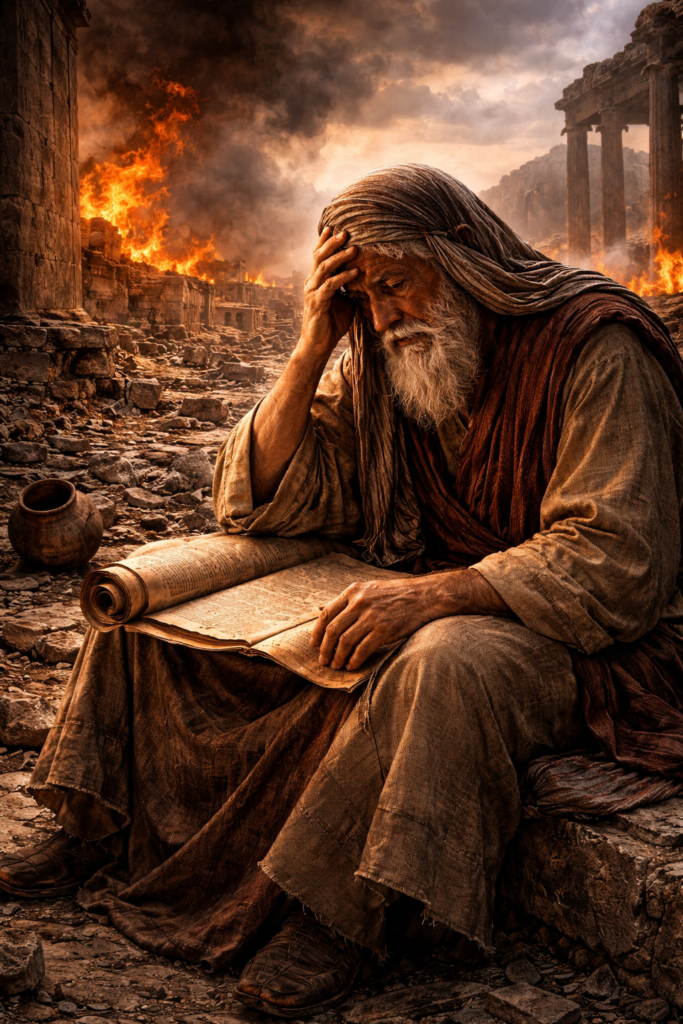
Lamentations — Grief That Leads to Hope
Introduction
Welcome to the Lamentations Study Hub — a deeply honest expression of grief, loss, and the search for hope in the midst of devastation.
Lamentations is traditionally attributed to the prophet Jeremiah.
It is written after the fall of Jerusalem.
- The city has been destroyed.
- The temple has been burned.
- The people have been scattered.
Everything that once represented stability, identity, and covenant life appears shattered.
This book does not rush past pain. It sits in it.
- It gives language to grief.
- It acknowledges loss.
- It expresses confusion, sorrow, and anguish.
Lamentations is written to:
- Give voice to deep sorrow
- Process the consequences of turning from God
- Reveal the weight of brokenness
- Hold space for honest lament
- Anchor hope in God’s unchanging character
Each chapter is poetic. Structured. Intentional.
Not chaotic grief — but expressed, processed grief.
This matters. Because Lamentations shows us: God does not reject honest emotion. He meets us in it.
The book moves between sorrow and remembrance. Between pain and truth.
Between what is seen… and what is still true.
At its centre is one of the most powerful anchors in Scripture:
“Because of the Lord’s great love we are not consumed, for His compassions never fail. They are new every morning; great is Your faithfulness.”
Even in devastation — God’s nature has not changed.
Lamentations does not deny pain. But it does not leave you without hope.
It reveals that:
- Grief can be expressed.
- Pain can be processed.
- Truth can still be held.
- Hope can still remain.
This book is not about staying in sorrow. It is about encountering God within it.
Lamentations 1 — When Everything Feels Lost
Summary
“How deserted lies the city, once so full of people…” Jerusalem is described like a widow.
Once full. Now empty. Once honoured. Now abandoned.
“She who was queen among the provinces has now become a slave.” Everything has reversed.
“Bitterly she weeps at night…” Grief is constant. Unhidden.
“Among all her lovers there is no one to comfort her…” What once seemed dependable is gone.
False supports have failed. “Her friends have betrayed her…” Isolation deepens.
Judah has gone into exile.
- Hardship.
- Servitude.
- Displacement.
“She dwells among the nations; she finds no resting place.” Restlessness. No sense of home.
“The roads to Zion mourn…” Even the pathways are empty.
- No festivals.
- No gatherings.
- No joy.
“Her priests groan, her young women grieve…” Every part of life is affected. Suffering is widespread.
Then comes recognition: “The Lord has brought her grief because of her many sins.”
There is awareness. Not denial. Not blame-shifting. Acknowledgement.
“Her children have gone into exile…” Loss is personal.
Then: “Is it nothing to you, all you who pass by?”
A cry to be seen. “To consider if there is any sorrow like my sorrow…”
Pain feels unique. Overwhelming.
The imagery continues:
- Fire.
- Nets.
- Yokes.
All describing heaviness. Weight. Restriction.
“My sins have been bound into a yoke…” Consequences are felt. Not abstract. Real.
Then again: “There is no one to comfort me…” Repeated. Loneliness is central.
The chapter ends with a cry: “Look, Lord, on my affliction…” “See how distressed I am…”
This is not polished prayer. It is honest expression.
Chapter 1 establishes:
- Grief can be expressed honestly.
- Loss can feel overwhelming and personal.
- False supports cannot sustain.
- Consequences are real and felt.
- Loneliness can accompany hardship.
- Awareness begins to emerge.
- God is still addressed in the pain.
Key Identity Realities
| Truth | Identity Proclamation |
|---|---|
| I Can Be Honest | I do not have to hide my pain from God. |
| God Sees My Grief | My sorrow is not overlooked. |
| I Am Not Alone in Expression | God welcomes my honesty. |
| Awareness Is the Beginning | I can recognise truth without condemnation. |
| False Supports Do Not Define Me | What fails does not determine my identity. |
| I Can Cry Out to God | Even in pain, I turn toward Him. |
| My Pain Matters | What I feel is seen and acknowledged. |
| God Remains Present | Even in loss, He is still there. |
Encouragement
Sister, Lamentations 1 gives you permission. Permission to be real.
To not rush past pain. To not pretend everything is okay.
This chapter is not trying to fix anything. It is allowing everything to be seen. And that matters.
Because healing does not begin with pretending. It begins with honesty.
And notice this: Even in the depth of grief — God is still being addressed. “Look, Lord…”
This is not separation. This is connection in pain.
You do not need perfect words. You do not need polished prayers.
You can come as you are. And say: “This is how it feels.” And God does not turn away.
He listens. He sees. He remains.
And even though this chapter feels heavy — There is something underneath it:
Awareness. Recognition. The beginning of turning.
You are not stuck here. But you are allowed to be here.
God is not rushing you. He is with you. In the honesty. In the expression. In the process.
And that is where healing begins.
Reflection Questions
- Am I allowing myself to be honest about what I am feeling?
- Do I feel comfortable bringing raw emotion before God?
- Where have I relied on things that could not truly support me?
- What might God be gently making me aware of in this season?
- How can I turn toward Him, even in the middle of my pain?
Lamentations 2 — When the Weight Is Felt
Summary
“How the Lord has covered Daughter Zion with the cloud of His anger…” The tone shifts.
God is now clearly identified as the One who has allowed what has happened.
This is not random. It is not without cause.
“He has hurled down the splendour of Israel…” What once stood strong has fallen.
“He has not remembered His footstool…” Even the temple — the place of His presence — has been affected.
“He has swallowed up all the dwellings of Jacob…”
The language is intense. Total devastation. Not partial. Complete.
“The Lord is like an enemy…” This is how it feels.
Not because God has changed His nature — but because the consequences are being experienced fully.
“He has broken down her strongholds…” Security is gone. Protection feels removed.
“Her gates have sunk into the ground…” Access points are destroyed.
Leaders are exiled. Guidance is missing.
“The law is no more…” There is confusion. Loss of direction.
“The prophets no longer find visions…” Silence. Disconnection.
“The elders… sit on the ground in silence…”
Grief is shared across generations. “My eyes fail from weeping…”
The expression becomes personal again. “My heart is poured out…” Deep emotional release.
Children faint in the streets. Hunger. Weakness. Vulnerability.
“They say to their mothers, ‘Where is bread and wine?’” Innocence affected.
Then comes a question: “What can I say for you?” “How can I comfort you?”
There is no easy answer. “No one can heal you…”
The depth feels beyond human solution.
Then a key insight: “Your prophets have seen for you false and deceptive visions…”
Truth had been compromised. Warnings were not given.Correction was avoided.
“They did not expose your sin to ward off your captivity…”
Avoiding truth delayed healing — and led to deeper consequence.
Then: “All who pass your way clap their hands at you…” Shame. Public exposure.
Then comes clarity: “The Lord has done what He planned…”
God’s justice is not impulsive. It is consistent with what was spoken. “He has fulfilled His word…”
Nothing is random. Everything aligns with truth.
Then the response: “The hearts of the people cry out to the Lord…” Turning begins.
“Pour out your heart like water in the presence of the Lord…” Invitation. Honest expression again.
Lift your hands. Cry out. Pray. Bring it all before Him.
Chapter 2 establishes:
- Consequences are real and weighty.
- God remains central even in hardship.
- Avoiding truth leads to deeper impact.
- False voices can mislead and delay alignment.
- Grief is shared and expressed deeply.
- Turning back to God begins in honest response.
- Prayer remains open even in pain.
Key Identity Realities
| Truth | Identity Proclamation |
|---|---|
| God Is Still Sovereign | Nothing in my life is outside His awareness. |
| I Can Face Truth | I am not afraid to acknowledge reality. |
| I Am Invited to Respond | I can turn toward God in every situation. |
| Truth Matters | I value what is real, not what is comfortable. |
| God Hears My Cry | I can pour out my heart before Him. |
| I Am Not Without Access | Prayer is always open to me. |
| God Is Just and Faithful | His actions are consistent with His word. |
| I Can Realign | Even in consequence, I am invited back. |
Encouragement
Sister, Lamentations 2 is confronting. But it is not without purpose. It brings clarity.
Because sometimes healing requires seeing clearly… Not avoiding what is real.
And this chapter shows:
- God is not absent.
- Even in consequence.
- Even in hardship.
- Even when things feel heavy.
He is still central. Still aware. Still present.
And this is important: The people begin to cry out again. “Pour out your heart…”
This is not closed access. This is open invitation.
You are not shut out. You are not beyond reaching Him.
Even when things feel like they have fallen apart — You can still come to Him.
Fully. Honestly. Completely.
And yes — truth matters. Avoiding it does not protect you. It delays restoration.
But embracing it… Opens the way for realignment.
You are not being asked to carry this in fear. You are being invited to walk in truth.
And even here — in the weight — there is movement.
Hearts are turning. Voices are rising. Prayer is returning.
And that is where restoration begins.
Reflection Questions
- Am I willing to face truth, even when it feels confronting?
- Where might I have avoided truth instead of embracing it?
- Do I believe I can still come to God, even in difficult circumstances?
- What does it look like for me to pour out my heart honestly before Him?
- Where is God inviting me to realign in this season?
Lamentations 3 — Hope in the Middle
Summary
“I am the man who has seen affliction…” The chapter begins personally.
Not general grief — experienced suffering.
“He has driven me away and made me walk in darkness…” It feels like isolation. Like God is distant.
“He has turned His hand against me…” Repeatedly. Relentlessly.
Imagery continues: Broken bones. Besieged life. Chains. Blocked prayers.
“He has made my skin and my flesh grow old…” Weariness. Fatigue. Loss of strength.
“My splendor is gone and all that I had hoped from the Lord…” Hope feels lost.
“I remember my affliction… and my soul is downcast within me.” Awareness of pain is real. Not denied.
But then — a turning point: “Yet this I call to mind…” This is intentional. Not automatic. Chosen.
“And therefore I have hope.” What is remembered? “Because of the Lord’s great love we are not consumed…”
Preservation. Still here. “His compassions never fail.” Not sometimes. Not partially. Never.
“They are new every morning…” Fresh. Daily.
“Great is Your faithfulness.” Unchanging. Steady.
“I say to myself, ‘The Lord is my portion… therefore I will wait for Him.’”
Identity shifts. From circumstance… to source.
“The Lord is good to those whose hope is in Him…” Goodness remains.
“It is good to wait quietly…” Trust grows in stillness.
“He does not willingly bring affliction…” God’s heart is not to harm.
Then reflection deepens: “Let us examine our ways and test them…”
Awareness leads to response. “Let us return to the Lord.” Turning. Realignment.
“Let us lift up our hearts and our hands…” Not just outward — inward.
Then honesty continues: “You have covered Yourself with anger…” Feelings are still expressed.
But now — anchored in truth.
Later: “You came near when I called You…” Presence is reaffirmed.
“You said, ‘Do not fear.’” Reassurance.
“You, Lord, took up my case…” Advocacy.
“You redeemed my life.” Restoration.
Chapter 3 establishes:
- Pain can be deeply real.
- Hope can rise in the middle of it.
- Truth must be intentionally remembered.
- God’s love and compassion do not fail.
- Faithfulness is constant.
- Identity is anchored in God, not circumstance.
- Turning is always available.
- God remains near, even when it does not feel like it.
Key Identity Realities
| Truth | Identity Proclamation |
|---|---|
| God’s Love Sustains Me | I am not consumed. |
| His Compassion Never Fails | I can trust His heart toward me. |
| Mercy Is New Every Morning | Each day carries fresh grace. |
| God Is Faithful | His nature does not change. |
| The Lord Is My Portion | My source is secure in Him. |
| I Can Choose Hope | I intentionally anchor my thinking in truth. |
| God Is Near | He comes close when I call. |
| I Am Not Alone | He sees, hears, and restores. |
Encouragement
Sister, This is the centre for a reason.
Because life does not wait for everything to feel better before hope appears. Hope rises in the middle.
And notice this: Nothing changed externally in this chapter. The situation is still heavy. The pain is still acknowledged.
But something shifts internally. “Yet this I call to mind…”
This is powerful. Hope is not found by denying reality. It is found by remembering truth.
And here is the truth: God’s love has not failed. His compassion has not run out. His mercy is not delayed.
His faithfulness is not shaken. Even when it feels like everything else is.
And this becomes your anchor: “The Lord is my portion.” Not circumstances. Not outcomes. Him.
And when He is your portion —
- You are not empty.
- You are not abandoned.
- You are not without hope.
- You are held.
And even more: “He came near when I called…”
You are not reaching into distance. You are calling to Someone who comes close.
This is not distant hope. This is present faithfulness.
So if you find yourself in a heavy place — Do not wait for everything to lift before you anchor yourself.
Call truth to mind. Choose to remember. Let hope rise.
Not because everything feels better — But because God is still faithful. And He always will be.
Reflection Questions
- What truth do I need to intentionally “call to mind” in this season?
- Am I allowing my circumstances to define my perspective?
- How can I anchor myself in God’s faithfulness daily?
- What does it mean for me personally that “the Lord is my portion”?
- Have I experienced moments where God has come near when I called?
Lamentations 4 — When Contrast Is Clear
Summary
“How the gold has lost its lustre…” The chapter opens with contrast. What was once pure… Now dimmed.
What was once valued… Now diminished.
“The sacred gems are scattered…” What was treasured is now dispersed.
“The precious children of Zion… are now considered as pots of clay…” Identity has shifted in how they are seen.
From honoured… to common.
Even harsh imagery follows: Compassion has diminished. Survival has overtaken nurture.
“The tongue of the nursing infant sticks to the roof of its mouth for thirst…” Deep need. Vulnerability.
“The children beg for bread, but no one gives it to them.” Provision is gone.
Those who once lived in luxury now sit in ashes. Those once well-fed now search the streets.
Everything has reversed.
Then a key statement: “The punishment… is greater than that of Sodom…”
The weight is acknowledged. Not minimised. Not avoided.
Then: “Her princes were brighter than snow…” They once reflected purity. “Now they are blacker than soot…”
Unrecognisable. Identity appears lost externally. “They are not recognised in the streets.”
Then clarity comes: “This was because of the sins of her prophets and the iniquities of her priests…”
Leadership failure again highlighted. Those meant to guide… misled.
“They shed within the city the blood of the righteous…” Justice was compromised. Truth was violated.
“They wandered blind in the streets…” Loss of vision. Loss of clarity.
“They were defiled by blood…” Consequences are visible.
The people cry: “Go away! You are unclean!” Separation. Rejection.
Then: “The Lord Himself has scattered them…” Again, God is acknowledged. Not removed from the situation.
Then a shift toward comparison: Rejoice, Daughter Edom… But your time will come. Justice is not ignored.
Then: “Your punishment… has been completed…” There is an end. This is important. It will not last forever.
“O Daughter Zion, He will not prolong your exile.” Restoration is implied. Hope is beginning to re-emerge.
Chapter 4 establishes:
- What was once bright can become dim without alignment.
- External conditions can reflect internal drift.
- Leadership carries deep responsibility.
- Consequences can affect identity perception.
- God remains present even in correction.
- Judgment is not endless — it has a limit.
- Restoration begins to come into view.
Key Identity Realities
| Truth | Identity Proclamation |
|---|---|
| My Identity Is Not Defined by Circumstances | What I go through does not define who I am in God. |
| God Sees Clearly | Nothing is hidden from Him. |
| Truth Matters | I value alignment over appearance. |
| I Am Not Abandoned | Even in consequence, God is present. |
| Seasons Have Endings | What I walk through is not permanent. |
| Restoration Is Possible | God brings renewal after brokenness. |
| I Can Learn and Grow | Awareness leads to transformation. |
| God Is Just | He sees all and responds in truth. |
Encouragement
Sister, Lamentations 4 is honest. It shows contrast. Not to condemn — but to reveal.
Because sometimes we need to see clearly: What was… and what is… So we can understand what has shifted.
And here is the key: Even when things look unrecognisable… God still knows who you are.
Even when identity seems lost externally… It is not lost to Him.
And notice this: “This was because…” Clarity matters. Understanding matters.
Not to carry guilt — but to walk in truth.
And then comes something important: “This will not last forever.” The exile has an end. The weight has a limit.
God does not leave His people in consequence endlessly. He restores. He renews. He brings them back.
And this is your anchor: What you are walking through is not your final state.
God sees. God knows. God restores.
You are not defined by what has dimmed. You are held by the One who restores light.
Stay anchored. Stay aware. Stay open. Restoration is already in motion.
Reflection Questions
- Where might I be seeing contrast between what once was and what is now?
- Am I allowing external circumstances to define my identity?
- What truth might God be revealing to me in this season?
- Do I trust that what I am walking through has an end?
- Where can I hold onto the promise of restoration right now?
Lamentations 5 — A Prayer for Restoration
Summary
“Remember, Lord, what has happened to us…” The chapter opens as a direct prayer.
No longer just describing pain — Now bringing it fully to God.
“Look, and see our disgrace.” Nothing is hidden. Everything is placed before Him.
“Our inheritance has been turned over to strangers…” Loss is acknowledged again. Identity markers feel taken.
“We have become fatherless…” Vulnerability. Lack of covering.
“Our mothers are widows…” Broken structure.
“We must buy the water we drink…” Even basic needs require effort. Provision feels strained.
“Those who pursue us are at our heels…” Pressure. No rest.
“We are weary and find no rest.” Exhaustion is real.
“We submitted… to get enough bread…” Survival has replaced freedom.
“Our skin is hot as an oven…” Physical suffering. Famine. Weakness.
“Women have been violated…” “Innocence has been harmed…”
The weight of injustice is spoken.
“Princes have been hung up…” Leaders dishonoured.
“The elders are gone from the city gate…” Guidance is missing.
“The joy of our hearts is gone…” Joy has faded.
“Our dancing has turned to mourning.” Everything feels reversed.
“The crown has fallen from our head…” Identity feels lost.
“Woe to us, for we have sinned.” There is awareness. Ownership. Not denial.
Then: “Because of this our hearts are faint…” Emotion and condition are connected.
“Our eyes grow dim…” Hope feels weakened.
“Mount Zion lies desolate…” What once represented God’s presence now appears empty.
But then — a shift: “You, Lord, reign forever…”
This is the anchor. Circumstances have changed — God has not.
“Your throne endures from generation to generation.” Stability. Unshakable.
Then the question: “Why do You always forget us?” Honest. Real. Yet still directed toward Him.
“Restore us to Yourself, Lord, that we may return…” This is the heart.
Not just: Fix our situation. But: Restore us to You.
“Renew our days as of old…” Desire for alignment. For relationship. For restoration.
The book ends here. Not with full resolution — But with surrendered hope.
Chapter 5 establishes:
- Prayer is the response to pain.
- Honesty belongs in conversation with God.
- Dependence is acknowledged.
- Awareness leads to turning.
- God’s reign is unchanging.
- Restoration is the true desire.
- Hope can remain even without immediate resolution.
Key Identity Realities
| Truth | Identity Proclamation |
|---|---|
| I Can Bring Everything to God | Nothing is too heavy to express before Him. |
| God Sees My Situation | He is aware of every detail. |
| I Am Dependent on Him | My strength and source are found in God. |
| God Reigns Forever | My circumstances do not change His authority. |
| I Can Ask for Restoration | I am invited to return to Him. |
| My Hope Is Anchored | I hold onto truth even when I do not see change yet. |
| I Am Not Forgotten | Even when it feels distant, God remains present. |
| Renewal Is Possible | God restores what has been lost. |
Encouragement
Sister, Lamentations 5 is not about having everything resolved. It is about being fully surrendered.
The people do not pretend. They do not minimise. They bring everything. And that is powerful.
Because sometimes the greatest step forward… Is not fixing everything. It is placing everything before God.
And notice this: They shift from describing their pain… To remembering who God is. “You, Lord, reign forever.”
This is the anchor. When everything else feels unstable — He is not.
And then comes the most beautiful prayer: “Restore us to Yourself…” Not just: Change our circumstances.
But: Bring us back to You. Because they recognise: Restoration is not just external. It is relational.
And this is your invitation: You do not need everything to be resolved… To come into alignment.
You can come now. With everything. Honest. Open. Real. And say: “Restore me to You.”
And God meets you there. Not distant. Not unwilling. But present. Faithful. And ready to restore.
You are not left without hope. You are anchored in Him.
Reflection Questions
- Am I bringing my honest thoughts and feelings fully to God?
- Do I recognise my dependence on Him in this season?
- What does it mean for me personally that God reigns forever?
- Am I seeking only change in circumstances, or restoration in relationship?
- Where is God inviting me to trust Him, even without immediate answers?
Completion Note — The Heart of Lamentations
From devastation to honesty, from sorrow to remembrance, from grief to anchored hope, the Book of Lamentations reveals one steady and life-giving truth:
- Pain can be real — and God can still be trusted.
- Grief can be deep — and hope can still remain.
- Circumstances can fall apart — but God does not change.
Lamentations is not a book of despair. It is a book of honest encounter.
- It gives language to sorrow.
- It validates grief.
- It acknowledges consequence.
- It reveals brokenness without hiding it.
But it does not leave you there. It brings you to the centre.
Where truth rises:
- His compassion never fails.
- His mercies are new every morning.
- Great is His faithfulness.
Lamentations dismantles pretending. It silences denial. It removes the pressure to appear strong.
It invites you to be real. Not before people — But before God.
It reveals that you can:
- Feel deeply… and still trust.
- Grieve honestly… and still believe.
- Express pain… and still remain anchored.
You are not required to rush healing. You are invited to walk through it with Him.
Lamentations does not avoid consequence. But it reveals that consequence is not the end.
God remains. God sees. God listens. God restores.
And even when resolution is not immediate — Hope is still present.
Because hope is not based on circumstance. It is anchored in who He is.
Lamentations does not finish with everything fixed. It finishes with a surrendered heart.
“Restore us to Yourself…” This is the true restoration.
Not just changed situations — but restored relationship.
You are not alone in your sorrow. You are not abandoned in your process. You are not without hope in your pain.
God is present. God is faithful. God is restoring.
And as you walk through… You are not breaking. You are being held. 💛
Overall Summary of Lamentations
1. Big-Picture Summary
Lamentations is a journey through grief — not to leave you in sorrow, but to lead you into anchored hope.
It is written in the aftermath of Jerusalem’s destruction.
Everything that once represented stability, identity, and God’s covenant presence appears broken.
The city is empty. The people are scattered. The temple is destroyed.
What once stood strong now lies in ruins.
The book does not rush past this. It slows down.
It gives voice to grief. It acknowledges pain. It expresses sorrow honestly and without restraint.
But Lamentations is not just about loss. It is about what remains true in the middle of it.
At the centre of the book, everything shifts: “Because of the Lord’s great love we are not consumed…”
Hope does not come after the pain. It rises within it. Lamentations reveals that:
- Grief can be expressed.
- Truth can be remembered.
- Hope can be anchored.
It does not deny consequence. But it does not remove God from the story.
He remains present. He remains faithful. He remains the anchor.
Lamentations is not about escaping sorrow. It is about encountering God within it.
2. Chapter-by-Chapter Summary
| Chapter | Summary |
|---|---|
| 1 | The devastation of Jerusalem is described; grief is expressed openly; loneliness and loss are deeply felt. |
| 2 | The weight of consequence is revealed; God’s justice is acknowledged; truth is confronted; the people begin to cry out. |
| 3 | Personal suffering is described; a turning point occurs; hope rises through remembering God’s love, mercy, and faithfulness. |
| 4 | The contrast between what was and what is becomes clear; consequences are visible; identity appears dimmed; restoration begins to be anticipated. |
| 5 | The book closes in prayer; sorrow is brought directly to God; dependence is expressed; hope remains anchored in His reign and the desire for restoration. |
3. Major Movements in Lamentations
| Movement | Chapters | Focus | Transformation Thread |
|---|---|---|---|
| 1. Honest Grief | 1 | Loss, sorrow, and loneliness expressed | Pain is acknowledged, not hidden |
| 2. Confronting Reality | 2 | Consequence and truth revealed | Awareness leads toward turning |
| 3. Hope Remembered | 3 | God’s love and faithfulness declared | Truth anchors the heart |
| 4. Perspective Deepened | 4 | Contrast between past and present | Understanding leads to expectation |
| 5. Prayer and Surrender | 5 | Honest dependence and request for restoration | Hope remains without full resolution |
4. Key Themes and Identity Revelations
| Theme | Identity Revelation |
|---|---|
| Honest Grief | You are allowed to express what you feel. |
| God’s Faithfulness | His nature does not change. |
| Mercy and Compassion | His love is constant and renewing. |
| Hope | You can anchor your heart even in hardship. |
| Truth and Awareness | Facing reality leads to realignment. |
| God’s Presence | He remains present even in sorrow. |
| Surrender | You are invited to bring everything to Him. |
| Restoration | God restores relationship, not just circumstances. |
5. Encouragement
Sister, Lamentations meets you in real places. Not polished places. Not resolved places. But honest ones.
Places where things feel broken. Where answers are not immediate. Where emotions are real.
And this is the beauty: God does not ask you to hide any of it.
He invites you to bring it. Fully. Honestly. Openly.
And in that place — You discover something unshakable. God has not changed.
His love has not failed. His mercy has not run out. His faithfulness has not weakened.
Even when everything else feels uncertain. Lamentations shows you: You can grieve… And still be anchored.
You can feel deeply… And still trust.
You can walk through sorrow… And still encounter Him.
You are not abandoned in your process. You are held within it.
And even when restoration is not immediate — Hope is not absent.
Because your hope is not in outcomes. It is in Him.
6. Reflection Questions
- Where might I need to allow myself to be more honest about what I am feeling?
- Do I believe God is still present with me in difficult seasons?
- What truth do I need to intentionally remember right now?
- Am I trying to rush past pain instead of bringing it to God?
- What would it look like for me to anchor my hope in God’s unchanging nature?