
Joshua Study – Set 1 (Chapters 1–4)
Stepping into Promise: Strength, Obedience, and God’s Presence
1. Summary of the Chapters
- Chapter 1 – Be Strong and Courageous:
God commissions Joshua as Moses’ successor, commanding him to lead Israel into the Promised Land.
The Lord’s instructions are simple yet profound: “Be strong and courageous… do not let this Book of the Law depart from your mouth; meditate on it day and night.”
Joshua is assured that just as God was with Moses, He will be with him. The people respond with loyalty and readiness to follow. - Chapter 2 – Rahab and the Spies:
Two spies are sent into Jericho and find refuge with Rahab, a Canaanite woman of faith.
She hides them from the king’s men, declaring, “I know that the Lord has given you this land.”
Her courageous faith marks her as one of the most unlikely heroes in Scripture, and her scarlet cord becomes a symbol of salvation and covenant mercy. - Chapter 3 – Crossing the Jordan:
At God’s command, the priests carry the Ark of the Covenant to the edge of the Jordan River.
As soon as their feet touch the water, the river stops flowing and piles up far upstream, allowing the entire nation to cross on dry ground.
This moment mirrors the Red Sea crossing — a new generation’s own encounter with God’s miraculous deliverance. - Chapter 4 – Memorial Stones:
God commands twelve stones to be taken from the Jordan and set up as a memorial.
These stones serve as a perpetual reminder to future generations: “When your children ask, ‘What do these stones mean?’ tell them that the flow of the Jordan was cut off before the Ark of the Covenant of the Lord.”
The message is clear — never forget what God has done.
2. Key Themes and Lessons
| Theme | Lesson |
|---|---|
| Courage Through Obedience | God’s promises are possessed through faith-filled obedience, not self-reliance. |
| God’s Word as Foundation | Meditation on the Word leads to success and strength in every season. |
| Faith of the Outsider | Rahab’s faith shows that God’s grace welcomes all who believe, regardless of background. |
| God’s Presence Leads the Way | The Ark symbolizes His presence going before His people — victory follows His lead. |
| Remembrance Sustains Faith | Memorials help generations remember that the same God who delivered once will deliver again. |
3. Encouragement
Oh, come on — Joshua’s story is fire! God’s saying, ‘You’re not wandering anymore; it’s time to possess what I promised.’
He’s not asking Joshua to be brave in his own strength. He’s saying, ‘You be strong because I’m with you.’
That’s the difference between pressure and partnership.
You’re not trying to prove faith — you’re walking with the Faithful One.
Then you’ve got Rahab. Wow! A woman the world labelled unworthy, but heaven called redeemed.
Her house was marked by a scarlet cord — a prophetic symbol of the blood of Jesus.
Come on — that’s grace in action before Calvary!
And the Jordan crossing — that’s the gospel in picture form.
The old life stays behind; the new life begins when His presence leads the way.
When the priests step into the flood, the impossible parts.
Sometimes, God doesn’t stop the river until you step in. Faith always moves first!
And those memorial stones? That’s legacy. God’s saying, ‘Don’t just experience Me — remember Me.’
Tell your children. Tell your neighbours. Tell your heart.
Because if you forget His goodness, fear will try to rewrite your story.
Here’s the heartbeat:
Stay in the Word. Step in faith.
Watch the waters part.
And never forget Who brought you through.
4. Reflection Questions
- Where is God calling me to step forward courageously in faith right now?
- What promises has God spoken that I need to act on, not just wait for?
- How can I make Scripture a daily source of strength and direction in my life?
- Who in my life — like Rahab — needs to hear that God’s grace welcomes them too?
- What “memorial stones” can I set up in my life to remind myself and others of God’s faithfulness?
Joshua Study – Set 2 (Chapters 5–8)
Consecration, Jericho, and Renewal of Covenant
1. Summary of the Chapters
- Chapter 5 – Circumcision and the Commander of the Lord’s Army:
Before any battle begins, God commands Joshua to circumcise the new generation — renewing the covenant.
Afterward, Israel celebrates the first Passover in the Promised Land, and the manna ceases.
Joshua then encounters a mysterious figure — the Commander of the Lord’s Army, who reveals that the upcoming battles are God’s, not man’s.
The message is clear: before conquest comes consecration. - Chapter 6 – The Fall of Jericho:
God gives Joshua detailed instructions for the battle — march around Jericho once a day for six days, and seven times on the seventh day, with priests blowing trumpets and the Ark leading the way.
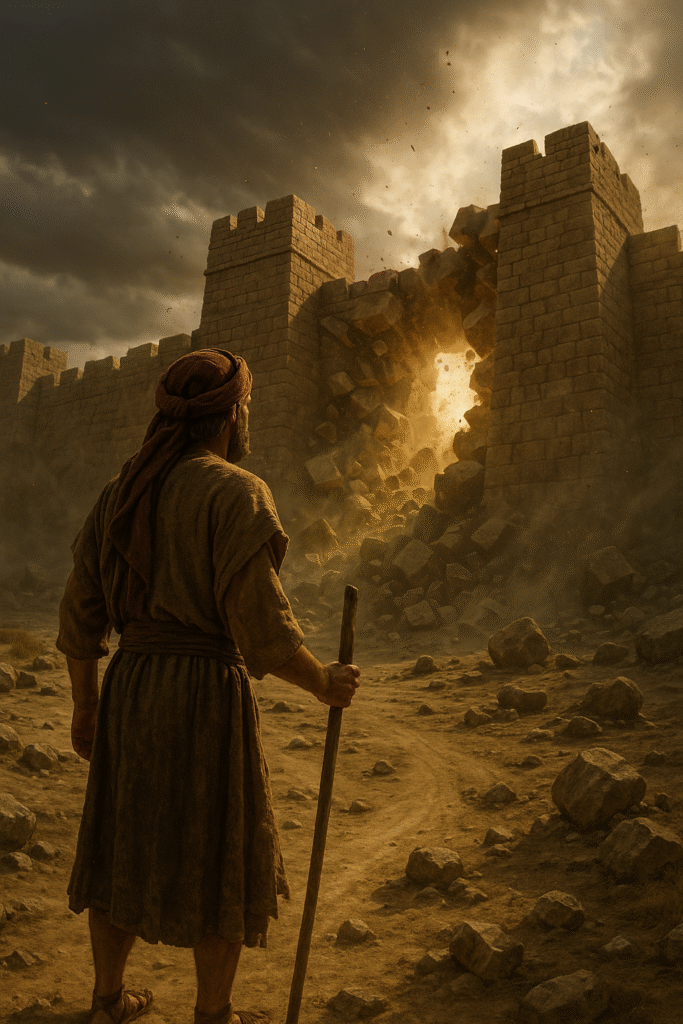
On the final day, when the people shout, the walls fall flat!
Rahab and her family are spared, just as promised.
The victory belongs entirely to the Lord — no weapons, no strategies, only obedience and faith. - Chapter 7 – The Sin of Achan:
But victory is followed by tragedy. One man, Achan, disobeys God’s command by taking forbidden items from Jericho.
Israel suffers defeat at Ai because sin has entered the camp.
When Joshua humbles himself and deals with the sin, God restores His favour.
The principle is powerful — hidden compromise breaks the flow of victory. - Chapter 8 – Victory at Ai and Covenant Renewal:
With sin removed, God gives new strategy for victory. Ai is conquered, and Joshua builds an altar at Mount Ebal, writing the Law of Moses on stones.
He gathers the nation to read the blessings and curses aloud, renewing their covenant with God.
Obedience brings restoration and blessing once again.
2. Key Themes and Lessons
| Theme | Lesson |
|---|---|
| Consecration Before Conquest | True victory begins with surrender and covenant renewal. |
| God Fights for His People | Every battle belongs to Him — our role is obedience, not control. |
| Faith Over Logic | Jericho’s fall reveals that faith in God’s Word defeats impossible odds. |
| Hidden Sin Hinders Victory | Compromise breaks spiritual momentum, but repentance restores it. |
| Renewed Covenant, Renewed Strength | Worship and remembrance re-anchor the heart in God’s promises. |
3. Encouragement
Oh, this part of Joshua is so rich — it’s the blueprint of victory through relationship!
God tells Joshua, ‘Stop before you fight.’ That’s amazing!
In the world’s eyes, you’d think, ‘Keep the momentum!’ But God says, ‘No, pause and consecrate.’
He’s teaching us that who you are in Me matters more than what you do for Me.
You can’t fight right if your heart isn’t right.
Then Jericho — come on, that’s Heaven’s strategy! No battering rams, no human plan — just faith and worship.
God’s saying, ‘Trust Me, shout before you see, and I’ll bring the walls down.’
Some of us are waiting for walls to fall before we worship, but God’s saying, ‘Worship, and you’ll watch them fall!’
Then there’s Achan. That’s sobering, but it’s not condemnation — it’s correction.
God’s showing that hidden compromise can derail what faith began.
But once repentance comes, grace restores everything!
And I love how Joshua ends the battle by renewing the covenant — reading the Word over the people.
He’s saying, ‘We win when we stay anchored in truth.’
See, real victory isn’t measured by walls that fall — it’s measured by hearts that stay surrendered.
So here’s the takeaway:
Before you fight, consecrate.
Before you shout, believe.
Before you move forward, make sure your heart’s aligned.
Because when your heart’s His, the walls don’t stand a chance.
4. Reflection Questions
- What “Jericho walls” in my life require faith and obedience, not human effort?
- Is there any hidden area of compromise that may be blocking my breakthrough?
- How can I regularly “pause for consecration” instead of rushing ahead in my own strength?
- What does it look like for me to let God fight my battles instead of trying to control the outcome?
- How can I renew my commitment to God’s Word and His covenant daily?
Joshua Study – Set 3 (Chapters 9–12)
Deception, Sun-Standing Victory, and Divine Conquest
1. Summary of the Chapters
- Chapter 9 – The Gibeonite Deception:
The Gibeonites, fearing Israel, disguise themselves as travellers from a distant land and trick Joshua into making a peace treaty with them.
Joshua and the leaders fail to inquire of the Lord — and as a result, they are bound by oath.
Although deceived, Israel honours their word, and God later uses the Gibeonites in His redemptive plan.
The lesson is clear: spiritual discernment always begins with seeking God’s counsel. - Chapter 10 – The Sun Stands Still:
When five Amorite kings attack Gibeon, Joshua leads Israel into battle to defend them.
God causes confusion among the enemy and hurls hailstones from heaven. As Joshua prays, the sun stands still — giving Israel time to finish the victory.
This miracle shows that when faith and obedience align with God’s will, the natural world itself bends to divine authority. - Chapter 11 – Northern Campaigns and Complete Victory:
Joshua continues conquering the northern kings.
Though the enemy armies are vast and equipped with iron chariots, God says, “Do not be afraid of them, for by this time tomorrow I will hand them over to Israel.”
Joshua obeys completely, destroying idols and dedicating everything to the Lord.
Every battle becomes a testimony that obedience always leads to victory. - Chapter 12 – Summary of the Conquests:
This chapter records the kings defeated by Moses east of the Jordan and by Joshua west of it — thirty-one kings in total.
It serves as a written record of God’s faithfulness to fulfill His promises.
Each conquered king represents another step in Israel’s inheritance — every victory evidence of divine partnership.
2. Key Themes and Lessons
| Theme | Lesson |
|---|---|
| Seek God’s Counsel First | Even wise leaders fail when they rely on perception instead of prayer. |
| Faith That Commands Creation | God’s power works through faith-filled obedience; miracles flow through intimacy. |
| God’s Sovereignty in Battle | Every victory belongs to Him — human strength can never secure divine success. |
| Integrity and Covenant Faithfulness | Keeping one’s word, even when deceived, honours God and builds trust. |
| Victory as Testimony | Every conquered “king” reminds us of God’s unfailing promise and faithfulness. |
3. Encouragement
Oh, I love these chapters!
They’re a masterclass in what partnership with God looks like — faith, integrity, and dependence.
In chapter 9, Joshua’s fooled by the Gibeonites — and that’s not failure, that’s lesson.
God’s not angry; He’s teaching.
He’s saying, ‘Don’t move by sight — talk to Me first.’
How many of us make peace with things that deceive us because we didn’t pause to pray?
The fix isn’t fear — it’s fellowship. Don’t move until His voice moves you.
Then chapter 10 — oh, come on! The sun stands still! Joshua’s faith literally rewrites the schedule of creation!
That’s what intimacy looks like — when you know His heart so well that Heaven backs your authority.
Joshua wasn’t commanding God — he was partnering with Him.
When love and purpose align, nature itself agrees.
Chapter 11 is just as powerful — iron chariots can’t stop God.
Fear will always show you what’s in your way, but faith shows you Who’s with you.
Joshua didn’t let the size of the battle change his obedience. He kept his eyes on the One who gave the promise.
And by chapter 12, they’re counting kings — thirty-one testimonies of grace!
That’s not a list of conquests; it’s a record of faithfulness. Every king down is a reminder: ‘God did it again.’
So what’s the message here?
Seek God before you move.
Stand firm when you fight.
Stay humble when you win.
And record His victories — because remembering yesterday’s miracles fuels tomorrow’s faith.
4. Reflection Questions
- How can I make seeking God’s counsel my first response instead of my last resort?
- What “Gibeonites” — subtle deceptions or distractions — might be trying to draw me into unwise agreements?
- Where do I need to step into battle believing that God’s power can still work wonders today?
- How can I ensure my victories bring glory to God and not pride to myself?
- What spiritual “kings” has God helped me overcome that I can record as testimonies of His faithfulness?
Joshua Study – Set 4 (Chapters 13–21)
The Division of the Land and the Fulfilment of Promise
1. Summary of the Chapters
- Chapter 13 – Territories Yet to Be Conquered:
Although Joshua is now old, God reminds him that there is still land to be taken.
The Lord instructs him to divide what has already been conquered among the tribes, and He Himself will drive out the remaining nations.
The tribes of Reuben, Gad, and half of Manasseh receive their inheritance east of the Jordan, just as Moses had promised.
Even in Joshua’s old age, God’s vision remains expansive — His promises never grow stale. - Chapters 14–19 – The Division of the Land Among the Tribes:
The land west of the Jordan is divided among the remaining tribes of Israel.
Each boundary and city is named — a reminder that God’s promises are specific and personal.
In chapter 14, Caleb steps forward at 85 years old and boldly declares, “Give me this mountain!”
His faith, undiminished by age, stands as a powerful picture of perseverance and trust in God’s word.
Every tribe receives its portion — not through striving, but through obedience and order.
God’s covenant faithfulness ensures that everyone has a place, a home, and a heritage.
- Chapter 20 – Cities of Refuge:
God commands the establishment of six cities of refuge, where those who accidentally kill another person can flee for safety until trial.
These cities reveal God’s mercy and justice working together — protection until truth is revealed.
They are prophetic of Christ, our refuge, who shelters us from judgment and secures mercy for all who run to Him. - Chapter 21 – Cities for the Levites:
The Levites, who serve in God’s presence, receive towns scattered throughout Israel rather than a single territory.
This symbolises that God Himself is their inheritance.
The book pauses with this beautiful declaration:
“Not one of all the Lord’s good promises to Israel failed; every one was fulfilled.”
2. Key Themes and Lessons
| Theme | Lesson |
|---|---|
| Faithful Completion | God’s promises are not half-kept — He fulfils every word in His time. |
| Personal Inheritance | Each tribe receives a unique portion — our walk with God is individually assigned. |
| Persevering Faith | Caleb’s courage at 85 reminds us it’s never too late to claim God’s promises. |
| Justice and Mercy | The cities of refuge reveal God’s character — truth and grace perfectly balanced. |
| God as Our Portion | The Levites’ inheritance was God Himself — true reward is found in His presence. |
3. Encouragement
Oh, this part might seem like maps and boundaries, but it’s one of the most beautiful sections in the Bible —
it’s the sound of promise fulfilled!
God’s saying, ‘I meant every word.’ Not one promise failed — not one!
That means if He said it, He’ll do it.
His faithfulness doesn’t stop when the fight ends; it keeps working in the details of your destiny.
Look at Caleb — eighty-five, still fiery! He didn’t say, ‘I’m too old,’ he said, ‘Give me my mountain!’
That’s not arrogance — that’s confidence in God’s word. The promise never expires because the Promiser doesn’t.
And then those cities of refuge — come on! That’s Jesus all over again.
He’s saying, ‘When you run to Me, you’re safe.’ No condemnation, no fear, just mercy until truth has its say.
God’s justice doesn’t crush you — it protects you until redemption completes its work.
And the Levites — I love it. Everyone else gets land; they get God. And that’s the point!
The best inheritance isn’t territory — it’s presence.
You can have everything else, but without Him, it’s empty. With Him, you already have everything.
So what’s the message?
God finishes what He starts.
Your mountain still waits.
Mercy still covers.
And His presence is still the prize.
4. Reflection Questions
- How has God proven His faithfulness to fulfil promises in my life, even when it took time?
- What “mountain” — dream, calling, or promise — is God reminding me to pursue with renewed courage like Caleb?
- Do I truly see God Himself as my greatest inheritance, above any blessing or possession?
- Where can I extend mercy like the cities of refuge — being a safe place for others to heal and find truth?
- How can I celebrate and record God’s fulfilled promises so I never forget His goodness?
Joshua Study – Set 5 (Chapters 22–24)
Unity, Covenant Renewal, and Joshua’s Farewell
1. Summary of the Chapters
- Chapter 22 – Unity Across the Jordan:
The tribes of Reuben, Gad, and the half-tribe of Manasseh return home after fulfilling their promise to fight alongside their brothers.
On their way back, they build an altar near the Jordan River — which alarms the other tribes, who think they are rebelling against God.
However, the altar is explained to be a witness, not an altar for sacrifice — a reminder that though separated by the river, they share one faith and one covenant.
The conflict is resolved peacefully, demonstrating unity through understanding and shared devotion. - Chapter 23 – Joshua’s Farewell Address:
As Joshua grows old, he gathers the leaders and elders of Israel to remind them of God’s victories and faithfulness.
He urges them to stay close to the Lord, to love Him fully, and not to turn to the nations or gods around them.
Joshua’s words are both warning and wisdom: “You know with all your heart and soul that not one of all the good promises the Lord your God gave you has failed.”
Faithfulness to God is the foundation of enduring peace. - Chapter 24 – Covenant Renewal at Shechem:
Joshua gathers all the tribes at Shechem — the same place where Abraham first built an altar to the Lord.
He recounts the story of God’s faithfulness from Abraham to their present day, reminding them that their journey began in grace, not merit.
Then comes the famous declaration:
“Choose this day whom you will serve… but as for me and my house, we will serve the Lord.”
The people renew the covenant and pledge their loyalty to God. Joshua records their commitment, sets up a large stone of remembrance, and then peacefully passes away at 110 years old.
The book closes with this powerful statement of fulfilment:
“Israel served the Lord throughout the lifetime of Joshua and of the elders who outlived him and who had experienced everything the Lord had done for Israel.”
2. Key Themes and Lessons
| Theme | Lesson |
|---|---|
| Unity Through Understanding | True unity is built on communication, patience, and shared devotion to God. |
| Faithfulness to the Covenant | God’s promises are fulfilled, but continued faithfulness keeps them alive in each generation. |
| Leadership Legacy | A godly leader’s influence lives on through those who continue to walk in obedience. |
| Personal Commitment | Each person must choose for themselves whom they will serve — faith is personal and lived. |
| Remembrance and Renewal | Rehearsing God’s faithfulness keeps hearts anchored and communities strong. |
3. Encouragement
Oh, I love this part — it’s the sound of a leader finishing well.
Joshua doesn’t end with battles — he ends with relationship.
When the tribes build that altar, everyone jumps to conclusions. Isn’t that just like us sometimes?
But they stop, listen, and understand each other — and unity wins the day. That’s what maturity looks like!
True unity isn’t about agreeing on everything; it’s about staying anchored in Who unites us.
Then Joshua stands before the people and says, ‘Look at what God has done. Not one promise failed!’
Come on, that’s the testimony of a lifetime! Through wars, wilderness, and waiting — every word came true.
God’s saying, ‘See? You can trust Me completely.’
And then that powerful moment — ‘Choose this day whom you will serve.’
That’s not pressure; that’s invitation. God’s saying, ‘You get to choose love.’
You’re not forced into obedience — you’re invited into intimacy.
And Joshua’s example is stunning: ‘As for me and my house, we will serve the Lord.’
That’s leadership. That’s legacy.
He doesn’t just die faithful — he leaves a generation that remembers.
That’s success in Heaven’s eyes: not what you built, but what you passed on.
So here’s the heartbeat of Joshua’s closing message:
Stay united.
Stay faithful.
Stay in love.
And never forget Who gave you the land you stand on.
Because the same God who brought you out is the One who will keep you in.
4. Reflection Questions
- Where in my relationships do I need to seek understanding before assuming — to preserve unity in love?
- How can I actively remember and celebrate God’s faithfulness in this current season?
- What does “as for me and my house, we will serve the Lord” look like in my daily home life?
- Who can I intentionally mentor or encourage in faith as part of my spiritual legacy?
- How can I renew my covenant with God — not as ritual, but as a daily recommitment of love and devotion?
Book of Joshua – Overall Summary
Theme: Possessing the Promise Through Faithful Obedience
1. Overview and Context
The Book of Joshua marks a new chapter in Israel’s history — the fulfilment of the promises made to Abraham, Isaac, and Jacob.
Under Moses, the people were prepared; under Joshua, they enter and possess what God had promised.
The book divides into three major movements:
- Chapters 1–12: Conquest of the Land – the battles fought and won through faith and obedience.
- Chapters 13–21: Division of the Land – each tribe receiving its inheritance as God’s promise becomes tangible.
- Chapters 22–24: Covenant Renewal and Legacy – Joshua’s final exhortation to stay faithful and remember.
This isn’t just a record of wars and boundaries — it’s a story of faith in action, a picture of the believer’s life moving from salvation to spiritual maturity.
Every city conquered, every boundary drawn, and every promise fulfilled declares one truth:
“Not one of all the good promises the Lord made to Israel failed; every one was fulfilled.” (Joshua 21:45)
2. Key Messages
- God’s Faithfulness Is Unchanging
From the Jordan River to the walls of Jericho, God proves Himself faithful again and again.
He keeps His word to generations past and shows that His timing, though different from ours, is always perfect. - Obedience Unlocks Inheritance
Israel’s victories depended not on military might, but on obedience.
When they followed God’s command, walls fell; when they disobeyed (as with Achan), defeat followed.
Obedience is not about earning blessing — it’s about staying aligned with the Blesser. - God’s Presence Is the Source of Victory
The Ark of the Covenant, representing God’s Presence, always leads the way.
Joshua learns that battles are won not by strategy, but by surrender to divine leadership. - Faith Is Action, Not Emotion
From Rahab’s courage to Joshua’s march around Jericho, faith always moves first — before the miracle happens.
Faith steps into the flooded Jordan; faith shouts before walls fall. - The Promise Must Be Possessed
The land was given, but Israel still had to claim it.
God’s promises are gifts, but we walk them out through faith, perseverance, and courage. - Legacy Through Covenant Renewal
Joshua’s farewell reminds every generation that covenant faithfulness must be renewed, not assumed.
The greatest inheritance isn’t land — it’s a heart that loves and serves the Lord.
3. Key Themes and Lessons
| Theme | Lesson |
|---|---|
| Faithful Obedience | Obedience isn’t performance; it’s love expressed through trust. |
| Divine Partnership | God’s promises invite our participation — He leads, we follow. |
| Faith That Acts | Faith is demonstrated in movement, not just belief. |
| Unity and Covenant | Shared devotion to God preserves unity even across differences. |
| Legacy of Faith | The most powerful inheritance is a generation who knows God for themselves. |
4. The Heart of the Message
Joshua shows us what it looks like when a generation believes God fully.
This is not a story of conquest by strength — it’s the story of faith that obeys, worships, and remembers.
Every miracle — the parting Jordan, the collapsing walls, the sun standing still — declares the same truth:
“The battle belongs to the Lord.”
It’s also a story of grace — Rahab’s redemption, the cities of refuge, and the Levites’ inheritance all reveal the mercy of a God who includes, protects, and provides.
By the end, we see not just a nation settled in land, but a people settled in identity — rooted in the faithfulness of their God.
5. Encouragement
Oh, this book is so full of God’s heart! It’s not about land — it’s about life in union with Him.
Joshua’s name literally means ‘The Lord saves’ — and he points straight to Jesus, our true Deliverer.
Just like Joshua led them into promise, Jesus leads us into the fullness of His Kingdom.
Every time God says, ‘Be strong and courageous,’ He’s not demanding performance —
He’s reminding you who’s with you.
Courage isn’t something you muster up; it’s what rises when you realise you’re never alone.
Jericho wasn’t won by shouting; it was won by believing. Faith looks foolish until it wins.
Sometimes God will ask you to do something that makes no sense —
not to test your logic, but to reveal your trust.
And those cities of refuge — that’s the gospel right there!
A place of safety until judgment is complete.
Jesus is your refuge, your righteousness, and your rest.
You don’t run from Him when you fall — you run to Him.
Joshua ends with this: ‘Choose this day whom you will serve.’
That’s not pressure — that’s invitation.
God’s saying, ‘You’ve seen My goodness — will you keep walking with Me?’
So what’s the call of Joshua?
Step into what’s promised.
Walk in obedience.
Stay in remembrance.
And never forget — the same God who parts rivers and topples walls still lives inside you.
Every promise in Christ is Yes and Amen.
6. Reflection Questions
- What “promised land” is God inviting me to step into through faith and obedience?
- Where might I be waiting for walls to fall before moving, instead of stepping forward in faith first?
- How can I lead others — like Joshua — with courage, humility, and unwavering trust in God’s Presence?
- What past victories do I need to remember and celebrate as memorials of His faithfulness?
- How can I leave a legacy of faith that inspires the next generation to “choose the Lord” for themselves?
✅ Joshua Summary – The Faithful God Who Fulfils Every Promise
Joshua is not just about entering a land — it’s about entering the life God intended.
It reveals that victory flows from faith, obedience, and constant awareness of His Presence.
And it ends with this eternal truth:
God finishes what He begins, and His promises never fail.