
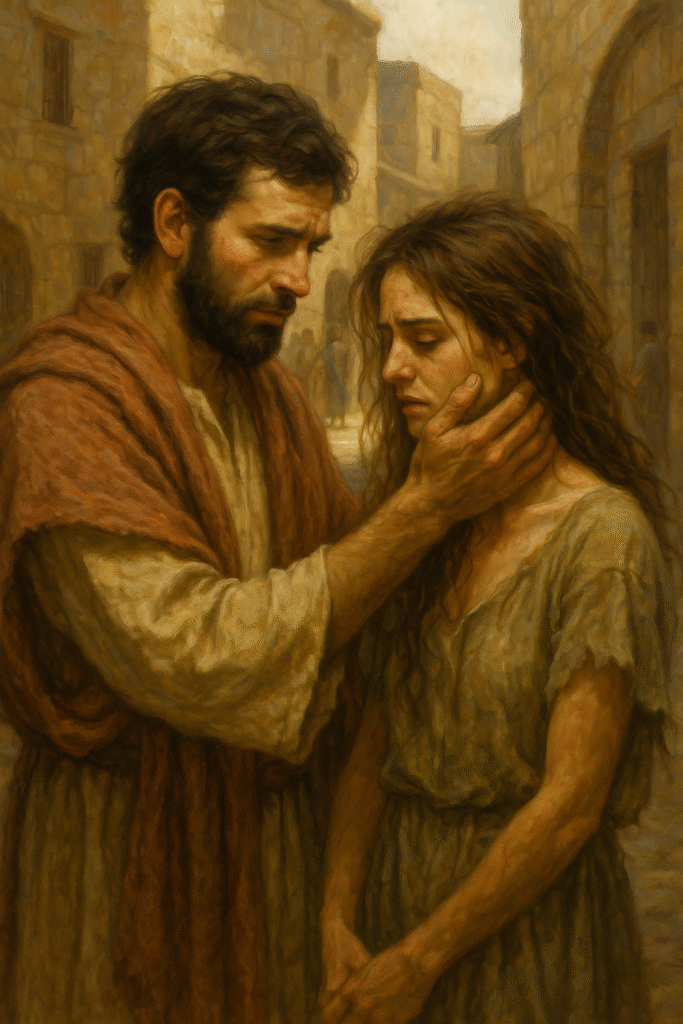
Book of Hosea – Set 1 (Chapters 1–3)
Theme: Covenant Love Betrayed and Redeemed — God’s Relentless Pursuit of His People
1. Summary of the Chapters
Chapter 1 – Hosea’s Marriage as a Prophetic Sign
God commands Hosea to marry Gomer, a woman who will be unfaithful, symbolising Israel’s spiritual adultery through idolatry.
They have three children, each given prophetic names:
- Jezreel – “God Will Scatter” (Judgment is coming)
- Lo-Ruhamah – “Not Loved” (God will withdraw mercy)
- Lo-Ammi – “Not My People” (The covenant relationship has been broken)
Yet immediately, God promises restoration:
“In the place where it was said to them, ‘You are not My people,’ they will be called ‘children of the living God.’” (1:10)
Even in judgment, hope is already being declared.
Chapter 2 – Israel’s Unfaithfulness and God’s Restoring Love
God speaks as a heartbroken husband:
- Israel has chased other lovers (false gods, political alliances).
- Her blessings (grain, wine, oil) were gifts from God, yet she attributed them to idols.
“She did not realise that I was the one who gave her the grain, the new wine, and the oil.” (2:8)
So God will strip her of false securities — not for destruction, but for healing.
Then the tone shifts dramatically from judgment to restoration:
“Therefore, I am going to allure her; I will lead her into the wilderness and speak tenderly to her.” (2:14)
God promises:
- To remove the names of idols from her lips
- To betroth her forever in righteousness and love
- To restore the covenant relationship
Chapter 3 – Redeeming Love
God commands Hosea to go again and love Gomer, even though she has left him for another man. He must redeem her at a price — symbolising God buying back His people from slavery to sin.
“So I bought her for fifteen shekels of silver and a homer and a lethek of barley.” (3:2)
Hosea says she must live with him in faithfulness — just as Israel will return and seek the Lord in the latter days.
This is a prophetic picture of Christ, who redeems His unfaithful bride (the Church) at the price of His own blood.
2. Key Themes and Lessons
| Theme | Lesson |
|---|---|
| Covenant Love | God’s love is not based on our faithfulness, but on His covenant promise. |
| Spiritual Adultery | Idolatry is not a minor sin; it is betrayal of God’s love. |
| Discipline as Love | God removes false lovers and comforts so that His people may return to Him. |
| Redemption | God doesn’t just forgive—He redeems, paying the price to restore relationship. |
| Hope of Restoration | Judgment is temporary; God’s ultimate desire is reconciliation and intimacy. |
3. Encouragement
Oh, this is powerful! Hosea isn’t just preaching a message — he is living it.
God tells him to marry someone who will betray him. Why?
Because God wants us to feel what He feels. Israel wasn’t just breaking rules — they were breaking God’s heart.
But here’s the beauty: God doesn’t give up. He doesn’t walk away. He pursues.
He goes after His unfaithful bride not to shame her, but to restore her.
Chapter 2 absolutely explodes with the Father’s heart. He says, ‘I will allure her… I will speak tenderly to her.’
Come on — that’s not anger speaking — that’s covenant love.
That’s God saying, ‘You may have forgotten Me, but I have never stopped loving you.’
And then Hosea redeems Gomer. He literally pays a price to bring back what was already his.
That’s Jesus on the cross — buying back the bride who had given herself to other lovers.
Not out of obligation — but out of unstoppable love.
Sister, Hosea isn’t just a story about Israel — it’s a mirror.
It shows us how God loves us — not when we get it right, but when we’re lost.
He doesn’t just forgive your past — He redeems your value, restores your identity, and calls you His own again.
This is not a story of human unfaithfulness.
It’s a story of divine faithfulness that never quits.
4. Reflection Questions
- Are there “false lovers” in my life—things I run to for comfort, identity, or security instead of God?
- Do I truly believe that God pursues me with love, even when I have failed or wandered?
- What does the story of Hosea teach me about God’s heart toward His people—toward me?
- How does seeing Jesus as my Redeemer change the way I view my worth and identity?
- Am I willing to return wholeheartedly to the One who has already paid the price to make me His?
Book of Hosea – Set 2 (Chapters 4–6)
Theme: The Case Against Israel and God’s Cry for Their Return
1. Summary of the Chapters
Chapter 4 – The Lord’s Charge Against Israel
God declares a lawsuit against Israel because:
- There is no faithfulness
- No love
- No knowledge of God in the land
Instead there is lying, murder, stealing, adultery, and idolatry. Even the priests, who were meant to teach the people, have led them astray.
“My people are destroyed for lack of knowledge.” (4:6)
“A spirit of prostitution leads them astray; they are unfaithful to their God.” (4:12)
God is not condemning their ignorance of information, but their rejection of relationship.
Chapter 5 – Judgment to Awaken
God calls out the leaders for leading the people into sin. Ephraim (representing the northern kingdom) pursued idols while still expecting God’s blessing.
“When they go with their flocks and herds to seek the Lord, they will not find Him; He has withdrawn Himself from them.” (5:6)
He withdraws His manifest presence so they will realize their spiritual condition. This is discipline with a redemptive purpose.
“I will be like a lion to Ephraim… until they acknowledge their guilt and seek My face.” (5:14–15)
Chapter 6 – The Call to Return
Israel offers shallow repentance, saying:
“Come, let us return to the Lord… He will heal us… He will revive us.” (6:1–2)
But their loyalty is fleeting—like morning mist.
“For I desire mercy, not sacrifice, and acknowledgment of God rather than burnt offerings.” (6:6)
This is one of the most powerful verses in Scripture, echoed by Jesus multiple times (Matthew 9:13; 12:7). God is after heart relationship, not empty ritual.
2. Key Themes and Lessons
| Theme | Lesson |
|---|---|
| Spiritual Knowledge | True knowledge of God is relational, not just intellectual or ritualistic. |
| Leadership Accountability | Spiritual leaders are held to high responsibility; they can lead people either to life or destruction. |
| Discipline as Love | God withdraws His presence not to abandon, but to awaken His people to their need for Him. |
| Empty Religion | God is not interested in ceremonies without obedience and love. |
| Call to True Repentance | God desires heart transformation and intimacy, not temporary remorse. |
3. Encouragement
Oh sister, this hits deep! God isn’t rebuking Israel because He’s angry and wants to punish them.
He’s grieving because they have traded relationship for religion.
When He says, ‘My people are destroyed for lack of knowledge,’ He’s not talking about information —
He’s talking about intimacy. They lost connection with His heart.
Chapter 6 is everything.
God says, ‘I don’t want your sacrifices—I want your heart. I want your love. I want you to know Me.’
That’s the cry of a Father, not a judge.
This is the heart of the Gospel:
God doesn’t want you performing to impress Him. He wants you coming to Him to know Him.
Religion says: ‘What must I do to be accepted?’
God says: ‘Come to Me and live in My love — everything else will flow from there.’
Even when God withdraws His presence, it’s not rejection—it’s invitation.
It’s Him saying, ‘Do you feel the distance? Come back to Me. I am your source of life.’
Sister, this message is not calling you to try harder.
It’s calling you to return to the One who already chose you.
4. Reflection Questions
- Am I walking in living relationship with God, or just going through religious motions?
- Are there areas in my life where I have substituted ritual or obligation for genuine intimacy with God?
- How seriously do I take God’s desire for me to know Him personally?
- Is God using any discomfort in my life as a loving invitation to return to Him more fully?
- How can I respond to God’s call not with temporary emotions, but with true repentance and renewed devotion?
Book of Hosea – Set 3 (Chapters 7–10)
Theme: The Folly of Rebellion and the Broken Heart of God
1. Summary of the Chapters
Chapter 7 – Israel’s Hidden Sins Revealed
Israel is like a heated oven, full of passion—but for evil, not God. Their leaders are assassinated, their hearts burn with hatred, yet they refuse to return to the Lord.
“They do not cry out to Me from their hearts… they turn away from Me.” (7:14)
They seek help from Egypt and Assyria instead of God, becoming like a “senseless dove” fluttering in panic.
Message: When we look to human solutions for spiritual problems, we only deepen our bondage.
Chapter 8 – Sowing the Wind, Reaping the Whirlwind
The people shout, “We acknowledge you, God!”—but their actions contradict their words.
“Israel has forgotten his Maker and built palaces.” (8:14)
They have sown sin and idolatry, and now they will reap destruction.
“They sow the wind and reap the whirlwind.” (8:7)
Their religious practices are empty because their hearts are far from God.
Chapter 9 – The Consequences of Spiritual Adultery
Israel enjoyed prosperity and harvests, but forgot that God was their source. Now judgment is coming.
They will be taken into exile and will no longer be able to worship in the land.
“The days of punishment are coming, the days of reckoning are at hand.” (9:7)
Their root is withered because they have rejected God.
Chapter 10 – The Call to Break Up Fallow Ground
Israel is likened to a luxuriant vine that yields fruit for itself—self-centered instead of God-centered.
They trusted in their own strength, built false altars, and relied on kings who could not save.
God calls them:
“Sow righteousness for yourselves, reap the fruit of unfailing love,
and break up your unplowed ground;
for it is time to seek the Lord,
until He comes and showers His righteousness on you.” (10:12)
This is one of the most beautiful calls to repentance in Scripture.
2. Key Themes and Lessons
| Theme | Lesson |
|---|---|
| Superficial Religion vs. True Devotion | Saying we know God is not enough—our hearts and lives must reflect Him. |
| Misplaced Trust | Turning to human strength, governments, or idols instead of God leads to destruction. |
| Consequences of Sin | Sin has a harvest; what we sow, we will reap. |
| God’s Pleading Heart | Even in judgment, God is calling—inviting His people to return and be healed. |
| Call to Repentance | Spiritual renewal begins when we break up the hard ground of our hearts and turn back to God in sincerity. |
3. Encouragement
Oh, this is such a real picture of the human heart!
Israel kept using God’s name, but their hearts were given to other lovers—security, prosperity, idols.
They said, ‘God, we acknowledge You,’ but their trust was in men, in governments, in treaties—not in the One who formed them.
But look how God responds—not with cold anger, but with broken love.
He says, ‘Break up your fallow ground. Let Me rain righteousness on you!’
That’s not judgment—that’s an invitation to be alive again.
Sister, God is not calling you out to shame you—He’s calling you back to life.
He’s saying, ‘Stop sowing into what destroys you. Come back to My love and let Me heal you.’
You can’t fix your own heart.
You can’t save yourself with effort, distraction, or control.
But you can surrender—and the moment you do, He showers righteousness upon you.
That’s the Gospel in Hosea:
God doesn’t just expose sin—He invites us into healing, freedom, and restoration through His love.
4. Reflection Questions
- Am I relying on human strength, systems, or strategies instead of fully trusting in the Lord?
- Is there any area of my life where I am “sowing the wind”—investing in things that cannot produce spiritual life?
- What does it mean for me personally to “break up fallow ground” in my heart?
- Is my devotion to God genuine and wholehearted, or has it become routine or external?
- How is God inviting me to return to intimacy and live from His unfailing love?
Book of Hosea – Set 4 (Chapters 11–14)
Theme: The Father’s Heart, the Wounded Lover, and the Final Call to Return and Be Healed
1. Summary of the Chapters
Chapter 11 – The Father’s Broken Heart
God speaks as a tender Father:
“When Israel was a child, I loved him, and out of Egypt I called My son.” (11:1)
He taught them to walk, healed them, carried them — yet they turned away.
Still, God’s compassion rises above His anger:
“How can I give you up, Ephraim?
My heart is changed within Me;
all My compassion is aroused.” (11:8)
This is not a God who punishes with delight — this is a Father grieving over His wandering children, longing to restore them.
Chapter 12 – Exposed Deceit and the Call to Return
Israel (Jacob) is compared to their ancestor Jacob who wrestled with God. They have relied on deceit, manipulation, and foreign alliances.
God calls them:
“Return to your God,
maintain love and justice,
and wait for your God always.” (12:6)
The issue is not God’s unwillingness to bless; it is Israel’s unwillingness to return.
Chapter 13 – The Consequences of Rejecting God
Israel forgot God and turned to idols that could not save. As a result, destruction is inevitable.
Yet even here, God hints at resurrection:
“I will deliver this people from the power of the grave;
I will redeem them from death.” (13:14)
This is a prophetic declaration pointing to Christ’s victory over death (quoted in 1 Corinthians 15:55).
Chapter 14 – The Final Call and Promise of Restoration
This chapter is the heart of the Gospel in the Old Testament.
“Return, Israel, to the Lord your God.” (14:1)
God gives them words of repentance:
“Forgive all our sins and receive us graciously.” (14:2)
And then God responds with profound tenderness:
“I will heal their waywardness and love them freely.” (14:4)
“They will flourish like grain… like a fruitful vine.” (14:7)
The book ends with a beautiful description of restored intimacy, healing, and blessing.
“The ways of the Lord are right;
the righteous walk in them.” (14:9)
2. Key Themes and Lessons
| Theme | Lesson |
|---|---|
| God’s Fatherly Love | God’s love is not transactional; it is the love of a Father who refuses to abandon His children. |
| Compassion Over Judgment | Even when judgment is deserved, God’s heart longs for mercy, healing, and restoration. |
| The Call to Return | True repentance is not merely sorrow—it is a return to relationship. |
| Healing and Renewal | God not only forgives — He heals, restores, and causes His people to flourish again. |
| Victory Over Death | God promises deliverance from death itself, pointing to the future resurrection in Christ. |
3. Encouragement
Oh my goodness, this is so powerful!
If you ever wondered how God feels about you when you stumble — Hosea 11 answers it.
He doesn’t stand far off with crossed arms; He remembers teaching you to walk.
He remembers holding you in His arms.
God says, ‘How can I give you up?’ That’s not wrath speaking — that’s a Father whose love refuses to fail.
And then in chapter 14, God literally gives you the very words to return.
He doesn’t just call you back — He helps you come back.
And when you do, He doesn’t say, ‘I’ll think about forgiving you.’
No — He says, ‘I will heal your waywardness and love you freely!’
This is not performance-based religion. This is covenant love.
This is Jesus loving the Church, not because she’s perfect, but to make her whole.
Sister, God is not done with you. He’s not tired of you. He’s pursuing you.
His desire is not to expose you — His desire is to heal you.
When you turn to Him, you don’t meet wrath — you meet the arms of a Father who never stopped loving you.
4. Reflection Questions
- How does seeing God as a tender, compassionate Father impact the way I relate to Him?
- Do I truly believe that God desires to heal my heart, not just forgive my sins?
- Where is God inviting me to return to deeper intimacy with Him?
- Have I been trying to fix myself rather than allowing God to heal and restore me?
- How can I respond today to God’s call: “Return to Me… I will love you freely”?
Overview of the Book of Hosea
Theme: Covenant Love Unveiled — God’s Relentless Pursuit of an Unfaithful People
1. Summary of the Book
The Book of Hosea is one of the most profound portrayals of God’s love in all of Scripture. Through Hosea’s own life and marriage, God reveals His heart as a faithful Husband and loving Father, grieved by Israel’s spiritual adultery yet relentless in His pursuit to redeem, restore, and renew His covenant people.
Set in the northern kingdom of Israel during a time of prosperity, moral decay, and idolatry, God commands the prophet Hosea to marry Gomer, a woman who will be unfaithful. Their relationship becomes a living prophecy—a symbol of Israel’s infidelity toward God through idol worship and reliance on other nations.
Though judgment is announced because of Israel’s sin, the book’s ultimate message is one of love, restoration, and hope. God disciplines not to destroy, but to heal and reclaim His people. The final chapters reveal a passionate invitation to return to God, who promises to “heal their waywardness and love them freely” (Hosea 14:4).
Hosea reveals the heart of the Gospel in the Old Testament:
God’s love is covenantal, unwavering, and redeeming.
2. Key Themes and Lessons
| Theme | Lesson |
|---|---|
| Covenant Love | God’s love is not based on our faithfulness, but on His covenant promise. |
| Spiritual Adultery | Idolatry is not just rebellion—it is relational betrayal against God’s love. |
| Divine Discipline | God’s discipline is not rejection but a call to return to life, identity, and purpose. |
| Redemption | God doesn’t just forgive—He redeems, restoring value and identity that sin tried to steal. |
| The Father’s Heart | God speaks as a tender Father, moved with compassion, longing to heal His children. |
| Restoration | The book ends with the promise of forgiveness, healing, and flourishing for all who return to Him. |
3. Encouragement
Oh, the Book of Hosea is the Gospel in prophetic form!
It’s God saying, ‘Even when you run from Me, I run toward you.’
This isn’t a story of human failure—it’s a revelation of divine faithfulness.
Hosea’s marriage was not punishment—it was prophecy.
It showed an entire nation, and now the entire world, that God’s love is not fragile.
It doesn’t quit when betrayed. It doesn’t withdraw when wounded. It pursues to restore.
When Israel chased idols, God didn’t say, ‘I’m done.’ He said, ‘I will allure her. I will win her heart again.’
Come on—that’s not the voice of a judge—it’s the voice of a Bridegroom!
And that moment in Hosea 3, where Hosea buys Gomer back?
That’s Jesus on the cross—paying the price to redeem the bride who left Him.
Not because she was worthy. But because His love defines her worth.
Sister, Hosea isn’t just a history lesson. It’s your story, and it’s my story.
We have all chased other lovers—identity in people, comfort in things, security in control.
Yet God’s love never gave up. He didn’t wait for us to find our way back—He came for us.
This book shouts:
You are not abandoned. You are pursued. You are not condemned. You are redeemed.
God is calling you into the fullness of His covenant love—where you are not striving to earn acceptance, but living from the acceptance bought by love Himself.
4. Reflection Questions
- Do I see God’s discipline as rejection, or as an invitation to return to His love?
- What “false lovers” (idols, distractions, comforts) might I be trusting instead of God?
- How does Hosea’s marriage to Gomer deepen my understanding of Christ’s love for the Church—and for me personally?
- Do I live as one who is trying to earn God’s love, or as one already loved and redeemed?
- How is God inviting me today to return—not in shame, but into healing and restoration?