
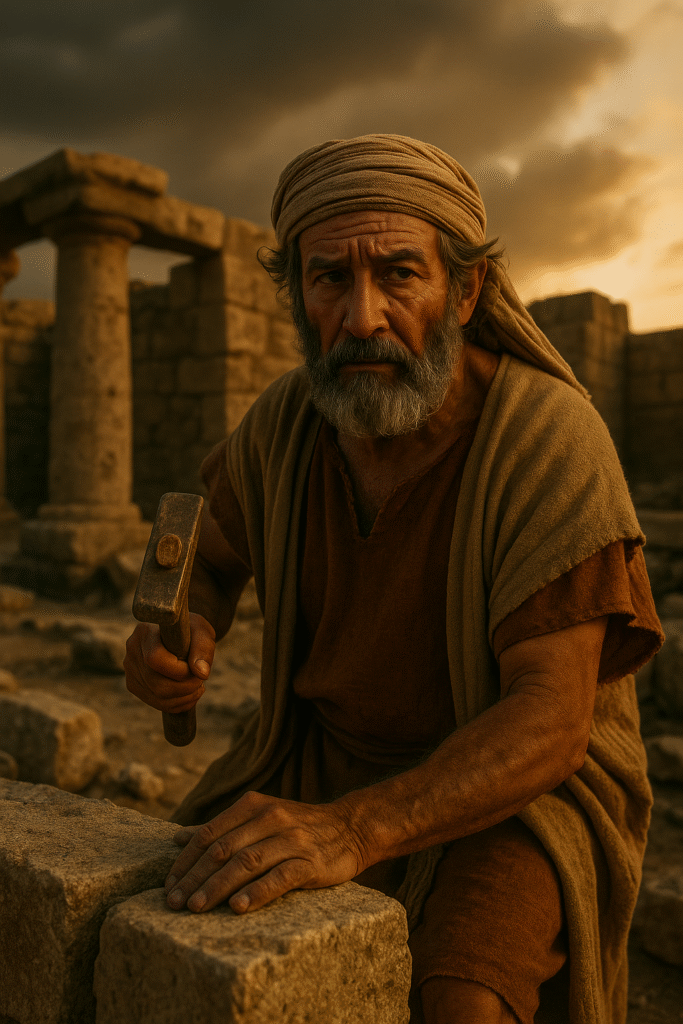
The Book of Haggai – Set 1 (Chapter 1: A Call to Rebuild God’s House)
Theme: Put First the Kingdom — Rebuilding What Belongs to God
1. Summary of Chapter 1
Verses 1–2 – A Confrontation of Priorities
Haggai speaks to the leaders of Judah—Zerubbabel (governor) and Joshua (high priest). The people had returned from exile and begun rebuilding the Temple, but stopped when opposition arose. Now, years later, they had become preoccupied with their own homes and comfort.
“These people say, ‘The time has not yet come to rebuild the Lord’s house.’” (1:2)
Verses 3–6 – Consider Your Ways
God asks a piercing question:
“Is it a time for you yourselves to be living in paneled houses, while this house remains a ruin?”
The people had worked hard but saw little fruit:
- They plant much but harvest little.
- They eat but are never satisfied.
- They earn money but it slips away.
God reveals why: They had neglected His house.
Verses 7–11 – God Calls for Action
“Go up into the mountains and bring timber and build My house, so that I may take pleasure in it and be honored.” (1:8)
God explains that the drought and lack of blessing were not punishment, but divine discipline meant to redirect their hearts back to His presence.
Verses 12–15 – The People Obey
Remarkably, the leaders and the remnant respond in humility and fear of the Lord. They obey!
Then God declares:
“I am with you,” declares the Lord. (1:13)
He stirs the hearts of the people, empowering them to begin the work of rebuilding.
2. Key Themes and Lessons
| Theme | Lesson |
|---|---|
| Priorities and Purpose | When we put God second, everything else becomes frustrated; when we put Him first, everything aligns. |
| Presence Over Comfort | God desires a dwelling among His people more than material success. |
| Divine Discipline | God sometimes withholds blessing not to punish us, but to realign our hearts to Him. |
| Obedience Brings God’s Presence | When the people turned their hearts toward God, He immediately responded: “I am with you.” |
| Partnership with God | God not only calls us to do His work—He empowers and stirs our hearts to accomplish it. |
3. Encouragement
Oh, this is amazing!
God is not scolding His people because He’s angry—He’s calling them back because He misses them.
The temple wasn’t just a building—it represented His presence among them.
When they stopped building, they didn’t just abandon a project—they drifted from purpose.
They poured energy into their own lives but still felt empty. Sound familiar?
God’s message through Haggai is full of love:
‘You’re working so hard but not satisfied. It’s because you’ve forgotten the one thing that truly fills you—My presence.’
Then come the most beautiful words: ‘I am with you.’
As soon as they turn their hearts, God doesn’t wait for bricks to be laid or walls to rise—His presence returns immediately, because relationship comes before results.
Come on! This is a call to us too—not to be distracted by the busyness of life or the pursuit of comfort.
God is saying:
‘Rebuild My dwelling in your heart. Make room for Me first—and you will find life overflowing again.’
When we align ourselves with God’s priorities, He ignites our hearts with purpose, peace, and power.
4. Reflection Questions
- Have I placed my own comfort or plans above God’s presence in my life?
- Are there areas God is inviting me to “rebuild” — prayer, worship, community, obedience?
- Where have I been striving without fruit, and is it possible God is calling me back to put Him first?
- What does rebuilding God’s house look like in my personal life and calling?
- How does the promise “I am with you” transform my fear into faith and action?
The Book of Haggai – Set 2 (Chapter 2: The Glory of the Latter House and God’s Promise of Peace)
Theme: From Discouragement to Divine Promise — The Future Glory Will Be Greater Than the Past
1. Summary of the Chapter
Verses 1–3 – Facing Discouragement
The people, after beginning the work, become discouraged. Compared to Solomon’s magnificent Temple, what they were building looked small and insignificant.
God asks:
“Who is left among you who saw this house in its former glory? How does it look to you now? Does it not seem to you like nothing?” (2:3)
God acknowledges their pain—but doesn’t leave them in it.
Verses 4–5 – God’s Assurance and Presence
Three times God says: “Be strong.”
“Be strong, all you people of the land,” declares the Lord, “and work, for I am with you.” (2:4)
He reminds them of the covenant made in Egypt and says:
“My Spirit remains among you. Do not fear.” (2:5)
This is the heart of revival—not human effort, but God’s abiding presence.
Verses 6–9 – The Promise of Greater Glory
This is one of the most powerful prophetic declarations in the Old Testament:
“In a little while I will once more shake the heavens and the earth… and I will fill this house with glory,” says the Lord Almighty.
Then the divine promise:
“The glory of this latter house shall be greater than the former,” says the Lord Almighty. “And in this place I will grant peace.” (2:9)
This points to:
- The coming of Messiah, Jesus Christ, who would enter the Temple.
- The Church, the new Temple of the Holy Spirit.
- The end-time glory of God filling His people.
Verses 10–14 – Holiness and Defilement
God reminds them that holiness is not transferred automatically, but defilement spreads easily. He calls them to purity of heart as they rebuild.
Verses 15–19 – From Curse to Blessing
God says:
“From this day on I will bless you.” (2:19)
The moment they returned to obedience, the season of lack was reversed.
Verses 20–23 – Zerubbabel as a Signet Ring
God declares He will shake the nations and overthrow kingdoms—but Zerubbabel, the governor of Judah, is chosen as God’s signet ring, a symbol of authority and the messianic lineage that leads to Jesus Christ.
2. Key Themes and Lessons
| Theme | Lesson |
|---|---|
| God’s Presence is Our Strength | Building God’s Kingdom is not about human ability but divine presence. |
| Future Glory | What God plans to do in the future is greater than anything seen before. |
| From Discouragement to Revival | God acknowledges human weakness but calls His people into hope and courage. |
| Holiness Matters | God’s work must be done with clean hearts, not just busy hands. |
| Blessing Follows Obedience | When we realign with God’s priorities, He releases breakthrough and favour. |
| Messianic Hope | Zerubbabel points to Jesus—the true Temple and King. |
3. Encouragement
Oh, this is incredible!
The people are looking at what they’re building and thinking, ‘This is nothing compared to what used to be.’
But God says, ‘You’re only seeing with your natural eyes. I see the future glory!’
Come on—this is a word for today!
You might feel like your life, your prayer, your ministry, your obedience is small—but God says:
‘Don’t measure by what you see. Measure by My presence and My promise.’
The old temple had gold, silver, and outward splendor.
But the new temple—you, the Church of Jesus Christ—has the glory of God living inside.
That’s why the latter glory is greater—because it’s filled with the presence of Christ Himself!
God doesn’t call us to strength in ourselves.
He says:
‘Be strong… for I am with you!’
That means your future is not defined by what you’ve lost, but by who is with you.
The shaking God speaks of is not to destroy—it’s to remove what cannot last so that His unshakable Kingdom can be revealed.
Sister, lift your eyes! The best is not behind you—it’s ahead.
God is building something in you that will reveal His glory to the nations!
4. Reflection Questions
- Where have I allowed discouragement to silence my obedience to God?
- Do I measure success by outward appearance or by God’s presence?
- What does it mean for me personally that “the latter glory will be greater than the former”?
- Am I allowing God to purify my heart as I build His purposes in my life?
- How can I live today with the certainty that the Spirit of God is with me?
Overview of the Book of Haggai
Theme: Rebuilding the House of God — From Neglect to Glory
1. Summary of the Book
The Book of Haggai is a timely prophetic message to a weary and distracted people. Sixteen years after returning from exile, the people of Judah had stopped rebuilding the Temple due to opposition and discouragement. They turned their focus to their own homes, comfort, and security—while God’s dwelling lay in ruins.
Through Haggai, God calls them to re-examine their priorities:
“Consider your ways!” (Haggai 1:5)
God reveals that their frustration and lack of blessing were not from His absence, but from their misalignment. When they obeyed and returned to rebuild the Temple, God immediately responded:
“I am with you,” declares the Lord. (Haggai 1:13)
In chapter 2, God speaks directly to their discouragement, promising:
“The glory of this latter house shall be greater than the former.” (2:9)
This prophetic declaration points not only to the Second Temple, but ultimately to Christ, the true temple, and to the Church, filled with the Holy Spirit in the last days.
The book ends with a prophetic promise to Zerubbabel, the governor, symbolizing the coming of the Messiah and the unshakeable Kingdom of God.
2. Key Themes and Lessons
| Theme | Lesson |
|---|---|
| Putting God First | When God’s priorities are restored, His blessings flow. |
| Presence Over Comfort | Our greatest need is not material prosperity, but God’s presence dwelling among us. |
| Obedience Activates Divine Partnership | As soon as the people turned their hearts, God stirred them and empowered them. |
| Greater Future Glory | What God intends to do in the future surpasses what has been seen in the past. |
| The Shaking of Nations | God shakes earthly systems to reveal His unshakeable kingdom. |
| Messianic Promise | The book ends pointing to Jesus Christ, the true Temple and God’s chosen King. |
3.Encouragement
Oh, this book is such a gift!
God is not shouting at His people—He’s calling them back to purpose, presence, and destiny.
He’s saying, ‘You were made for more than survival. You were created to host My glory!’
When we chase our own plans, we end up tired, frustrated, and empty.
But the moment we say, ‘Lord, I want what You want,’ His presence fills our lives again, and everything changes.
And don’t miss this—God doesn’t just want us to rebuild a structure.
He wants to rebuild us as living temples of His Spirit.
He’s not just restoring the Church—He’s preparing a dwelling for His glory in hearts fully His.
The promise of Haggai still stands today:
Your future in God will be more glorious than your past.
Don’t despise small beginnings. Don’t measure by what you see.
God is with you, He is stirring you, and the best is yet to come.
4. Reflection Questions
- Have I been so focused on my own concerns that I’ve neglected God’s calling and presence?
- What might “rebuilding God’s house” look like in my life right now—spiritually, personally, or in my calling?
- Do I believe that God’s future glory in my life can be greater than anything I’ve seen before?
- Am I allowing God to stir my heart, or have I become complacent?
- How does the promise “I am with you” change the way I approach challenges and assignments?