
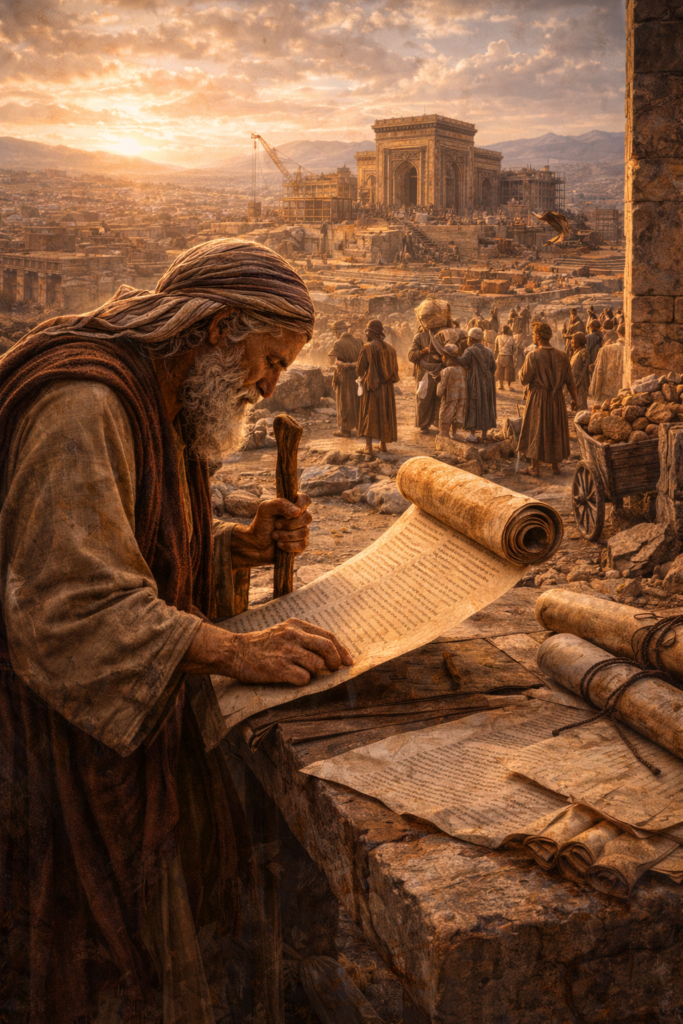
Ezra — Restoration, Return, and Rebuilding What Matters
Introduction
Welcome to the Ezra Study Hub — a journey of restoration, rebuilding, and returning to what truly matters.
Ezra takes place after exile.
The people of Israel have been scattered, displaced, and removed from their land.
What was once established has been broken.
The temple destroyed. The city left in ruins. Identity shaken.
But this is not the end of their story
Ezra reveals: God restores what has been lost.
This book follows the return of God’s people to Jerusalem and the rebuilding of the temple.
It is not just about construction. It is about restoration.
Ezra is written to:
- Reveal God’s faithfulness to restore
- Call His people back into alignment
- Re-establish worship at the centre
- Show the importance of obedience
- Restore identity through God’s Word
This book is not about returning to the past. It is about rebuilding from truth.
It reveals that restoration is not automatic — it is intentional.
The people return physically. But they must also return spiritually.
Ezra reminds us: God does not abandon what has been broken.
He restores. He rebuilds. He calls His people back into alignment with Him.
And what is rebuilt with Him at the centre… is established again. 💛
Ezra 1 — When Restoration Begins with a Stirring
Summary
“In the first year of Cyrus king of Persia…” A new season begins.
“…in order to fulfil the word of the Lord spoken by Jeremiah…”
This is not random. This is fulfilment. God is moving according to what He has already spoken.
“The Lord moved the heart of Cyrus king of Persia…” God initiates. Even through unexpected people.
A king. A foreign ruler. Yet: God stirs him.
Then a proclamation: “The Lord, the God of heaven… has appointed me to build a temple for Him…”
Recognition. Assignment. “…at Jerusalem in Judah.” Specific. Clear.
Then the invitation: “Any of His people among you may go up to Jerusalem…” Open. Available.
“And may their God be with them.” Blessing declared.
“And in any locality where survivors may now be living…” Provision extends.
“The people are to provide them with silver and gold…” Support.
“...with goods and livestock…” Resource.
“…and with freewill offerings…” Willing participation.
“For the temple of God in Jerusalem.” The focus is clear: Rebuild what honours God.
Then: “The family heads of Judah and Benjamin…” Response begins.
“And the priests and Levites…” Those set apart.
“Everyone whose heart God had moved…” This is key. Not obligation. Not pressure. Stirring. Internal response.
“They prepared to go up and build the house of the Lord…” Action follows stirring.
Then: “All their neighbours assisted them…” Support increases.
“With articles of silver and gold…” Provision flows.
“With goods and livestock…” Everything needed.
“And with valuable gifts…” Generosity.
“In addition to all the freewill offerings.”
Then: “Moreover, King Cyrus brought out the articles belonging to the temple…” Restoration of what was taken.
“These Nebuchadnezzar had carried away…” What was lost is returned.
“And placed in the temple of his god.” Now reversed.
“Cyrus king of Persia had them brought…” Intentional. “…and counted out…” Careful.
“To Sheshbazzar, the prince of Judah.” Leadership entrusted.
Then a list:
- Gold dishes.
- Silver dishes.
- Bowls.
- Pans.
- Other articles.
“All in all…” Everything accounted for. “In total, there were 5,400 articles…” Nothing missing.
“Sheshbazzar brought all these along…” Return begins.
“When the exiles came up from Babylon to Jerusalem.” Movement. From exile — to restoration.
Chapter 1 establishes:
- God initiates restoration.
- He fulfils what He has spoken.
- He can move hearts — even unexpected ones.
- Restoration begins with a stirring within.
- Participation is willing, not forced.
- Provision accompanies God’s purpose.
- What was lost can be restored.
- Return is both physical and spiritual.
- Rebuilding begins with obedience.
Key Identity Realities
| Truth | Identity Proclamation |
|---|---|
| God Moves First | I respond to what God initiates in my life. |
| My Heart Can Be Stirred by God | I remain open and responsive to Him. |
| I Am Invited into Restoration | I am part of what God is rebuilding. |
| Provision Follows Purpose | God supplies what is needed for what He calls me to. |
| I Respond Willingly | I choose participation, not obligation. |
| What Was Lost Can Be Restored | God brings back what has been taken or broken. |
| I Am Positioned for Purpose | My life is aligned with what God is doing. |
| I Move When God Leads | I act when He stirs my heart. |
Encouragement
Sister, Ezra 1 begins with something powerful: “The Lord moved…”
Restoration does not begin with you. It begins with Him.
And this is freeing:
You are not trying to rebuild your life. You are responding to the One who is already restoring it.
And notice this: God can move anyone. Even a king. Even someone outside of what you would expect.
This means: Nothing is outside His reach. Nothing is beyond His ability to align.
And then this beautiful truth: “Everyone whose heart God had moved…”
This is how restoration works. Not pressure. Not striving. Stirring. Gentle. Clear. Internal.
And your role is simple: Respond.
And then this promise: Provision follows purpose. Everything needed was given. Resources. Support.
Restoration of what was lost.
And this means: You do not need to fear lack. Where God leads — He provides.
And then this: What was taken… was returned. This is the heart of God.
He restores. He rebuilds. He brings back what seemed gone.
And you are invited into that process. Not as someone striving — But as someone responding.
And this is where it begins: With a stirring. And your willingness to say: “Yes.”
Reflection Questions
- Have I noticed any areas where God may be stirring my heart recently?
- Am I open to responding when God initiates something in my life?
- Do I trust that God will provide what is needed for what He calls me to?
- Is there anything I have assumed is lost that God may want to restore?
- What would it look like for me to respond willingly to God today?
Ezra 2 — When Restoration Includes Every Name
Summary
“Now these are the people of the province who came up from the captivity…” Return continues.
“They returned to Jerusalem and Judah…” Back to their towns. Restoration is not vague. It is specific.
Names. Families. Places. Then the list begins.
Families listed. Numbers recorded. Groups identified.
“The descendants of Parosh… 2,172”
“The descendants of Shephatiah…”
“The descendants of Arah…”
One by one. Each counted. Each seen.
This is not just a crowd. This is individuals. Belonging matters.
Then: “The priests…” Spiritual leadership restored.
“The Levites…” Service re-established.
“The musicians…” Worship included.
“The gatekeepers…” Structure restored.
“The temple servants…” Every role matters.
Then: “The descendants of the servants of Solomon…” Generations remembered.
Then: “These searched for their family records…” Identity verified.
“But they could not find them…” Uncertainty.
“They were excluded from the priesthood…” Not rejection — clarity. Alignment required.
“The governor ordered them not to eat any of the most sacred food…” Boundaries.
“Until there was a priest ministering with the Urim and Thummim.” Waiting for clarity.
Then the total: “The whole company numbered 42,360…” Significant. Not small. Not insignificant.
Then additional: “Besides their male and female servants…” Expansion.
“They also had 200 male and female singers…” Worship continues.
“They had 736 horses…” Provision. “245 mules…” Resources. “435 camels…” Movement.
“6,720 donkeys…” Support. Everything needed for the journey.
Then: “Some of the heads of the families gave freewill offerings…” Willing giving.
“For the rebuilding of the house of God…” Purpose remains central.
“They gave according to their ability…” Not comparison. Not pressure. Contribution.
“Into the treasury…” Collected.
Then: “The priests, the Levites, the musicians…” Each group positioned.
“The gatekeepers, the temple servants…” Function restored.
“And all the other Israelites settled in their own towns.” Belonging. Stability. Re-establishment.
Chapter 2 establishes:
- Restoration includes individuals, not just groups.
- God values identity, names, and belonging.
- Every role has significance in rebuilding.
- Alignment matters in positioning and responsibility.
- Uncertainty requires patience, not assumption.
- Contribution is willing and according to capacity.
- Provision accompanies return.
- Restoration re-establishes structure and function.
- Belonging is part of God’s restoration plan.
Key Identity Realities
| Truth | Identity Proclamation |
|---|---|
| I Am Known by Name | I am not overlooked in God’s restoration. |
| I Belong | I have a place in what God is rebuilding. |
| My Role Matters | What I carry contributes to God’s purpose. |
| I Am Positioned with Purpose | I am placed where I am meant to be. |
| I Honour Alignment | I allow God to establish my role clearly. |
| I Contribute Willingly | I give according to what I have. |
| I Am Part of Restoration | I am included in what God is doing. |
| God Sees Me Individually | I am not lost in the crowd. |
Encouragement
Sister, Ezra 2 may look like a list — but it is something much deeper.
It is recognition. Every name recorded… is a life remembered. A person seen. A place restored.
And this reveals something beautiful: God does not restore in general. He restores personally.
You are not just part of something. You are known within it.
And this means: You are not overlooked. You are not forgotten. You are not just one of many. You are seen.
And then this truth: Every role mattered. Priests. Levites. Musicians. Gatekeepers. Servants.
No role was insignificant.
And this speaks to you: What you carry matters.
Even if it feels small. Even if it is unseen by others. God sees it. And it is part of what He is building.
And then something important: Some could not verify their identity. And they had to wait.
This was not rejection. It was alignment.
And this is freeing: You do not need to force your place. God establishes it.
And where there is uncertainty — You can wait with trust.
And then: “They gave according to their ability…” This is how restoration works.
Not comparison. Not pressure. Participation.
And this is your invitation: To take your place. To recognise your belonging. To contribute what you carry.
Because restoration is not just happening around you — You are part of it.
Reflection Questions
- Do I truly see myself as known and included in what God is doing?
- What role or contribution might God be inviting me into?
- Am I comparing myself to others, or giving according to what I have?
- Is there any area where I need to wait for clarity rather than force direction?
- What does belonging in God’s restoration look like for me personally?
Ezra 3 — When Worship Comes Before Structure
Summary
“When the seventh month came…” Timing. Significant.
“The Israelites had settled in their towns…” Stability begins.
“…the people assembled together as one in Jerusalem.” Unity. Intentional gathering.
Then: “Jeshua… and his fellow priests…” Leadership steps forward.
“Zerubbabel… and his associates…” Partnership.
“They began to build the altar of the God of Israel…” First action.
Not walls. Not buildings. The altar. Worship restored first.
“To sacrifice burnt offerings on it…” Returning to alignment.
“In accordance with what is written in the Law of Moses…” Not reinventing. Returning to truth.
Then: “Despite their fear of the peoples around them…” Fear present.
“But they built the altar…” Response continues anyway.
“And sacrificed burnt offerings…” Morning and evening. Consistency.
Then: “They celebrated the Festival of Tabernacles…” Obedience. Rhythm restored.
“As prescribed…” Alignment.
“After that, they presented the regular burnt offerings…” Daily. Monthly. Seasonal. Order re-established.
“From the first day of the seventh month…” Beginning again.
“They began to offer burnt offerings…”
Even before: “Though the foundation of the Lord’s temple had not yet been laid.” Worship before structure.
Then: “They gave money to the masons and carpenters…” Practical steps begin.
“They gave food and drink and olive oil…” Provision flows.
“To the people of Sidon and Tyre…” Resources gathered.
“To bring cedar logs by sea…” Preparation for building.
Then: “In the second month of the second year…” Progress continues.
“Zerubbabel… Jeshua… and the rest…” Unified effort.
“They began the work…” Action.
“Appointing Levites twenty years old and older…” Structure. Responsibility.
“To supervise the building…” Order.
Then: “The Levites joined together…” Unity again. To oversee the work.
Then: “When the builders laid the foundation…” A milestone.
“Of the temple of the Lord…” Significant moment.
“The priests in their vestments…” Prepared.
“With trumpets…” Sound.
“The Levites… with cymbals…” Expression.
“Took their places to praise the Lord…” Worship integrated.
“As prescribed by David…” Continuity.
“With praise and thanksgiving they sang…” Response.
“To the Lord: ‘He is good; His love toward Israel endures forever.’” Truth declared.
Then: “All the people gave a great shout of praise…” Celebration.
“Because the foundation… was laid.” Joy.
But then: “Many of the older priests and Levites…” Perspective.
“Who had seen the former temple…” Memory.
“Wept aloud…” Grief.
“At the sight of the foundation…” Comparison. Loss felt.
“While many others shouted for joy…” Mixed response.
“…so that the sound of weeping and of joy…” Combined.
“Could not be distinguished…” Both present.
“The sound was heard far away.” Significant moment.
Chapter 3 establishes:
- Worship comes before structure.
- Unity precedes rebuilding.
- Fear does not have to stop obedience.
- Alignment with God’s Word is foundational.
- Restoration includes both spiritual and practical steps.
- Consistency in worship matters.
- Progress takes time and participation.
- Milestones can carry mixed emotions.
- Both joy and grief can exist in restoration.
Key Identity Realities
| Truth | Identity Proclamation |
|---|---|
| I Worship First | I place God at the centre before building anything else. |
| I Am Part of Unity | I move together with others in God’s purpose. |
| I Respond Despite Fear | Fear does not stop my obedience. |
| I Build from Truth | My life is aligned with God’s Word. |
| I Am Consistent | I live with steady devotion, not inconsistency. |
| I Participate in Restoration | I take part in what God is rebuilding. |
| I Honour the Process | I allow restoration to unfold step by step. |
| I Embrace the Journey | I hold both joy and reflection without losing direction. |
Encouragement
Sister, Ezra 3 reveals something foundational: Worship comes first. Before the temple. Before the structure.
Before everything else — the altar.
This means: Your life is not built from activity. It is built from relationship.
And this is freeing: You do not need everything in place… to begin. You begin with Him.
And then something powerful: “Despite their fear…” They still built. Fear was present — but it did not lead.
And this speaks to you: You do not need to eliminate fear to move forward.
You move aligned. And fear loses its influence.
And then this beautiful truth: Consistency. Morning and evening. Daily. Rhythmic. Not occasional.
Because stability is built through consistency. Not intensity.
And then this moment: The foundation is laid. And the response is mixed.
Some rejoice. Some weep. And both are valid.
Because restoration can feel like: Joy for what is being built. Grief for what once was.
And you are allowed to hold both. Without losing direction.
Because what matters is this: The foundation is laid.
And that means: Something is being rebuilt.
And you are part of it. And you do not need to rush ahead.
You stay present. Aligned. Worshipping. Building. Step by step.
Reflection Questions
- Am I placing worship at the centre of my life, or building around other things?
- Is there any fear that I have allowed to slow my response to God?
- How consistent is my connection with God day by day?
- How do I respond to seasons where joy and grief coexist?
- What foundation am I currently laying in my life?
Ezra 4 — When Opposition Tries to Stop What God Started
Summary
“When the enemies of Judah and Benjamin heard…” Opposition begins.
“They were building the temple…” Progress attracts resistance.
“…to the Lord, the God of Israel…” This is not just construction. It is spiritual.
Then: “They came to Zerubbabel…” Approach.
“Let us help you build…” Offer. Sounds supportive.
“For we, like you, seek your God…” Appears aligned.
“And have been sacrificing to Him…” Claim of connection.
But: Discernment is required. “Zerubbabel… replied…” Clarity.
“You have no part with us…” Boundary.
“In building a temple to our God…” Protection of purpose.
“We alone will build it…” Responsibility owned.
“As King Cyrus… commanded us.” Alignment with instruction.
Then: “The peoples around them set out to discourage…” Opposition shifts.
“They made them afraid…” Pressure.
“To go on building…” Intimidation.
“They bribed officials…” External interference.
“To work against them…” Resistance increases.
“…throughout the reign of Cyrus…” Not momentary. Sustained opposition.
Then: “At the beginning of the reign of Xerxes…” Time passes. Opposition continues.
“They lodged an accusation…” False claims. Against the people.
Then letters are sent. To authorities. Against Jerusalem.
“This city is rebellious…” Misrepresentation.
“…a troublemaker…” False narrative.
“If this city is rebuilt…” Fear projected.
“They will not pay taxes…” Manipulation.
“…and the royal revenues will suffer.” Self-interest.
Then: The response comes. “Now issue an order…” Authority used.
“To stop the work…” And: “This city is not to be rebuilt…” Until permitted.
Then: “As soon as the copy of the letter was read…” Immediate action.
“They went to the Jews…” Force applied.
“…and compelled them by force to stop.” Work halted.
“Thus the work on the house of God in Jerusalem came to a standstill…” Pause.
“…until the second year of the reign of Darius…” Delay. Not the end. But a stopping.
Chapter 4 establishes:
- Opposition often follows progress.
- Not all offers of help are aligned with purpose.
- Discernment is necessary in partnership.
- Boundaries protect what God has called.
- Resistance can shift from subtle to direct.
- External pressure can influence internal response.
- Delays do not cancel God’s purpose.
- Misrepresentation does not change truth.
- God’s work may pause, but it is not abandoned.
Key Identity Realities
| Truth | Identity Proclamation |
|---|---|
| I Discern What Is Aligned | I recognise what is truly from God. |
| I Set Boundaries | I protect what God has entrusted to me. |
| I Am Not Discouraged by Opposition | Resistance does not define my direction. |
| I Remain Steady | I do not withdraw when challenged. |
| God’s Purpose Stands | What He begins is not undone by pressure. |
| I Am Not Moved by Misrepresentation | Truth is not defined by others’ opinions. |
| I Trust God in Delays | A pause does not mean the end. |
| I Stay Aligned with God | My focus remains on His instruction. |
Encouragement
Sister, Ezra 4 reveals something important:
Opposition does not mean you are off track. It often means you are on track.
Because when something is being built… that matters — resistance will come.
And notice this: Opposition did not begin with force. It began with an offer. “Let us help you…”
And this is where discernment matters. Because not everything that sounds supportive… is aligned.
And you are allowed to say: “No.” Without guilt. Without hesitation.
Because protecting what God has called you to… matters.
And then: Opposition shifts. Discouragement. Fear. Pressure. Even misrepresentation.
And this is where many stop. But here is the truth: A delay is not a denial.
The work stopped — but the purpose did not.
And this is where you stand: Not needing to fight everything. Not needing to force progress.
But remaining steady. Trusting that what God has begun… He will continue.
And even when it pauses — He has not abandoned it. And neither should you.
Reflection Questions
- Am I discerning clearly what is aligned with God and what is not?
- Are there any areas where I need to establish stronger boundaries?
- How do I respond when I face discouragement or resistance?
- Have I interpreted delay as failure, or do I trust God’s timing?
- What has God started in my life that I need to remain steady in?
Ezra 5 — When God’s Word Restarts What Was Stopped
Summary
“Now Haggai the prophet and Zechariah the prophet…” A shift. God speaks again.
“To the Jews in Judah and Jerusalem…” Direction returns.
“In the name of the God of Israel…” Authority. God initiates the restart.
Then: “Zerubbabel… and Jeshua…” Leadership responds.
“They set to work to rebuild the house of God…” Action resumes.
“…and the prophets of God were with them, supporting them.” Not alone. Encouraged. Strengthened.
Then: “At that time Tattenai… and his associates…” Authority figures approach.
“Who authorised you to rebuild this temple?” Questioning. “Who gave you a decree?” Challenge.
Then: “They also asked, ‘What are the names of those who are constructing this building?’”
Accountability. Identification.
But: “The eye of their God was watching over the elders…” Key truth. God sees. God covers.
“They were not stopped…” This time: No interruption.
“…until a report could go to Darius…” Process allowed.
Then a letter is written: “To King Darius…” Formal inquiry.
“The governor… and his associates…” Detail recorded.
“…sent this report…” Communication continues.
Then they describe: “We went to the district of Judah…” Observation.
“To the temple of the great God…” Recognition.
“The people are building it with large stones…” Visible progress.
“…and placing the timbers in the walls…” Structure forming.
“The work is being carried on with diligence…” Faithfulness.
“And is making rapid progress…” Momentum.
Then: “We questioned the elders…” Inquiry.
“Who authorised you…?” Seeking legitimacy.
Then the response of the builders: “We are the servants of the God of heaven and earth…” Identity. Clear.
“We are rebuilding the temple that was built many years ago…” Restoration.
“But because our ancestors angered the God of heaven…” Acknowledgement.
“They were given into the hands of Nebuchadnezzar…” History recognised.
“…who destroyed this temple…” Past understood.
Then: “However, in the first year of Cyrus…” Turning point.
“King Cyrus issued a decree to rebuild…” Authority confirmed.
“…and he even removed the gold and silver articles…” Restoration already begun.
“…and returned them to the temple…” Evidence.
Then: “He entrusted them to a man named Sheshbazzar…” Leadership.
“And said… ‘Rebuild this house of God.’” Clear instruction.
Then: “Since then, it has been under construction…” Ongoing.
“But is not yet finished.” Process continues.
Then the request: “Now if it pleases the king…” Inquiry submitted.
“Let a search be made…” Verification requested.
“To see if King Cyrus did issue a decree…” Seeking truth.
Then: “Let the king send us his decision…” Awaiting response.
Chapter 5 establishes:
- God’s Word reactivates what has been paused.
- Encouragement strengthens obedience.
- Leadership responds to God’s voice.
- Opposition may question, but cannot stop what God sustains.
- God sees and watches over His people.
- Identity is rooted in being God’s servants.
- Restoration acknowledges both past and promise.
- Authority is confirmed through truth.
- Progress resumes when God speaks.
Key Identity Realities
| Truth | Identity Proclamation |
|---|---|
| God Speaks and I Respond | His voice reactivates my movement. |
| I Am Not Alone | God supports and strengthens me. |
| I Am Seen by God | His eye is on my life and my work. |
| I Continue Despite Questioning | I remain steady when challenged. |
| My Identity Is in God | I live as His servant, not for approval. |
| I Honour the Process | I remain faithful even when things are unfinished. |
| God Confirms What He Begins | His purposes are established in truth. |
| I Move with Confidence | I walk in what God has already spoken. |
Encouragement
Sister, Ezra 5 reveals something powerful: What was stopped… can begin again.
Not by force. Not by striving. But by God speaking.
The prophets came — and everything shifted.
And this shows you: You do not restart your life by effort. You respond to His voice. And movement returns.
And then this beautiful truth: “The eye of their God was watching over them…”
You are not unseen. Even when questioned. Even when challenged. Even when others are unsure.
God sees. And His awareness brings covering.
And this means: You do not need to defend yourself. You remain steady.
And then: The question comes — “Who authorised you?”
And their answer is simple: “We are the servants of the God of heaven and earth.” Identity.
Not explanation. Not justification.
And this is where you stand:
Not needing approval. But anchored in who you belong to. And what He has spoken.
And then this: The work was not finished. But it was progressing. And this matters.
Because you are not required to be complete — You are called to be faithful.
And as you continue — God confirms. God establishes. God completes.
And what He has started in you — will not remain unfinished.
Reflection Questions
- Is there anything in my life that God may be inviting me to restart?
- How do I respond when God speaks — do I move or hesitate?
- Do I live aware that God sees and is present in my life?
- How do I handle being questioned or challenged?
- Am I focused on being faithful in the process, even if it is not yet complete?
Ezra 6 — When God Confirms and Completes What He Began
Summary
“King Darius then issued an order…” A response. To the inquiry.
“A search was made…” Investigation.
“In the archives stored in the treasury…” Looking for truth.
Then: “A scroll was found…” Confirmation.
“In the citadel of Ecbatana…” Recorded.
And this was written: “King Cyrus issued a decree…” Not assumption. Fact.
“Concerning the temple of God in Jerusalem…” Clear instruction.
“Let the temple be rebuilt…” Authority confirmed.
“…as a place to present sacrifices…” Purpose restored.
“…and let its foundations be laid…” Stability.
Then detailed instructions: Height. Width. Materials. Nothing vague.
Then: “The costs are to be paid by the royal treasury…” Provision confirmed.
“And the gold and silver articles…” Restored again.
“Are to be returned…” Nothing withheld.
Then Darius responds: “Now then, Tattenai…” Direct instruction.
“Stay away from there…” Opposition halted.
“Do not interfere…” Clear boundary.
“Let the work on this house of God alone…” Freedom to continue.
Then more: “Pay the expenses of these men…” Provision continues.
“…so that the work will not stop.” Support increases.
“Whatever is needed…” No lack.
“Bulls, rams, male lambs…” Worship provision.
“Wheat, salt, wine, olive oil…” Daily need.
“Without fail…” Consistency.
“So that they may offer sacrifices…” Purpose remains central.
“And pray for the well-being of the king…” Influence extends.
Then: “I decree that if anyone changes this edict…” Protection.
“A beam is to be pulled from their house…” Serious.
“…and they are to be impaled on it…” Strong warning.
“May God… overthrow any king or people…” Authority acknowledged.
“Who lifts a hand…” Against this work.
Then: “I Darius have decreed it.” Final.
“Let it be carried out with diligence.”
Then: “Tattenai… carried it out with diligence.” Alignment. Obedience.
Then: “The elders of the Jews continued to build…” Progress continues.
“And prospered through the prophesying…” God’s Word still central.
“They finished building the temple…” Completion.
“According to the command of the God of Israel…” Primary authority.
“And the decrees of Cyrus, Darius and Artaxerxes…” Earthly confirmation.
“The temple was completed…” Milestone.
“In the sixth year of the reign of King Darius.” Time fulfilled.
Then: “The people… celebrated the dedication…” Joy. “With gladness.”
Then: “They offered sacrifices…” Worship restored.
“…as a sin offering…” Alignment.
“For all Israel…” Inclusion.
Then: “They installed the priests…” Order.
“And the Levites…” Structure.
“For the service of God…” Function restored.
“As it is written…” Back to truth.
Then: “On the fourteenth day of the first month…” Passover observed.
“The exiles celebrated the Passover…” Remembrance.
“The priests and Levites had purified themselves…” Preparation.
“All of them were ceremonially clean.” Alignment.
“They slaughtered the Passover lamb…” For all.
“For their fellow exiles…” Community. “For themselves…” Personal. “For the priests.”
Then: “So the Israelites who had returned…” Identity restored. “Ate it…” Participation.
“Together with all who had separated themselves…” Alignment chosen.
“From the unclean practices…” Turning.
“To seek the Lord…” Intentional.
Then: “For seven days they celebrated…” Consistency.
“The Festival of Unleavened Bread…” Rhythm restored.
“With joy…” Emotion restored.
“For the Lord had filled them with joy…” Source.
“By changing the attitude of the king of Assyria…” God moves hearts again.
“So that he assisted them…” Support.
“In the work on the house of God…” Purpose fulfilled. “The God of Israel.”
Chapter 6 establishes:
- God confirms what He has spoken.
- Authority aligns with God’s purpose.
- Opposition is removed when truth is established.
- Provision flows when God’s work is honoured.
- God’s Word sustains progress.
- What God begins, He brings to completion.
- Restoration leads to worship and joy.
- Structure and order are re-established.
- Identity is restored through alignment and remembrance.
Key Identity Realities
| Truth | Identity Proclamation |
|---|---|
| God Confirms His Word | I stand on what He has already spoken. |
| I Am Supported by God | He provides what is needed for my journey. |
| Opposition Does Not Prevail | What God establishes cannot be stopped. |
| I Am Part of Completion | I participate in what God brings to fulfilment. |
| I Live from God’s Authority | My life is aligned with His direction. |
| I Experience Joy in Restoration | I receive what God restores with gratitude. |
| I Am Positioned in Order | My life has structure and purpose. |
| I Belong in God’s Work | I am included in what He is building. |
Encouragement
Sister, Ezra 6 brings something deeply stabilising: What God begins — He completes.
The decree was found. The truth was confirmed. And everything shifted.
And this reveals something powerful: You do not need to defend what God has already established.
Truth stands.
And when it is revealed — opposition loses its authority.
And then this beautiful flow: Not only was the work allowed — it was supported.
Provision increased. Resources flowed.
And this is the heart of God: He does not call you to build — and then leave you without supply.
He provides. Fully. Consistently.
And then: The temple was finished. Completion.
But notice — completion leads to worship. Joy. Celebration.
Because restoration is not just about rebuilding structure. It is about restoring relationship.
And then this truth: “The Lord had filled them with joy…”
Joy is not something they created. It was something they received.
And this is where you stand: Not striving to complete your life.
But responding to the One who is completing it.
And as you walk with Him — what has been started… will be finished. And it will be filled with joy.
Reflection Questions
- Do I trust that God will complete what He has begun in my life?
- Am I standing on what God has spoken, or being influenced by uncertainty?
- Have I recognised the ways God has provided for me?
- How do I respond when I see progress — do I pause to celebrate and acknowledge God?
- What does it look like for me to live from joy rather than striving?
Ezra 7 — When God’s Word Leads the Way
Summary
“After these things…” A new phase.
“During the reign of Artaxerxes king of Persia…” Time has passed.
Then: “Ezra son of Seraiah…” Introduction. Lineage given. Tracing back through generations.
To: “Aaron the chief priest.” Priestly identity.
Then: “This Ezra came up from Babylon…” Movement. Return continues.
“He was a teacher well versed in the Law of Moses…” Skilled. Grounded in truth.
“Which the Lord… had given…” Source is God.
“The king had granted him everything he asked…” Favour.
“…for the hand of the Lord his God was on him.” Key truth. God’s hand.
Then: “Some of the Israelites… also came up…” Not alone. Community continues.
“In the seventh year of King Artaxerxes…” Timing.
Then: “Ezra arrived in Jerusalem…” Destination reached.
“The king had granted him everything…” Repeated. Because: “The gracious hand of his God was on him.”
Then: “For Ezra had devoted himself…” This is the foundation.
“To the study of the Law of the Lord…” Knowing. “And to doing it…” Living.
“And to teaching its decrees and laws…” Multiplying. Study. Obedience. Teaching. Threefold alignment.
Then: “This is a copy of the letter…” Authority documented. From King Artaxerxes. To Ezra.
Then the letter: “Ezra, teacher of the Law of the God of heaven…” Identity recognised.
“Now I decree…” Authority given. “Any of the Israelites… who volunteer…” Willing participation.
“May go up with you to Jerusalem…” Return continues.
“You are sent by the king…” Assignment. “To inquire about Judah and Jerusalem…” Purpose.
“With regard to the Law of your God…” Word central. “Which is in your hand.” Entrusted.
Then: “You are to take with you silver and gold…” Provision.
“Which the king and his advisers have freely given…” Generosity.
“For the God of Israel…” Purpose. “...whose dwelling is in Jerusalem.”
Then: “Anything you need…” Open provision. “For the house of your God…” Supply continues.
“Pay for it…” No restriction.
Then: “You are to use these funds…” Responsibility. “To buy bulls, rams, male lambs…” Worship provision.
“With their grain offerings and drink offerings…” Order. “And sacrifice them…” Purpose.
Then: “You and your fellow Israelites may then do whatever seems best…” Trust given.
“With the rest of the silver and gold…” Stewardship. “In accordance with the will of your God.” Alignment.
Then: “Deliver to the God of Jerusalem all the articles…” Careful. Entrusted.
Then: “Whatever else is needed…” No lack. “For the temple of your God…” Continued provision.
“You may provide it…” From royal treasury.
Then: “I… issue a decree to all the treasurers…” Extended authority.
“Whatever Ezra… may ask of you…” Support. “Must be fully paid…” Without delay.
“Up to a hundred talents of silver…” Abundance.
Then: “Whatever the God of heaven has prescribed…” Alignment again.
“Let it be done with diligence…” Urgency. “For the temple of the God of heaven…” Purpose.
“Why should there be wrath against the realm…” Awareness.
Then: “You are also to know…” Instruction continues. “You have no authority to impose taxes…” Protection.
“For priests, Levites…” Servants of God.
Then: “And you, Ezra…” Direct instruction. “In accordance with the wisdom of your God…” Source.
“Appoint magistrates and judges…” Structure. “To administer justice…” Order restored.
“To all the people…” Widespread. “All who know the laws of your God…” Foundation.
“And you are to teach any who do not know them.” Expansion.
Then: “Whoever does not obey…” Accountability. “The law of your God…” Authority.
“And the law of the king…” Alignment. “Must surely be punished…” Consequences.
Then Ezra responds: “Praise be to the Lord…” Acknowledgement. “The God of our ancestors…” Continuity.
“Who has put it into the king’s heart…” God moves hearts again.
“To bring honour to the house of the Lord…” Purpose. “In Jerusalem.”
Then: “He has extended His good favour to me…” Personal. Before the king. And his officials.
“Because the hand of the Lord my God was on me…” Repeated truth.
“I took courage…” Response. “And gathered leaders…” Action. “To go up with me.”
Chapter 7 establishes:
- God raises people for specific purpose.
- Favour follows alignment with God.
- The Word of God must be known, lived, and taught.
- God’s hand brings provision and influence.
- Authority can be aligned with God’s purpose.
- Restoration includes structure, order, and teaching.
- Courage follows awareness of God’s presence.
- Identity is rooted in calling and obedience.
- God’s Word becomes central in rebuilding.
Key Identity Realities
| Truth | Identity Proclamation |
|---|---|
| God’s Hand Is on Me | I live aware of His favour and guidance. |
| I Am Called with Purpose | My life carries intentional direction. |
| I Value God’s Word | I learn, live, and share truth. |
| I Am Supported by God | He provides what I need. |
| I Walk in Courage | I respond boldly when God leads me. |
| I Am Entrusted with Responsibility | I steward what God places in my hands. |
| I Help Establish Order | My life contributes to alignment and structure. |
| I Live from Alignment | I follow what God has revealed. |
Encouragement
Sister, Ezra 7 brings something beautifully clear: “The hand of the Lord… was on him.” This is the difference.
Not ability. Not position. Not effort. God’s hand.
And this is true for you.
You are not trying to make things happen. You are living with His hand on your life.
And from that place — everything flows.
And then this powerful pattern: Ezra devoted himself to: Study. Obedience. Teaching.
Not just knowing. Not just doing. But living fully aligned.
And this is your invitation: To let truth shape your life — not just inform it.
And then: Favour follows alignment. Doors open. Provision comes. Influence is given.
Not because of striving — but because of alignment.
And this is freeing: You do not chase favour. You walk with God — and favour follows.
And then: “I took courage…” Courage did not come first. It came after awareness.
After recognising: God is with me.
And this is where you stand: Not needing to create courage. But responding to His presence.
And as you do — you move. With clarity. With purpose. With confidence.
Because His hand is on you.
Reflection Questions
- Am I living aware that God’s hand is on my life?
- How am I engaging with God’s Word — am I studying, living, and sharing it?
- Do I recognise the ways God has shown favour and provision?
- Where is God inviting me to step forward with courage?
- What has God entrusted to me that I am called to steward?
Ezra 8 — When the Journey Requires Trust
Summary
“These are the family heads…” The return continues. Names listed again. Leaders identified.
Those willing to go. Each connected to a household. Each part of the journey.
Then: “I assembled them at the canal that flows toward Ahava…” Preparation. Pause before movement.
“We camped there three days…” Time taken. Observation.
Then: “I found no Levites there…” Something missing. Those needed for service.
Then: “I sent for Eliezer… Ariel… Shemaiah…” Action. Intentional. “Men of learning…” Understanding required.
“I told them what to say…” Clarity. “To Iddo… at Casiphia…” Seeking help.
“For ministers for the house of our God.” Purpose remains central.
Then: “Because the gracious hand of our God was on us…” Repeated truth.
“They brought us Sherebiah…” Provision. “A capable man…” What was lacking is supplied.
Then more: “Hashabiah…” “And others…” Support increases.
“All these were listed by name.” Identity matters again.
Then: “There, by the Ahava Canal, I proclaimed a fast…” Pause. Not rushing ahead.
“So that we might humble ourselves before our God…” Posture.
“And ask Him for a safe journey…” Dependence.
“For ourselves, our children and all our possessions.” Everything entrusted.
Then: “I was ashamed to ask the king for soldiers…” Not self-reliance. “To protect us…”
Because: “We had told the king…” Declaration already made.
“The gracious hand of our God is on everyone who looks to Him…” Confidence.
“But His great anger is against all who forsake Him.” Awareness.
Then: “So we fasted and petitioned our God…” Response. “And He answered our prayer.” Faithfulness.
Then: “I set apart twelve of the leading priests…” Responsibility. “And Sherebiah…” Trusted.
“I weighed out to them the offering…” Accountability. Silver. Gold. Articles. Everything counted.
Then instruction: “You as well as these articles are consecrated to the Lord…” Set apart.
“The silver and gold are a freewill offering…” Willing. “Guard them carefully…” Stewardship.
“Until you weigh them out…” Completion. “In the chambers of the house of the Lord…” Purpose.
Then: “The priests and Levites received…” Entrusted. “To bring them to Jerusalem…” Journey continues.
Then: “On the twelfth day… we set out…” Movement. “From the Ahava Canal…” Departure.
“To go to Jerusalem…” Destination.
“The hand of our God was on us…” Protection. “He protected us from enemies…” Covering.
“And bandits along the way.” Safety. Then: “So we arrived in Jerusalem…” Arrival.
“Where we rested three days.” Pause. Then: “On the fourth day…” Action resumes.
“Weighed out the silver and gold…” Accountability fulfilled. “In the house of our God…” Everything returned.
“Everything was accounted for…” Nothing missing. Integrity.
Then: “Then the exiles… sacrificed burnt offerings…” Worship.
Twelve bulls. Ninety-six rams. Seventy-seven lambs. Twelve male goats. For all Israel.
Then: “They also delivered the king’s orders…” Authority confirmed. “To the royal satraps…” Support continues.
“Who then gave assistance…” Favour extends. “To the people and the house of God.”
Chapter 8 establishes:
- God gathers people intentionally for His purpose.
- Preparation includes recognising what is needed.
- Dependence on God is chosen, not assumed.
- Fasting and humility position the heart.
- God responds to sincere seeking.
- Stewardship and accountability matter in restoration.
- God’s hand brings protection and provision.
- The journey requires trust at every step.
- What is entrusted must be carried with care.
Key Identity Realities
| Truth | Identity Proclamation |
|---|---|
| I Am Gathered with Purpose | My life is part of God’s plan. |
| I Depend on God | I trust Him for guidance and protection. |
| I Am Positioned Through Humility | I come before God with openness and trust. |
| God Responds to Me | He hears and answers when I seek Him. |
| I Am Entrusted with Responsibility | I carry what God has given me with care. |
| God’s Hand Is on Me | I am protected and guided by Him. |
| I Walk in Integrity | I steward what is given faithfully. |
| I Trust the Journey | I move forward with confidence in God. |
Encouragement
Sister, Ezra 8 shows you something deeply grounding: The journey requires trust.
Not just at the beginning. Not just at the end. But in every step.
And notice this: Ezra did not rush. He paused. He observed. He recognised what was missing.
And then he responded. This is wisdom.
You do not need to move quickly. You need to move aligned.
And then: They fasted. They humbled themselves.
Not out of fear — but out of dependence.
And this is the invitation for you: To recognise that you do not carry your life alone. God’s hand is on you.
And then this powerful truth: “I was ashamed to ask for protection…”
Because he had already declared: God would provide. And God did.
He protected. He guided. He carried them through.
And this shows you: When you trust Him — He is faithful.
And then: Everything entrusted… was carried carefully.
Accounted for. Returned fully. Integrity matters.
And this is where you stand: Not just moving forward — but stewarding what God has placed in your life.
And as you do — You will find: You are protected. You are guided. You are supported.
Because His hand is on you.
Reflection Questions
- Where in my life is God inviting me to trust Him more deeply?
- Am I taking time to pause and recognise what is needed before moving forward?
- How do I respond when I feel uncertain — do I turn to God or to control?
- What has God entrusted to me that I need to steward with care?
- How can I walk more consciously aware that God’s hand is on my life?
Ezra 9 — When Awareness Leads to Humility
Summary
“After these things had been done…” A new moment. “The leaders came to me and said…” A report is brought.
“The people of Israel… have not kept themselves separate…” Misalignment.
“They have taken some of their daughters as wives…” Compromise. “For themselves and their sons…”
Generational impact.
“And have mingled the holy race with the peoples around them…” Identity blurred.
“The leaders and officials have led the way…” Those responsible have contributed.
Then: “When I heard this…” Ezra responds. “I tore my tunic and cloak…” Grief expressed.
“Pulled hair from my head and beard…” Intensity. “And sat down appalled.” Shock. Weight.
Then: “Everyone who trembled at the words of the God of Israel…” Awareness. Those responsive gather.
“Because of this unfaithfulness…” Clarity. “They gathered around me…” Community forms around truth.
“While I sat there appalled…” Stillness.
Then: “At the evening sacrifice…” Timing. Ezra moves. “I rose from my self-abasement…” Transition.
“With my tunic and cloak torn…” Still aware. “Fell on my knees…” Posture.
“Spread out my hands to the Lord…” Open.
Then prayer: “I am too ashamed and disgraced…” Honesty.
“My God, to lift up my face to you…” Awareness of misalignment.
“Because our sins are higher than our heads…” Overwhelming.
“Our guilt has reached to the heavens…” Recognised.
“From the days of our ancestors until now…” Not new. Pattern.
“Our guilt has been great…” Acknowledged. “Because of our sins…” Ownership.
“We and our kings and our priests…” All included.
“Have been subjected to the sword and captivity…” Consequences understood.
Then: “But now, for a brief moment…” A shift. “The Lord our God has been gracious…” Grace acknowledged.
“In leaving us a remnant…” Preservation. “And giving us a firm place…” Stability.
“In His sanctuary…” Restoration.
“And so our God gives light to our eyes…” Clarity returns.
“And a little relief in our bondage…” Grace within consequence.
Then: “Though we are slaves…” Reality. “Our God has not forsaken us…” Presence remains.
“He has shown us kindness…” Favour. “In the sight of the kings of Persia…” Provision.
“He has granted us new life…” Renewal. “To rebuild the house of our God…” Purpose restored.
“Repair its ruins…” Restoration continues. “And given us a wall of protection…” Covering.
Then: “But now, our God, what can we say…” Awareness deepens. “After this?” No excuse.
“For we have forsaken the commands…” Truth faced.
“Which you gave through your servants the prophets…” Not unknown. Clearly spoken.
Then: “The land you are entering…” Reminder. “It is a land polluted…” Context.
“Because of the detestable practices…” Understanding.
“Therefore, do not give your daughters…” Instruction given. “Do not seek a treaty of friendship…” Boundary.
Then: “After all that has come upon us…” Reflection. “Because of our evil deeds…” Ownership continues.
“And our great guilt…” Clarity.
“Yet our God, you have punished us less than our sins deserved…” Grace recognised.
“And have given us a remnant…” Again. Hope remains.
Then: “Shall we again break your commands?” Conviction. “And intermarry with the peoples…” Question.
“Would you not be angry enough…” Awareness of consequence.
“Until you had destroyed us…” Understanding. “Leaving us no remnant or survivor?”
Then: “Lord, the God of Israel, you are righteous!” Declaration. “We are left this day as a remnant…” Identity.
“Here we are before you…” Position. “In our guilt…” Honesty.
“Though because of it not one of us can stand in your presence.” Humility.
Chapter 9 establishes:
- Awareness of misalignment leads to humility.
- Sin is acknowledged honestly, not hidden.
- Leadership responsibility matters.
- Grief and response are appropriate to truth.
- Community forms around awareness of God’s Word.
- God’s grace remains even in failure.
- A remnant is preserved.
- Restoration does not remove responsibility.
- Humility positions the heart for realignment.
Key Identity Realities
| Truth | Identity Proclamation |
|---|---|
| I Respond to Truth | I do not ignore what God reveals. |
| I Walk in Humility | I come before God honestly and openly. |
| I Take Responsibility | I acknowledge where I need alignment. |
| God Is Gracious to Me | His kindness remains present. |
| I Am Part of a Remnant | I am preserved within God’s purpose. |
| I Value God’s Word | I allow His truth to shape my life. |
| I Do Not Hide | I bring everything into the light. |
| I Am Being Realigned | God restores me through truth. |
Encouragement
Sister, Ezra 9 reveals something deeply important: Awareness is not the end. It is the beginning.
Because when truth is seen… alignment becomes possible.
And notice this: Ezra did not minimise. He did not excuse. He responded.
Fully. Honestly. Openly. And this is what humility looks like.
Not shame. Not withdrawal. But honesty before God. And this is where transformation begins.
And then this beautiful truth: “God has been gracious…” Even in failure. Even in misalignment. Grace remains.
And this means:
You are not coming to God from a place of rejection. You are coming to Him from a place of invitation.
And then: “A remnant remains…” You are not removed. You are preserved.
And this is where hope is found: Not in perfection — but in God’s faithfulness.
And this is your invitation: To come honestly. To allow truth to realign you.
Not to condemn you. But to restore you.
And as you do — you will find: Grace is already there. Waiting. Holding. Restoring.
Reflection Questions
- How do I respond when I become aware of something that needs to change?
- Am I willing to be fully honest before God?
- Do I recognise God’s grace even when I see areas of misalignment?
- Is there anything I have been avoiding bringing into the light?
- What would it look like for me to respond with humility and openness today?
Ezra 10 — When Alignment Becomes Action
Summary
“While Ezra was praying and confessing…” The moment continues. Weeping. Falling before the house of God.
Emotion expressed. Not hidden.
Then: “A large crowd of Israelites…” Men. Women. Children.
“They gathered around him…” Community responds.
“They too wept bitterly.” Shared awareness. Not individual. Corporate.
Then: “Then Shekaniah… said to Ezra…” A voice rises.
“We have been unfaithful…” Acknowledgement. Ownership. “To our God…” Clarity.
“By marrying foreign women…” Specific.
“But in spite of this…” Hope remains. “There is still hope for Israel.” Not final.
Then: “Now let us make a covenant…” Decision. Before God.
“To send away all these women and their children…” Action.
“In accordance with the counsel…” Aligned. “With the law…” Not emotion-driven. Truth-led.
“Rise up…” Encouragement. “This matter is in your hands…” Responsibility. “We will support you… Unity.
“So take courage…” Strength. “And do it.” Action required. Then: “So Ezra rose up…” Movement begins.
“And put the leading priests…” Leadership engaged. “Under oath…” Commitment.
“To do what had been suggested.” Agreement.
Then: “Ezra withdrew…” Personal processing. “To the room of Jehohanan…” Private space.
“While he was there…” Stillness. “He ate no food…” Fasting continues. “And drank no water…” Depth.
“Because he continued to mourn…” Grief remains present.
Then: “A proclamation was issued…” Public. “All the exiles were to assemble…” Gathering required.
“In Jerusalem…” Central place. “Within three days…” Urgency. “If anyone failed to appear…” Consequence.
“Their property would be forfeited…” Serious. “They themselves would be expelled…” Weight of decision.
Then: “All the men of Judah and Benjamin…” They gather. “Within the three days…” Response given.
“It was the ninth month…” Timing. “And all the people were sitting…” Positioned.
“In the square…” Public accountability. “Before the house of God…” Presence.
“Greatly distressed…” Emotion. “Because of the occasion…” Conviction.
“And because of the rain.” External discomfort. Internal weight.
Then: “Ezra the priest stood up and said…” Truth spoken. “You have been unfaithful…” Clarity.
“You have married foreign women…” Specific. “Adding to Israel’s guilt.” Impact.
Then: “Now honour the Lord…” Call to response. “The God of your ancestors…” Connection.
“And do His will.” Alignment.
“Separate yourselves…” Instruction. From surrounding peoples. From foreign wives.
Then: “The whole assembly responded…” Unity. “With a loud voice…” Agreement.
“You are right…” Acknowledgement.“We must do as you say.” Commitment.
Then: “But there are many people here…” Realistic. “And it is the rainy season…” Practical consideration.
“We cannot stand outside…” Limitations acknowledged. “Let our officials act…” Order.
“Then let everyone…” Process. “In their towns…” Structured response. “Come at a set time…” Wisdom.
“Until the fierce anger of our God…” Awareness. “In this matter is turned away.” Desire for restoration.
Then: “Only Jonathan… and Jahzeiah opposed this…” Not all agree. But movement continues.
Then: “So the exiles did as was proposed.” Action. “The family heads…” Leadership.
“They sat down…” Process begins. “To investigate the cases…” Careful.
“By the first day of the tenth month…” Start. “They finished dealing with all the men…” Completion.
“By the first day of the first month.” Time taken. Not rushed.
Then: “The list of those found guilty…” Recorded. Names given. Accountability. Specific. Not general.
Among them: Priests. Levites. Singers. Gatekeepers. Others. All included.
Then: “They all gave their hands in pledge…” Commitment.
“To put away their wives…” Action followed through. “And for their guilt…” Responsibility.
“They presented a ram…” Atonement. Restoration pursued.
Chapter 10 establishes:
- Conviction leads to action.
- Awareness must result in response.
- Community can move together toward alignment.
- Leadership plays a key role in guiding change.
- True repentance includes practical steps.
- Restoration requires courage and commitment.
- Processes can be structured and thoughtful.
- Accountability matters in realignment.
- God’s will is the goal, not comfort.
Key Identity Realities
| Truth | Identity Proclamation |
|---|---|
| I Respond to Conviction | I take action when truth is revealed. |
| I Choose Alignment | I align my life with God’s will. |
| I Am Part of Community | I walk with others toward truth. |
| I Act with Courage | I do what is right, even when it is difficult. |
| I Am Committed to Change | I follow through, not just feel conviction. |
| I Honour God | My life reflects obedience and alignment. |
| I Walk in Accountability | I take responsibility for my actions. |
| I Pursue Restoration | I move toward wholeness and alignment. |
Encouragement
Sister, Ezra 10 brings everything to a point: Response. Because awareness alone is not the goal.
Alignment is.
And notice this: “There is still hope…” Even after failure. Even after misalignment. Hope remains.
And this is so important: God is not looking for perfection. He is inviting response.
And the people chose it. Not easily. Not comfortably. But willingly.
And this is where transformation becomes real: When what you see… becomes what you do.
And yes — this chapter carries weight. Because realignment often does.
But underneath it is something powerful: Courage. Commitment. Movement.
And this is your invitation: Not to stay in awareness. But to step into alignment.
And you do not do it alone. The people stood together. Supported one another. Moved as one.
And this is how God restores: Not through condemnation. But through invitation.
And as you respond — you will find: Restoration begins. Not in striving. But in surrender.
Not in fear. But in trust.
You are not being pushed away. You are being drawn back into alignment.
And that is where life is found.
Reflection Questions
- Is there something God has made me aware of that I have not yet acted on?
- What might alignment look like practically in my life right now?
- Am I willing to take steps, even when they feel uncomfortable?
- Do I allow community or support in my journey of change?
- What would it look like for me to respond fully to what God is showing me?
Completion Note — Ezra
Ezra is a book of return. Not just physically — but spiritually.
It begins with movement. People leaving exile. Returning to Jerusalem. Rebuilding what was lost.
But as the journey unfolds, something becomes clear: Restoration is not only about rebuilding structures.
It is about realigning hearts.
Because the temple can be rebuilt — but if the people are not aligned, the purpose is lost.
And this is the deeper thread of Ezra:
God is not only restoring what was broken. He is restoring His people to Himself.
We see this through every stage:
- The return from exile.
- The rebuilding of the temple.
- The opposition faced.
- The persistence required.
- The rediscovery of God’s Word.
- The awareness of misalignment.
- The response of humility.
- The decision to realign.
Each step reveals something essential: Restoration is a process. It is not instant. It unfolds.
And throughout this entire journey — God’s hand is present. “The gracious hand of our God was on us…”
This phrase is repeated. Not casually. But intentionally. Because it anchors everything.
- The success.
- The provision.
- The protection.
- The restoration.
It is not achieved by human effort alone. It is carried by God’s faithfulness.
And this is important: Even when the people falter — God remains.
Even when misalignment appears — grace is still present.
Even when correction is needed — hope is not removed.
Because Ezra shows us this clearly: God’s desire is not to abandon. It is to restore.
But restoration requires response.
And this is where the book becomes personal:
Awareness is not enough. Realignment is required.
The people did not ignore what was revealed. They responded. With humility. With honesty. With action.
And this is what sets Ezra apart: It does not stop at rebuilding. It moves into transformation.
Because God is not just concerned with where we are. He is concerned with how we are aligned.
And this is the invitation for you: To recognise that restoration is available. That God’s hand is on your life.
That He is not distant from your process.
That even in areas where adjustment is needed — grace is already present.
But also: That alignment matters. That what God reveals is an invitation.
Not to condemnation — but to transformation.
And this is where you stand: Not in exile. Not in separation. But in invitation.
An invitation to return. To rebuild. To realign. To walk in what God intended.
Because the story of Ezra is not just about a people returning to a place.
It is about hearts returning to God. And that is where true restoration is found.
Overall Summary of Ezra
1. Big-Picture Summary
Ezra is the story of restoration — the return of a people from exile into purpose, identity, and worship.
It reveals not only a physical rebuilding of Jerusalem and the temple, but a deeper spiritual journey of realignment with God.
From the decree of a foreign king to the completion of the temple, Ezra shows that God is sovereign over history, moving hearts, opening doors, and guiding His people back into His purposes.
The book unfolds in layers:
- a return from exile
- a rebuilding of the altar and temple
- resistance and opposition
- persistence and completion
- the reintroduction of God’s Word
- the exposure of misalignment
- a response of humility
- a call to realignment
Through leaders like Zerubbabel and Ezra, God restores both structure and spiritual direction.
The temple is rebuilt. Worship is restored. But more importantly — hearts are awakened.
Ezra teaches that restoration is not simply about returning to what was…
It is about becoming aligned with what God has always intended.
Throughout the book, one phrase anchors the entire journey: “The gracious hand of our God was on us.”
This reveals the true source of restoration: Not human effort. But God’s faithfulness.
Ezra shows us that God initiates restoration, sustains it through opposition, and completes it as His people respond with humility and obedience.
Transformation is not found in rebuilding outwardly alone — but in aligning inwardly with God’s truth.
2. Chapter-by-Chapter Summary
| Chapter | Summary |
|---|---|
| 1 | King Cyrus issues a decree allowing the exiles to return — God stirs hearts and begins restoration. |
| 2 | The returning exiles are listed, re-establishing identity, belonging, and community. |
| 3 | The altar is rebuilt and worship resumes before the temple is completed — God is placed first. |
| 4 | Opposition arises and attempts to stop the work — resistance challenges restoration. |
| 5 | The prophets encourage the people and rebuilding resumes — truth strengthens perseverance. |
| 6 | The temple is completed and dedicated — God’s purposes are fulfilled despite opposition. |
| 7 | Ezra arrives, bringing the Law of God — spiritual alignment begins through truth. |
| 8 | The journey to Jerusalem is marked by fasting, trust, and God’s protection — dependence is chosen. |
| 9 | Ezra becomes aware of sin among the people and responds with humility and confession. |
| 10 | The people take action to realign with God — conviction leads to practical change. |
3. Major Movements in Ezra
| Movement | Chapters | Focus | Transformation Thread |
|---|---|---|---|
| 1. The Return from Exile | 1–2 | Invitation, gathering, identity restored | God calls His people back into belonging and purpose |
| 2. Rebuilding the Temple | 3–6 | Worship restored, opposition faced, completion achieved | Restoration continues through persistence and trust |
| 3. Spiritual Renewal Through the Word | 7–8 | Ezra’s leadership, teaching, and dependence on God | Truth realigns hearts and restores direction |
| 4. Conviction and Realignment | 9–10 | Awareness of sin, humility, and decisive action | Transformation occurs through honest response and alignment |
4. Key Themes and Lessons
| Theme | Transformation Lesson |
|---|---|
| Restoration | God restores what was broken and brings His people back into purpose. |
| God’s Sovereignty | God moves through kings, leaders, and circumstances to fulfil His will. |
| Worship First | True restoration begins with placing God at the centre. |
| Opposition | Resistance does not stop God’s plan — perseverance is required. |
| The Power of God’s Word | Truth reveals, corrects, and realigns the heart. |
| Humility and Repentance | Awareness of misalignment leads to transformation, not condemnation. |
| Obedience and Action | Realignment requires practical steps, not just awareness. |
| God’s Faithfulness | God’s hand sustains, protects, and completes the journey of restoration. |
5. Encouragement
Sister, Ezra is your reminder that restoration is not only possible — it is God’s desire.
No matter what has been lost, delayed, or broken, God still calls you into return.
And not just to rebuild what was…
But to step into alignment with what He intended from the beginning.
You are not defined by seasons of exile. You are defined by God’s invitation to come back.
To rebuild. To realign.
And through every stage of the journey, this truth remains: “The gracious hand of our God is on us.”
That means:
- You are not doing this alone.
- God is the One who initiates.
- God is the One who sustains.
- God is the One who completes.
And when areas of your life are brought into the light — this is not rejection. It is invitation.
Invitation into deeper alignment. Deeper freedom. Deeper restoration.
You are not being pushed away. You are being drawn closer.
Ezra shows you that transformation is not about striving harder… It is about responding honestly.
Walking humbly. And allowing God to restore both your life and your heart.
You are in a season of rebuilding. And God is faithful to complete what He has begun in you.
6. Reflection Questions
- Where is God inviting me into restoration in this season?
- Am I allowing Him to rebuild both outward areas of my life and inward alignment?
- How do I respond when I face resistance or delay?
- What role does God’s Word play in shaping and realigning my heart?
- Is there anything God is gently bringing to my awareness that requires response and alignment?