
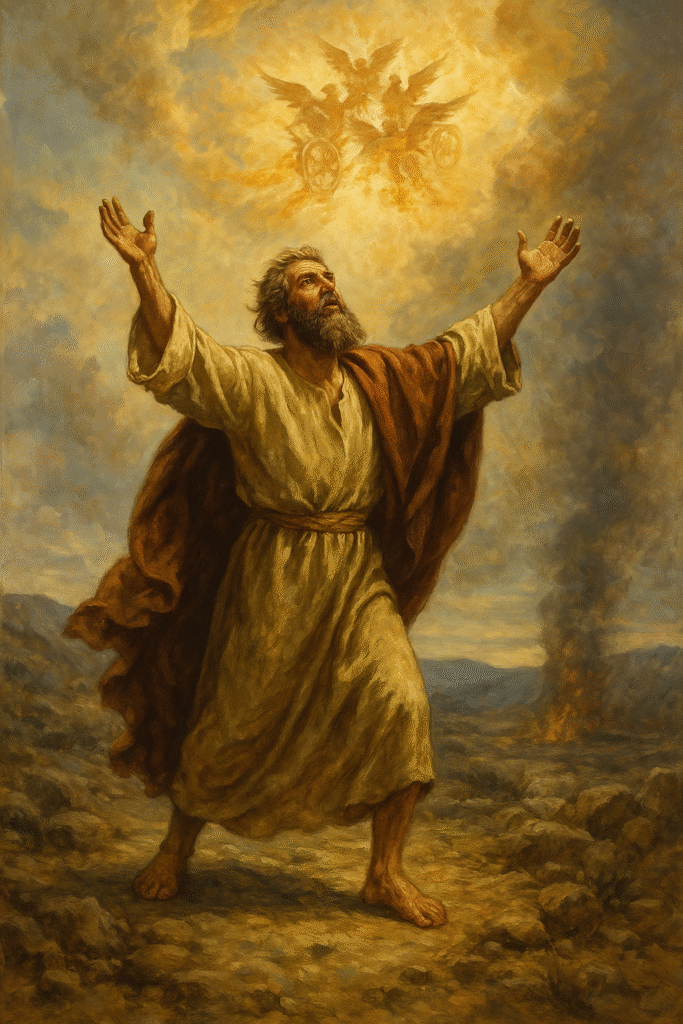
Book of Ezekiel – Set 1 (Chapters 1–4)
Theme: The Glory of God Revealed — A Prophet Called from Exile
1. Summary of the Chapters
Chapter 1 – The Vision of God’s Glory
Ezekiel, a priest in exile by the Kebar River in Babylon, receives an overwhelming vision of the glory of God.
He sees living creatures with four faces, wheels covered in eyes, fire flashing forth — and above it all, a throne with the likeness of a man surrounded by radiant glory.
“This was the appearance of the likeness of the glory of the Lord. When I saw it, I fell facedown.” (1:28)
This vision reveals that God is not confined to Jerusalem—He is enthroned even in exile.
Chapter 2 – Ezekiel’s Commission
God calls Ezekiel to be a prophet to a rebellious nation.
“Whether they listen or fail to listen, for they are a rebellious people, they will know that a prophet has been among them.” (2:5)
Ezekiel is commanded not to fear man, but to faithfully deliver God’s words.
Chapter 3 – The Scroll of Lament and Hope
God gives Ezekiel a scroll to eat — it is full of lament, mourning, and woe, yet it tastes as sweet as honey.
This symbolic act shows that God’s Word brings both sorrow and sweetness — judgment and life.
Ezekiel is appointed as a watchman: if he warns the people, he is faithful; if he remains silent, he is accountable.
Chapter 4 – Symbolic Acts of Prophecy
Ezekiel is instructed to perform prophetic signs:
- Lie on his left side for 390 days to represent Israel’s sins.
- Lie on his right side for 40 days to represent Judah.
- Eat measured bread baked over dung to illustrate coming famine.
These actions communicate that sin has real consequences, yet God is still speaking through signs to awaken repentance.
2. Key Themes and Lessons
| Theme | Lesson |
|---|---|
| God’s Glory Is Everywhere | Even in exile, God’s presence is powerful and sovereign. |
| Calling in Difficult Times | God calls His servants not into comfort, but into obedience and truth. |
| Sweetness of God’s Word | True prophetic message may be hard, but it brings life and intimacy with God. |
| Symbolic Warning | God often speaks through signs when words are ignored, showing both warning and mercy. |
| Responsibility of the Watchman | Hearing truth brings accountability; silence in the face of sin is not neutrality, but guilt. |
3. Encouragement
Oh, come on — this is powerful!
Ezekiel isn’t in a temple; he’s in exile — and guess what? That’s exactly where God shows up!
Because His glory doesn’t depend on your situation — it defines it.
God shows him that even though the people are scattered, He is still enthroned.
Your location doesn’t determine God’s presence — your heart does.
Then God says, ‘Eat the scroll.’ It’s full of lament — yet it tastes like honey! Why?
Because even correction is sweet when it comes from a loving Father.
Truth might confront you, but it also transforms you.
Ezekiel is called a watchman. That’s identity.
A watchman cares enough to warn. God isn’t looking for popular voices — He’s looking for faithful ones.
And even the symbolic actions — lying on his side, eating rationed food — they show us this:
sin leads to captivity, but God never stops speaking redemption.
Sister, you may feel like you’re in a foreign land — spiritually, emotionally, or circumstantially —
but lift your eyes: His glory is right there with you.
Your calling isn’t delayed by your exile — it’s being defined by it.
4. Reflection Questions
- How does the vision of God’s glory encourage me in my own difficult seasons?
- Do I receive God’s Word—even the challenging parts—as sweet because of who it comes from?
- Where might God be calling me to stand as a “watchman” for truth?
- Have I been silent where God has asked me to speak?
- How can I respond with obedience even when God’s calling is uncomfortable?
Book of Ezekiel – Set 2 (Chapters 5–7)
Theme: The End Has Come — Judgment for Rebellion, a Call to Recognise God’s Holiness
1. Summary of the Chapters
Chapter 5 – A Sign of Divine Judgment
“This is Jerusalem, which I have set in the centre of the nations.” (5:5)
God instructs Ezekiel to shave his head and beard — a sign of mourning and humiliation. He is told to divide the hair into three parts:
- One third burned in the fire (symbolising famine and plague).
- One third struck with the sword (symbolising war and invasion).
- One third scattered to the wind (symbolising exile).
A few hairs are tucked into Ezekiel’s garment — representing a remnant that God will preserve. This shows that judgment is not annihilation, but purification.
“Then My anger will cease and My wrath against them will subside, and I will be avenged.” (5:13)
Judgment is not an uncontrolled rage — it is God acting in righteousness to defend His covenant.
Chapter 6 – Judgment Against Idolatry
“I will destroy your high places.” (6:3)
The Lord speaks against Israel’s idolatry on the hills and mountains. Altars, shrines, and pagan idols will be smashed. Those who worshipped lifeless gods will fall before them lifeless.
Yet in wrath, God remembers mercy:
“But I will spare some… and they will loathe themselves for the evil they have done.” (6:8–9)
Even in exile, God will use repentance to restore hearts to Him.
Chapter 7 – The End Comes
“The end! The end has come upon the four corners of the land!” (7:2)
This chapter is a divine announcement that judgment is no longer avoidable. God declares that the day of reckoning is here — not for punishment only, but for revelation:
“Then they will know that I am the Lord.” (7:4)
Doom is described in escalating intensity:
- Disaster upon disaster
- Terror, not peace
- No rescue through silver or gold
Their idols, wealth, and pride will not save them. Only the Lord remains.
2. Key Themes and Lessons
| Theme | Lesson |
|---|---|
| Holiness of God | God’s judgment flows from His holiness — He cannot coexist with sin. |
| Inevitable Consequences of Sin | Sin is not merely wrong — it is destructive, and leads to ruin. |
| False Security Exposed | Wealth, idols, and self-reliance cannot save in the day of truth. |
| God’s Justice and Mercy | Even in wrath, He preserves a remnant who will return to Him. |
| Purpose of Judgment | The goal is not destruction, but revelation — that all may know the Lord. |
3. Encouragement
Oh, this is intense — but it’s also deeply loving!
God isn’t losing His temper.
He’s defending His covenant, fighting for hearts that have given themselves to dead idols.
Why does He judge?
Because anything that steals your worship is stealing your life.
He’s not punishing people to hurt them — He’s removing everything that keeps them from Him.
Ezekiel cuts his hair — it’s humiliating, but it’s prophetic.
God is saying, ‘You shaved Me out of your life… now you’re reaping what you’ve sown.’
But then He takes a few strands and tucks them into his robe — that’s the heart of God!
Even in discipline, He’s preserving a remnant for Himself.
And chapter 7 — ‘The end has come!’
Not because God is done with them — but because God is ending the rule of idols over their lives.
Come on — He loves us too much to let us keep calling destruction “freedom.”
So sister, if God is confronting idols in your life, don’t resist — rejoice!
It means He hasn’t given up on you. It means He’s clearing the way for you to know Him more fully.
Judgment is not God pushing people away.
It’s God clearing away everything that pushes people away from Him.
4. Reflection Questions
- What “idols” (sources of security or identity apart from God) might God be exposing in my own life?
- How do I respond when God confronts areas that need correction — resistance or repentance?
- What does it mean that judgment’s purpose is “that they may know I am the Lord”?
- How can I see discipline as an expression of God’s love rather than anger?
- Where have I seen God mercifully preserve a remnant (a seed of hope) in my own story of struggle or setback?
Book of Ezekiel – Set 3 (Chapters 8–11)
Theme: The Departing Glory — Idolatry Exposed and the Promise of a New Heart
1. Summary of the Chapters
Chapter 8 – The Abominations in the Temple
Ezekiel is taken by the Spirit in a vision to Jerusalem’s temple. There, he sees layer upon layer of hidden idolatry:
- Priests secretly worshipping carved images.
- Women weeping for Tammuz (a pagan fertility god).
- Men bowing to the sun inside the temple courts.
Each scene exposes deeper rebellion — the people were still in the temple physically, but their hearts had left God long ago.
“Have you seen, son of man, the utterly detestable things the Israelites are doing here?” (8:6)
This vision reveals that judgment is not coming because God abandoned His people — but because His people abandoned Him first.
Chapter 9 – The Mark of the Righteous
God commands an angelic figure to go through the city and mark those who grieve over its sins. Then judgment falls on all who have aligned themselves with wickedness.
This reveals two things:
- God always knows those who are His — those whose hearts are tender toward His righteousness.
- Judgment begins in the house of the Lord—the religious, not the pagan, are judged first.
Chapter 10 – The Glory of God Begins to Depart
Ezekiel sees the Shekinah glory — the visible presence of God — lift from the inner sanctuary to the threshold of the temple.
The same glory that once filled the temple with fire and cloud (in Solomon’s day) is now leaving because of sin.
“The glory of the Lord departed from over the threshold of the temple.” (10:18)
This is one of the most tragic moments in Scripture — God is not leaving because He is powerless, but because He will not dwell among rebellion.
Chapter 11 – A Promise in the Midst of Departure
God shows Ezekiel that leaders are deceiving the people with false security. Judgment will fall on Jerusalem — but not as the end of Israel’s story.
In the same chapter where God’s glory departs, He makes a breathtaking promise:
“I will gather you from the nations… I will give them an undivided heart and put a new spirit in them; I will remove their heart of stone and give them a heart of flesh.” (11:17,19)
Even as His presence leaves the temple, His mercy is already preparing a return — through transformation from the inside out.
2. Key Themes and Lessons
| Theme | Lesson |
|---|---|
| God Sees the Hidden Heart | Outward religion cannot hide inner idolatry; worship is a matter of the heart. |
| Judgment Begins with God’s People | Those closest to truth are held most accountable. |
| The Glory Can Depart | It is possible to have the structure of worship without the presence of God. |
| The Remnant is Marked | God protects those who grieve over sin and desire righteousness. |
| Hope in Exile | Even as judgment falls, God promises restoration by giving His people new hearts and a new spirit. |
3. Encouragement
Oh, this is massive!
God isn’t showing Ezekiel a pagan temple — He’s showing him His own house. Why?
Because idolatry doesn’t start out there in the world — it starts in the heart of God’s people.
He shows Ezekiel the secret chambers — the hidden allegiances, the divided hearts — and then He asks, ‘Do you see?’
He’s not trying to shame them — He’s trying to awaken them!
And then, when judgment begins, who’s marked?
Not the perfect.
Not the elite.
But those who weep over sin — those who care about what God cares about.
Come on, that means tenderness matters more than titles.
God’s eye is on those whose hearts are aligned with His.
Then the unthinkable happens — the glory departs. Why?
Because God will never force Himself on people who prefer idols to Him.
But don’t miss this — in the same breath that His presence departs, His promise appears!
‘I will give them a new heart!’
That’s Jesus! That’s the Holy Spirit! That’s the New Covenant!
God isn’t just going to fix their city — He’s going to fix their nature.
Sister, God doesn’t just want your behaviour modified — He wants your heart transformed.
He doesn’t want you living by rules — He wants you living by union.
Yes, glory can depart. But glory also comes again… into people who have been made new from the inside out.
4. Reflection Questions
- Are there any “hidden rooms” in my heart where I’ve allowed compromise or distraction from God?
- Do I grieve over what grieves God, or have I grown numb to unrighteousness?
- What does it mean for God’s glory to depart — and how can I stay aligned with His presence above all else?
- How does the promise of a “new heart and new spirit” change my understanding of salvation?
- Am I living from a transformed heart — or trying to follow God through external effort alone?
Book of Ezekiel – Set 4 (Chapters 12–15)
Theme: Living Parables and the Futility of False Hope — A Call to Authentic Repentance
1. Summary of the Chapters
Chapter 12 – Ezekiel Acts Out the Coming Exile
God commands Ezekiel to pack his belongings and dig through a wall in front of the people, symbolising King Zedekiah’s impending escape attempt and ultimate capture.
“I am a sign to you.” (12:11)
The people had heard warnings but didn’t believe them. God exposes their false belief:
“The days are prolonged, and every vision fails.” (12:22)
God responds firmly:
“None of My words will be delayed any longer.” (12:28)
Chapter 13 – False Prophets Exposed
God rebukes spiritual leaders who proclaim peace when destruction is imminent. They are compared to people whitewashing a weak wall—which looks stable but collapses in the storm.
“Because they lead My people astray, saying, ‘Peace,’ when there is no peace.” (13:10)
False prophecy comforts without transforming—offering reassurance without repentance.
Chapter 14 – Idols in the Heart
Some elders come to seek God, but the Lord reveals that they have idols lodged in their hearts. God declares that He will answer them according to their idols—exposing inner rebellion.
“Repent! Turn from your idols and renounce all your detestable practices!” (14:6)
God also declares that righteousness is not transferable: if Noah, Daniel, or Job were present, they could only save themselves—not the nation. Personal accountability is affirmed.
Chapter 15 – The Useless Vine
Israel is compared to a vine used only for firewood. A vine is valuable only if it bears fruit—but if fruitless, it is burned.
“Is wood ever taken from it to make anything useful?” (15:3)
This parable illustrates that without faithfulness, Israel has lost its purpose—but also implies hope: if God is the vinedresser, He can replant and restore.
2. Key Themes and Lessons
| Theme | Lesson |
|---|---|
| Prophetic Signs and Warnings | God uses living parables to awaken those who are spiritually asleep. |
| False Security is Dangerous | Comfort without conviction leads to destruction. |
| Accountability Before God | Righteousness is personal; no one can rely on another’s faith for salvation. |
| The Heart is God’s Focus | True repentance begins not with outward change but with inward surrender. |
| Purpose and Fruitfulness | Our value is not in appearance, but in our fruit—authentic obedience to God. |
3. Encouragement
Oh, this is so relevant for today!
God isn’t just speaking with words—He’s acting it out through Ezekiel. Why?
Because when people stop listening, God paints the message with His servant’s life.
Ezekiel packs his bags and digs through a wall not to be dramatic—but to show them: ‘This is what rebellion leads to.’
God loves so much that He won’t let false comfort keep you asleep on the edge of a cliff.
Then He exposes false prophets—those who say, ‘You’re fine! Everything’s okay!’ when hearts are far from God.
Sister, God doesn’t speak peace to rebellion.
He speaks truth that leads to real peace—peace that comes through repentance, not avoidance.
Then chapter 14 hits the core: idols in the heart.
These aren’t statues—they’re hidden dependencies. Things we trust more than God.
God says, ‘I will answer you according to your idols.’
In other words, He will bring to surface whatever is ruling your heart—not to condemn you, but to free you from it.
And that vine in chapter 15—it’s powerful.
The vine’s worth is not in its appearance but in its fruit.
God is saying, ‘You were made to abide in Me, to bear fruit for My glory.’
It’s not about performance; it’s about connection.
So if you find yourself clinging to something that’s not Him, don’t hide it—hand it over.
Idols cannot hold you. They only hold you back.
God is calling you not to punishment—but to purpose!
He is inviting you back to bear fruit in the fullness of who you were made to be.
4. Reflection Questions
- Where might I be seeking comfort rather than transformation in my spiritual life?
- Are there “hidden idols” in my heart—things I rely on more than God?
- Have I allowed any “false peace” to silence the need for repentance?
- In what areas is God calling me to personal accountability rather than relying on others’ faith?
- Am I bearing fruit in this season—or simply maintaining appearance without spiritual substance?
Book of Ezekiel – Set 5 (Chapters 16–19)
Theme: Covenant Betrayal, Personal Responsibility, and the Promise of New Life
1. Summary of the Chapters
Chapter 16 – The Adulterous Bride
This is one of the most heartbreaking and poetic chapters in Scripture. God tells the story of Israel as a newborn abandoned in a field. In compassion, He rescues her, raises her, adorns her with beauty, and makes her His bride.
“I clothed you with embroidered dress… I adorned you with jewellery.” (16:10–11)
But Israel uses God’s blessings to worship idols and pursue other nations. She becomes spiritually unfaithful, not out of desperation, but out of choice, seeking fulfilment apart from God.
“You adulterous wife! You prefer strangers to your own husband!” (16:32)
Yet—in the deepest display of covenant love—God promises future restoration:
“I will remember the covenant I made with you… and you will know that I am the Lord.” (16:60–62)
Judgment will come, but love will have the final word.
Chapter 17 – The Parable of the Two Eagles
This prophetic parable depicts two great eagles (Babylon and Egypt). The first eagle plants a vine (Israel) in fertile soil, but the vine rebels and seeks help from the second eagle.
This is an image of King Zedekiah breaking his oath to Babylon and turning to Egypt for military aid.
“Will it thrive?” (17:9)
No. The vine will be uprooted, illustrating the consequences of trusting human power instead of God.
Yet there is hope again:
“I Myself will take a shoot… and it will become a splendid cedar.” (17:22–23)
This points to Messiah, the coming King from the line of David.
Chapter 18 – Personal Responsibility and the Justice of God
People were quoting a proverb:
“The fathers eat sour grapes, and the children’s teeth are set on edge.” (18:2)
They were blaming ancestors for their suffering. But God declares:
“The one who sins is the one who will die.” (18:4)
Each person is responsible for their own choices.
Yet God pleads for repentance:
“Do I take any pleasure in the death of the wicked? Rather, am I not pleased when they turn from their ways and live?” (18:23)
God’s heart is not judgment—but repentance leading to life.
Chapter 19 – A Lament for the Princes of Israel
This chapter is a funeral song over the fallen kings of Judah (symbolised as young lions and a vine). It mourns their rebellion and downfall.
It is both a eulogy and a warning: leadership without righteousness leads to ruin, but God still holds out the hope of future restoration.
2. Key Themes and Lessons
| Theme | Lesson |
|---|---|
| Covenant Love and Betrayal | God is deeply grieved by spiritual unfaithfulness—but His love still calls to restore. |
| Misplaced Trust | Depending on human alliances rather than God always leads to disappointment and ruin. |
| Personal Accountability | God judges each person by their own heart and actions—not by their past or family line. |
| God’s Desire for Repentance | God takes no pleasure in judgment—He longs for all to return to Him and live. |
| Hope in the Messiah | Even in judgment, God points to the coming King who will restore all things. |
3. Encouragement
Oh, this is pure Gospel foreshadowing!
In chapter 16, God’s not just angry—He’s heartbroken.
He found Israel abandoned and dying, and He gave her everything. That’s His heart toward you!
You weren’t saved because you were strong—you were saved because He is love.
But Israel took the gifts and forgot the Giver.
She chased identity, acceptance, and protection from idols and nations instead of from the One who made her.
Sound familiar?
Every time we turn to lesser things to feel valuable, we’re doing the same.
Yet—oh, come on—God doesn’t end the story in betrayal. He ends it in covenant!
‘I will remember My covenant… and you will be ashamed and never open your mouth again because of your shame when I atone for you.’
That’s Jesus. That’s the cross. That’s God saying, ‘Your unfaithfulness won’t cancel My promise.’
Then in chapter 18, we hear His heart cry:
‘I don’t want anyone to die. I want them to turn and live!’
This is not a God eager to judge; this is a God desperate to redeem.
Sister, you are not defined by your past. You are not trapped by your family line.
God says, “Turn and live!”
Not a command of condemnation—but an invitation to restoration.
He’s the God who confronts truthfully, loves relentlessly, and restores fully.
That’s the God we belong to.
4. Reflection Questions
- Where might I be using God’s gifts for my own purposes rather than for His glory?
- What “foreign alliances” (human strategies or securities) am I trusting more than God?
- Do I truly believe that God desires my repentance more than my punishment?
- How does the promise of a coming Messiah (the tender branch from David) strengthen my hope today?
- What would it look like, practically, to “turn and live” in this season of my life?
Book of Ezekiel – Set 6 (Chapters 20–24)
Theme: Rebellion Remembered, Judgment Declared, and the Final Sign Before Jerusalem Falls
1. Summary of the Chapters
Chapter 20 – Israel’s History of Rebellion
Elders come to “inquire of the Lord,” but God refuses their pretense and instead recounts their unfaithfulness across generations:
- In Egypt: they clung to idols.
- In the wilderness: they rebelled against God’s commands.
- In the promised land: they adopted pagan practices.
Yet in all this, God withheld His wrath “for the sake of His name,” showing mercy again and again.
“I gave them My statutes… which if a man does, he shall live by them.” (20:11)
“But the children rebelled against Me.” (20:21)
God promises both judgment and restoration—a purification through exile that will lead to renewal.
Chapter 21 – The Sword of Judgment
God describes His judgment as a sharpened sword coming against Judah and Jerusalem.
“I am against you. I will draw My sword from its sheath and cut off from you both righteous and wicked.” (21:3)
Even Babylon (represented as God’s instrument) is shown pausing to consult divination—yet ultimately carrying out God’s decree.
Chapter 22 – The Sins of Jerusalem Exposed
This chapter lists Judah’s sins in detail: bloodshed, idolatry, sexual immorality, oppression of the poor, corruption among leaders, and false prophets covering sin with “whitewash.”
God searched for someone to stand in the gap—to intercede for the land—but found none.
“I looked for someone among them who would build up the wall and stand before Me in the gap on behalf of the land, but I found no one.” (22:30)
Judgment comes because intercession was absent and repentance refused.
Chapter 23 – The Parable of Two Sisters
Oholah (Samaria) and Oholibah (Jerusalem) are depicted as two sisters who prostituted themselves with other nations (Assyria, Egypt, Babylon). Their unfaithfulness is more than political—it is spiritual idolatry.
Jerusalem is shown as even more corrupt than Samaria, leading to greater judgment.
Chapter 24 – The Boiling Pot and the Death of Ezekiel’s Wife
God uses two final signs:
- The Boiling Pot: Jerusalem is like a pot of meat boiling with impurity—judgment is the fire that will purge it.
- The Death of Ezekiel’s Wife: God tells Ezekiel that the “delight of his eyes” will die, but he is not allowed to publicly mourn. This mirrors what will happen to the people: they will lose the temple—the delight of their eyes—yet be too stunned to grieve traditionally.
“You will not mourn or weep… yet you will waste away because of your sins.” (24:23)
This marks the final prophetic act before the fall of Jerusalem begins.
2. Key Themes and Lessons
| Theme | Lesson |
|---|---|
| God’s Faithfulness vs. Human Rebellion | Even repeated mercy does not cancel the consequences of persistent sin. |
| Judgment as Purification | God’s discipline is not for destruction, but for refining His people. |
| The Need for Intercessors | God is looking for those who will stand in the gap—judgment falls when no one responds. |
| Spiritual Adultery | Idolatry is not a small sin; it is spiritual unfaithfulness that grieves the heart of God. |
| Surrender in Suffering | Ezekiel’s loss of his wife shows that our response to pain can itself become a message from God. |
3. Encouragement
Oh, this is intense—but it’s also revealing God’s heart so clearly!
Chapter 20 is God saying, ‘Let’s remember our history—you turned away, but I stayed.’
Every time Israel rebelled, God withheld judgment for His name’s sake.
That means His mercy isn’t based on our performance—it’s based on His unchanging character!
Then God raises the sword of judgment—not because He hates His people, but because He loves truth, justice, and covenant purity.
He won’t let sin define His children.
Chapter 22 wrecks me… God says, ‘I looked for someone to stand in the gap, but found no one.’
That’s not anger—that’s grief.
God is literally looking for a heart that will care enough to intercede.
He’s still looking today. Will He find you standing in the gap?
Then Ezekiel loses his wife—his greatest earthly delight—and God says, ‘Don’t mourn outwardly.’
Why? Because the people’s attachment to the temple had become idolatrous.
God is showing us: if you cling more tightly to the gifts than to the Giver, you will be shaken.
But beneath every warning is this blazing truth: God disciplines to restore.
He’s not abandoning His people—He’s calling them back with urgency.
Sister, what if God’s warnings in our lives are not rejection—but invitation?
An invitation to drop what is killing us and return to Life Himself.
4. Reflection Questions
- Where has God repeatedly shown me mercy “for His name’s sake,” even when I fell short?
- Am I relying on religious forms while my heart is distant from God?
- What would it mean for me to “stand in the gap” for my family, city, or nation?
- What do I cling to more tightly than God Himself?
- How can I respond to discipline not with denial, but with surrender and expectation of restoration?
Book of Ezekiel – Set 7 (Chapters 25–28)
Theme: Judgment on the Nations and the Fall of Pride — The Spiritual Root of Rebellion
1. Summary of the Chapters
Chapter 25 – Judgment on Israel’s Neighbouring Nations
God begins judging four nations that mocked or harmed Israel in her time of judgment:
- Ammon rejoiced when the temple was destroyed.
- Moab claimed Judah was no different than other nations, denying her covenant identity.
- Edom took vengeance on Israel.
- Philistia acted with ancient hatred.
“Because you clapped your hands and stamped your feet, rejoicing with all the malice of your heart… I will stretch out My hand against you.” (25:6–7)
Lesson: God sees how others respond to His people, and even when He disciplines Israel, they still belong to Him. Mockery of God’s covenant is mockery of God Himself.
Chapter 26–27 – Judgment on Tyre
The city of Tyre celebrated Jerusalem’s destruction because it saw personal gain in Israel’s fall.
“I am a perfect beauty.” (27:3)
Tyre is described as a magnificent merchant ship full of riches and splendour — yet destined to sink.
- Chapter 26 declares her destruction.
- Chapter 27 is a poetic lament, portraying Tyre as a ship broken by the east wind of God’s judgment, sinking into the depths.
Lesson: Wealth, success, and pride cannot shield a nation from divine accountability.
Chapter 28 – Judgment on the Prince and King of Tyre
This chapter pulls back the veil on the spiritual root behind pride.
- The Prince of Tyre is a human ruler who exalts himself: “In your heart you say, ‘I am a god…’ But you are a mere mortal and not a god.” (28:2)
- The King of Tyre is described in language that goes beyond any human ruler: “You were the seal of perfection, full of wisdom and perfect in beauty… You were anointed as a guardian cherub.” (28:12–14)
This is widely understood as describing Satan, the spiritual power behind earthly pride — once a glorious angel, now fallen through rebellion.
“Your heart became proud on account of your beauty, and you corrupted your wisdom because of your splendour.” (28:17)
Lesson: Pride is the root of all rebellion. It is satanic in origin, deceptive in nature, and destined for destruction.
2. Key Themes and Lessons
| Theme | Lesson |
|---|---|
| God Defends His People | Even when disciplining Israel, God does not allow other nations to mock or exploit her. |
| Pride Goes Before the Fall | Tyre’s wealth and self-exaltation brought about its own destruction. |
| Satanic Origin of Pride | The spirit behind worldly kingdoms is often rooted in rebellion against God. |
| God’s Justice Is Universal | No nation or leader is beyond God’s authority. |
| Spiritual Insight | Earthly events reflect spiritual realities — what happens in the natural is influenced by the unseen realm. |
3. Encouragement
Oh, this is powerful!
God’s not just talking about nations — He’s revealing spiritual principles that affect us today.
Tyre represents the spirit of the age — looking strong, successful, untouchable — yet God says, ‘You think you’re a god? You’re just a man.’
That’s not God humiliating someone — that’s God exposing the lie of pride that keeps people from receiving truth.
And then that deeper layer — the King of Tyre.
‘You were in Eden… you were an anointed cherub… until wickedness was found in you.’
That’s not a human king — that’s the devil himself.
Ezekiel is showing us that pride didn’t start on earth — it started in Heaven with Lucifer.
Pride is not just arrogance — it’s independence from God. It says, ‘I don’t need You.’
That’s why pride always leads to downfall — because it disconnects you from the only Source of life!
But here’s the stunning truth:
Even while God judges pride, He defends the humble.
He disciplines His people, yes — but He also protects them.
He never disowns them. Even in exile, they are still His covenant people.
Sister, this means you are never abandoned.
When you feel disciplined, that’s proof of sonship — not rejection.
And when your enemies mock or when pride tries to rise up,
God is right there, defending His covenant and inviting you back to humility, which is the doorway to glory.
4. Reflection Questions
- Where might pride be subtly influencing my thoughts — wanting control, credit, or self-dependence?
- Have I ever struggled to see myself as God’s covenant child when facing correction or hardship?
- How does the fall of Tyre remind me that earthly success without God is unstable and temporary?
- What is the difference between confidence in Christ and pride in self?
- How can I intentionally walk in humility and dependence on God this week?
Book of Ezekiel – Set 8 (Chapters 29–32)
Theme: The Fall of Egypt — The End of Human Pride and False Security
1. Summary of the Chapters
Chapter 29 – Egypt the Giant Fallen
God speaks against Pharaoh and the nation of Egypt, calling Pharaoh “the great monster lying among your streams.” Pharaoh claimed ownership of the Nile, saying:
“The Nile is mine; I made it for myself.” (29:3)
Egypt is judged for two main sins:
- Pride — claiming divine power.
- Deception — Israel relied on Egypt for help, but Egypt failed them, like a broken reed that injures those who lean on it.
God declares Egypt will be desolate for 40 years but promises a limited restoration—yet never again will it be a superpower.
“Egypt will no longer be a source of confidence for Israel.” (29:16)
Chapter 30 – The Day of the Lord for Egypt
Egypt and her allies will fall. The pride of her power will come to an end. This chapter is filled with repeated declarations:
“The day of the Lord is near—a day of clouds, a time of doom for the nations.” (30:3)
The message is clear: no earthly alliance can save the people of God — only God Himself can.
Chapter 31 – The Parable of the Cedar of Lebanon
God uses the image of a mighty cedar tree (symbolising Assyria—but applied prophetically to Egypt and all proud kingdoms). It towered above all others, nourished by deep waters, admired by nations.
“But it was brought down because it became proud and arrogant.” (31:10)
Every nation that exalts itself will meet the same end.
Chapter 32 – A Funeral Song for Pharaoh
This chapter is a lament over Pharaoh, who is portrayed as a monster dragged from the river, his carcass feeding the birds and beasts. Nations tremble at his fall.
“You will be laid among the uncircumcised, with those slain by the sword.” (32:28)
Egypt’s fall becomes a warning to every nation: no strength, no wisdom, and no military might can stand against the purposes of God.
2. Key Themes and Lessons
| Theme | Lesson |
|---|---|
| False Security | Trusting in worldly powers or human strength leads to disappointment and ruin. |
| The Illusion of Self-Sufficiency | Pharaoh claimed he made the Nile. Pride blinds us to our dependence on God. |
| God’s Sovereignty Over Nations | Even superpowers fall under God’s judgment; no kingdom is beyond His reach. |
| Humility vs. Pride | God resists the proud but preserves the humble remnant. |
| Purpose of Judgment | Egypt’s fall is not just punishment—it is a sign to Israel: “Do not put your trust in man, but in God alone.” |
3. Encouragement
Oh, this is rich with revelation!
Egypt in Scripture is always a symbol of the old life, the world system, human strength.
Israel kept wanting to go back to Egypt when things got hard—just like we’re tempted to lean on natural solutions instead of trusting God.
God isn’t destroying Egypt because He hates nations — He’s exposing the lie of self-reliance.
Pharaoh said, ‘The Nile is mine, and I made it.’
That’s the essence of pride: taking credit for what God alone sustains.
But watch this — Egypt falls so that Israel will no longer put confidence in them.
That’s not rejection — that’s rescue!
God is teaching His people: ‘Your help will never come from the world. It will come from Me.
And that cedar tree in chapter 31? It’s stunning, majestic — and it falls in a moment because of pride.
God is saying: ‘Don’t envy the powerful. Don’t fear them. They are grass before My breath.’
Sister, this means you don’t have to be shaken by the rise and fall of nations, economies, or leaders.
Your confidence isn’t in Egypt, Babylon, or any system of man.
Your confidence is in the eternal Kingdom that cannot be shaken.
God is dismantling false securities—not to leave you vulnerable,
but to anchor you in the only place where true safety, identity, and purpose exist — in Him.
4. Reflection Questions
- Are there “Egypts” in my life — people, systems, or strategies — that I’ve relied on instead of trusting God?
- How might I be tempted to find confidence in status, finance, or human strength rather than God’s promises?
- What does God’s sovereignty over nations teach me about His ability to handle my personal battles?
- How can I actively choose humility and dependence on God in this season?
- What would it practically look like for me to say: “My help comes from the Lord alone”?
Book of Ezekiel – Set 9 (Chapters 33–36)
Theme: The Turning Point — Watchmen, Restoration, and the Promise of a New Heart
1. Summary of the Chapters
Chapter 33 – The Watchman and Personal Responsibility
God reaffirms Ezekiel’s role as a watchman. His job is to warn the people. If he speaks and they ignore, the responsibility is theirs; if he stays silent, he is accountable.
“As surely as I live… I take no pleasure in the death of the wicked, but rather that they turn and live.” (33:11)
Jerusalem falls during this chapter. A fugitive arrives announcing its destruction — confirming all Ezekiel has prophesied.
Even in judgment, God pleads:
“Turn back, turn back from your evil ways! Why will you die?” (33:11)
Chapter 34 – The Lord Himself Will Shepherd His People
God condemns Israel’s leaders (shepherds) who fed themselves instead of the flock. They neglected, exploited, and scattered the sheep.
God makes a breathtaking declaration:
“I Myself will search for My sheep and look after them.” (34:11)
He promises to:
- Rescue the lost
- Bind the injured
- Strengthen the weak
And then a clear Messianic prophecy:
“I will place over them one Shepherd, My servant David, and He will tend them.” (34:23)
This points directly to Jesus Christ, the Good Shepherd.
Chapter 35 – Judgment on Mount Seir (Edom)
Edom rejoiced at Israel’s fall and sought to take their land. God judges Edom as a symbol of perpetual hatred and worldly opposition to God’s people.
“Because you harboured an ancient hostility… I will make you desolate.” (35:5–7)
This chapter contrasts human hatred with God’s compassion for His people.
Chapter 36 – The Restoration and New Covenant Promise
This is one of the most important chapters in all of Scripture.
God promises to restore Israel—not because they deserved it, but to reveal His holy name.
“I will sprinkle clean water on you, and you will be clean.” (36:25)
“I will give you a new heart and put a new spirit in you.” (36:26)
“I will put My Spirit in you and move you to follow My decrees.” (36:27)
This is the New Covenant, fulfilled in Christ and sealed by the Holy Spirit.
God also promises to restore the land, rebuild the cities, and cause His people to flourish again.
2. Key Themes and Lessons
| Theme | Lesson |
|---|---|
| Responsibility to Respond | We each have a personal responsibility to respond to God’s truth. |
| God as the True Shepherd | When human leadership fails, God Himself steps in to guide, rescue, and care for His people. |
| Messianic Hope | The promise of one Shepherd from the line of David points to Jesus, our eternal King. |
| Judgment with Purpose | Even in judgment, God’s aim is restoration and the vindication of His holiness. |
| New Heart & Spirit | Transformation is not external behavior change—God promises inner renewal through His Spirit. |
3. Encouragement
Oh, this is where everything shifts!
Up to now, it’s been heavy judgment, right? But in chapter 33, God says, ‘I don’t want anyone to perish.
I want you to turn and live!’
That’s the heartbeat of God! He’s not wielding a sword in anger — He’s sounding a trumpet in love.
Then chapter 34 wrecks me in the best way:
God looks at failed leaders — shepherds who abused the flock — and He says, ‘Enough.
I Myself will be their Shepherd.’ That’s Jesus coming!
That’s God making a promise that He will no longer rely on broken humanity to reveal His heart — He will come Himself.
Then in chapter 36… oh, come on! This is the Gospel before the Gospel was announced!
God doesn’t say, ‘Try harder, do better.’ He says:
- ‘I will wash you.’
- ‘I will give you a new heart.’
- ‘I will put My Spirit inside you.’
That’s not a self-improvement plan — that’s transformation through union!
He’s not inviting us back to religion. He’s inviting us into life with Him within us.
We don’t just follow commandments — we live from the indwelling presence of God.
Sister, you were never meant to live for God in your own strength —
you were created to live from God through His Spirit.
That’s the promise of Ezekiel 36 — and that is your reality in Christ today!
4. Reflection Questions
- Am I living with the awareness that I am responsible to respond to God’s truth—not just hear it?
- Have I allowed any “false shepherds” (voices, influences, fears) to guide my life instead of Jesus, the Good Shepherd?
- Do I believe that God Himself wants to personally shepherd, heal, and lead me?
- What does it mean in my life to receive a new heart instead of trying to fix my old one?
- How would my life look different if I truly lived from the Spirit within me rather than striving in my own strength?
Book of Ezekiel – Set 10 (Chapters 37–39)
Theme: Resurrection, Restoration, and Final Victory — The God Who Brings Life Out of Death
1. Summary of the Chapters
Chapter 37 – The Valley of Dry Bones & The Two Sticks
Vision 1: The Valley of Dry Bones
Ezekiel is set down in a valley full of dry, scattered bones — symbolising Israel’s hopelessness.
“Son of man, can these bones live?” (37:3)
Ezekiel responds, “O Sovereign Lord, You alone know.”
God commands him to prophesy, and as he speaks, bones rattle together, flesh forms, breath enters them — and a vast army rises to life.
“I will put My Spirit in you and you will live.” (37:14)
This vision represents:
- Israel’s physical return from exile,
- Their future spiritual renewal,
- And spiritually, the resurrection life believers receive through Christ.
Vision 2: The Two Sticks
Ezekiel joins two sticks labeled Judah and Israel (the divided kingdoms). God declares He will reunite His people as one nation under one King — from the line of David (the Messiah).
“My servant David will be king over them… and I will make an everlasting covenant of peace with them.” (37:24–26)
Chapter 38 – The Prophecy Against Gog (End-Time Invasion)
Gog, from the land of Magog, symbolizes a future world leader or anti-God coalition that arises against God’s people in the last days.
“You will invade a land of unwalled villages… attacking My people Israel.” (38:11)
God Himself intervenes:
- With earthquakes
- Torrential rain
- Hailstones
- Fire
“I will make Myself known in the eyes of many nations. Then they will know that I am the Lord.” (38:23)
This foreshadows the ultimate defeat of evil at the end of the age.
Chapter 39 – The Defeat and Burial of Gog
God promises total victory over Gog. The land of Israel will bury the fallen armies in a valley called Hamon-Gog (“Multitude of Gog”).
“So the house of Israel shall know that I am the Lord their God from that day forward.” (39:22)
The chapter ends with renewed covenant promises:
“I will no longer hide My face from them, for I will pour out My Spirit on the people of Israel.” (39:29)
This is complete restoration — physical, national, and spiritual.
2. Key Themes and Lessons
| Theme | Lesson |
|---|---|
| Resurrection Power | God brings life where there is only death — spiritually, personally, and nationally. |
| Restoration & Unity | God reunites His people and establishes Messiah as King of an everlasting covenant. |
| God’s Sovereign Intervention | No enemy, no matter how powerful, can prevail against God’s purposes. |
| End-Time Hope | Gog represents the final uprising of evil — ultimately destroyed by God alone, not by human power. |
| Outpouring of the Spirit | The Spirit is central to God’s restoration plan — He creates life, renews hearts, and brings unity. |
3. Encouragement
Oh, come on — this is resurrection glory!
That valley of dry bones? That’s not just Israel — that’s every heart that thought its story was over.
God doesn’t ask Ezekiel what he thinks — He asks if he believes.
Can these bones live? Yes — when God speaks, death has no choice but to yield to life!
This is not self-improvement. This is God-breathed transformation.
The bones didn’t gradually get better — they went from death to life in a single Word!
And those two sticks — that’s unity under one King. That’s Jesus!
He doesn’t just patch up brokenness; He makes something completely new and eternal.
Then God takes us into the end times with Gog.
This is not to make you afraid — it’s to make you confident.
It’s God saying, ‘At the end of the story, I still win.
I fight for My people. I establish My Kingdom. I pour out My Spirit.’
Sister, if you ever feel surrounded, remember — Gog still falls. Evil still loses. God still reigns.
You weren’t called to survive dry bones — you were called to prophesy life!
You weren’t called to fear Gog — you were called to stand with the God who defeats Him.
This is your inheritance: resurrection life now, eternal victory forever.
4. Reflection Questions
- Are there areas in my life that feel like “dry bones,” where hope seems dead? How might God be inviting me to speak life?
- What does it mean for me personally that God promises one Shepherd, one King — Jesus — ruling in righteousness and peace?
- How does the prophecy of Gog help me live with confidence in God’s sovereign protection?
- How am I participating in God’s heart to restore unity and bring life to others?
- What does it mean to live from the truth that God has put His Spirit in me and made me alive?
Book of Ezekiel – Set 11 (Chapters 40–44)
Theme: The Vision of the New Temple and the Return of God’s Glory
1. Summary of the Chapters
Chapter 40 – The Vision Begins: A New Temple
In the 25th year of exile, Ezekiel is taken in the Spirit to Israel’s land and shown a high mountain with a massive temple complex. A radiant man with a measuring rod guides Ezekiel through every part of this temple — gates, courts, chambers, and altars — each detail precise and holy.
This is not a replica of Solomon’s temple — it is far greater, symbolizing God’s perfect order, holiness, and future dwelling place among His people.
Chapter 41 – The Inner Temple
Ezekiel sees:
- The Most Holy Place
- Intricate carvings of cherubim and palm trees (symbols of God’s presence and flourishing life)
- Measurements that reflect reverence and purity
This chapter emphasizes the holiness of God’s dwelling. Nothing impure may enter.
Chapter 42 – Priests’ Chambers and Sacred Space
Ezekiel is shown rooms where priests will eat holy offerings and prepare the sacred portions. There is a clear separation between what is holy and what is common.
This reinforces a powerful truth:
God is restoring holiness among His people — not outward religion, but true reverence for His presence.
Chapter 43 – The Glory Returns!
This is the climax of the entire book — a direct reversal of chapter 10 when God’s glory departed.
“The glory of the God of Israel came from the way of the east… and the glory of the Lord filled the temple.” (43:2,5)
Ezekiel falls facedown as the radiant presence of God fills the sanctuary. God declares:
“This is the place of My throne… where I will live among the Israelites forever.” (43:7)
God commands Ezekiel to describe the temple to the people, so they will feel shame for their sins and return to Him. The altar is described and consecrated — signaling renewed worship.
Chapter 44 – The Holiness of the Priesthood
The east gate is shut because the Lord entered through it — symbolizing that His entrance is sacred.
Only those who are faithful to God and His covenant — the sons of Zadok — may minister before Him. The priests must:
- Teach the difference between holy and unholy
- Live lives of integrity and purity
- Serve God’s people as representatives of His presence
“They shall teach My people the difference between the holy and the common.” (44:23)
2. Key Themes and Lessons
| Theme | Lesson |
|---|---|
| God’s Presence Restored | The glory of God returns to dwell permanently with His people — a prophecy fulfilled in Christ and looking forward to the New Jerusalem. |
| Holiness and Order | God’s presence requires holiness, not in ritual, but in heart and identity. |
| Spiritual Temple | This vision foreshadows Christ (the true temple), the Church, and the ultimate dwelling of God with humanity in the age to come. |
| God’s Covenant Love | Despite judgment, God restores His people and reestablishes relationship with them forever. |
| Priestly Calling | God’s people are called to be set apart, teaching holiness and living as ministers of His presence. |
3. Encouragement
Oh, come on — this is the moment all of Ezekiel has been building towards!
The glory that departed because of sin has now returned because of God’s covenant faithfulness.
Notice God didn’t wait for Israel to rebuild themselves or get everything right. He comes because He promised.
His glory doesn’t return to condemn — it returns to dwell. That’s restoration. That’s redemption.
And guess what? This isn’t just about a future building. This is about you.
You are now the temple of the Holy Spirit. The glory of God doesn’t visit you — it dwells in you.
Jesus is the greater temple, and through Him, God’s presence has returned to humanity forever.
When Jesus said, ‘Destroy this temple and in three days I will raise it up,’ He was talking about His body.
And now in Him, you are that body!
The message is clear:
God is not looking for places to visit — He’s looking for people to inhabit.
Holiness is not about rules — it’s about protecting the presence.
It’s about living conscious of the One who lives in you, walking in identity, honour, and purpose.
This vision is not only a prophecy — it’s an invitation.
To be a people saturated with His presence, set apart in love, and shining with His glory.
4. Reflection Questions
- Do I truly see myself as a dwelling place of God’s presence?
- In what ways is God inviting me to honour the holiness of His presence in my daily life?
- What areas of my life might need “measuring” and bringing into alignment with God’s order?
- How does the return of God’s glory give me hope for restoration in my own life or family?
- What does it mean that God Himself desires to dwell with me forever?
Book of Ezekiel – Set 12 (Chapters 45–48)
Theme: The Kingdom Restored — The River of Life, the Inheritance of the Tribes, and the Eternal Presence of God
1. Summary of the Chapters
Chapter 45–46 – Holy Worship and Righteous Leadership
God assigns sacred land for the sanctuary, the priests, and the prince. The prince is not like past kings—he leads in righteousness and humility. Worship is restored with order, justice, and purity.
- The prince leads as a servant, not a tyrant.
- Feasts and Sabbaths are reestablished, pointing prophetically to Christ, our eternal Passover and Sabbath rest.
“My princes shall no longer oppress My people.” (45:8)
This introduces the Messianic reign — Jesus as the perfect Prince of Peace.
Chapter 47 – The River of Life
This is one of the most breathtaking visions in all Scripture.
Ezekiel sees water flowing from the temple threshold — shallow at first, then ankle-deep, knee-deep, waist-deep, until it becomes a river too deep to cross.
Everywhere the water flows, life explodes.
- Dead places come alive.
- Trees bear fruit every month.
- Leaves bring healing to the nations.
- The Dead Sea becomes fresh and full of life.
“Where the river flows, everything will live.” (47:9)
This river represents:
- The Holy Spirit flowing from the presence of God
- The life of Christ released to the world
- The New Creation reality fulfilled in Revelation 22
Chapter 48 – The Division of the Land & The Eternal Name
The twelve tribes receive their inheritance — a prophetic promise of restoration and belonging.
The book ends with the new name of the city:
“The name of the city from that time on will be:
THE LORD IS THERE (YHWH-Shammah).” (48:35)
This is the final message:
God’s presence will never again depart. We are His, and He dwells with us forever.
2. Key Themes and Lessons
| Theme | Lesson |
|---|---|
| Restored Worship | True worship is centered around God’s presence, purity, and righteousness. |
| Servant Leadership | In God’s Kingdom, leaders serve under God’s authority, not for personal gain. |
| The River of Life | Life flows from God alone; wherever His presence is, healing and abundance follow. |
| Inheritance & Belonging | God’s people are restored to their rightful inheritance — identity, land, purpose. |
| God’s Eternal Presence | The final promise is not a place, but a Presence — The Lord is there. |
3. Encouragement
Oh, this is what it’s all been leading to!
Judgment wasn’t the end — restoration was the goal.
God didn’t expose sin to condemn you — He exposed it so He could bring you into fullness.
That river from the temple — that’s the Holy Spirit flowing through the Body of Christ!
It doesn’t trickle into death — it transforms death into life.
It doesn’t just bless the temple — it flows outward to the world.
Come on — this is your life in Christ!
You are now the temple. The river of life is the Spirit in you, and everywhere you go, life should break out!
People should taste healing, hope, and restoration because you carry the presence of God.
Then the book ends with the greatest promise of all:
The Lord is there.
Not ‘was there.’
Not ‘will be there.’
He IS there — permanently dwelling among His people.
This isn’t just a future promise—it’s your reality now through Christ — and your eternal destiny in the New Jerusalem!
Sister, Ezekiel ends with a declaration that should anchor your soul:
- You will never again be separated from His presence.
- You are His dwelling place forever.
- Everywhere you go, the River goes with you – bringing life to dead places.
That’s not just theology — that’s identity. Walk in it!
4. Reflection Questions
- Is the river of God’s presence flowing in my life—or have I stayed in ankle-deep waters when God is calling me deeper?
- What dead or dry areas of my life need His river to flow through them?
- Do I live with the awareness that I am God’s dwelling place — and He is with me always?
- How is God calling me to bring life, healing, and hope to others through His Spirit in me?
- What does it mean for me to live under the eternal truth of “The Lord is there”?
Overview of the Book of Ezekiel
Theme: From Judgment to Glory — The God Who Removes, Restores, and Returns
1. Summary of the Book
The Book of Ezekiel is a prophetic journey from devastation to ultimate hope. Written by Ezekiel, a priest turned prophet, during Israel’s exile in Babylon (approx. 593–571 BC), this book reveals God’s justice against sin and His unstoppable plan to restore His people and dwell among them forever.
Structure of the Book:
- Chapters 1–24: Warnings & Judgment on Israel (God’s glory departs because of sin)
- Chapters 25–32: Judgment on the Nations (God is sovereign over all kingdoms)
- Chapters 33–39: Restoration Promised (New heart, new spirit, resurrection, reunification)
- Chapters 40–48: The Glory Returns (Vision of God’s eternal dwelling & the river of life)
Key Moments:
- Vision of God’s Throne (Ch. 1): A revelation of God’s glory, holiness, and sovereignty.
- Departure of God’s Glory (Ch. 10–11): Because of Israel’s idolatry, God’s presence leaves the temple.
- Valley of Dry Bones (Ch. 37): Israel’s spiritual resurrection by the Spirit of God.
- Gog and Magog (Ch. 38–39): God’s victory over evil in the last days.
- New Temple & Return of Glory (Ch. 40–43): God’s glory returns to dwell among His people.
- The River of Life (Ch. 47): Flowing from the temple, bringing healing and renewal to the whole earth.
- Final Name of the City (Ch. 48): YHWH-Shammah — “The LORD is There.”
Ezekiel’s message is clear:
God must remove what is unholy, not to abandon His people, but to cleanse and restore them so that He may dwell among them again in everlasting covenant love.
2. Key Themes and Lessons
| Theme | Lesson |
|---|---|
| God’s Holiness | His presence cannot coexist with sin; judgment is the removal of what opposes His glory. |
| Personal Responsibility | Each person is accountable before God—righteousness cannot be borrowed or inherited. |
| False Security vs. True Hope | Trusting in worldly power leads to ruin; trusting in God leads to restoration. |
| God as Shepherd | When human leaders fail, God Himself becomes the Shepherd of His people. |
| New Heart & Spirit | True transformation comes from God placing His Spirit within us, not mere external reform. |
| Resurrection & Restoration | God can bring life from death—spiritually, personally, and nationally. |
| Return of God’s Presence | The ultimate goal of restoration is not land, temple, or prosperity—but God dwelling with His people forever. |
3. Encouragement
Oh sister, this book is one of the clearest pictures of the Gospel!
Ezekiel starts with devastation — Jerusalem in ruins, the people in exile, and the glory of God departing.
It looks hopeless. But watch what God does…
He doesn’t abandon His people.
He confronts everything that separates them from Him so He can restore them to Himself.
That’s not anger — that’s passionate covenant love!
In chapter 36, God says, ‘I will give you a new heart. I will put My Spirit in you.’
That’s the New Covenant! That’s Jesus! God isn’t calling us to live for Him in our own strength —
He’s putting His own life in us so we can live from Him.
Then in chapter 37, those dry bones — that’s every hopeless place, every promise that seemed dead.
God says, ‘Prophesy life!’
Because when God speaks, death loses its grip.
And the book ends with the most powerful declaration:
“The LORD is there.”
Not visiting. Not appearing occasionally. He is there — permanently.
That’s the story of salvation: God making His home in you.
So no matter what you’ve lost, no matter what seems dry or scattered — He’s not done.
He’s removing what doesn’t belong so He can fill you with what always has — His glory, His Spirit, His presence forever.
4. Reflection Questions
- Do I truly understand that God’s correction in my life is not rejection, but preparation for His presence?
- Where in my life have I allowed “dry bones” of hopelessness to settle instead of inviting God to speak life?
- Am I living from a new heart and new spirit reality—or still trying to perform through self-effort?
- What would it look like for me to live every day with the awareness: “The Lord is here — He dwells in me”?
- How can I act as a vessel of the “river of life,” bringing healing, hope, and God’s presence everywhere I go?