
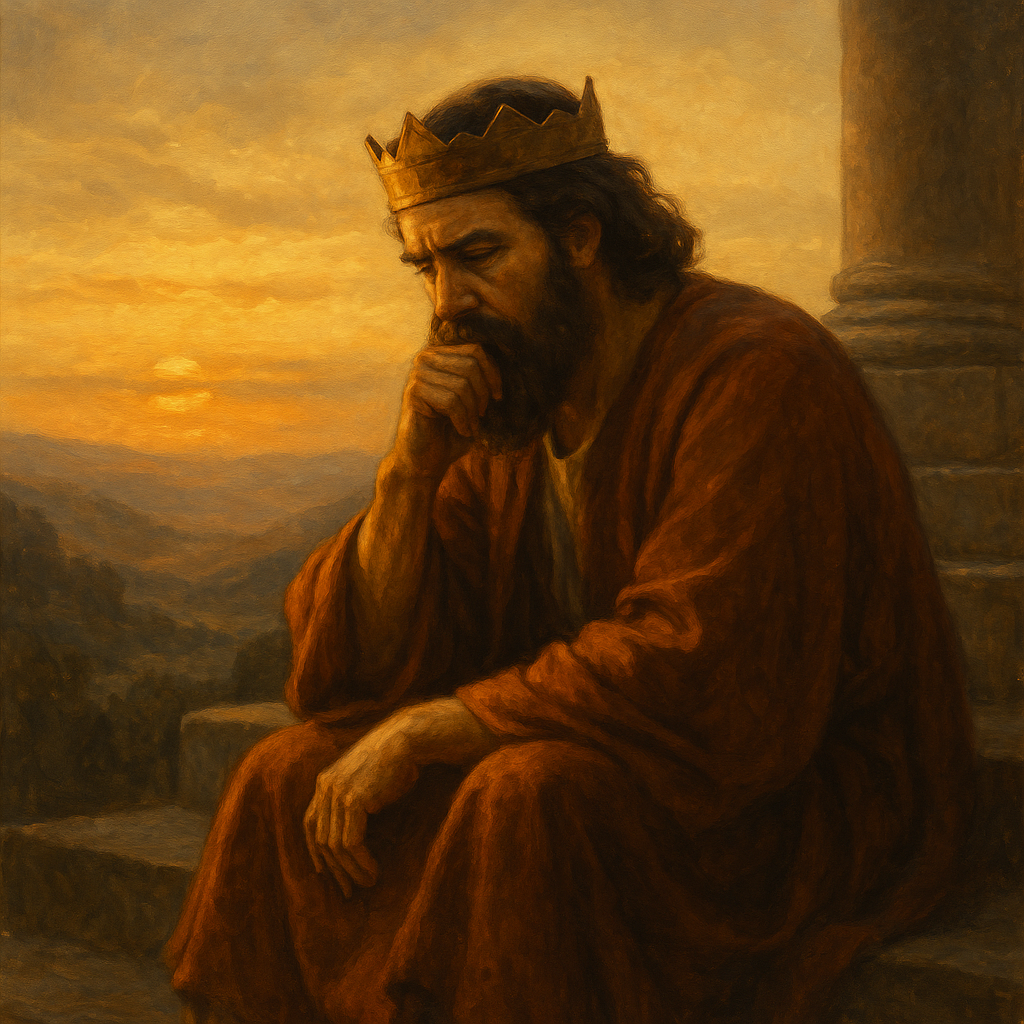
Book of Ecclesiastes – Set 1 (Chapters 1–4)
Theme: The Search for Meaning — Life Under the Sun vs. Life Under Heaven
1. Summary of the Chapters
Chapter 1 – The Futility of Human Pursuit
“Meaningless, meaningless,” says the Teacher, “utterly meaningless! Everything is meaningless.” (1:2)
Solomon opens with brutal honesty. He has seen the rise and fall of kingdoms, the cycles of nature, and the endless striving of humanity — yet finds no true fulfilment in anything “under the sun.”
Generations come and go; the wind blows, rivers flow, but nothing truly changes. The world’s pursuits bring momentary pleasure but no eternal satisfaction.
“What do people gain from all their labours at which they toil under the sun?” (1:3)
Solomon concludes that knowledge and wisdom — though noble — bring sorrow if they are pursued apart from God.
“For with much wisdom comes much sorrow; the more knowledge, the more grief.” (1:18)
Chapter 2 – The Emptiness of Pleasure and Achievement
Solomon experiments with every form of earthly satisfaction — laughter, wine, building projects, wealth, music, art, and luxury.
He denies himself nothing, yet his heart remains empty.
“I denied myself nothing my eyes desired… yet when I surveyed all that my hands had done… everything was meaningless, a chasing after the wind.” (2:10–11)
He recognises the tragic truth that both the wise and the fool die alike — and that toil, without eternal purpose, becomes vanity.
Still, a glimmer of truth appears:
“A person can do nothing better than to eat and drink and find satisfaction in their own toil. This too, I see, is from the hand of God.” (2:24)
Meaning, he discovers, is not in what we do, but for Whom we live.
Chapter 3 – A Time for Everything
This poetic masterpiece reveals the rhythm of divine sovereignty:
“There is a time for everything, and a season for every activity under the heavens.” (3:1)
Birth and death, weeping and laughter, building and tearing down — all occur under God’s appointed timing.
Solomon perceives that eternity is woven into every heart:
“He has made everything beautiful in its time. He has also set eternity in the human heart.” (3:11)
We long for eternity because we were created for it.
Wisdom sees beyond the temporary to the eternal — trusting that God is sovereign in both joy and sorrow.
Chapter 4 – The Burdens and Blessings of Life
This chapter turns toward the human experience — oppression, loneliness, rivalry, and greed.
Solomon laments that many labour endlessly for wealth yet live without companionship or joy.
But he also reveals the redemptive beauty of relationship:
“Two are better than one, because they have a good return for their labour… though one may be overpowered, two can defend themselves. A cord of three strands is not quickly broken.” (4:9, 12)
It’s a picture of divine companionship — human partnership woven with God’s presence at the centre.
2. Key Themes and Lessons
| Theme | Lesson |
|---|---|
| Life Without God Is Empty | Every pursuit apart from God leads to futility — meaning is found only in Him. |
| The Cycles of Life | Seasons come and go, but God’s purposes remain constant through them all. |
| True Wisdom Comes from Eternity | God places eternity in the heart to draw us beyond earthly distractions. |
| Contentment in Simplicity | Joy is not in having more but in recognising every good thing as a gift from God. |
| The Gift of Companionship | Life is not meant to be lived alone — unity and love reflect God’s image. |
3. Encouragement
Oh, this book — it’s raw, it’s honest, it’s the cry of a soul that’s tasted everything the world offers and still comes up empty.
Solomon’s saying, ‘I built the palaces, I planted the vineyards, I had the laughter, the gold, the songs — and it still wasn’t enough.’
Why? Because the human heart was never made to be filled by creation — it was made for the Creator!
You see, you can chase success, comfort, or even knowledge, but if it’s not rooted in intimacy with God, it will feel hollow.
Because you weren’t made to find meaning under the sun — you were made to live under Heaven!
Ecclesiastes isn’t depressing — it’s liberating!
It strips away illusion so you can see truth.
When Solomon says, ‘Meaningless,’ he’s not cursing life — he’s exposing what life looks like apart from God.
Then chapter 3 — oh, come on! ‘He has made everything beautiful in its time.’
That’s trust. That’s peace. It means even when you don’t understand, God is still weaving beauty from chaos.
And I love chapter 4 — the picture of two walking together.
That’s covenant! That’s friendship! That’s the Father saying, ‘You were never meant to do this alone.’
He’s the third strand in your cord — the strength that never breaks.
So if you’ve been searching, striving, or wondering if your life has purpose — stop running and rest.
The meaning you’re looking for isn’t something you achieve — it’s Someone you know.
Jesus is wisdom. Jesus is peace. And when you live for Him, everything under Heaven suddenly makes sense.
4. Reflection Questions
- Where have I been seeking meaning or satisfaction apart from God’s presence?
- How can I learn to find peace in the seasons God has appointed for my life?
- What does “eternity in my heart” mean to me personally, and how can I live with that awareness daily?
- In what areas can I practise greater gratitude and simplicity instead of striving for more?
- How can I strengthen the relationships God has given me to reflect His love and unity more deeply?
Book of Ecclesiastes – Set 2 (Chapters 5–8)
Theme: Reverence, Balance, and the Mystery of God’s Ways
1. Summary of the Chapters
Chapter 5 – Reverence in Worship and Contentment in Wealth
“Guard your steps when you go to the house of God.” (5:1)
Solomon warns that true worship begins not with words, but with reverence.
“Do not be quick with your mouth… let your words be few. God is in heaven and you are on earth.” (5:2)
Worship without awe becomes noise. Wisdom listens before it speaks.
He also addresses wealth — reminding us that money never satisfies:
“Whoever loves money never has enough.” (5:10)
The secret to peace is contentment:
“When God gives someone wealth and possessions, and the ability to enjoy them, this is the gift of God.” (5:19)
True joy is not in the gift, but in recognising the Giver.
Chapter 6 – The Futility of Riches Without Gratitude
“God gives some people wealth, possessions and honour, so that they lack nothing their hearts desire, but He does not grant them the ability to enjoy them.” (6:2)
Here Solomon laments that abundance without gratitude leads to emptiness.
It’s not what you have, but the heart you carry, that determines fulfilment.
Without God’s perspective, even blessings become burdens.
He concludes that chasing after more is like chasing the wind — satisfaction comes only through a thankful, surrendered heart.
Chapter 7 – Wisdom in Balance and Perspective
“A good name is better than fine perfume, and the day of death better than the day of birth.” (7:1)
This chapter contrasts superficial happiness with deep wisdom.
Sorrow, though painful, often teaches more than laughter.
“The heart of the wise is in the house of mourning, but the heart of fools is in the house of pleasure.” (7:4)
Solomon urges moderation — neither legalism nor recklessness, but balance under God’s guidance.
“Do not be overrighteous, neither be overwise — why destroy yourself?” (7:16)
This is not compromise; it’s humility. It reminds us that only God is perfect, and wisdom is walking in reverent dependence on Him.
“When times are good, be happy; but when times are bad, consider: God has made the one as well as the other.” (7:14)
Wisdom learns to rest in mystery, trusting that God’s goodness governs every season.
Chapter 8 – The Mystery of God’s Justice
“Who is like the wise? Who knows the explanation of things?” (8:1)
This chapter explores the tension between human injustice and divine sovereignty.
Solomon observes that the wicked sometimes prosper while the righteous suffer — yet faith clings to the unseen justice of God.
“Because the sentence against an evil deed is not executed speedily, the hearts of men are set to do evil.” (8:11)
But patience belongs to the wise:
“It will be well with those who fear God, who are reverent before Him.” (8:12)
In the end, Solomon concludes that we cannot grasp God’s ways with intellect alone — we must walk by trust.
“No one can comprehend what goes on under the sun… even if they claim they know, they cannot really comprehend it.” (8:17)
2. Key Themes and Lessons
| Theme | Lesson |
|---|---|
| Reverence in Worship | Approach God with humility and awe — listening before speaking. |
| Contentment and Gratitude | Wealth and success mean nothing without a heart that enjoys and honours God. |
| Wisdom Through Sorrow | God often uses pain to deepen perspective and purify priorities. |
| Balance and Moderation | True wisdom avoids extremes — walking humbly between self-righteousness and compromise. |
| Trust in God’s Justice | When life seems unfair, faith rests in God’s eternal governance. |
| Embracing Mystery | Not everything can be understood — but everything can be trusted to His care. |
3. Encouragement
Oh, this section is gold — pure Kingdom perspective right here!
Proverbs teaches us how to live wisely; Ecclesiastes teaches us how to rest wisely.
Look at chapter 5 — ‘Guard your steps when you go to the house of God.’
Come on, that’s about posture!
God’s not after performance — He’s after reverence.
He’s saying, Don’t just come to talk — come to listen.
Because when your heart is quiet, His Spirit speaks clearly.
And that part about wealth? Oh, how powerful!
You can have everything and still be poor if you don’t have gratitude.
But when you have peace and thankfulness, even little feels like abundance.
That’s not resignation — that’s freedom.
Chapter 7 — I love this!
‘Do not be overrighteous or overwise.’
That’s Solomon saying, ‘Stop trying to be God.’
We’re not saved by perfect performance; we’re transformed by perfect relationship.
Wisdom isn’t pride in your understanding — it’s peace in your surrender.
And chapter 8 — oh, come on!
‘It will be well with those who fear God.’
That’s the secret right there.
You don’t have to figure everything out — you just have to stay in awe.
The fear of the Lord doesn’t shrink you; it secures you.
It anchors your heart when the world feels unfair.
Sister, there’s so much rest here.
You don’t have to carry the weight of “why.”
Let reverence replace reasoning.
Let gratitude replace striving.
Let trust replace control.
Because when you live in holy awe, you’ll find what Solomon finally found —
that life’s meaning isn’t in understanding everything, but in being held by the One who does.
4. Reflection Questions
- How can I approach God more reverently — listening more deeply and speaking more intentionally?
- In what areas of life am I striving for more instead of thanking God for what I already have?
- What painful or confusing experiences has God used to teach me deeper wisdom?
- How can I live more balanced — avoiding extremes and resting in God’s sovereignty?
- What helps me stay peaceful when life feels unjust or mysterious?
Book of Ecclesiastes – Set 3 (Chapters 9–12)
Theme: The Conclusion of All Things — Remembering God, Finding Joy, and Living in Reverence
1. Summary of the Chapters
Chapter 9 – The Mystery of Time and the Call to Joy
“The same destiny overtakes them all.” (9:2)
Solomon faces the reality of death — the great equaliser. Both the righteous and the wicked share the same end under the sun. Yet he realises that despair is not the answer — joy is.
“Go, eat your food with gladness, and drink your wine with a joyful heart, for God has already approved what you do.” (9:7)
He urges us to embrace the gift of today — to live fully, love deeply, and work wholeheartedly, because every breath is a gift from God.
“Whatever your hand finds to do, do it with all your might.” (9:10)
Wisdom doesn’t eliminate uncertainty; it redeems it through gratitude.
Chapter 10 – Wisdom and Foolishness in Everyday Life
This chapter contrasts wisdom and folly in vivid imagery.
“As dead flies give perfume a bad smell, so a little folly outweighs wisdom and honour.” (10:1)
Solomon reminds us that wisdom preserves stability while foolishness destroys through impulsiveness, pride, or careless words.
He warns against rash speech, poor leadership, and laziness — all of which unravel what wisdom builds.
Yet through it all, he points to balance:
“If the axe is dull and its edge unsharpened, more strength is needed, but skill will bring success.” (10:10)
Wisdom sharpens effort with divine perspective — it is not louder, but deeper.
Chapter 11 – The Freedom of Faithful Living
“Cast your bread upon the waters, for after many days you will find it again.” (11:1)
Solomon’s imagery here is of faith-filled generosity. He encourages bold action and trust in unseen outcomes — to give, plant, and work without fear of tomorrow.
“Whoever watches the wind will not plant; whoever looks at the clouds will not reap.” (11:4)
Waiting for perfect conditions is the enemy of obedience.
Instead, he invites us to live freely and joyfully, knowing that all things are in God’s hands.
“Light is sweet, and it pleases the eyes to see the sun.” (11:7)
He ends the chapter urging the young to rejoice — but to remember that every choice carries eternal weight.
“Be happy, young man, while you are young… but know that for all these things God will bring you into judgment.” (11:9)
Chapter 12 – Remember Your Creator
This final chapter is both poetic and sobering.
“Remember your Creator in the days of your youth.” (12:1)
Solomon describes old age with poetic beauty — the dimming eyes, trembling hands, fading voice, and slowing body. Yet amid the imagery, his call is clear:
Don’t wait to honour God until life fades — begin now, while your heart is alive with strength and wonder.
“The dust returns to the ground it came from, and the spirit returns to God who gave it.” (12:7)
All life returns to the One who made it.
Then the Teacher brings his long search to its conclusion:
“Now all has been heard; here is the conclusion of the matter: Fear God and keep His commandments, for this is the duty of all mankind.” (12:13)
Everything begins and ends here — reverence, obedience, and relationship.
“For God will bring every deed into judgment, including every hidden thing, whether it is good or evil.” (12:14)
This is not a call to fear punishment but to walk in reverent love before the God who holds eternity in His hands.
2. Key Themes and Lessons
| Theme | Lesson |
|---|---|
| The Gift of Life | Every moment is sacred when lived in awareness of God’s presence. |
| Joy in the Ordinary | True joy is found not in control, but in gratitude and wholehearted living. |
| Wisdom vs. Folly | A single careless act can undo much good — wisdom keeps the heart steady and discerning. |
| Faithful Action | Obedience is not about outcomes but about trust — sow freely and live boldly. |
| Remembering God Early | Honour your Creator while you have strength — your youth is a divine opportunity, not a distraction. |
| The Fear of the Lord | Reverence is life’s anchor — it aligns our hearts with eternal purpose and peace. |
3. Encouragement
Oh, this is powerful!
Solomon’s coming to the end of his reflections, and you can feel the transformation happening in his heart.
In the beginning, he said, ‘Everything is meaningless,’ but by the end, he’s saying, ‘Fear God and keep His commandments.’
That’s not contradiction — that’s revelation!
He’s gone from chasing satisfaction to finding surrender.
Chapter 9 says, ‘Eat your food with gladness.’
That’s not about indulgence — that’s about gratitude!
When you know God loves you, everything becomes holy — meals, moments, work, relationships —
all of it is sacred when done in His presence.
And chapter 10 — I love how real it is!
He’s saying, ‘Don’t let little compromises spoil what’s good.’
Come on, that’s wisdom for life right there.
Guard your heart. Sharpen your axe. Keep your spirit teachable.
Then chapter 11 — that’s a call to faith!
‘Cast your bread upon the waters.’
That means give, serve, love, and sow — even when you don’t see immediate return.
You’re not living for what you can control; you’re living from who you trust.
You never lose when you give in love.
And chapter 12 — oh, come on! That’s the heart of it all.
‘Remember your Creator in the days of your youth.’
Do not waste your best years searching for what was never lost.
God’s been here the whole time — inviting you to walk with Him, not just know about Him.
At the end Solomon says, ‘Fear God and keep His commandments.’
That’s not rules — that’s relationship!
To fear God is to be so in awe of Him that nothing else can steal your devotion.
It’s resting in His love and living from His wisdom every single day.
Sister, here’s the truth — life under the sun is fleeting, but life under Heaven is eternal.
So live joyfully, love deeply, and walk reverently.
When God is your meaning, everything else becomes beautifully simple.
4. Reflection Questions
- What simple, everyday blessings can I thank God for today with fresh gratitude?
- How can I live with greater joy and purpose in the work and relationships I already have?
- Where do I need to sharpen my “axe” — growing in wisdom and self-discipline?
- What does it mean for me personally to “cast my bread upon the waters”?
- How can I begin to “remember my Creator” daily — not just in worship, but in the way I live, love, and serve?
Overview of the Book of Ecclesiastes
Theme: The Search for Meaning — Finding Fulfilment Through Reverence and Relationship
1. Summary of the Book
The Book of Ecclesiastes is one of the most profound and poetic reflections in all of Scripture — a deeply honest search for the purpose of life apart from God, and a revelation of how true meaning is found only in Him.
Traditionally attributed to King Solomon, the book presents him as “the Teacher” — a man who had tasted every form of wealth, wisdom, and pleasure yet found all human pursuits empty when lived “under the sun.”
“Meaningless, meaningless,” says the Teacher, “utterly meaningless! Everything is meaningless.” (1:2)
At first glance, Ecclesiastes appears sombre or even cynical. Yet beneath its melancholy tone lies a golden thread of redemption — the understanding that life apart from God is hollow, but life in awe of Him is whole.
Solomon observes the cycles of nature, the injustice of men, the limits of wisdom, and the brevity of life. He experiences wealth, labour, and luxury, only to conclude that none of these can satisfy the human heart.
“He has made everything beautiful in its time. He has also set eternity in the human heart.” (3:11)
This single verse becomes the book’s turning point — humanity longs for eternity because we were made for the Eternal One.
In its closing chapters, Solomon moves from despair to devotion.
He realises that joy is not found in possessions or achievements, but in simple gratitude, humble obedience, and constant remembrance of the Creator.
“Fear God and keep His commandments, for this is the duty of all mankind.” (12:13)
Ecclesiastes, then, is not a book of hopelessness but of holy clarity. It strips away illusion so that only what is eternal remains.
It teaches that life “under the sun” is fleeting, but life “under Heaven” — lived in reverence, humility, and joy — is full of beauty, peace, and purpose.
2. Key Themes and Lessons
| Theme | Lesson |
|---|---|
| The Vanity of Life Without God | Every pursuit apart from God ends in emptiness. True meaning begins in relationship with Him. |
| The Sovereignty of God | There is a divine rhythm and order to all things — a time for every purpose under Heaven. |
| The Gift of the Present Moment | Joy is not in control, but in gratitude — receiving each day as a gift from God. |
| Wisdom and Humility | Understanding life’s limits leads us to trust, not despair. God’s mystery invites reverence, not frustration. |
| The Fear of the Lord | Reverence is not terror, but alignment — a heart posture that honours God in every thought and decision. |
| Remembering Our Creator | Life’s purpose is fulfilled when we live aware of our Creator — especially in the strength of our youth. |
3. Encouragement
Oh, this book is amazing — it’s not depressing, it’s awakening!
Solomon had everything: wisdom, power, wealth, pleasure —
yet he realised that without intimacy with God, none of it mattered.
That’s not despair; that’s deliverance!
He’s showing you that the world’s best cannot compare to Heaven’s presence.
You see, Ecclesiastes doesn’t say life is meaningless — it says life without God is meaningless.
But when you walk with Him, every moment becomes sacred.
Work becomes worship. Eating becomes gratitude. Rest becomes communion.
Chapter 3 says, ‘He has made everything beautiful in its time.’
That’s not just poetry — that’s truth!
God is never late, never early.
He’s weaving eternity into your story, and even the painful seasons carry purpose when surrendered to Him.
And I love how the book ends: ‘Fear God and keep His commandments.’
That’s not about legalism — that’s about love!
To fear God is to live in holy awe, to be so overwhelmed by His goodness that you cannot imagine life outside His will.
Sister, the message of Ecclesiastes is this:
Stop chasing what cannot fill you, and return to the One who made you.
Joy is not found in answers but in presence.
Meaning is not discovered through success but through surrender.
When God becomes your centre, even the smallest things in life overflow with wonder.
You don’t need to understand everything — you just need to walk with the One who does.
4. Reflection Questions
- What areas of my life have I been trying to find meaning in apart from God?
- How can I practise daily gratitude and see ordinary moments as gifts from Heaven?
- What does it look like for me to “fear God” in a way that draws me closer to His heart rather than away from it?
- How can I honour God more fully in this current season, trusting His timing and purpose?
- What does “remembering my Creator” look like practically — in my work, relationships, and inner life?